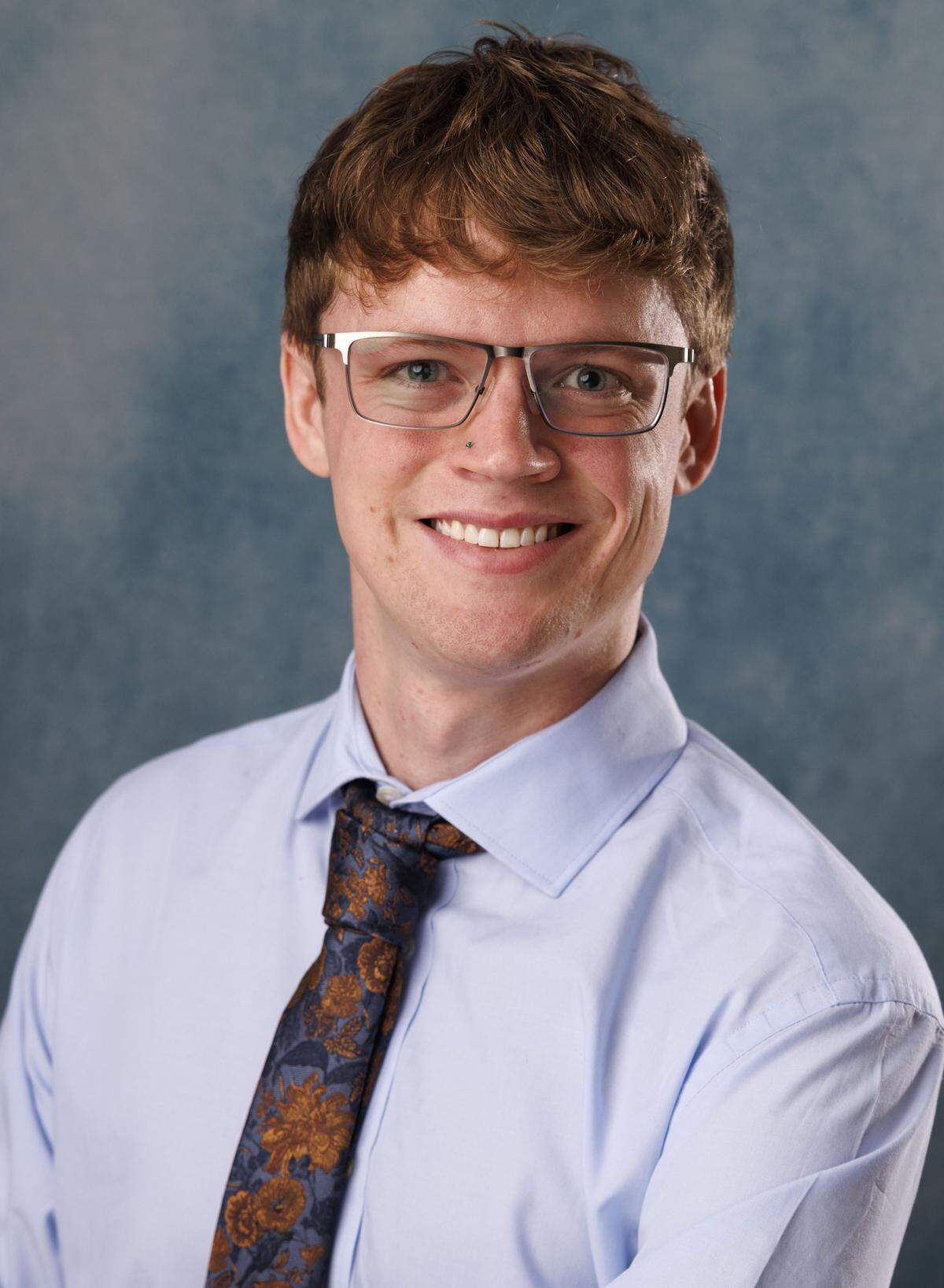
James Fishback pushes white nationalism into Florida GOP’s race for governor
By all traditional measures, James Fishback’s campaign for Florida governor is a political dead end: he’s barely raised any money, has never run for office before and is plagued by scandals.
A hedge fund employer successfully sued Fishback for more than $200,000, which Fishback told the court he’s unable to pay. Broward County Schools says it cut ties with his debate program over concerns about his “failure to follow district safeguards” with students. And he has been condemned by other Republicans for his promotion of white nationalist ideas and near-constant firehose of inflammatory social media posts.
Plus, campaign finance reports show he had only raised about $22,000 by the end of December, compared to the $45 million raised by President Donald Trump’s endorsed candidate, U.S. Rep. Byron Donalds.
“He’s shown absolutely nothing to demonstrate that he’s actually a serious candidate for governor,” said Steve Schale, a longtime Democratic political consultant.
But instead of languishing in obscurity along with the nearly three dozen other political unknowns who’ve also filed to run for Florida governor, Fishback’s nonstop social media outrage machine has raised his profile enough to force the Republican establishment to contend with him — and with the white nationalists to whom he’s been appealing.
Since announcing his bid in November, Fishback’s extremely online campaign strategy has captured the attention of some of the loudest voices on the right, including former Fox News host Tucker Carlson, who recently granted him an hour-long interview.
He’s driven more national news cycles in the past two months than any of the traditionally viable candidates in the race — most recently generating headlines about a public feud with one of the most successful adult online content creators over his “sin tax” proposal.
He also got months of campaign advice from one of Gov. Ron DeSantis’ closest allies, and is now polling within the margins of higher-profile electeds, like Florida’s former House Speaker Paul Renner and Lt. Gov. Jay Collins.
Florida Republicans are increasingly sounding alarms against him, insisting he’s a noisy distraction to be ignored. Fishback is “somebody being very loud for the sake of clicks” as fellow Gen-Z South Florida Republican Juan Carlos Porras described him, “but it’s dangerous and we cannot allow rhetoric like the kind that he says every day to be representative of our party, in any situation.”
For his part, Fishback told the Herald/Times, “The Republican Party is a bunch of feckless losers, as far as I’m concerned.”
‘Rage bait might pay off’
Fishback’s online persona is as frenetic as it is volatile. He ricochets between policy proposals and grievance politics.
He wants to end Florida’s investment in Israeli bonds, block immigrant visa programs and prevent foreign students from attending Florida universities. He says that the only “systemic racism” that exists in the United States is against white Christian men. He’s also proposed burning abortion clinics.
Fishback insists he’s not racist. Researchers of the far right along with Fishback’s Democratic opponents say his rhetoric — particularly against Donalds, the GOP frontrunner, who is Black — are explicit callouts to white nationalists and racists on the right.
“His undisguised racist comments describing a Black candidate’s vision as ‘Section 8 ghetto’ and referring to Byron Donalds as ‘By’rone’ and a ‘slave’ are deliberate, offensive, and beneath this state,” Democratic gubernatorial candidate David Jolly said this week, calling on all candidates to “denounce, deplatform, and dismiss” Fishback.
Ben Lorber, who studies the far right and antisemitism for Political Research Associates, said Fishback is sending a clear message to white nationalist groups: “I’m your guy.”
Those cues resonate with “Groypers,” followers of online streamer Nick Fuentes, an avowed white nationalist and Holocaust denier, who captured headlines this weekend for helping get a Miami DJ to play the Kanye West song “Heil Hitler.” Fuentes, who attended the 2017 Charlottesville “Unite the Right” rally, gathered an online following promoting far-right, Christian nationalist and white supremacist ideas. “It’s more and more explicit, but it also is coded,” Lorber said of Fishback’s use of rally chants embraced by the far right including “Christ is King” and “America First is inevitable.” Fishback has also claimed to be running for governor to stop a “white genocide.”
“If you’re not a Groyper or immersed in their discourse — unfortunately as I am — you might not pick up that that is a slogan straight from the Groypers,” Lorber said. “Great replacement and Christian nationalism are not things that you heard from MAGA politicians two years ago.”
Fishback told the Herald/Times he has never met Fuentes and doesn’t identify as a “Groyper,” but has repeatedly defended Fuentes’ followers, saying “they have a real pulse for what’s going on in the country.” Fuentes has reciprocated praise for Fishback.
In his interview with Tucker Carlson, Fishback attributed his own radicalization — or as he called it, becoming “nationalist-pilled” and “red-pilled” — to a “steady stream” of posts from a Christian nationalist account on X.
Fishback, a graduate of the majority-Black Boyd H. Anderson High School in Broward County, is a Spanish speaker who spent his summers in Colombia, where his mother is from. He described his teenage self to the Herald/Times as a “really talkative kid,” but a “reject in many respects.” He attended Georgetown University in Washington, D.C., but dropped out after his sophomore year to work in finance.
Now, based in Madison, Florida, he spends “three to four” hours a day on X producing constant online content, including podcasts and YouTube interviews with gaming streamers — a strategy he’s used to emerge from dozens of political unknowns who’ve filed to run in Florida’s governor’s race and jump into the public eye.
Fishback dismissed criticisms that his campaign was immaterial beyond social media, pointing to his recent events at gas stations, Waffle House and college campuses across Florida. He said he spends more time crisscrossing the state in his self-driving Tesla than he does sleeping.
Donalds has largely refused to acknowledge Fishback, only once responding on X to Fishback’s dozens and dozens of attack posts. But he has addressed Fishback in subtler ways, denouncing the so-called “woke right” during a fundraiser in Miami last fall as Fishback was ramping up his online attacks against him.
“Are we going to have a spirit of power and say no to the soft bigotry that might be popping up on social media?” Donalds asked the crowd.
Longtime GOP political consultant Stephen Lawson said Donalds — who has more than 1 million X followers compared to Fishback’s 195k — said Fishback is irrelevant.
“Byron Donalds is so far out in front of the governor’s race it’s probably hard for him to see the clown car pileup behind him right now,” Lawson said. “Fishback is certainly one of those cars.”
Despite his relative obscurity, Fishback’s online machine has captured the attention of some college Republican chapters and is forcing Florida Republicans to contend with who they are as a party — and to where the limits of their followers should extend.
“I don’t know if tomorrow’s MAGA politicians are going to be as inflammatory and racist as he is, but I mean that’s also kind of more and more standard fare in the GOP,” Lorber said. “He might be calculating that rage bait might pay off.”
Boosted by a DeSantis aide
Fishback’s longshot campaign has been aided by the advice of one of DeSantis’ top advisors, Christina Pushaw, who cemented her own heavily online presence by attacking and criticizing journalists, particularly in the lead-up to DeSantis’ failed presidential run. The connection has further stirred the rumors that DeSantis is actively trying to undermine Donalds to pave the way for a future candidate of his preference — he gave the cold shoulder to Renner and declined to endorse Collins, his current lieutenant governor.
Per Fishback’s accounting to the Herald/Times, Pushaw spoke with him “a couple times a week and shared unpaid political advice — “some of it good, some of it bad,” he added.
NBC News reported in December that DeSantis’ allies were quietly working with Fishback, as DeSantis has withheld his endorsement in the race and is at odds with Donalds. Pushaw denied her involvement at the time.
Pushaw, the DeSantis adviser with a nearly $180,000-a-year state salary, admitted on social media Sunday that she provided unpaid advice to Fishback for two months and is now, “ashamed that I ever spoke to Fishback or offered any help to his campaign at all.”
“Although I disagreed with his campaign rhetoric increasingly over time as it became more extreme, I still considered James Fishback a friend,” Pushaw wrote this weekend, insisting that the governor’s office had no knowledge of her informal work with Fishback.
Fishback said he first met with Pushaw in late October at a Flannigan’s in Surfside. Now, he said, “It seems like she has ‘Fishback Derangement Syndrome,’” parroting a phrase from Trump.
Fishback claimed on social media Pushaw texted him that she planned to resign her post with the governor over her work with him. In an emailed statement to the Herald/Times Tuesday, she said, “I am willing to do what is best for the state and the governor, whatever that may be.”
The governor’s office did not respond to a request for comment.
Fishback’s extremely online. Voters aren’t.
A Mason-Dixon poll of Republican primary voters about Donalds, Renner, Collins and Fishback this month found that 81% didn’t recognize Fishback’s name, the worst of the four candidates presented to respondents. Donalds was the only candidate a majority of polled voters had actually heard of.
Pollsters say Fishback’s campaign strategy of being aggressively online is unlikely to actually penetrate the Republican party establishment, even though it’s getting him attention and headlines.
“If you look at the make-up of the Republican primary electorate and then you look at where he stands to make the most noise, they just don’t compute well,” University of North Florida pollster Michael Binder said of Fishback.
Republican pollster Ryan Tyson said his polls show very few Republican primary voters are active on X, and those that are skew younger and more male — a segment of the population that is less likely to vote in primaries.
“In our most recent Republican primary voter sample in Florida in December, we found that just 7% indicated they use X ‘a lot’,” Tyson said. “By comparison, roughly 70% of primary voters say they don’t use X at all.”
But while his chances of winning a Republican primary are still extremely low, Fishback’s open embrace of the far right is causing shockwaves within the party.
As Carlson put it on social media after interviewing Fishback: “Pretty soon, all winning Republican politicians will talk like this.”
This story was originally published January 20, 2026 at 3:52 PM.
.jpg)