FinCEN Files: Shell companies help Venezuelans get rich at home, spend big in Florida
READ MORE
The FinCEN Files
A massive leak of bank documents connects the dots between money laundering, the pilfering of public funds, terror-financing and ponzi schemes. The documents were leaked to BuzzFeed News, which shared them with the International Consortium of Investigative Journalists. ICIJ recruited a global team of journalists, including reporters from the Miami Herald, el Nuevo Herald and McClatchy.
Expand All
Alejandro Ceballos Jiménez doesn’t seem the kind of Venezuelan who’d fly under the radar. His family is tied to South Florida property worth millions. He imports thoroughbreds from Kentucky, co-invests in a giant gold mine and enjoys lucrative construction contracts from a government the United States is actively trying to shut out of the global financial system.
YetWestern diplomats say they haven’t heard of him. He’s not on any sanctions list, even as he is among the businessmen whose fortunes have grown during the regime of strongman Nicolás Maduro and his predecessor, Hugo Chávez.
Venezuelans have a name for such businessmen — boliburgueses. It’s a word play in Spanish, a reference to the bourgeoisies grown wealthy under Venezuela’s socialist government and its self-proclaimed Bolivarian revolution.
Ceballos, 62, and his siblings run a large construction business, led by its principal company, Inversiones Alfamaq. It does public works projects and builds government housing in Venezuela. His third-generation family business predates Venezuela’s socialist governments.
The Ceballos family restored Venezuela’s best-known horse-racing track, Hipódromo La Rinconada, and is actively involved in the sport at home and in the United States through his company Grupo 7C Racing Stable, active in Florida. One of his horses, Majesto, raced in the Kentucky Derby in 2016, finishing 18th out of 20.
.jpeg "download (51).jpeg")
That same year Alfamaq and its associates with Miami addresses invested about $34 million to take a roughly 10 percent stake in a Canadian company called Gold Reserve Inc. that hopes to develop a giant gold mine in Bolivar state despite the cloud of U.S. sanctions. And the Ceballos family has partnered in a casino in Panama.
Coming into View
Ceballos has avoided the attention of the Obama and Trump administrations as they successively tightened the grip of sanctions on dozens of similarly successful businessmen.
But a Miami bank did consider the magnate and his family risky.
It filed to regulators two Suspicious Activity Reports, or SARs, detailing more than $260 million in transactions from April 2013 to January 2014 flowing between banks and offshore companies believed by the bank to be controlled by the large Ceballos clan.
McClatchy, the Miami Herald and el Nuevo Herald have obtained the SARs relating to the Ceballos family as part of a leak of secret banking documents originally obtained by online news outlet BuzzFeed News. BuzzFeed shared the documents with the Washington, D.C.-based International Consortium of Investigative Journalists, which assembled a team of partners for a 16-month global collaboration. The project is called the The FinCEN Files, after the agency — the Financial Crimes Enforcement Network, or FinCEN — that examines SARs.
Like the Panama Papers in 2016, The FinCEN Files show the vulnerability of the international financial system to money laundering, often through the use of offshore shell companies. Miami is a money-laundering hot spot, especially when it comes to proceeds from Venezuela, a geopolitical foe of the United States.
The project is based on more than 2,100 unique SARs, reported on by 110 news outlets from 88 countries. It identifies more than $2 trillion in suspicious transactions flagged by banks and includes reports sent to FinCEN, charged with sniffing out money laundering, and to the Treasury Department’s intelligence unit.
FinCEN has declined to answer questions on the content of the SARs. But on its website the agency has declared that “the unauthorized disclosure of SARs is a crime that can impact the national security of the United States, compromise law enforcement investigations, and threaten the safety and security of the institutions and individuals who file such reports,” adding: “FinCEN has referred this matter to the U.S. Department of Justice and the U.S. Department of the Treasury’s Office of Inspector General.”
A SAR in and of itself does not connote anything criminal, but can lead to investigations. Neither Ceballos nor members of his family have been charged with any crimes.
The initial Ceballos SAR was filed by the Miami branch of Portugal’s Banco Espirito Santo, which operated as Brickell Bank in a high-rise on Brickell Avenue. More than $100 million of Ceballos family money flowed through Espirito Santo before the bank came under investigation for money laundering by both the United States and Portugal, which eventually closed it.
The SARsfilings are required under the Bank Secrecy Act, and regulators warn on the actual bank forms that the reports are confidential and contain unsubstantiated allegations of possible criminal activity.
The initial SAR filed by the Miami bank in 2013 points to $206 million of transactions by firms tied to several members of the Ceballos family that a bank compliance officer or officers felt were potentially problematic.
“The SAR was filed to document the Bank’s suspicion concerning the source of funds derived from Venezuelan government payments; possible involvement in public foreign corruption [Venezuela]; unusual use of multiple accounts; funds sent to high risk jurisdictions and suspicious wire transfers; questionable or apparent false documentation; negative press on owners [nominee and actual]; and possible association with individuals in Venezuela under review due to apparent disappearance of funds,” the report read.
Venezuela’s national oil company Petroleos de Venezuela S.A., or PDVSA, and an anti-poverty program called the Misión Che Guevara were among the government agencies that paid Ceballos’ companies huge sums, routed through a shell company in London.
Ceballos did not respond to requests for an interview by the reporting partnership, nor answer detailed questions submitted in writing in August. In an email, he cited difficulties accessing documents due to Venezuela’s COVID-19 quarantine.
“In light of the following I confirm the impossibility of meeting your requests in the time specified,” he said, adding that “I confirm the consideration that is due to journalists for their courage, valiance and ethics, provided that their work has respect for the truth as its true north.”
Ceballos didn’t respond to later emails offering to extend the deadline for a response, and a list of follow-up questions that did not require access to files and documents.
It’s unknown what, if anything, followed the bank’s reporting on the transactions.
“The federal government and banks need to do more, and Congress needs to act. That starts with cracking down on anonymous shell companies,” said Sen. Ron Wyden, an Oregon Democrat who is pushing to add just such legislation he crafted with Republican Sen. Marco Rubio of Florida into a bill in its final stages of House-Senate negotiation. “Lawmakers need to continually push this issue. Powerful forces want to preserve the status quo, so it’s going to take all of our effort to finally force change.”
The original SAR was amended several times and became what’s called a Continuing Suspicious Activity Report. Through at least 2014, banking activities by the Ceballos clan through Espirito Santo were being shared with FinCEN.
The Justice Department has sought to prosecute middlemen involved in corruption schemes linked to Venezuela’s energy sector, which is one of the country’s few remaining sources of hard currency. Those who have worked with or for PDVSA are frequent targets of fraud prosecutions.
That appears to be why the Ceballos family caught the attention of bank compliance officials. It worked with PDVSA and other Venezuelan government entities.
Family Shells
The Suspicious Activity Report from Espirito Santo said that the Ceballos family created a business checking account in 2012, through a shell company based in the U.K. called Sarleaf Limited, “whose structure was created for security purposes to protect the Ceballos family from public exposure in Venezuela.” It listed as beneficiaries of the checking account not only Ceballos and his brother Javier Francisco, but also his sisters, Luz Marina, Zoraida Josefina,Maura Virginia,and their mother and matriarch, Maura Betty.
Offshore shell companies can serve both illicit and legitimate purposes, and the bank said it was troubled by the nominee shareholders who were designated to make decisions about the shell company. Several were Swiss attorneys with Helvetic Services Group, which had been the subject of news reports that tied them to alleged money laundering on behalf of Néstorand Cristina Fernández deKirchner, the husband-and-wife duo that took turns running Argentina from 2003 to 2015.
The ostensible purpose of the account, said the SAR, was to receive funds from Venezuela’s Ministry of People’s Power for the Communes and Social Protection and the Misión Che Guevara, created to develop government-subsidized housing for Venezuela’s poor. Some money also went to pay Chinese suppliers of industrial steel tubes and it was also used as an investment vehicle, according to the SAR.
The Ceballos family lived in Colombia during the 1960s, where their father ran a successful construction business. When he died, family members returned to their native Venezuela and Maura Betty and the children worked together in the same group of construction companies. One of the older children, Nelson, served as the new patriarch, and after his death was succeeded by his brother Alejandro, who at the time of the bank reports oversaw construction and horse-racing ventures.
Public works projects in Venezuela caught the attention of the Miami bank officers. The Ceballos companies remodeled a large indoor sports arena in Caracas called Poliedro de Caracas. Another Ceballos company, New Zealand-incorporated Maple View Limited, imported steel products from Brazil for use in social housing units subsidized by the Misión Che Guevara.
“The contracts provided to corroborate the incoming activity were questionable and raised numerous concerns to include missing dates, differences with the measurements of buildings being built, contradictory comments within the contracts, incoming funds … differences on tubing specs, and missing payment schedules related to the contracts,” the reports noted.
Media reports in Venezuela have accused Ceballos of working in cahoots with a high-level government official to embezzle money.
“There are concerns regarding the negative press identified for Alejandro Andres Ceballos referring to associations with the Venezuelan Interior Minister Rodolfo Sanz and that Minister’s alleged misappropriation of $500 million in government funds,” the SAR said. “There is additional press regarding Alejandro Ceballos and his involvement with a group that received $120 million for professional fees in a questionable contract with a Chinese company.”
Sanz was minister of basic industry and mining when then-President Chávez on April 30, 2008, ordered the nationalization of the country’s largest private steel company, Sidor, and appointed Sanz president of the newly seized company. A year later, Chávez nationalized the massive Brisas gold mine while Sanz was still minister. Ceballos, in a company blog, dismissed the Sanz allegations.
In 2016, Ceballos led a group of relatives and business associates in taking a roughly 10 percent stake in Gold Reserve Inc., the Canadian company that has long owned mining rights it hopes one day to exploit. The company had reached an expropriation settlement through international arbitration and was returning to Venezuela. The new investors, with addresses in Doral, included Alfamaq suppliers, the family of Ceballos’ third wife and a prominent Venezuelan family that had previous ties to the mine.
“After the announcement of the Settlement and Joint Venture agreement with Venezuela in February 2016 .... Alejandro Ceballos approached Gold Reserve wishing to make an investment in the Company,” Doug Belanger, Gold Reserve’s president, said in a statement. “In May 2016, the Company closed a private placement with a group of Venezuelan investors of 8.5 million shares at $4 per share. As a result of Gold Reserve returning to Venezuela in 2016 we re-initiated some of the social programs we had conducted from 1992-2008 in the area of the mining project.”
This included refurbishing schools, recreation courts, a church and a healthcare center.
“This work was completed in 2018. With international sanctions in place, the company has not conducted any further construction projects in the local community near the mining project, but should sanctions be lifted and the social programs resumed we would consider using Alfamaq again as the local contractor for this work,” Belanger said.
Semi-vacant housing
Last year, an audit committee of the Venezuelan legislature began investigating an alleged fraudulent land transfer. The local mayor of Simón Bolívar, part of the municipality of San Francisco de Yare, reportedly sold public land to Ceballos and two other businessmen at outlandish markups. It’s not exactly clear who benefited.
That happened to be the site of a recent high-profile Ceballos project in Venezuela involving public housing in San Francisco de Yare. Reporting partners Armando.info, a Venezuelan investigative news organization, visited the buildings erected by Ceballos companies 40 miles south of Caracas, and found them lacking potable water and somewhat empty.
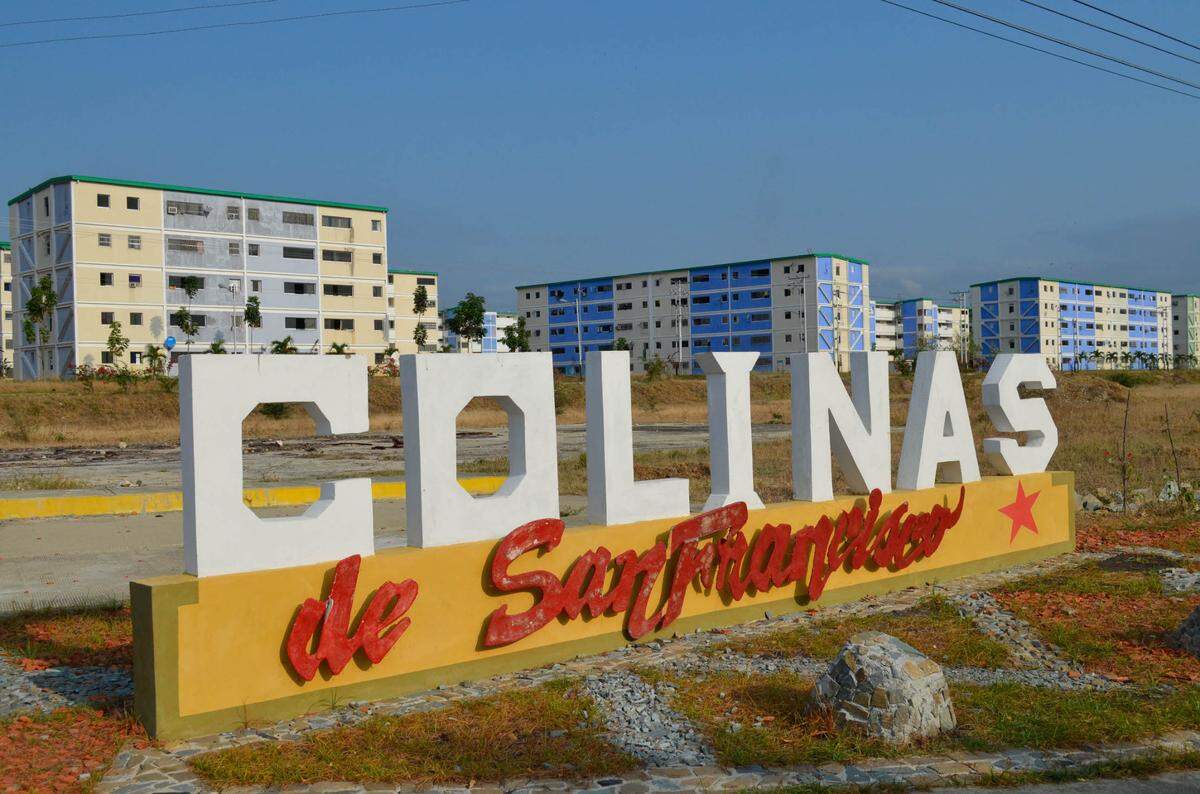
“There are many empty apartments, it’s people who have left,” said Selena Ramirez, 69, who moved in with her daughter and her 11-year-old grandson, who requires a wheelchair and does not speak.
“Some have been ransacked, everything has been taken. They say some were sold in dollars. Where does one get dollars here?”
A SAR from Banco Espirito Santo said that the Ceballos offshore company Sarleaf was supposed to be used for paying for construction materials, but noted roughly $52 million went to accounts of other Ceballos companies, including one account that explicitly says it was for Alejandro Ceballos’ personal expenses. Around $6 million more went to accounts belonging to individuals tied to the family.
“While transfers to Ceballos individuals and companies is [sic] in line with the purpose of the accounts, the dollar amounts are considered excessive and funds were transferred out of the account within two days of receipt of large deposit(s),” one of the reports noted. “In addition, the purpose of these transfers was undetermined.”
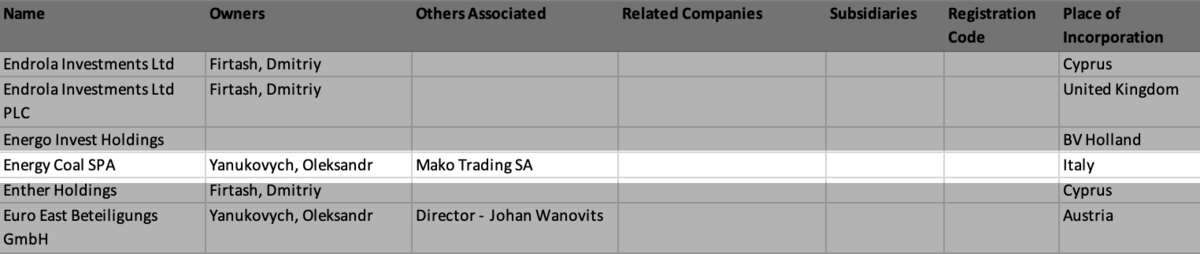
The reports also noted that some of the money for the San Francisco de Yare housing project appeared to come from PDVSA but should actually have been coming from an Italian company, Energy Coal, which had won a $126 million contract for the project. It was later found by a Venezuelan government inquiry to have lacked the expertise, and has subcontracted to Sarleaf — the London shell controlled by the Ceballos family.
In a curious global twist, separate documents found amid the leaks show that Energy Coal is owned by Oleksandr Yanukovych, the son of Viktor Yanukovych, the ex-Ukrainian president. The father was a client of Paul Manafort, the now-convicted campaign chief during Donald Trump’s 2016 presidential campaign.
Viktor Yanukovych and his family have been suspected of stealing millions from Ukraine’s public funds using a network of shell companies, including according to one SAR, Energy Coal.
When contacted by the Herald and McClatchy’s reporting partners, Energy Coal denied being beneficially owned by Oleksandr Yanukovych.
Miami Spice
The layers of offshore companies and bank accounts across the globe make the Ceballos family’sholding in South Florida all the more intriguing.
Florida Division of Corporation records show that both Javier Francisco and Luz Marina Ceballos appear as managersof multiple Florida-registered companies. The address listed under their names on these different companies is in the posh Jockey Circle neighborhood in Davie. Online real estate companies estimate the eight-bedroom home at 2701 Jockey Circle is valued at more than $2 million.
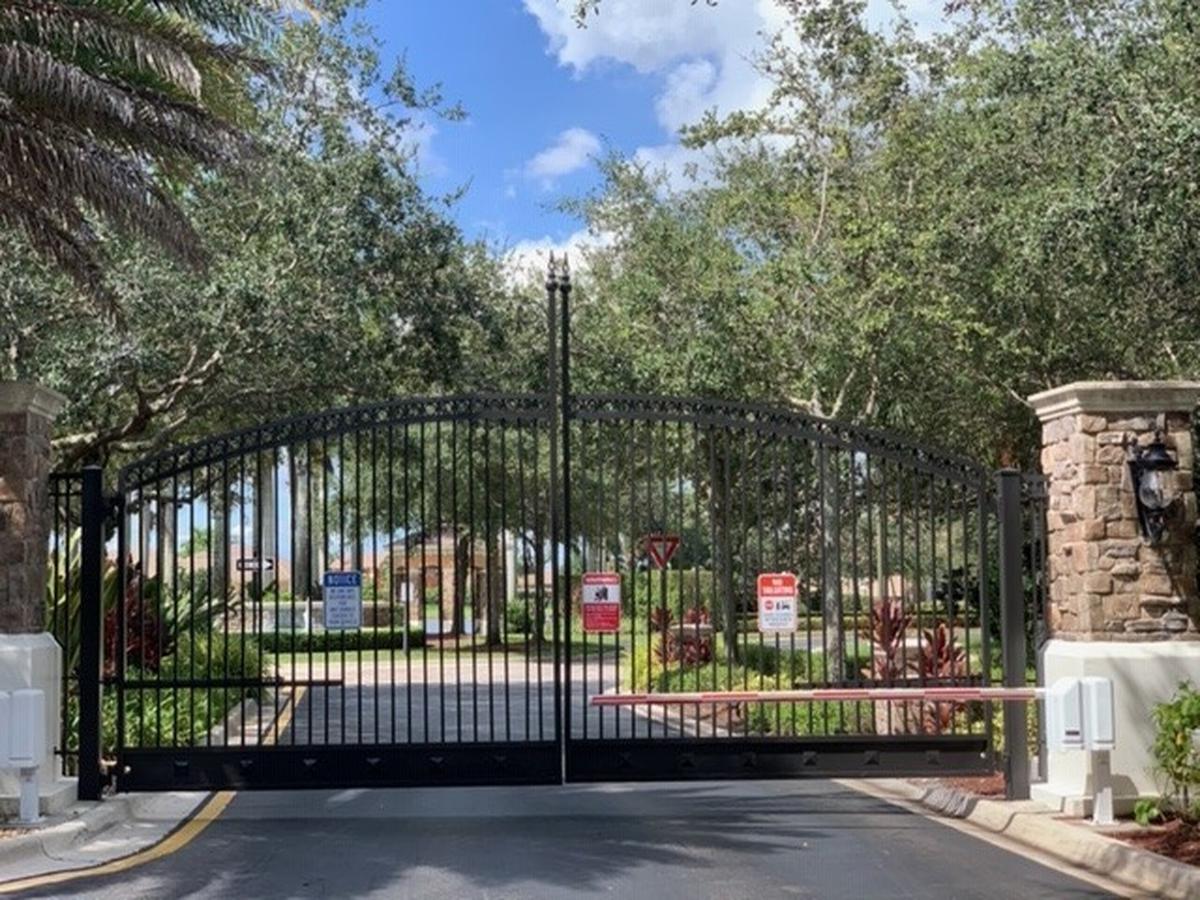
Property records show the house in the gated community, not far from Gulfstream Park where Alejandro’s racehorses compete, was purchased on New Year’s Day in 2012 for $1.3 million by Urace LLC, a corporation managed by Alejandro. When reporters visited the development, they found the name J. Caballos listed on the digital intercom. A man identifying himself as the manager of Grupo 7C answered the intercom and said Alejandro was back in Caracas.
Documents unearthed in Broward County records show the LLC took out a short-term balloon mortgage in 2017 for an unspecified amount rather than seek aconventional bank loan. It was a so-called hard-cash loan from 1250916 Ontario Ltd.
1250916 Ontario LTD’s address traces to a gigantic mansion outside Toronto, with an indoor pool, heated concrete driveway and wrought-iron fencing. The company is owned by an Alexander Garber.
An emigre from the former Soviet Union by that same name is the co-founder of a large Canadian bakery chain called Fiera Foods. A woman who answered the phone at the number for 1250916 Ontario Ltd. and identified herself in a thick accent as Anna Garber — the same name as the wife of Fiera Foods’ co-founder — referred calls to her lawyer. David Gelbloom, who is Fiera Foods’ general counsel, would not discuss if the same Alex Garber owned Ontario LTD and Fiera.
U.S. court records where 1250916 Ontario Ltd. was a plaintiff show it lent almost $5 million to South Florida borrowers, including Alejandro’s LLC, between 2016 and 2018. The loans were so-called hard-cash loans, characterized by higher interest rates for short-term borrowers seeking to avoid the more rigorous documentation required by banks like the one that had flagged the Ceballos transactions, The mortgage was paid off in April 2020. The due date had been May 2019.
The Florida home is modest when compared to the Ceballos’ four-story mansion in the ritzy Alto Hatillo neighborhood of Caracas. When Gold Reserve inked its settlement agreement with the Venezuelan government, Alejandro Ceballos held a celebration in the mansion, a former employee of his told reporting partner Armando.Info.
Alejandro’s son Jesus is a household name in Venezuela and among expats in the diaspora as one-half of the popular reggaeton group Jesus y Yorky. Their throbbing dance videos are shot in mansions and on yachts.
The Ceballos empire overlaps with another intriguing figure in the murky world of Latin American finance, Diego Marynburg. He is reported by Colombian news media to be under Justice Department investigation for allegedly helping the Maduro regime hide millions.
British corporation records show that the Ceballos shell Sarleaf changed its name to Steeleaf International Limited in 2015. The following year, Steeleaf deposited $15 million at Banco del Orinoco in Curaçao.
Most of that deposit came from the sale of Venezuelan government bonds via the Israeli-Argentine businessman Marynburg and his company Mercantil Valores Agente de Valores.
In 2018, Argentine law enforcement also cited that deposit in its investigation into the husband-and-wife politicians, the Kirchners. Not long afterward, Curaçao withdrew the banking license of Banco del Orinoco, saying it had falsified documents and violated anti-money-laundering and counterterrorism financing laws.
Among the violations it documented were processing suspicious transactions by Sarleaf/Steeleaf, Mercantil Valores and other Marynburg entities.
This article has been updated to correct the caption on the photo of the gate controlling access to the Woodbridge Ranches subdivision in Davie, Florida. The Ceballos property is one of 66 homes behind the gate, the homeowner association said.
Researcher Monika Leal contributed, as did FinCEN files partners Armando.info in Venezuela, La Nacion and Infobae in Argentina and ICIJ in Washington, D.C.
This story was originally published September 22, 2020 at 6:00 AM.