Why did Fla. woman’s account wire $97K to a Syrian later tied to chemical weapons program?
READ MORE
The FinCEN Files
A massive leak of bank documents connects the dots between money laundering, the pilfering of public funds, terror-financing and ponzi schemes. The documents were leaked to BuzzFeed News, which shared them with the International Consortium of Investigative Journalists. ICIJ recruited a global team of journalists, including reporters from the Miami Herald, el Nuevo Herald and McClatchy.
Expand All
The automated monitoring system at a South Florida branch of Bank of America first flagged the suspicious activity.
An otherwise unremarkable bank account belonging to a local Realtor suddenly began transferring cash to and from locations across the globe, including to Russia’s Sberbank.
The recipient of funds at the Russian bank was a Syrian, Issa al-Zeydi, who was later included on a sanctions list of the U.S. Treasury Department, accused of propping up the regime of Syrian strongman Bashar al-Assad.
So how did a West Palm Beach real estate professional’s bank account end up associated with now-sanctioned entities?
Nearly a decade later, thanks to a large leak of secret bank documents, the puzzle pieces from across the globe are fitting together. And the details include a rogue’s gallery of characters who together underscore the whack-a-mole challenge of combating money laundering.
Red Flags
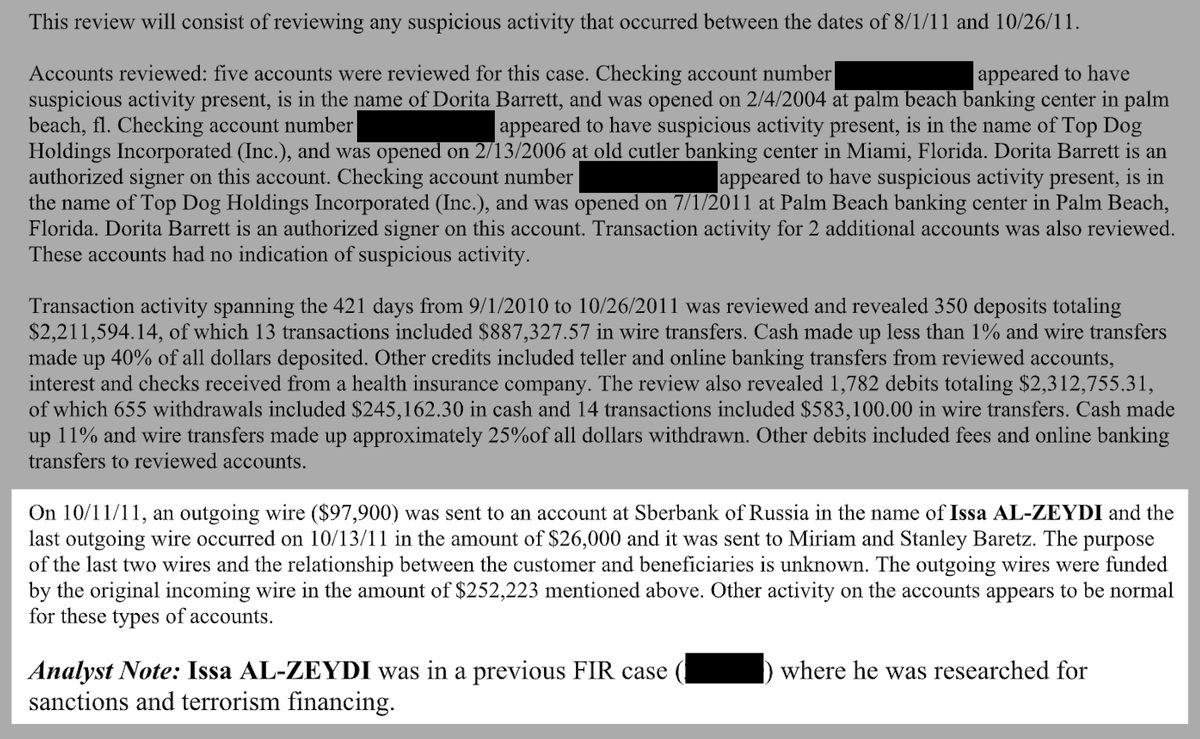
The red flags started back in 2011, when Bank of America’s monitoring system noticed an outgoing wire of $97,900 to al-Zeydi’s Sberbank account, and another wire for $26,000 to Miriam and Stanley Baretz.
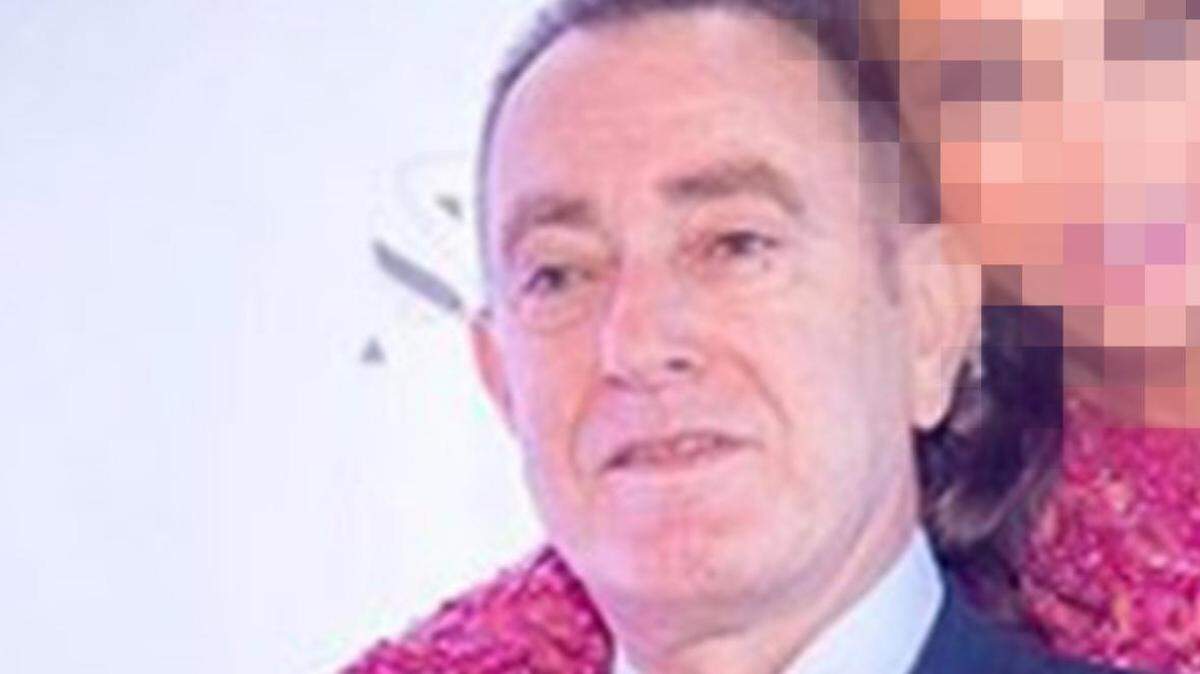
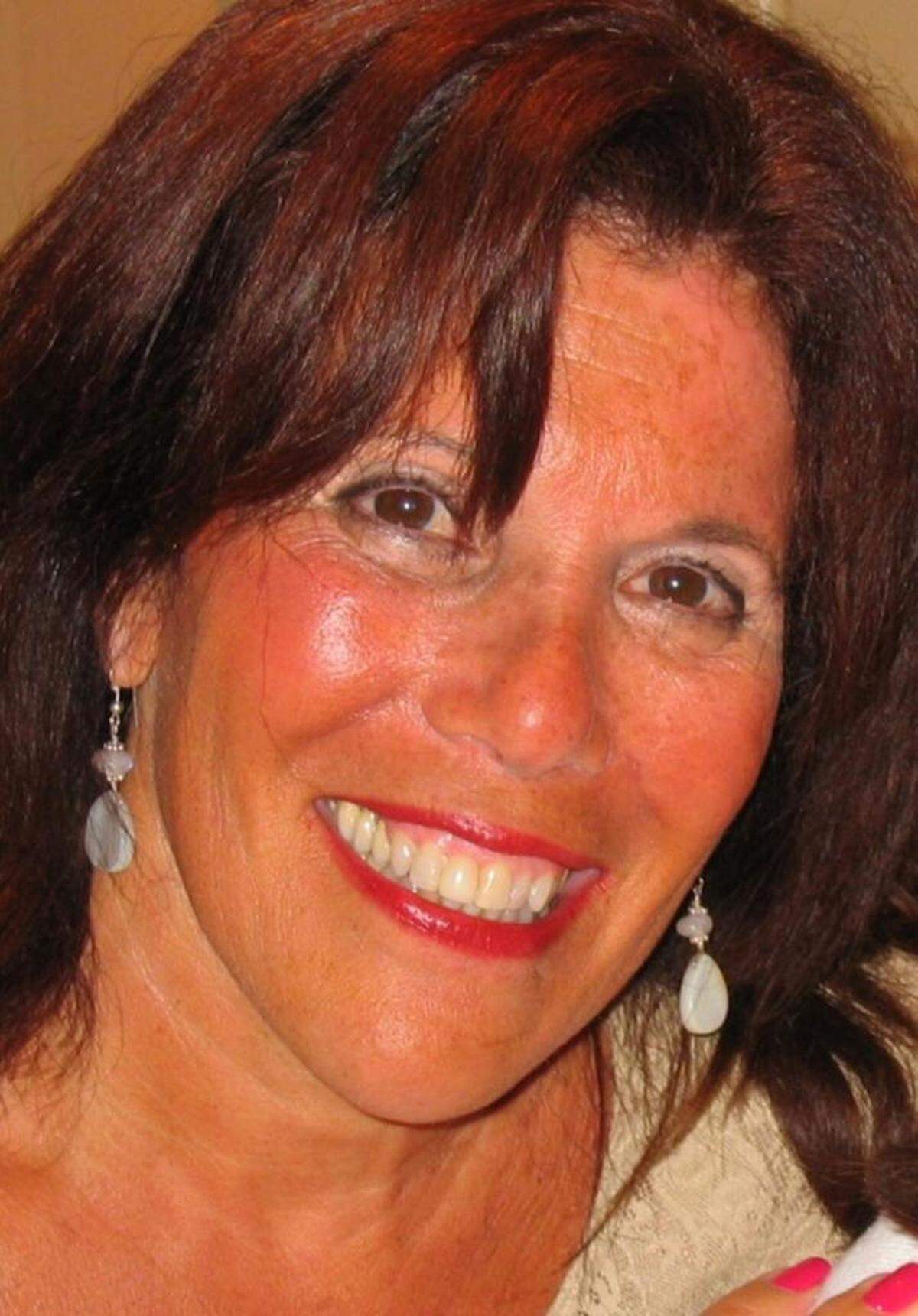
Unknown to investigators, the Baretzes were the parents of Dorita Barrett, the Realtor associated with a Florida company called Top Dog Holdings Inc. She has since died, and her son ran the business, which has been inactive since her death.
“The purpose of the last two wires and the relationship between the customers and beneficiaries is unknown,” read a Suspicious Activity Report, or SAR, viewed by McClatchy, the Miami Herald, el Nuevo Herald and their reporting partners.
The SAR said the outgoing wires were funded by a prior incoming wire in the amount of $252,223.
SARs are the mechanism by which financial institutions report to financial regulators transactions that could involve fraud or money laundering. SARs are not, in and of themselves, evidence of a crime. They’re considered more like an unverified intelligence tip.
The Top Dog report appears in a leak of secret banking documents first obtained by the online news outlet BuzzFeed News. The files are maintained by the Financial Crimes Enforcement Network, or FinCEN, which is in charge of monitoring money laundering. BuzzFeed shared the documents with the Washington, D.C.-based International Consortium of Investigative Journalists, which assembled a team of partners for a 16-month global collaborative project that went live across the globe Sunday. It’s called The FinCEN Files.
The project is based on more than 2,100 unique SARs, involving flagged transactions exceeding $2 trillion. Some 110 news outlets from 88 countries pored over the documents, which include reports sent by banks and other financial companies to the Treasury Department’s intelligence unit and FinCEN.
Once a SAR comes into FinCEN it is shared with liaisons from the IRS, FBI and State Department to determine what information is passed on to law enforcement. It’s difficult to gauge from the outside which tips are pursued, which aren’t and why.
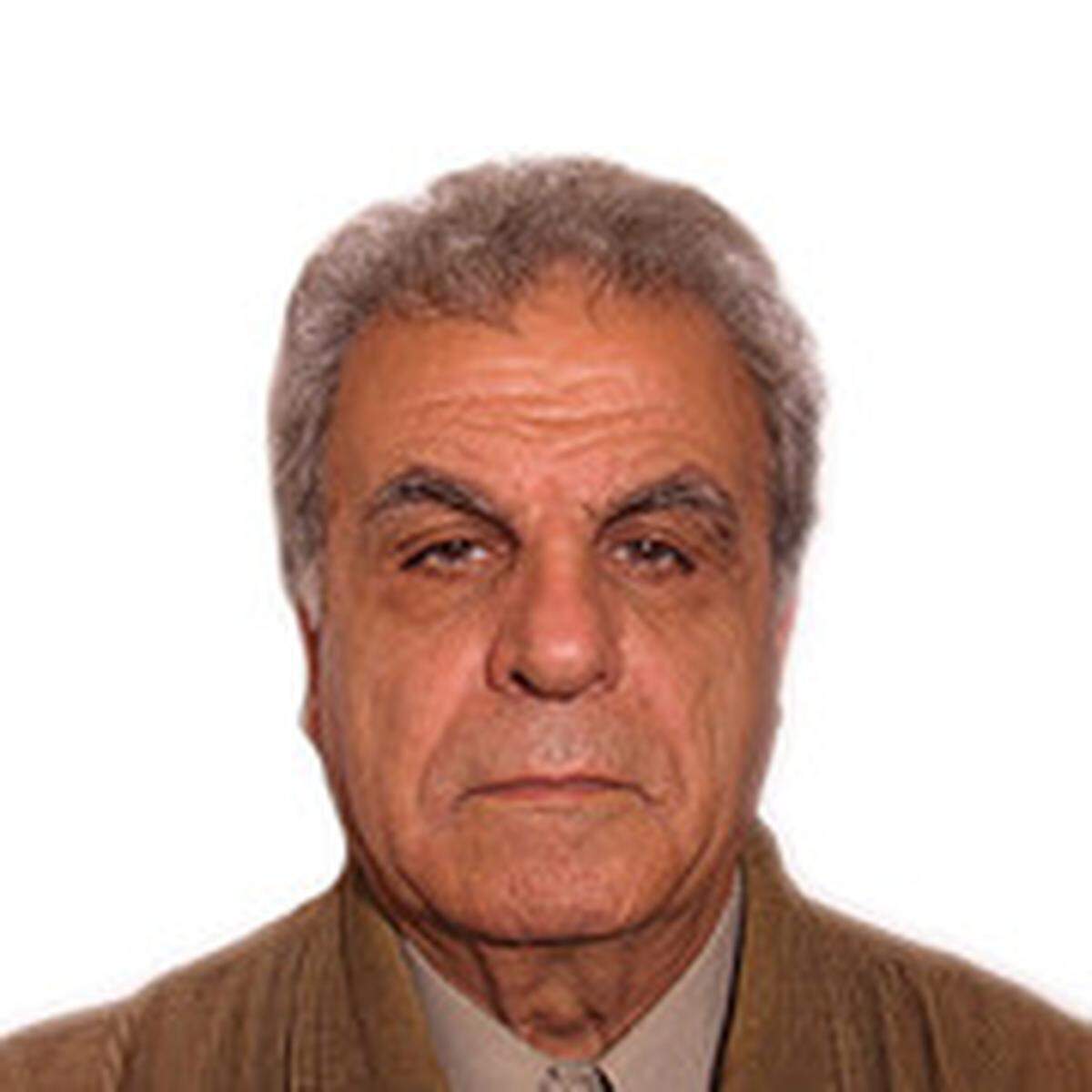
Al-Zeydi, the recipient of the nearly $98,000 from Top Dog, is an interesting character. He was put on a sanctions list in 2014 after being identified as a frontman for Syria’s chemical weapons program. He had moved hundreds of millions through a Kremlin-linked slush fund.
A man in his 80s who lives in Moscow, al-Zeydi is also a close associate of another Russian-Syrian, Mudalal Khouri. He too has been sanctioned — blacklisted by financial institutions — for helping fund Assad’s regime and moving $40 million into Moscow real estate on behalf of Assad’s family. A bloody civil war aimed at toppling Assad began in March of 2011, the same year the suspicious transactions were flagged.
The Miami Herald and McClatchy also found an invoice showing that Top Dog seemed to transact with shell companies that themselves pointed at one time to a member of the inner circle of Russian President Vladimir Putin, an Assad ally.
Because the sanctions weren’t in place when the potentially problematic transactions were flagged, there was nothing necessarily illegal about them.
“The whole SAR reporting and anti-money-laundering systems and law enforcement systems are inherently reactive,” said Dennis Lormel, a former FBI special agent who set up anti-terror financing programs after the 9/11 attacks.
Lormel believes SARs are helpful but that money laundering is now so pervasive that more aggressive, disruptive steps need to be taken by regulators.
Cyprus calling
The details from at least two Top Dog SARs appear in a broader investigative memorandum requested in 2017 by the Cyprus Unit for Combating Money Laundering, or MOKAS. It wanted information on Top Dog and on transactions involving Kazakh fugitives, financiers of porn and clients of the now-shuttered FBME Bank, founded by Lebanese shareholders and last based in Tanzania.
The memorandum from FinCEN to MOKAS reviewed transactions in Top Dog’s multiple West Palm Beach accounts from September 2010 through October 2011. It doesn’t discuss the degree to which Top Dog was related to other cases, and it’s unclear if investigations went any further. Both the embassy of Cyprus in Washington, DC., and MOKAS declined to comment.
However, documents not part of the leak but obtained by reporters from the 2011 time period show that Top Dog appeared to do oil business with companies tied to Syria,an international pariah, and some of these companies are found in a database of leaked confidential documents involving alleged Russian money laundering. More on that shortly.
Only one of the three West Palm Beach accounts flagged by Bank of America was in the name of Barrett,who specialized in sales of high-end homes. She lost her five-year battle with pancreatic cancer in November 2012.
Two other flagged accounts, also at Bank of America, were both tied to Top Dog Holdings but operated in the name of her son, Hunter S. Singer. Barrett was the bank signatory, however.
Nearly $900,000 in wire deposits and about $583,000 in outward wire transfers were made through the flaggedaccounts, the investigative memorandum said.
At the time, Singer lived with his dying mother. A handful of people who were close to Barrett, who was 67 when she died, insisted there was no way she was involved in what the FinCEN report described as possible “structuring” — layering smaller payments to camouflage the large-scale transfer of funds.
“I cannot possibly fathom Dorita would do anything untoward,” said Lynn Warren, a fellow Realtor and friend who lived in the same building as Barrett. “The relationship between her and her son was strained.”
In Barrett’s final year, Singer began driving a Rolls-Royce. It was leased for him by his mother, one of the many eccentricities friends and former business associates described about the otherwise phantom-like man who was always on the cusp of a blockbuster that never quite materialized.
In fact, the first response from many when asked about Singer was surprise that he was still alive.
What was up?
Almost a decade after Bank of America flagged the transactions, the reporting partnership pieced together a likely reason for why Cyprus was interested in Top Dog.
An invoice marked confidential from Aug. 2, 2011, obtained by the Herald and McClatchy, shows Singer inan apparent $22 million oil deal with a Cyprus-based company called Teeana Limited. The other companies listed on the invoice are Russia’s oil giant Russneft (Rosneft), a Ukrainian transport firm Kapital Trans Grupp and Basam al Jamal, a trader who appears to have written or sent the invoice.
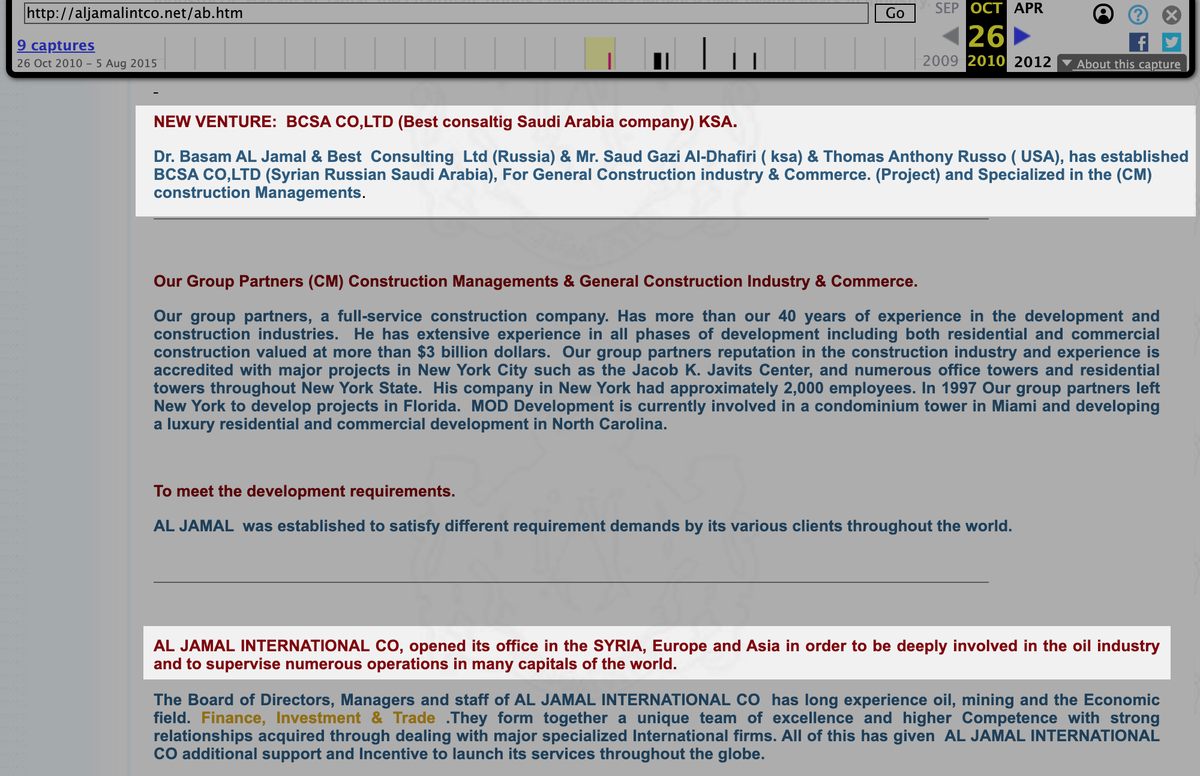
The invoice, which bears the signature and company seal of al Jamal, shows that his firm, Al Jamal International, had offices in Syria and Russia, and cites a brief meeting that included Oleg Gordeev, who later became president of Russneft.
The invoice also lists Al Jamal’s global offices, including a phone number for one in Wayne, New Jersey. When a reporter called and asked to speak to Basam al Jamal, a man with a thick New Jersey accent answered: “No, he lives in Syria.”
The man, who declined to identify himself, did not remember Top Dog but remembered Singer, describing him in unflattering terms.
First reached on a Finnish mobile phone number, al Jamal said he doesn’t do business in Syria, had no recollection of Top Dog and did not know his own name was on a Nevada-registered corporation called Al Jamal Petroleum US.
An archived version of Al Jamal International’s website — which lists Basam al Jamal as chairman of its board and Al Jamal Petroleum US as a subsidiary — shows that the company was doing business in sectors as varied as energy, construction, food, currency exchange and letters of credit, vehicle distribution and films. The website also said that the firm had offices in the United States, Germany, Italy, Saudi Arabia, Syria and Russia.
In cryptic follow-up communications, al Jamal said that his firm “was dealing with many companies in the world before some company is real and some company is not good, and I cannot help you in this matter.”
The invoice, he claimed, was “fake from his [Singer’s] side” and that he never received any money from Top Dog Holdings,” pointing out that the document had no bank information and that it was in better English than he himself speaks. (It actually was in garbled English.)
Al Jamal said he didn’t know al-Zeydi or Khouri, the accused moneymen for dictator Assad. Confronted with the fact that his U.S. associate said that he was in Syria, al Jamal was evasive.
“Yes I am in Syria. No, I am in Lebanon now,” he said. “What use is where I am? I don’t know you.”
Teeana, Russneft and Oleg Gordeev — all on the invoice — are all also found in the database of the Russian “Troika Laundromat” investigation, a trove of documents tied to some 70,000 banking transactions from 2011 to 2014 that were leaked to the independent Russian newspaper Novaya Gazeta and the Organized Crime and Corruption Reporting Project.
It’s unclear what if anything Top Dog knew of its partners before the apparent deal. The Laundromat database shows Teeana wired almost $2.9 million to a company called Belconta Corporation, which itself had transactions with a top Laundromat company named Quantus Division. That’s significant because Quantus had previously sent at least $69 million to firms linked to Putin’s close childhood friend, cellist Sergei Roldugin, from 2008 to 2010. Little known outside Russia, the cellist gained notoriety in the 2016 Panama Papers because of suspicions that he was a frontman for Putin’s wealth.
Teeana also appears on an internal FinCEN Files spreadsheet of higher profile companies the Treasury Department had been monitoring.
Cyprus corporate records showthat at the date of the purported invoice between Top Dog and al Jamal — August 2011 — Teeana was “owned” by Sasha Levina, a Cypriot Ukrainian, who had acquired it just two months prior from Galina Alexandrou, a Cypriot. She has close ties to Serhiy Kurchenko, through a Cypriot company, Wonderbliss Ltd, of which she became shareholder and director in July 2011.
Kurchenko became a billionaire at just 29, thanks to ties to an oligarch close to Putin’s inner circle, Dmytro Firtash. Kurchenko is one of the beneficial owners of Wonderbliss, and the Treasury Department placed him on a Crimea-related sanctions list in 2015 to “target the misappropriation of state assets” in Ukraine.
Few footprints
Who is Hunter Singer and where does he fit into this complexoverseas money matrix?
Demanding anonymity because they feared retribution, five associates who knew Singer in New York and Florida describe him as having sketchy associates and often having worked with foreign investors as a middleman in deals. He lived for a while in a posh East Side apartment in New York, golfed frequently and sported expensive watches. And he left a trail of unhappy associates from Brazil to Thailand.
Court records show that Singer was the subject of a bitter eviction process after his mother died and the estate sold her condominium. Family members said they’d lost contact with him and declined to comment for this story.
.jpg "unnamed (6).jpg")
Singer was listed as a shareholder in some startups in the early 2000s, found in archived documents at the Securities and Exchange Commission.
Then in June 2006 his employer — May, Davis Group Inc. — was expelled by the National Association of Securities Dealers (NASD), and eventually in October of that year Singer was permanently banned from working in any capacity in the securities markets.
“Singer failed to respond to NASD requests for information,” said a disbarment report from FINRA, the industry’s self-regulating group.
The mysterious businessman had another now-inactive Florida company called Vertical Commodities, and a Hong Kong corporate database and a business card show he claimed to be a partner in a Chinese company called House of Qin.
When a Mandarin speaker called House of Qin in Beijing, the receptionist first said “wrong number” and hung up.
On a callback, she refused to give the name of the company: “I am just a receptionist.”
Hunter Singer has a now-defunct email address associated with House of Qin. Asked about whether an American works there, the receptionist said he is rarely there and asked, “Are you looking for him for personal reasons or what?”
Singer’s already small public footprint largely disappeared after Barrett’s death, until February 2016. That’s when he was arrested at a Motel 6 outside Orlando, jailed and charged with grand theft for failing to return a rental car in Broward County. That’s where theonly available photo of the bald middle-aged Singer appears, a related Osceola County mug shot. Singer does not appear to have faced criminal charges for anything related to his many financial businesses.
In September 2017, Singer petitioned the clerk of Palm Beach County to legally change his name to Hunter Barrett Scott. It is unclear why. His petition was rejected three months later.
McClatchy and the Herald located Singer by phone, and after acknowledging it was him, Singer hung up when asked about Top Dog. In a follow-up call to the sameWest Palm Beachnumber several weeks later, another man answered and said he’d recently been assigned the number by his cellular provider upon getting a new phone.
Singer did not respond to detailed questions sent by email about Tog Dog’s activities or its relations with the now-sanctioned Syrian and Russian entities.
Guy Rabideau, the Palm Beach lawyer who registered Top Dog and added and subtracted its members over the years, with Barrett’s signature, did not return numerous calls or respond to an unannounced visit to his office.
Rabideau incorporated Top Dog in 2004 under Barrett’s name. Singer first appeared as an officer in 2007, resigning as vice president in 2010. In October 2010, Barrett signed a document that added a Washington state commodities trader, Matthew Henning, as a new director.
That was news to Matthew Henning.
“Honestly I met Hunter Singer when I was doing commodities trading and there was a sugar deal that he was representing, or said he was. It never happened,” Henning said in a phone interview from Scottsdale, Arizona.
“I just kind of let it go, and then I found out that I was a director, and I said remove it immediately.”
In emails dating to September 2011 provided by Henning, he asks the Florida’s Department of State to remove him as a director of Top Dog because he said he’d never consented. Henning declined to share other emails. He remained a director on Top Dog’s annual filing in 2011, but Singer reappeared on its 2012 filing, about seven months before his mother’s death, listed as Top Dog’s CEO. No subsequent filings appear in Florida records for Top Dog.
Sour Sugar
A Florida lawsuit filed around the time of the suspicious wire transfers adds to the curious cast of characters along Top Dog’s money trail.
In May 2011, Singer and Top Dog filed a civil lawsuit against another Florida shell company called High Sea Sugar over a supposed failed deal to sell sugar from Brazil. The deal was worth an eye-popping $1.3 billion, big money for someone without much of a public record or profile in the trade.
Top Dog described itself in the lawsuit as a reseller of sugar, oil and gas. It alleged fraudulent inducement by High Sea and its representative, Newell “Nick” Smith, accusing them of entering into a contract in late 2010 for bulk delivery of nearly four million tons of sugar even though High Sea did not possess the product.
The sugar was to ship in monthly chunks over a 12-month period to destinations of Top Dog’s choosing.
Except that Smith and High Sea didn’t own any sugar, the suit said, accusing the company of “contumacious disregard” of truth.
In multiple interviews, Smith, who no longer works out of Miami, denied any knowledge of Syrians or Russians involved in the deal. He said his brief foray into the world of sugar sent him scurrying back to the more familiar product of coal.
“It was a fool’s errand, it was virtually impossible,” he said in a telephone interview from North Carolina.
Mysteriously, Singer never pursued the suit any further and a judge dismissed the case in May 2012 for inaction.
Singer’s attorney in the suit, Richard D. Seay, did not return multiple requests for comment.
Smith’s attorney, Robin Pimentel, said he advised his client to pull the plug on the deal.
“Everyone you are typically dealing with in that industry is playing the same game. It’s like a con man trying to con the cons,” saidPimentel, a former prosecutor. “As sweet as it may sound, sugar is a dirty business.”
Stelios Orphanides from the Europe-based investigative nonprofit Organized Crime and Corruption Reporting Project contributed to this report.
This story was originally published September 24, 2020 at 6:00 AM.