FIU staffer who worked with Rosenberg said he called her ‘princess,’ would divorce wife, report says
READ MORE
FIU president resigns
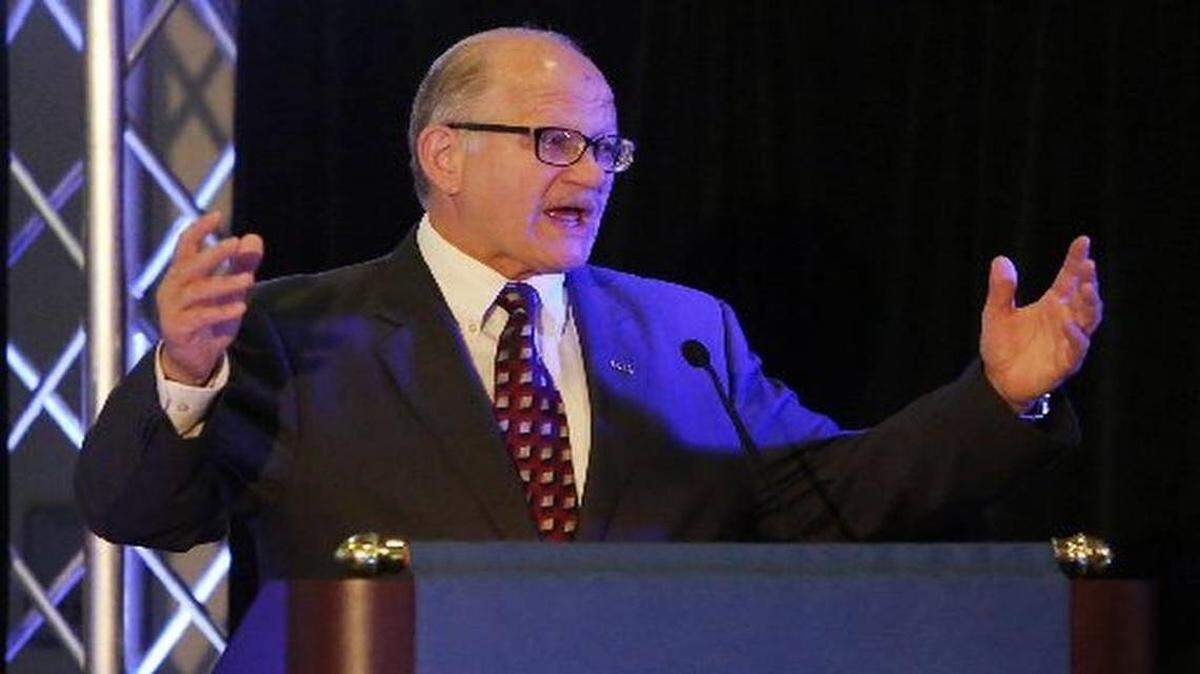
Mark Rosenberg, Florida International University’s fifth president, installed in August 2009, abruptly resigned in January. He cited health issues for his departure after about 45 years of service. But he later acknowledged that he had “caused discomfort for a valued colleague.”
Expand All
He started calling her “princess.” He commented on her clothes, asking if she had dressed “so nicely for him.” He wouldn’t have lunch without her, wouldn’t leave the office until she did and hugged her when greeting her.
He also extended a proposition: He told her he would get a divorce and asked her to be his “lover.” He then confessed he had fallen in love with her and wanted to marry her, promising she would be “taken care of” financially and professionally.
Those are some of the allegations of misconduct described in detail by the young woman who in December asked to be transferred out of the President’s Office at Florida International University because of how her boss, the university’s former president Mark Rosenberg, treated her, according to a report FIU released Wednesday about its investigation of the incidents.
READ MORE: Source: FIU employee confided to colleague that Rosenberg had been harassing her
Rosenberg is 72; the woman is in her 20s.
Her allegations led to Rosenberg’s abrupt resignation in late January, and triggered the two-and-a-half-month investigation conducted by an outside law firm at FIU’s behest. FIU is the state’s second-largest public university and the nation’s fourth largest, with more than 56,000 students.
The report stopped short of concluding he sexually harassed her, but determined Rosenberg, FIU’s president since 2009, “acted in a manner that was unprofessional and that he crossed appropriate boundaries in his behavior towards and interactions with a female subordinate.”
On Wednesday, a day before FIU’s Board of Trustees will meet for the first time since Rosenberg’s abrupt exit Jan. 21, the lead investigator — attorney Eric Isicoff — delivered his final report to the trustees. The Herald obtained a copy.
Although the woman treated Rosenberg with the “same degree of familiarity and lack of formality” as he treated her, the report blames Rosenberg.
“It was up to President Rosenberg to set the tone and the boundaries,” the report reads.
“Given his position as President of a major educational institution, the substantial disparity in age and the obvious power dynamic that existed in the relationship, the President, at best, displayed extremely poor judgment,” he added. “That poor judgment continued after being told to stop on more than one occasion.”
‘No smoking guns’ but Rosenberg apologized
Rosenberg “flatly denied” calling her princess and commenting on her clothes, according to the report.
He said he never discussed marriage, but admitted he had feelings for her. The “taken care of” bit, he said, “was in the context of letting her know that if he left FIU for another position, he would make sure she could come and have a meaningful job.”
He said he never used the term “lover” but suggested she could act as his “companion” post-presidency. He also said he thinks he told her he loved her, “but in a broader context,” according to the report.
The 15-page investigative report features interviews with the woman, Rosenberg and two witnesses, as well as reviews of text messages and emails between Rosenberg and the woman, whom the Herald is not identifying as its policy is not to identify harassment victims.
In the report, Isicoff notes he found no “smoking guns,” or “propositions and nothing that could be construed as constituting sexual harassment” in the text messages. However, the text messages “reveal an uncomfortable and inappropriate level of familiarity and informality” on part of both Rosenberg and the female staffer. The two complimented each other often, sprinkling in hearts and other emojis.
Isicoff cited an instance where Rosenberg texted her after they both attended an FIU event: “Missing you already — going into [Female Employee’s name] withdrawal!!”
Investigators reviewed the emails and found no red flags.
The Herald has attempted to contact the woman for comment since January unsuccessfully.
In a statement emailed through his lawyer on Wednesday, Rosenberg chalked up what happened to “misunderstandings.”
“The report shows there was no harassment, no advances and no corroboration on the very few inflammatory terms that were suggested I used. I did not use those terms,” he wrote. “This was a series of misunderstandings resulting from my position as president which required intensive interaction between me and my team and my personal circumstances and I regret that this is where we’ve ended up.”
In his initial statement announcing his Jan. 21 resignation, Rosenberg vaguely mentioned the “deteriorating health” of his longtime wife, Rosalie, and his own health issues. Two days later, on Jan. 23, he disclosed he had “unintentionally created emotional [not physical] entanglement” with an FIU employee. In that same statement, he apologized: “I take full responsibility and regret my actions.”
Rosenberg’s attorney, Gary Costales, said during Rosenberg’s nearly 50-year tenure at FIU, he promoted and championed women. Rosenberg joined FIU as an assistant professor of political science in 1976, four years after the university began on the site of the old Tamiami Airport at Southwest Eighth Street and 107th Avenue.
“Obviously, he’s embarrassed,” Costales said Wednesday. “He deeply regrets to go out in this very public way, but hopefully this won’t detract from all that he accomplished at the university.”
What will happen next between Rosenberg and FIU?
When the board meets Thursday, trustees are likely to discuss the report’s findings and possibly weigh in on whether Rosenberg will return to teaching at FIU.
However, it won’t be up to them to decide that.
According to Rosenberg’s contract, because he resigned in good standing, Rosenberg could return to campus after his one-year sabbatical at full salary and teach classes with a $377,000 annual salary. If he does, he would do so as a tenured faculty member, which means he would be covered by the faculty union’s collective bargaining agreement and would report to a department chair, a dean and ultimately the provost.
The decision as to whether Rosenberg returns as a tenured faculty member falls on the FIU Faculty Advisor Board, which is comprised of the vice provost for faculty leadership and success, the associate provost for academic planning and finance, the director of employee and labor relations, the associate director of employee and labor relations and FIU’s deputy general counsel.
Those five members will decide “what, if any, further steps may be taken based on the facts gathered in the instant investigation or any further investigation it may wish to conduct,” according to the report.
Isicoff told the Herald Wednesday he doesn’t know when the Faculty Advisory Board will discuss Rosenberg’s future, but that they could issue a recommendation that could range from counseling to reprimand, to suspension or termination. Rosenberg’s department chair or dean — whom Isicoff couldn’t identify — would ultimately decide what to do. Depending on the severity of the decision, Rosenberg could appeal it.
“I don’t know exactly how quickly they will convene and deal with this, but my understanding is that they will not wait until he returns as a teacher or a researcher or to write a book or whatever he will do when he comes back. I don’t believe the Faculty Advisory Board is going to wait for that; I think they’re going to proceed forward,” he said.
Isicoff said that he’s not aware of any separation agreement being negotiated between Rosenberg and FIU.
After Rosenberg resigned on Jan. 21, FIU’s Board of Trustees, during an emergency meeting, appointed Kenneth Jessell, 66, FIU’s chief financial officer and senior vice president of finance and administration since 2009, as interim president while FIU searches for a permanent successor. The board will discuss Jessell’s employment agreement during its meeting Thursday.

It started in spring, escalated in fall, imploded in winter
The woman first joined Rosenberg’s office in July 2019. She told the investigators during her interview on Jan. 19 that she first felt uncomfortable last May, after Rosenberg met her boyfriend during the South Beach Wine & Food Festival. She said Rosenberg later told her he wasn’t “good enough for her.” Rosenberg said he never criticized her partner, according to the report.
In October, she planned to vacation in Salt Lake City, Utah, and then Las Vegas. Rosenberg would be visiting Las Vegas around that time. She said he called and texted her repeatedly, pushing her to stay at a specific hotel and coordinating so their visits overlapped. She didn’t. He referred to his arranging for a free room for her as an “act of kindness,” according to the report.
The day she returned to work from vacation, Rosenberg was scheduled to be off but came into the office and bought her tacos. He said buying lunch for others wasn’t unusual in the office.
A few days later, on Oct. 16, Rosenberg asked her for a breakfast meeting. That’s where she said he asked her to be his “lover” and mentioned leaving his wife. The next day, she pretended the conversation hadn’t taken place, but he kept inquiring if she had considered his proposal, the report said.
Sometime in the following two weeks, Rosenberg invited her to lunch at the FIU Reagan House, the president’s house on FIU’s main campus off Southwest Eighth Street. He told her he loved her and wanted to marry her, and that she would be “taken care of.”
Investigators interviewed Rosenberg twice — once on Dec. 20 and then again on Monday. He confessed he was depressed and struggled with his wife’s illness. Rosenberg started the process of a divorce under Jewish religious law, known as a get, in June 2021.
Rosenberg told investigators when he asked if the woman would be interested in being his “companion,” she said “yes.” They both discussed writing a book together and sharing the same interests, including music, travel and exercise.
They didn’t bring up sex, but the companionship might have included sex, Rosenberg told investigators.
After that conversation, Rosenberg said, their relationship turned “great, warm, positive.” She told him she needed new running shoes, and he bought her some. When they didn’t fit, she asked him to get a new size. She told him she needed Airpods, so he gave her his own pair.
But, by November, things changed. The staffer told investigators she broke down crying on Nov. 5 and confided to her friends and mother what was happening; they condemned her work environment and advised her to move on.
Sometime in early November, over dinner at Graziano’s, she said she told Rosenberg she wasn’t interested and wanted a transfer. She said Rosenberg “assured her that he would stop any ‘advances.’” He denied saying that, the report said.
In mid-November, he started making unwanted advances again. He started hugging her in greetings, calling her princess, having lunch with her, not leaving the office until she did. Once, he entered a room where she was taking a remote class. She left and he followed, then took pictures of her.
They often traded music, and he started sending her romantic songs, she said. She worried he was sending her encrypted messages. Rosenberg said she sent him songs with graphic sexual lyrics.
She said Rosenberg mentioned his son wanted an apartment in Coral Gables, and she said she loved Coral Gables and would move there if she could afford it. She said she then saw him looking for apartments in that area, implying he would offer it to her and pay for the rent.
Rosenberg told investigators he was searching for a place for himself, as he considered moving his wife nearby to The Palace, an independent living facility for seniors in the Gables.
She said he also invited her to a one-day trip to New Orleans over the winter break to visit museums.
By Dec. 14, the woman told Rosenberg she wanted to transfer out of his office. That set in motion the FIU investigation and the final report issued Wednesday by the outside counsel.
This story was originally published March 2, 2022 at 1:23 PM.