Miami basketball games played in a theater? That downtown building may soon be history
READ MORE
Looking back at old Miami
Photos and memories of the way South Florida used to look: its streets, stores, events and people.
Expand All
Will the Hyatt Regency and the James L. Knight Center disappear from downtown Miami?
The city is considering a redevelopment plan for the riverfront property. The complex — which consists of the hotel and the adjoining convention center-theater — opened in 1982 near the Brickell Bridge.
And through the years, it has hosted hundreds of exhibitions, concerts, conventions and special events. The Knight Center even served as the unconventional home of the newly revived University of Miami basketball team for a few years starting in 1985.
Let’s dig into the Miami Herald archives and go back to the start, when the Hyatt and Knight Center opened and changed downtown Miami.
Here’s what we were saying about it back then:
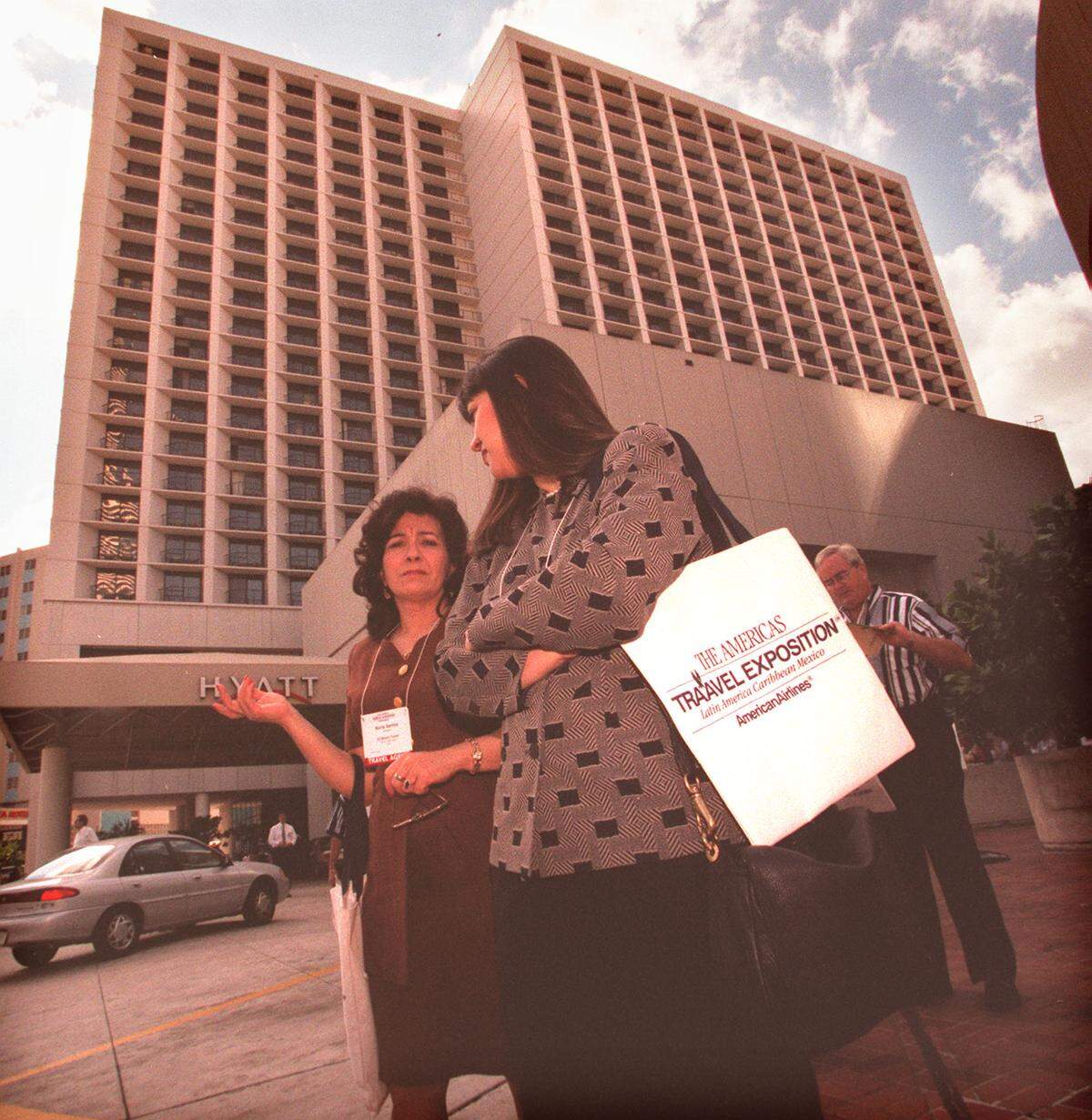
How the Knight Center complex was built
Published Oct. 2, 1982
“Don’t you think this is great?” Miami Mayor Maurice Ferre asked.
“Yes.” shouted back the 300 who gathered Friday to dedicate the James L. Knight International Center, Miami’s new $110 million downtown conference complex.
A joint effort of the city, the University of Miami and developer Earl Worsham, the center is Miami’s trump card in a bid to become an international convention city.
The effort began with $5 million in city money and a $2.5- million grant to UM from the James L. Knight Charitable Trust. Construction of the hotel-convention center complex took 4 1/2 years, a process complicated by delays and cost overruns.
But Friday all that was set aside.
UM President Edward T. (Tad) Foote II set the tone of the gathering, calling the Knight Center “a place of culture and beauty, of education and fun.”
Foote drew an analogy between the government-university- private sector partnership that created the center and Miami’s diverse ethnic composition.
“The most important thing about the Knight Center> is the strength of different people, brought together in what is common and human and good about us all,” Foote said.
The centerpiece of the complex is a 5,000-seat auditorium. Pie-shaped, the hall features advanced audio-visual equipment including translation facilities for up to six languages.
In mid-October, the center will host the American Society of Travel Agents convention, which is expected to bring 7,000 travel agents to the Miami area.
Adjacent to the auditorium is UM’s School of Continuing Studies, itself a generator of conferences. Worsham’s 19-story hotel, managed by the Hyatt Corp., tops off the center.
Sounding a familiar theme, Ferre recounted for Friday’s audience how downtown was in a slump when construction of the Knight Center began. But the center served as a catalyst, he said, drawing other developers to Miami, helping to trigger a $2.5-billion building boom.
“Miami is one of those places where dreamers come together and buildings sprout up,” the mayor said.
Developer Worsham commented: “It took, above everything else, a miracle.”
Alvah H. Chapman Jr., president and chief executive officer of Knight-Ridder Newspapers Inc. stood in for James L. Knight, whose $2.5-million donation to UM helped get the center started.
Knight, who was unable to attend, was a founder of the Knight newspaper group and is chairman of The Miami Herald Publishing Co.
“Those who know James L. Knight can picture his eyes sparkling when he thinks of this project,” Chapman said.
Knight, a self-described “nuts-and-bolts man,” shuns ribbon cuttings.
Also absent was Miami Assistant City Manager Vincent E. Grimm Jr., the city’s nuts-and-bolts man on the project. Grimm, a stern administrator who keeps an ancient shotgun on his office wall, helped prevent squabbles among the developer, the architects and the construction company from scuttling the project.
Grimm, according to his secretary, Marie Holliday, was “hunting in Wyoming.”
What we thought of the building
Published Sept. 26, 1982
By Beth Dunlop, Miami Herald Architecture Writer
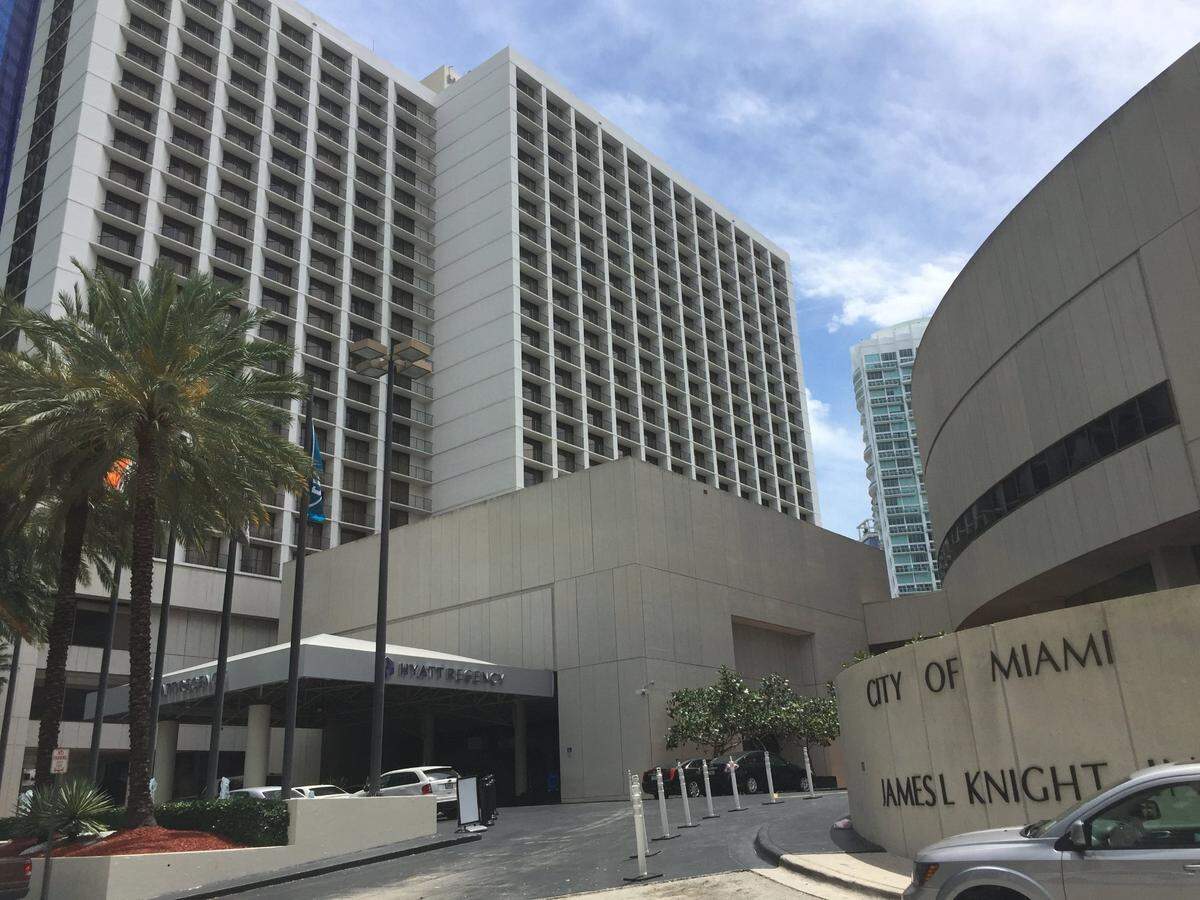
The James L. Knight International Center is a diligent and workmanlike building, sculpted out of gray concrete and positioned high above Dupont Plaza and the Miami River.
It ought to be one of Miami’s most distinctive buildings, a landmark, but it isn’t. The Knight Center falls short of being monumental in a place and time that cries out for architecture to remember.
The $80-million Knight Center, which will be dedicated Friday, is really three buildings in one -- a hotel, a conference-convention center for the City of Miami and a continuing education center for the University of Miami. And, appropriately enough, the structure itself breaks down into three distinct elements -- a tower, a cube and a sheared-off cylinder, each separated visually but connected physically.
It should be a bold design, but it isn’t, really. It could be a work of striking geometry, but the hotel tower - with all its bays and balconies - is too busy, so the impact of the geometry of the convention center is diminished.
The use of great expanses of gray concrete -- a trademark for the Knight Center’s architects, Ferendino/Grafton/Spillis/ Candela -- serves here to make the building seem less imposing, less important. This is a place where a less minimal material -- granite, marble, even stucco -- would not have made an overly pretentious building.
At the north end, there’s a stairway leading up to the Knight Center’s 4,000-seat auditorium. The stairway is a ziggurat shape, and it’s repeated inside, a continuing architectural motif. But it is too steep to be sweeping and too narrow to be dramatic, and to add insult, the best views of it are blocked by a curved wall, which thwarts its architectonic and theatric possibilities.
At the base, the steps look steep enough to be part of a pyramid in Chichen-Itza. And alongside the stairway, there’s a would-be mirror image -- a black glass window in the same shape, which could likewise be dramatic but isn’t. It’s too small, and that makes it merely a feeble echo of the stairs.
The 19-story hotel tower is a bore, a fussy and repetitive building not at all distinctive on the skyline. On the outside, it bears more resemblance to a high-rise apartment for the elderly than to a classy hotel.
All that being said, this is not really a bad building. It simply has one overriding weakness -- a failure to make more of this prodigious architectural opportunity than less of it.
It is a building that the city and the region can be proud of, pleasant, mostly tasteful and almost always thoughtfully designed. But when all of the 50- and 60-story towers around it are in place, it may seemed to have been completely swallowed up.
The conference center of a major international city could well be grand, and it’s entirely possible to design a grand building without making it grandiose.
Where it’s kept simple, the geometry of the building
is quite powerful. And there are some wonderful spaces -- a ground floor promenade by the river, a third-floor terrace, intriguingly odd-shaped meeting rooms. There’s lots of light in the public corridors and delightful, surprising glimpses of the river and bright, airy spaces throughout the building.
The Knight Center will become part of a complex of buildings constructed under an intricate arrangement of contracts for the development of almost seven acres of downtown Miami, bounded roughly by SE Second Street, Second Avenue, Miami Avenue and the Miami River. (The Knight Center covers just over four acres.)
The conference center portion was constructed under a joint agreement between the City of Miami and the University of Miami. The Hyatt Regency Hotel was built by Miami Center Associates, a firm founded by Atlanta developer Earl Worsham.
By December, the Knight Center is to be linked by a walkway under the expressway ramps to a Worsham-constructed parking garage with 1,450 spaces, also designed by Ferendino/Grafton. On top of that parking structure will go the Miami World Trade Center, designed by I.M. Pei for Dade Federal Savings & Loan, which is leasing the garage’s air rights for this. Construction should start next year. The Knight Center will also be linked, by way of the riverwalk, to the River Parc Hotel, scheduled to open in April. It is being adapted by the Miami architectural firm of Baldwin/Sackman from the former Bauder Fashion College, a building that began life as the home of the Miami YWCA.
All told, there’s an ambitious amount of municipal urban development taking shape here. And across the street, there’s more: The first two buildings of Miami Center, the Edward Ball Office Building and the Pavillon Hotel are nearing completion on Ball Point, and the 55-story Southeast Financial Center is emerging slowly.
Amid the bustle of new office buildings and hotels, the Knight Center will be both a place of respite and reflection and a place of activity and excitement. It will be able to seat comfortably conventions of up to 5,000. The 3,838-seat (with floor space for an additional 1,000) auditorium is the biggest one south of the Hollywood Sportatorium, making it a likely locale for big-name concerts and other big-draw events.
The auditorium -- which the city terms the convention hall -- consumes the third and fourth floors of the north end of the conference center. It is a fan-shaped hall, with rows of seats rising sharply above a broad flat floor. This is a subdued, dark-hued space, carpeted and upholstered in terra cotta. The walls, designed for acoustical control, are covered by wood battens. The ceiling, also acoustical, has dark exposed metal trusses.
There is a portable stage, a screen and lots of state of the art audio-visual equipment, including translation booths to allow for discussions in six languages. The auditorium is equipped with theatrical lighting, and like Miami Beach’s Theater of the Performing Arts, it can be made smaller with the drop of a curtain that cuts out half the seats.
The aisles are all carpeted, but the floor in front of the seats is not. It is painted concrete rather than being finished in a more permanent way, this to allow for anything from a small circus to an OAS summit meeting. The auditorium is largely untested (for acoustics, for traffic flow, for sightlines), but it will likely be an effective hall, cavernous but not overwhelming, dark but not forboding.
The inner workings of the conference center will be almost as intricate as the contracts governing its construction. City- operated meeting rooms are served by hotel kitchen facilities, and city or university-sponsored events will hold their luncheons and gala parties in a Hyatt-operated ballroom. The university didn’t quite fill its end of the third and fourth floors, so there are some city meeting rooms tucked inside the university quarters.
Each of the Knight Center’s three proprietors chose different interior designers, and each of the interior designers chose different color schemes, which means it is quite easy to discern what belongs to whom.
For the Hyatt Regency, New York designer Henry End chose a navy and tan theme, and inserted marble paving in the terra cotta. The city’s space -- by Design Matrix, the interior design group of Ferendino/Grafton -- relies on rust tones with terra- cotta tile pavers, terra-cotta carpet and wood (eventually there will be lots of it). The university’s color scheme, by Richard Plumer of Miami, revolves around green -- with bold green carpet and orange-and-green windowpane carpet and green upholstered seats in the 444-seat theater.
This imposition of interior design wills provides a curious clash here. The impact, if momentary, is striking.
The hotel lobby - which is where most pedestrians and out- of-town visitors will arrive - is actually on the second floor of the four-story conference center. The architects hoped that people would be able to walk in and look right back out at the river, thereby instantly understanding how the building related to the city.
But the Hyatt’s designers had other thoughts. They decided to install under the skylight an elevated “palm court” (so identified by signs as well as palms), a seating area that will double as a piano bar. Directly under the hotel’s three-story atrium, the palm court’s centerpiece is the sculpture by Israeli Yaacov Agam that Worsham bought specifically for the site. Dubbed Anitral (after the Worshams, Earl and his wife Anita), the tower is too tall for the space, which is sad. Otherwise, it does its sculptured-optical trick, providing a focus from all sorts of vantage points.
Along the sides of the palm court are fountains, constructed of corrugated fiberglas, the kind used for carports in the ‘50s, and illuminated with blue lights, altogether astonishingly tacky and a much worse view than the river.
The finishes in the lobby are largely fake - fake bamboo, fake leather, fake suede, fake wood. All these finishes are durable, to be sure, but they don’t support any aspirations the hotel might have toward the luxury leagues.
Off to the south of the palm court are two restaurants and a bar, all positioned to give some of the diners and drinkers river views and views of the swimming pool (which is elevated above an archeological preserve site). One oddity: The ceilings in the 24-hour restaurant were left unfinished, which is a disconcerting sight while eating.
The hotel is equipped to wine and dine almost 600 in its restaurants and lounges and can feed an additional 1,100 at a time in the ground floor ballroom, the ugliest of all the Knight Center’s facilities. The ballroom’s decorators decided to install glittery gold ceilings over the plain ones the architects designed, and in the foyer, didn’t even manage to have the flimsy gold ceiling decorations line up with the recessed lights. Worse still, the carpet chosen for the ballroom is a nightmare -- a modified origami pattern in maroon and orange and beige.
Contrarily, the promenade leading to the ballroom is the most pleasant spot in the building. It is a two-story foyer that parallels the Miami River, an airy and soaring space and one that exploits the best opportunities of the site and the city.
There are meeting rooms on ground and third floors -- 16 rooms of various sizes with folding walls that allow the creation of 29 smaller ones. These are of simple design, but they are wired for advanced technology with audio-visual hookups.
The university space includes classrooms, the 444-seat auditorium, a smaller lecture hall and a television studio. It is all carpeted in the dark grass green, and after the first startling sight of it, the color grows to be likable.
The Knight Center is still unfinished, although work is progressing steadily, and much of it will be complete by Oct. 10, when the first major convention, the American Society of Travel Agents, opens. But there’s a temporary news and sundries stand instead of the planned 40,000-square-foot retail mall, which eventually will connect the Hyatt lobby with the walkway to the parking garage. Further, until the garage is opened, hotel guests have to rely on valet parking.
Still to be installed, too, is an electronic signboard that will run ribbon-like across the top of the ticket sales booths and past the shops. There’s furniture still to arrive, and a lot of the oak trim is not in place.
A lot of the landscaping has yet to be installed, too. The curved wall in front of the monumental staircase is to have night-lit plants and trees in it. The plaza along SE Second Avenue is adorned with royal palms, flagpoles, a tentative- looking fountain and Tootsie-Pop styled lampposts. The architects and the city plan to acquire a major work by the aging Spanish artist Joan Miro to sit in front of the building.
The Knight Center sits at a 45-degree angle to the city’s grid, a Ferendino/Grafton trademark, and it covers virtually all of its four-acre site. The latter is not a trademark of the architects, but it was a conscious decision to make a strong urbanistic statement by filling the whole site.
It sits very close to the street and the river, which is not bothersome in the southbound approach to the building but is quite troubling in the northbound approach; with the Hyatt tower, sitting on the west side of the Brickell bridge and the Dupont Plaza Building on the east side, it looks like downtown Miami is a walled city.
The idea was to make the building an integral piece of the city’s fabric, accessible to pedestrians and visible to motorists, and --if the city and state ever work out a traffic- light system that actually allows people to cross streets, that idea will prove itself out.
Ultimately, the closeness to the city that the Knight Center achieves may not matter at all. The state is to build gigantic I-95 exit ramps that will plunge past it, blocking it from the north. And the intent of developer Theodore Gould is to build a 14-story parking garage that will span the two westernmost blocks of Dupont Plaza, and that will thoroughly block the Knight Center.
For now, the Knight Center has a position of prominence, presiding over empty parking lots and hugging the river’s edge.
But if we’d had a crystal ball to foretell that the southern end of downtown Miami would be destined for such dense development, we might have opted from the start for a different kind of design for the Knight Center -- one that was lifted off the ground and lushly landscaped, an urban antidote. We don’t have crystal balls; we never even had a plan for the Dupont Plaza-Convention Center area.
So, as it is, we can only hope that we’ll be able to get around the parking garages and under the expressway ramps and through the traffic to the Knight Center, which will be one of the few places to enjoy such elusive urban pleasures as a view of the river.
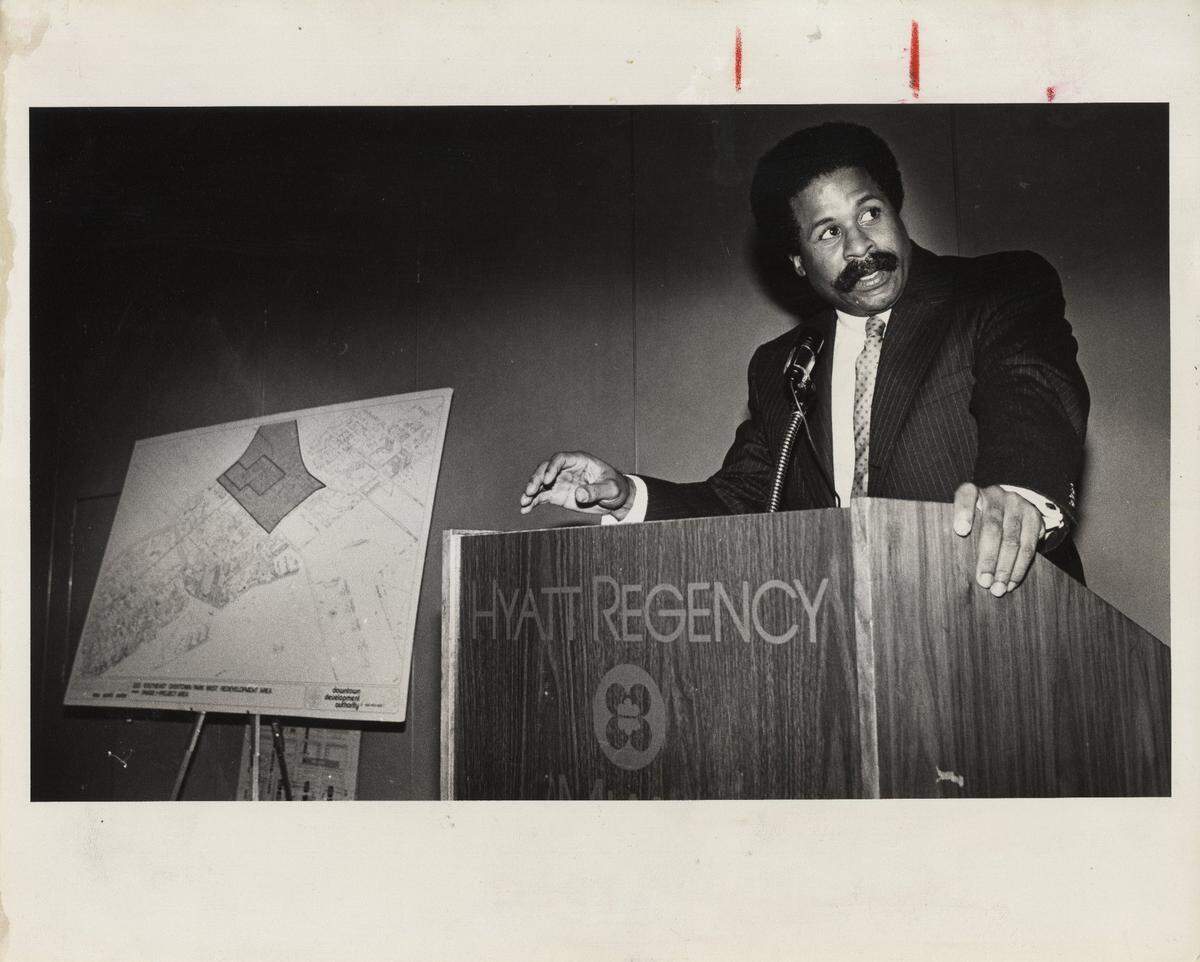
Focus of downtown development
Published Sept. 26, 1982
They were, in the simplest terms, gamblers.
A city government jockeyed by Maurice Ferre, the mayor who lost his personal fortune in downtown real estate but never tired of selling downtown development as Miami’s salvation.
Earl Worsham, the Tennessee developer who dreamed of dollar signs buzzing in neon at the mention of Miami’s name.
And the University of Miami, frustrated in its efforts to build a conference center on campus by the small-city fears of Coral Gables residents.
They came together to build the James L. Knight International Center - a convention center, hotel and school of higher education - on a 4.5-acre downtown site on the Miami River.
When the city bought the land at a bargain price in 1975, Miami’s downtown boom had gone bust. But when the $110 million Knight center is formally dedicated at a ribbon-cutting ceremony Friday, it will take its place among $2 billion of ongoing downtown development.
“There will be decisions made there, findings will come out of meetings that will be datelined Miami,” says Burdines Chairman Richard McEwen. “It will bring the attention of the world: an educational facility in the heart of a major downtown.”
The James L. Knight center, named for the former chairman and executive officer of Knight-Ridder Newspapers Inc., will house UM’s conference center. The James L. Knight Charitable Trust gave the university $2.5 million for the center.
But the Knight center is more than a collection of college clasrooms and meeting halls.
At its core is the city’s convention hall, a 5,000-seat, pie-shaped auditorium equipped with the latest in audio-visual gear and with simultaneous translation facilities capable of handling six languages.
In October, the convention hall will host the much-courted American Society of Travel Agents (ASTA), which will bring 7,000 travel agents from all over the world to the Miami area.
The hall can also be used for concerts and the arena-style stage can accommodate a boxing ring, indoor tennis or a basketball game. There are two smaller meeting rooms that can seat 225 and 96 persons, respectively.
Convention center managers see it as a generator of events --concerts, plays and lectures-- that will bring people to downtown Miami in the evening hours.
“It’s going to breathe life into the city at night,” says Worsham, who owns the hotel and managed over-all construction of the center.
The university’s green-carpeted conference center holds a 500-seat auditorium, a 150-seat lecture hall and several smaller classrooms. UM Conference Center Director Robert La Prad sees it as a “downtown campus” for UM.
The promise of the facility, La Prad likes to point out, is in the technical services UM can offer groups meeting there.
Foremost among these is tele-conferencing, the technology of enabling groups a continent or ocean apart to share meetings via satellite hookup. UM is part of the burgeoning National University Tele-Conference Network.
“It’s the first time the university has been in the ballgame with a major facility like this,” La Prad says.
The Knight center is topped by Worsham’s 19-story hotel, managed by the Hyatt Corp. The 620-room hotel has riverfront restaurants that will stay open until 2 a.m., seven days a week, an 11,700-square-foot ballroom, and 21 shops scheduled to open later in the fall.
Scheduling of events will be handled by Hyatt, UM and the city, through a central booking office controlled by the city. “It’s really a joint effort,” says Marketing Director Sandra J. Opes.
The effort began on a rather small scale.
“It was all leverage financing,” says Ferre.
The city started with $4 million from the proceeds of a 1969 convention-center bond sale. By 1980, it had invested $15 million in the project, including a $4-million federal grant that paid for foundation work before plans for the rest of the facility were complete.
In 1980, the city sold $60 million in revenue bonds for the Knight Center and construction began in earnest.
For the next two years, the center would be plagued by construction delays, botched plans, a $15-million cost overrun and Worsham’s threats of a lawsuit against the city. A five- month delay in completion forced Worsham to refinance over $50 million in loans.
“The amazing thing about it is that everybody stayed together,” Ferre says.
As the center’s construction advanced, it provided a psychological boost for other downtown development.
“It created confidence,” says Natun Rok, downtown’s largest landlord in numbers of properties. “I see the center as a first step, a good one.”
The Knight center was an impetus to development of the nearby World Trade Center, a 35-story tower that will sit atop a 14-story, city-owned garage.
Next door to the Knight center, the former Bauder Fashion College building is being converted by Worsham associate Adrian Werner into a luxury hotel, to be called the River Parc.
But the Knight center itself is in need of an important addition if it is to compete for a significant share of U.S. conventions, city officials say. Without some 200,000 square feet of additional exhibit space, city officials concede that the center is a three-legged table.
“We need that fourth leg,” Ferre says.
Without it, according to Miami Convention Bureau Director Tony Pajares, the center can only compete for between 10 and 15 per cent of the U.S. convention market. Exhibit space for major conventions like ASTA is being provided at the city’s Coconut Grove Exhibition Hall, some five miles away.
Because of the lack of exhibit space, Pajares is seeking to tap the European convention market. Conventions in Europe follow a conference format, dispensing with the American habit of displaying wares.
Worsham and the city would like the exhibit space built nearby as part of a $240-million complex that would include a sports arena and an international trade mart. But right now that is only a plan.
Another piece of unfinished of business concerns a sculpture Ferre wants for the Knight center entrance. The City Commission has announced plans to acquire “Lunar Bird,” a 20-foot high steel creation of Spanish surrealist Joan Miro.
The sculpture’s $600,000 price is no object. Says the mayor: “It will do for downtown Miami what Picasso’s ‘Steel Sculpture’ did for Chicago’s Civic Center Plaza.”
But when the ribbon is cut this Friday, the focus will not be on what remains to be done. Instead, heady superlatives will be heaped on what already has been accomplished.
M. Robert Allen, dean of UM’s School of Continuing Studies --of which the conference center is part-- sees the Knight center as a “great trading post” of ideas at the center of an international city “bursting into a great financial and cultural center.”
Ferre, in a recent interview, sounded a more pragmatic note. The mayor ticked off a roster of cherished projects that have yet to be set in steel, concrete and glass. Ferre drew a breath when he mentioned the Knight center.
“It’s the only one I’ve been able to get off the ground,” he said fondly.
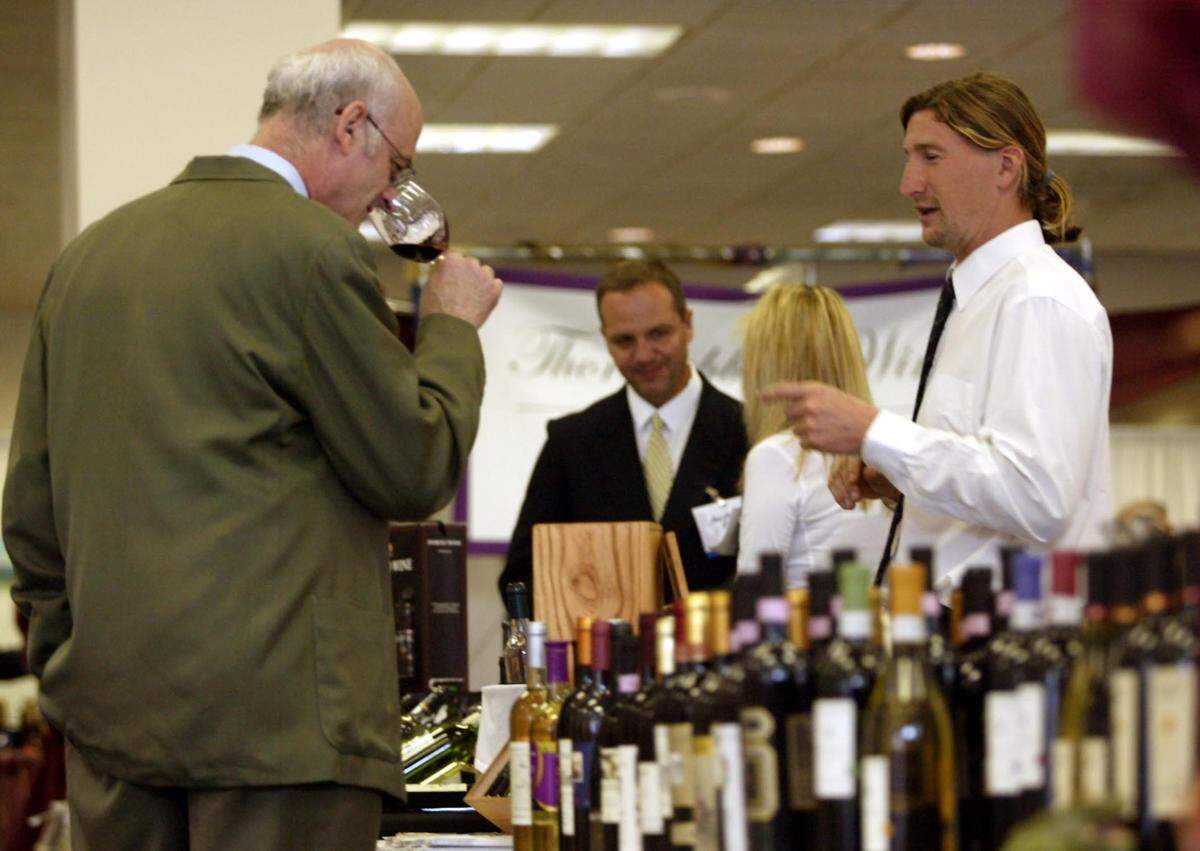
Ready for the debut
Published Sept. 14, 1982
Monday was “dead day” at the Hyatt Regency Hotel. Most of the employes were gone fishing, compliments of the company. It was the last day before the hotel opens for business, with 60 guests set to check in today.
The employees looked happy. They had spent the weekend doing what hotel workers seldom get a chance to do: be rude. They yelled at the bellhop, insulted the waiter and gave the front desk a hard time.
“We had half the employees pretending to be guests and the other half waiting on them,” said Hyatt sales director Michael Consuello. “It was part of our shakedown procedure, to make sure we are ready for the public.”
The shakedown is all leading up to what hotel and city officials hope will be a successful debut on Oct. 1 of the James L. Knight International Center, which includes the City of Miami Conference Center, the University of Miami Conference Center and the Hyatt.
The convention center, overlooking the Miami River on the edge of Dupont Plaza, is expected to play a major part in downtown revitalization.
This weekend was something of a dress rehearsal for the hotel staff as bogus guests pretended their luggage had been lost, that their reservations had been mishandled and that the waiter had brought them the wrong dish. The working employees had to swallow it all, smile and remain unruffled.
“Some were acting deliberately disruptive, just to make sure we could handle it,” Consuello said. “We had everything from ruly to unruly. They all really performed well.”
The “trial feeds” were the most fun, said Laura Sonnenmark, Hyatt assistant personnel director. “You got to go into the restaurant and order whatever you wanted off the menu.”
She and other T-shirted employes were climbing aboard tour buses in front of the hotel Monday morning, off for a day’s fishing at the hotel’s expense. Some 351 employes will be on the job this morning when the Hyatt greets its first guest.
Monday, the construction workers practically had the place to themselves.
The 24-story, 615-room hotel is operated by Hyatt for the center’s owners, Miami Center Associates Ltd., a partnership whose primary stockholder is Worsham Brothers, an Atlanta-based developer.
The first group to use the Convention Center will be 900 employes of Dunn Technology, coming to town this Sunday. There will be plenty of room for them: The convention center seats 4,000. Considerably larger will be the Annual Congress of the American Society of Travel Agents, convening at the center Oct. 10-16. As many as 6,000 people are expected.
The convention hall didn’t look ready Monday morning. Some seats hadn’t been installed yet and dozens of crates of Quartzline lamps had yet to be unpacked. Consuello insisted everything would be finished by Sunday, however.
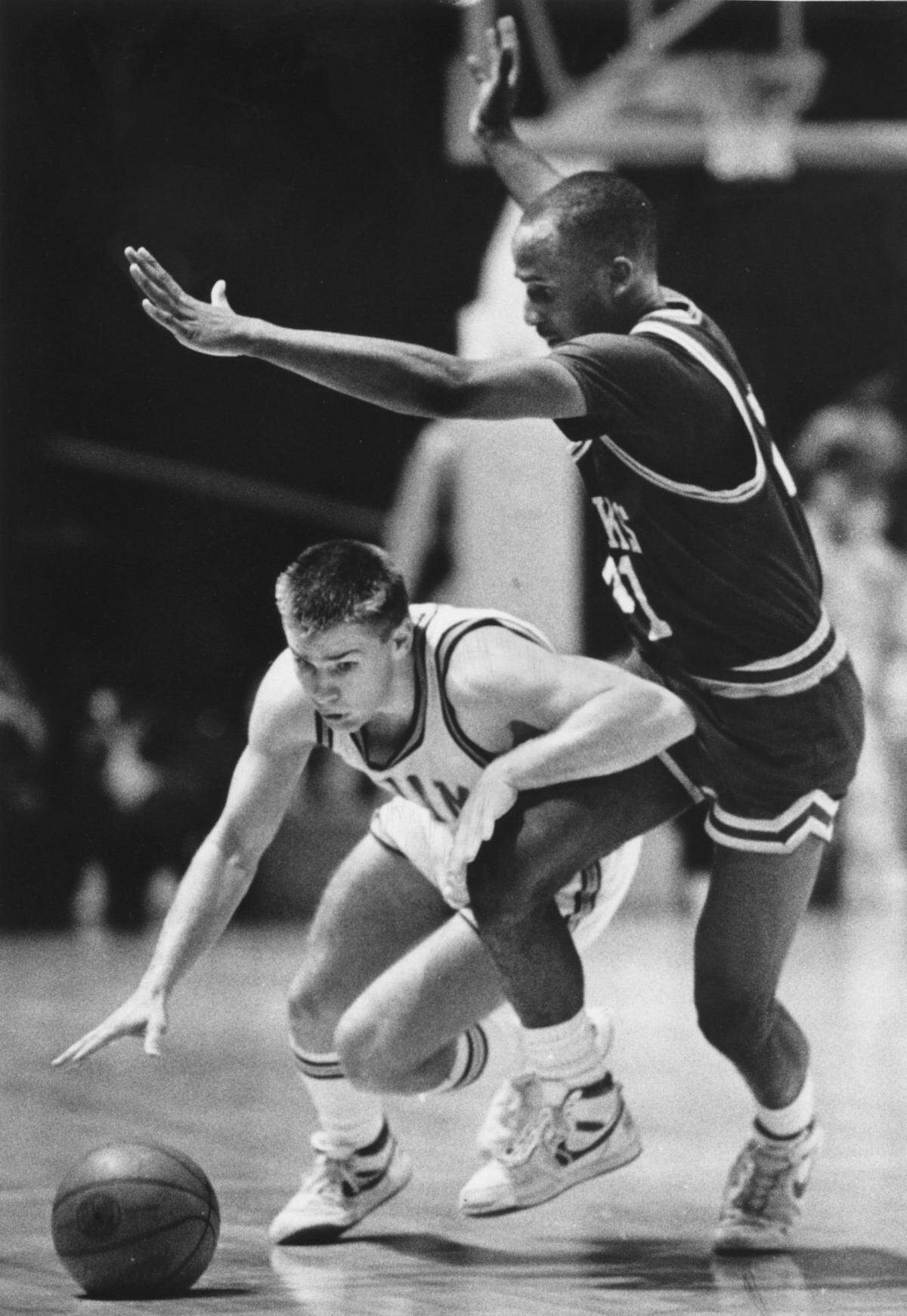
Basketball in the auditorium
Published Nov. 23, 1985
Suddenly it was just the two kids in white jerseys and the one kid in light-blue.
“Two-on-one! Two-on-one!”
Pounding down the court.
“Fast break!”
Then the bounce pass, the catch in midflight, the up-up-up, the mammoth slam-dunk.
BOOM!
“I’ve been living for this night,” Mitch Anton said Friday.
Recently elected Margate City Commissioner Mitch Anton? No. Basketball fan Mitch Anton. The one who remembers that incredible season when -- oh, let him tell it, even though he’s a little hoarse.
“I’ve followed the ‘Canes since I was 10, 11 years old. When Rick Barry was here. When Barry had that incredible season, finishing No. 1 in the nation. Thirty-seven-point-four points a game!”
That made history.
But so did this: The first University of Miami basketball game in 14 years, since 1971, against The Citadel before a crowd of 4,984 at the James L. Knight Convention Center.
“I started buying season tickets, oh, about here,” said David Sims, pointing to the mid-1950s on his year-by-year Hurricanes’ scorecard. “And I had them until they gave it up. What a disappointment.”
A smile passed over Sims’ round, red face, under his University of Miami baseball cap, as he watched the game unfold before him.
“I’m glad it’s back. You know, I once saw Rick Barry break a guy’s jaw. A player from some New Orleans school. Gave him a shove, the kid fell and broke his jaw,” Sims said.
Judging from his glow, Paul Herald -- longtime fan and booster -- felt OK about the 41-37 halftime lead. He admitted a chill ran down his spine on that first point in 14 years, a free-throw by Bryan Hughes 36 seconds into the game.
“Look at that! How about that? Yeah!” Anton said, as Kevin Presto, the spark-plug guard with the great name, sank one from a mile away. “They’re playing great ball for a bunch of freshmen and sophomores.”
Just one problem. The No-Shows. Anton, like all great fans, wants everyone to love this sport as much as he does. He is an evangelist.
“Look at this. See how many coats and ties there are in this room?” he said. “These are not real fans. Look at these empty seats.”
Then the gush begins again. After all, this, an 85-77 Miami win, is the feast after 14 years of fasting.
“I’ve lived on football, because that’s all they gave me,” Anton said. “But this is just great.
This is just what Miami needs.”
This story was originally published May 11, 2022 at 8:43 AM.
.JPG)
.JPG)