Have you seen the Everglades Skunk Ape and the Miami chupacabra? They’ve made a mark
READ MORE
Looking back at old Miami
Photos and memories of the way South Florida used to look: its streets, stores, events and people.
Expand All
Is the Everglades Skunk Ape real? What about the chupacabra?
Well, it’s up for debate.
Mythical Miami creatures for some. Real-life sightings for others.
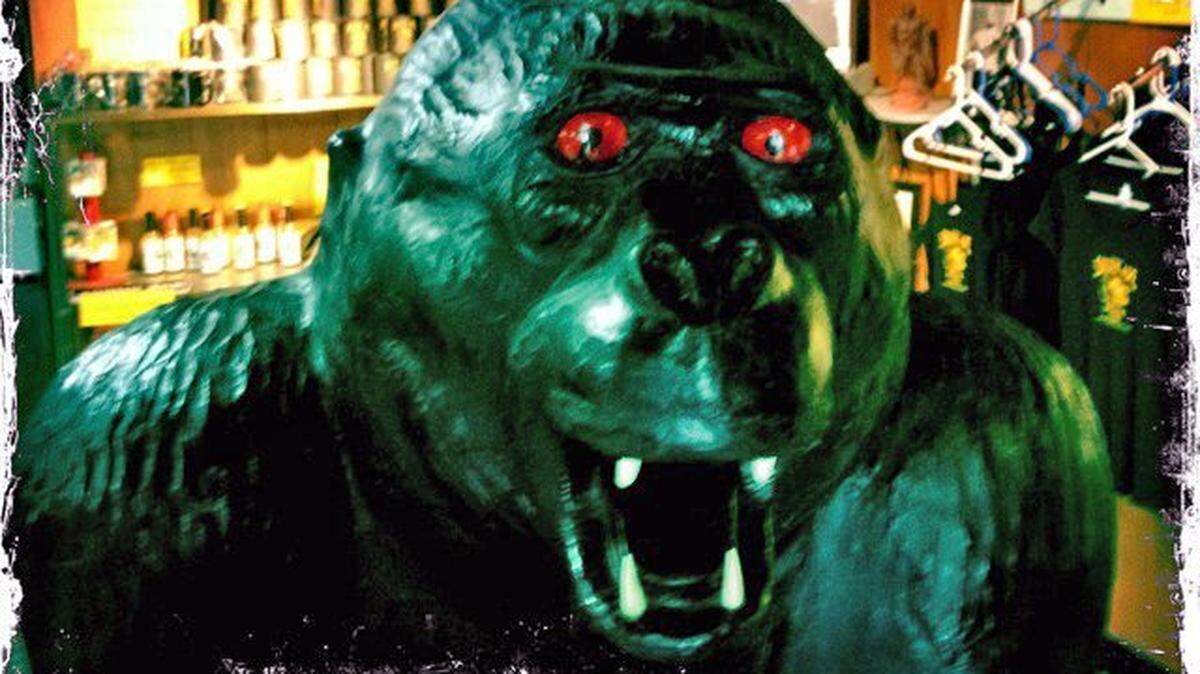
Whatever you think about Florida’s versions of Big Foot, Sasquatch and the Loch Ness Monster, you have to admit they are interesting.
What, you never heard of them or run into them? It’s just a matter of time.
Let’s go through the Miami Herald archives and recount the sightings of the Skunk Ape and the chupacabra.
Who killed the heifers?
Published May 9, 1996
By Damarys Ocana
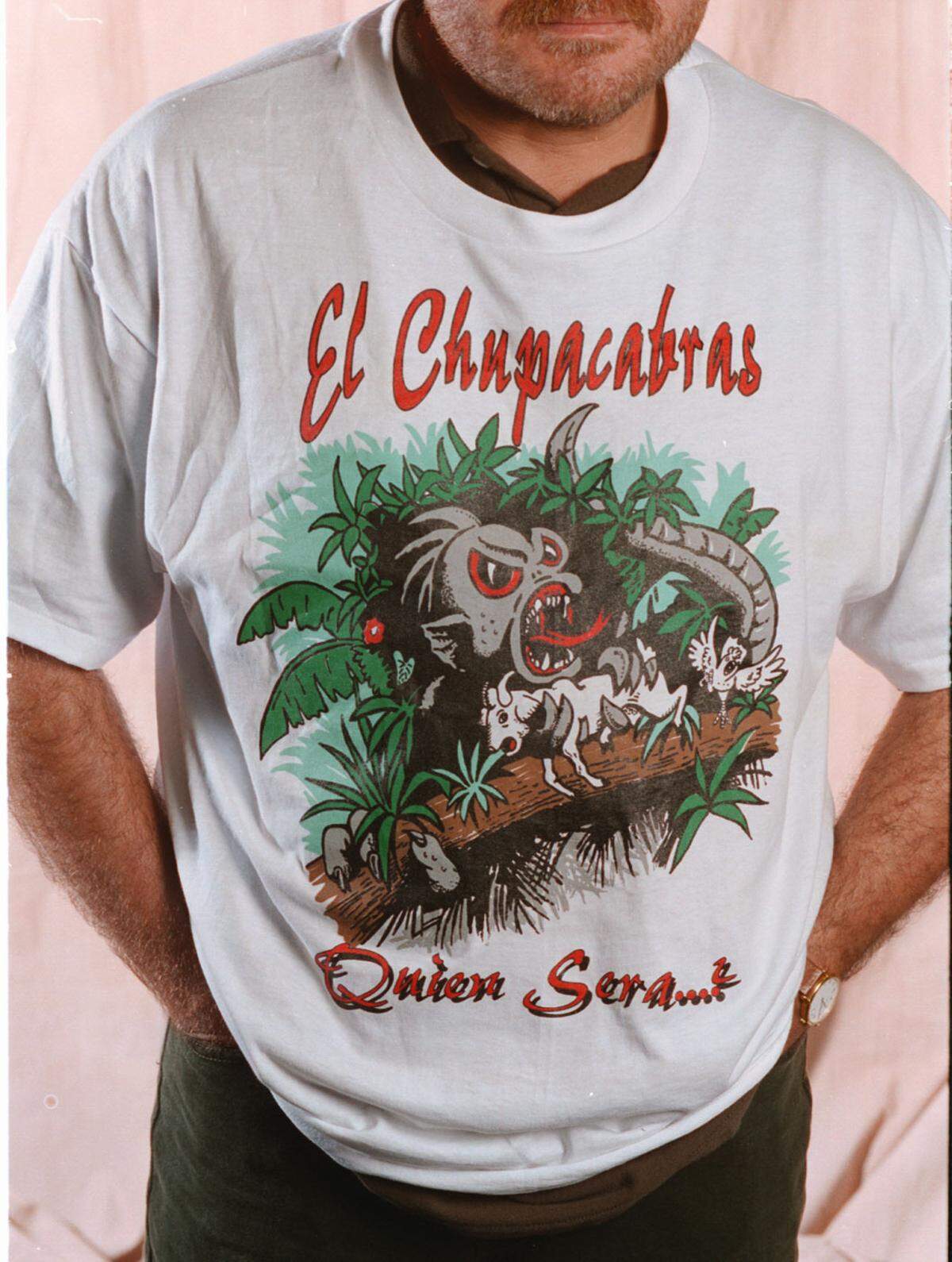
Don’t chalk this one up to the chupacabra. That’s what a Northwest Dade cattle rancher and rodeo host said after finding remains of two of his heifers piled in the entrance of his fenced-in ranch west of the Florida Turnpike last week.
Onelio Olazabal, a Palm Springs North resident, said Friday afternoon he drove to his property, Day Riding Club Ranch, at Northwest 152nd Street and 117th Avenue. He immediately found a bloody scene - the severed head of a heifer and heaps of guts and internal organs.
He called police and discovered two heifers were missing.
He said rustlers, not the legendary animal who West Dade residents have claimed sucked blood from their animals and mutilated them, are responsible.
“Pirates - they were professionals. You could tell by the cuts and because they knew what to leave behind,” said Olazabal, who kept the heifer head. “They had guts to do it right by the road, too. There can be a lot of traffic on that road.”
But he is not surprised. He said rustlers, who keep the meat for themselves or sell each carcass for up to $1,000, have hit other ranches west of the turnpike recently.
If that is so, no one but Olazabal has reported the incidents, said Metro-Dade police. A detective for the area was not available for comment, but crime analysts said they have not spotted any other cow thefts or slaughterings in the last month. Police are still investigating this latest case.
This isn’t the first time Olazabal cattle have disappeared from the ranch, where Olazabal hosts weekend rodeos and roping competitions. Last year, he said, rustlers stole 17 cows and a trailer.
Olazabal said he does not plan to add equipment to ward off rustlers or hire a live-in employee to watch the sunken field already bordered by a barbed wire fence.
“The chupacabra is the guy you really have to worry about,” joked Olazabal. “Anyway, who wants to live among cows?”
A taste of goat?
Published April 14, 1996
By Maria Morales
Although local authorities deny it, the Chupa Cabra is in Miami.
Those who have seen it give the same description: 25 feet wide, 30 feet long, and green, brown and orange.
And although it became famous in Puerto Rico and Miami for its elusive characteristics, the Chupa Cabra today will receive anyone who knocks on its door.
We’re talking about the brand new Chupa Cabra Restaurant Cafeteria, at 150 NW 27th Ave., in Little Havana.
“Don’t you think it’s a good name? Every one who sees it or hears it likes it,” said Julio Ramirez, 66,, who owns the small eatery.
“I named the restaurant that because it’s what’s on the hit parade.”
The manager said most people who hear the name laugh, but others don’t find it so funny.
We gave it that name so it will be a reminder that the Chupa Cabra was once in Miami,” said Rosario Belez, 46. “Though, by the time the fever is over, we may have to change the name.”
The menu includes chicken, roast beef, palomilla steak, shrimp creole, tacos and tamales, among others.
So what about goat or lamb stew?
“No, no. Not that,” Ramirez said. “We are going to serve a line of traditional, typical fare.”
“Until now, everybody has only talked about how many the chupacabras has eaten,” Ramirez said. “Now we will see how many come to eat at Chupa Cabra.”
Pursuit of the goatsucker
Published April 10, 1996
By Liz Balmaseda
The “X Files” are just about closed. Good thing, too. The stink was getting out of hand.
You see, the “X Files” contained six dead goats found March 18, another six found March 19, four dead pigs found March 20, and a slew of animals wounded March 21.
But the stink wasn’t caused entirely by the decomposing animals, which turned up on the same ranch in deep Northwest Dade just days after a string of similar killings in Sweetwater.
The stink was coming from a decomposing myth, the weird and unearthly legend of the chupacabras, the feared and fearless goatsucker who was believed to have arrived mystically from earlier rampages in Puerto Rico.
Well, the goatsucker tale ran its course. But it just wouldn’t go away. It held on to its pop culture icon status and lingered on the sensational edges of the population, where people believed it actually sucked out the blood and organs of its prey through small fang holes.
Ask Ron Magill, Metrozoo communications director.
Just after the brush fire that ripped through Metrozoo on March 23, searing 120 acres, forcing zookeepers to evacuate animals, Magill’s phone jangled with certain urgency. A national TV producer teased, “You know why I’m calling?”
The fire?” he asked, rather naively.
Of course not the fire. It had to be something a little more sexy to lure a news magazine show like 48 Hours.
“X Files,” wrote Metro Police Detective Tim Smith on his dead animal folder. Working out of the Miami Lakes precinct, he became the lead detective on the chupacabras case in March when a uniformed sergeant called to report the killing spree on the Northwest Dade ranch. He set out to track the curious pattern of puncture wounds each animal bore on their rear hind quarters.
He met the ranch owner, Ralph Marino, who showed him the animal carcasses.
“He didn’t understand it, but he didn’t believe it was the legend,” says the detective.
The beleaguered rancher had called Animal Control inspectors, who set up traps. (The traps caught a cat and a small dog, but the killings didn’t stop.) And, suddenly and reluctantly, he was in demand by mysterious animal trackers, devotees of the paranormal, and tabloids. People came by and took carcasses, samples, soil.
Back at precinct, Detective Smith also got the goatsucker calls. “We were getting calls from outside the state. The media wanting to pursue this legend . . . and Mr. Marino was sitting out there losing animals,” he says. “For the animals’ sake and for Mr. Marino’s, we wanted to put a stop to all the guessing.”
For expertise, Smith went to Ron Magill, who enlisted the help of pathologists at the University of Miami School of Medicine.
“They do all our pathology at Metrozoo, and I said, ‘We need a respectable, definitive source on this,’ “ says Magill.
“We were going to put an end to it,” echoes Smith.
So Magill and Smith plotted a way to kill the goatsucker. They agreed to hold a public necropsy on the very next goat to turn up dead. The rancher would beep them and they would beep each other and call a press conference, where they would cut open the goat.
The next dead goat was found on Easter. Magill picked up the carcass first thing Monday, took it to UM and called reporters.
The pathology report: Most likely a dog -- or two.
Smith called the rancher and told him and referred the case to Animal Control. And that just about closed the X Files.
Alas, the goatsucker was dead. Unfortunately, so were Ralph Marino’s goats and pigs. Unlike the chupacabras, the predator was still on the loose.
Opening the goat
Published April 9, 1996
By Geoffrey Tomb
In an attempt to drain every ounce of sensationalism from Miami’s maceratingly mad chupacabra mystery, the medical and zoological establishment Monday performed a very public necropsy on the latest victim, a very dead goat.
As a horde of news-hungry reporters crowded around the table, Alan Herron, veterinarian and professor of pathology at the University of Miami School of Medicine, served up his definitive conclusion:
“The bite wounds are suggestive of a predation that is most likely a dog,” he said.
A chupacabras - aka goat-sucker -- is said to be a night-stalking creature, possibly an alien, with reptilian skin, glowing red eyes and a vampire-like taste for draining animal blood and/or organs.
The chupa chase began in Puerto Rico and captured South Florida last month, fed by rumor and talk radio.
The most recent animal death, sometime Sunday, came from a farm at Northwest 154th Street and 150th Avenue. Exasperated Metro police decided to examine the latest “victim,” to debunk the myth once and for all.
“There is nothing to be afraid of out there,” said Ron Magill, Metrozoo communications director. “It ends here.”\
But, ripe for jokes as it may be, it is not funny. There is fear in Barbara Martinez’s eyes when she talks about the night two weeks ago when she lost 42 livestock animals, all of them pets.
There is sadness when she talks about her favorite goose, Pachy, a 10-year-old bird she raised from the time he was hatched. She remembers his shrieks eight years ago when a bad dog ripped open his belly. She nursed him back to health. How could it be that he could die so silently? She showed me the feathers on the grass Friday.
“My husband looked out the window at 3 a.m. that night and Pachy was still alive, standing by the riding lawn mower,” she said. “We didn’t hear a peep.”
She has lived in that house for 25 years, surrounded by her geese, pheasants and doves. All she has left is a dove and a small young flock of newly purchased ducks.
She says her son called county officials to investigate the killings, but no one came, so her husband burned the carcasses.
She still sleeps in fear. As I said goodbye, she echoed something her neighbor Govea had said: “I’m afraid when this thing finishes with the animals, it’ll start with the people.”
As I walked out of her house, I noticed a string of garlic by the door frame.
Chasing after the Everglades Skunk Ape
Published Jan. 2, 2007
By Curtis Morgan
The scene: the Everglades, mysterious in the darkness.
Four college kids, armed only with a night-vision camera, trudge through a palmetto thicket, guided by a snake-booted man who claims to have had multiple encounters with the state’s most elusive creature.
They seek a half-man, half-simian, fully reeking legend known as the Skunk Ape.
A curious rustling draws them closer. Nervous patter. Closer. What is making those sounds? Closer. Suddenly, a blinding flash, screams and . . . .
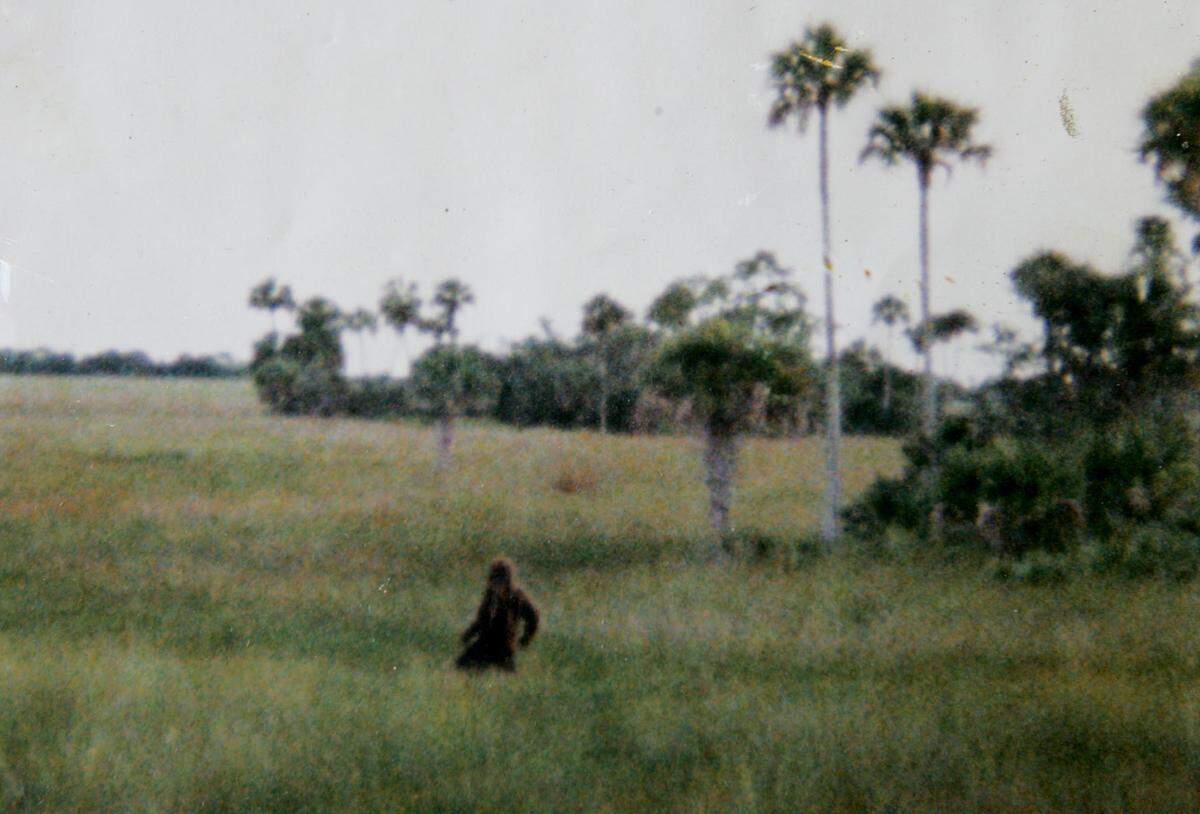
This is not some cheesy monster movie. It’s the real experience of Florida International University film students who spent months on the trail of one of the shaggiest tales in folklore -- the Skunk Ape, a k a Florida’s Bigfoot.
What they found in Footprints, a brisk and engaging documentary completed last month for a class project, won’t rewrite anthropology texts.
Turns out that unsettling flash came from an automatic camera set up by their guide to record what a skeptical world still awaits - ironclad evidence of the existence of the Skunk Ape, Yeti, Sasquatch and other hulking, hairy relations.
“We looked and we looked and, of course, we didn’t find anything. We came to the conclusion that it’s a myth,” said Romy Santana, one of eight seniors who teamed on the film.
And yet after much digging, talks with claimed witnesses, interviews with scholars of Bigfoot lore and other experts, they’re not dismissing every believer as hoaxer or wacko either.
“There are a lot of things going on in the Everglades, a lot of reports of smells and sightings and a whole bunch of things,” Santana said. “Who are we to say because we didn’t see it, it doesn’t exist? Maybe there is something out there.”
At least in the public imagination.
Several websites about “cryptozoology” - that being the study of supernatural creatures - chronicle steady sightings.
Most recently, there was 2004’s Green Swamp Ape episode in the Panhandle and the mysterious, much-analyzed Port Myakka photos of 2000 depicting an orangutanish beast hunkered behind saw palmetto. In 1997, a flurry of reports emerged from the Big Cypress National Preserve, including a supposed sighting by a busload of British tourists.
In the 1970s, the infamous Green Chimp apparently stalked south Broward County. A decade earlier, rumors circulated about a Bigfoot in Everglades National Park, possibly held under government guard.
Still, the students - Santana, Kallie Burke, Kirmaya Cevallos, Maria Delgado, Claudia Echeverria, Juan Carlos Gonzalez, Lino La Rosa and Luis Vale - confessed to knowing squat about Sasquatch when they started.
The project began when Bert Delgado, an associate professor of film at FIU, teamed them for a final test before graduating - make a movie, anything from a music video or a thriller to a documentary.
In a brainstorming session, Cevallos brought up a beast she had once seen on TV, a story that stuck in her mind.
“It just caught my attention about the Everglades, about how huge it really is and how little I knew about it,” Cevallos said. ‘It’s a myth you always think about.”
It offered an entertaining mix of mystery, history and nature. Plus, for students with a lean budget (ultimately, about $700), the story had the practical benefit of providing a beautiful and absolutely free scenic backdrop.
What they wound up putting together looks as slick as much of what airs on cable. They filmed on location in the Everglades and Big Cypress. Vale even managed to sweet-talk a helicopter business into a free flight over the Glades.
Though at less than 15 minutes, it’s shorter than professional features produced in the past, including episodes of the In Search Of and Unsolved Mysteries series, Footprints covers a lot of ground and never stumbles into spoof or hype. Nobody, for instance, shows up in an ape suit in the few “re-created” sightings.
“The topic really surprised me,” said Professor Delgado, who gave a thumbs-up that echoed reviews from friends and fellow students. “They were really interested in this thing, and they went after it. To me, it was very appealing.”
Though it uncovers nothing shocking, the film features interviews with both notable and notorious Skunk Ape authorities, who offer thoughtful and sometimes surprising ruminations on the phenomenon.
There’s David Shealy, tireless promoter and proprietor of a Skunk-Ape theme campground in tiny Ochopee on the Tamiami Trail, who guided them on that semi-scary walk.
There’s Scott Marlowe, a cryptozoologist who recounts the eerie feeling of a Skunk Ape staring at him in woody outskirts of Orlando.
And Loren Coleman, perhaps the foremost cryptozoologist and author of Bigfoot books, including a field guide describing five types going by about 500 different names.
Coleman, based in Maine, said he has spent years sifting through reports and dismisses perhaps 80 percent of them as hoaxes or misidentification.
“Being a cryptozoologist doesn’t mean you just openly, hook, line and sinker, take everything in,” he said. But tossing those aside, there’s enough hair, prints and reliable reports that “I accept right now that there seems to be an abundance of evidence that the Skunk Ape exists.”
One well-respected South Florida anthropologist - Bob Carr, executive director of the Archaeological and Historical Conservancy in Davie and a man who helped uncover and preserve the Miami Circle - won’t go that far.
But Carr, long fascinated by the sociology and psychology behind Bigfoot, would “never eliminate the possibility” of something like a Skunk Ape. He has interviewed credible witnesses himself, he said, and seen reputed hair, footprints and a lot of collected material to support a hoary myth.
“If you tried to pin me down, I’d have to say, ‘Well, there is no proof that the creature exists,’ “ he said. But, “It’s a complex answer, and it doesn’t fall easily into saying yes or no.”
Carr and Ron Magill, Metrozoo’s director of communications, are the film’s voices of logic and skepticism.
Magill points out the utter absence of verifiable evidence: no body or clear photo after a century of sighting. No conclusive DNA tests on dung or hair. And with so few, just where are Bigfoot babies coming from, anyway?
“I’m one of those people who want to believe the thing exists,” Magill said.
“It would be one of the greatest discoveries of the millennium.”
Have You Seen The Skunk Ape?
Some “facts” about a creature reportedly seen, but never quite well enough, in Florida:
▪ Size: Sometimes described as similar to its northern Bigfoot cousins, typically is estimated to reach seven to eight feet in height and weigh in at 300-pounds plus. But noted “cryptozoologist” Loren Coleman describes true Florida skunk apes as smaller, perhaps four to five feet.
▪ Appearance: Furry and lumbering. Larger Bigfoots are reported to walk erect on two legs, but the smaller skunk is more apelike in movement, hunched and scrambling on all four limbs with a distinct monkeylike jutting toe.
▪ Smell: Worse than its namesake, a nostril-searing combo of rotten eggs, animal dung and soggy compost.
▪ Range: Reportedly seen across much of the South, including Georgia’s Okeefeenokee Swamp -- more famous as home to a clearly fictional character, Pogo of cartoon fame - and everywhere in Florida.
The Skunk Ape expert
Published April 19, 2005
By Cara Buckley
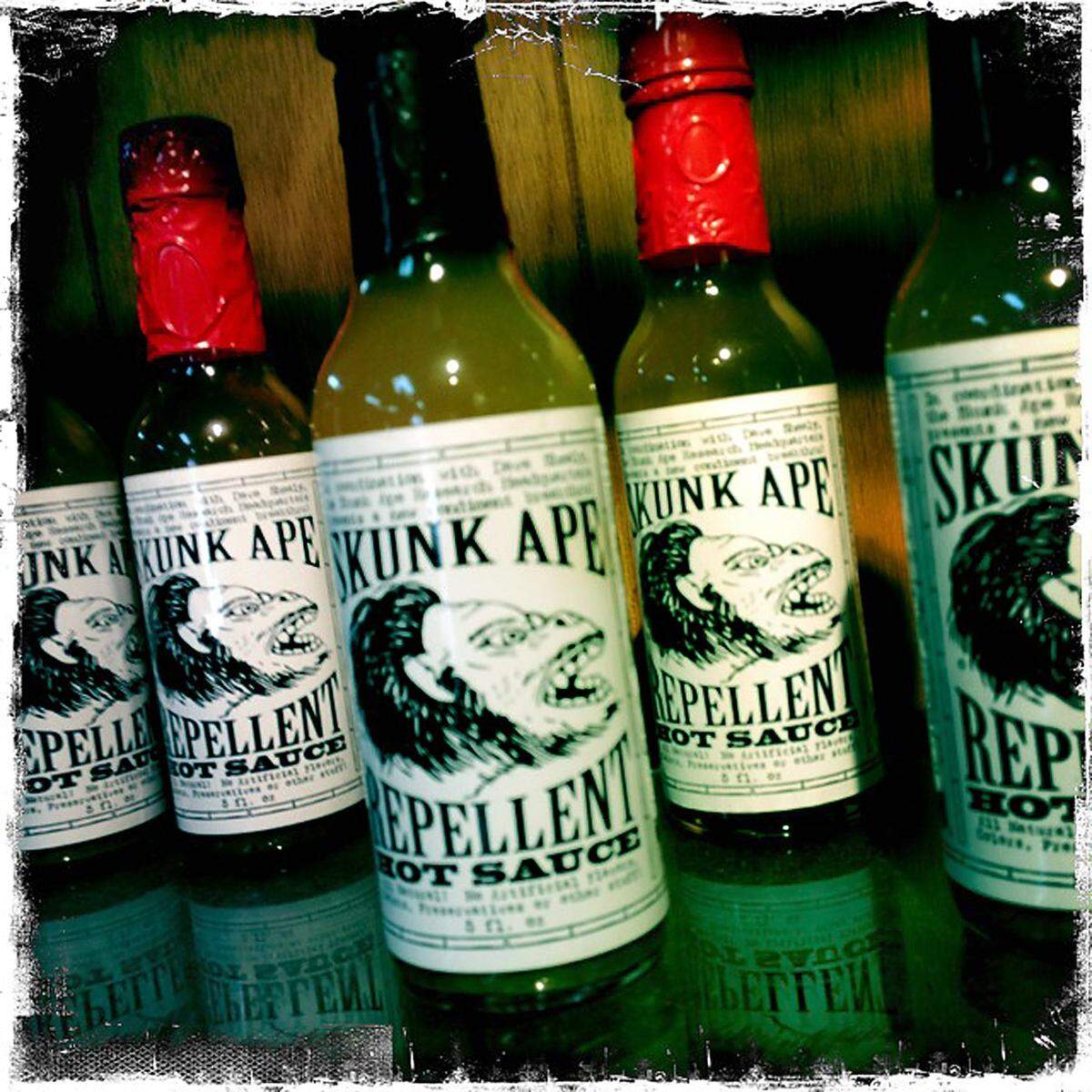
David Shealy’s life mission is singular, a little lonely, and sometimes jinxes him with the ladies. None of this may be surprising, given that for more than a decade Shealy has tried to convince the world that outsized, lumbering ape-men call the Everglades home.
“It opens up a whole Pandora’s box of bull--,” Shealy, 41, conceded one recent sweltering morning as the sun made soup out of the air in Ochopee, a blip of a town in Big Cypress Nation- al Preserve, 30-odd miles west of the Miami-Dade County line.
Shealy is the self-appointed world expert on the Florida skunk ape, a legendary seven-foot-tall mangy creature and presumable cousin of Bigfoot, Sasquatch, Yowie, the Abominable Snowman, el Chupacabra, Harry of Hendersons fame and possibly Chewbacca the Wookiee.
The skunk ape, alias swamp ape, apparently smells like bad eggs and goat dung, an odor attributed to its poor bathing habits and penchant for sulfurous alligator caves. Tales of its existence percolated in Everglades City and points north for a hundred-plus years, with various people - including a busload of highly excited British tourists who swore the creature revealed itself to them in 1997 - finding massive footprints and claiming sightings.
But Shealy, tall, lanky and goateed, a man rarely seen without his snakebite-proof boots, is the first to make the Florida skunk ape a full-time, if struggling, business. He guesses about seven apes wander about Florida, with Miami-Dade’s expansion flushing them his way.
“I don’t have a choice to believe, because I’ve seen him three times,” said Shealy, blue eyes a-twinkle beneath the brim of his gator-tooth-embossed, black leather outback hat.
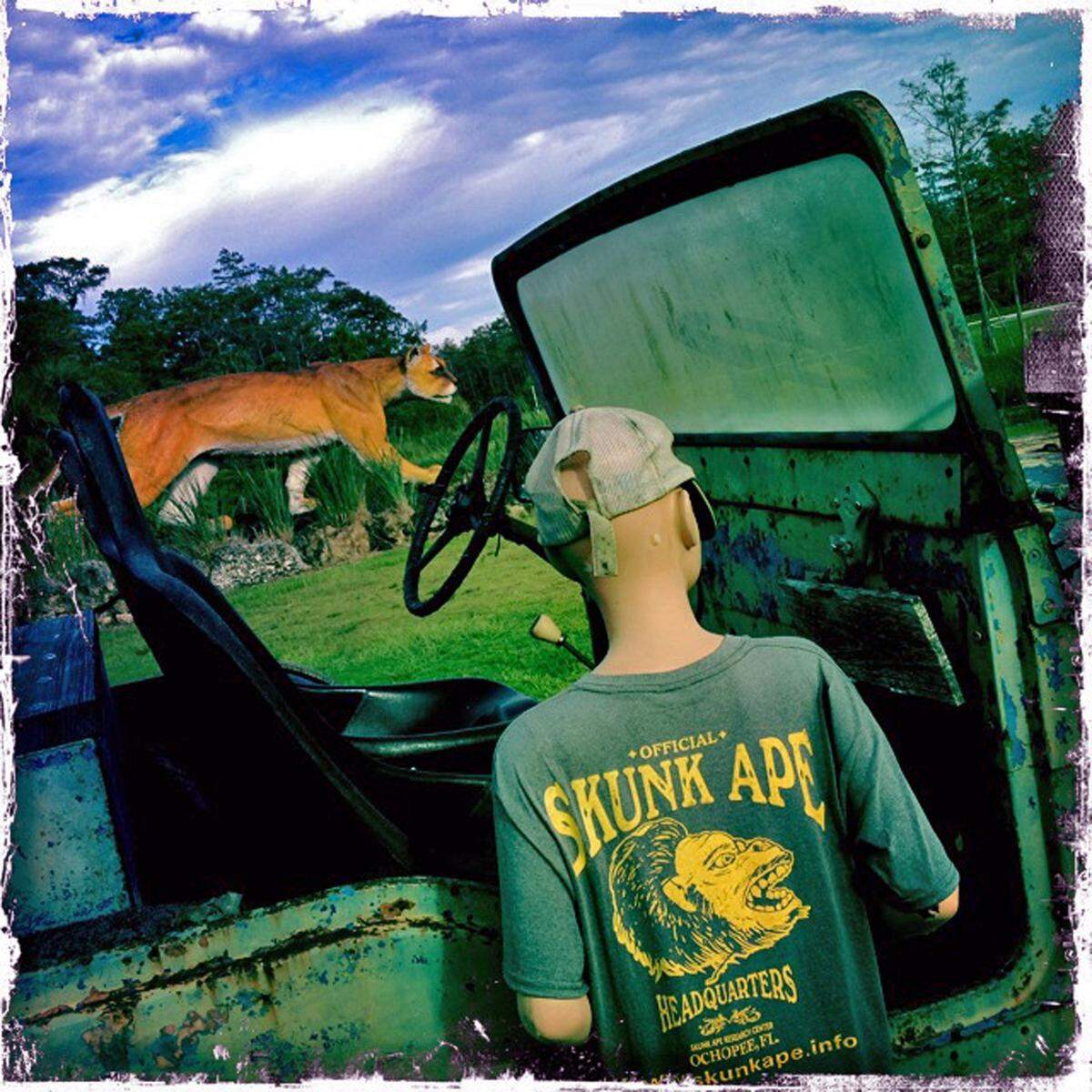
Shealy sells skunk ape ball caps, camouflage T-shirts and bumper stickers in the curio shop run by his brother, Jack, at the pair’s dusty, sprawling campground in Ochopee on the Tamiami Trail. He hosts a somewhat annual Skunk Ape Festival, replete with bands and hippies. He talks the creature up on local radio. He believes the skunk ape legend could bolster tourism for Collier County, and once convinced its Tourist Development Council to part with $44,000 for a skunk ape hunting expedition, a plan the County Commission shot down.
“It serves the tourist promotion business best as legend,” Jim Coletta, a county commissioner, wrote in a solemn consolation letter.
Shealy’s efforts drum up a mixed local response. Staff members at nearby Everglades City’s visitors center roll their eyes at the mention of his name. A young woman at another tourist spot said the skunk ape was hooey, but noted Shealy’s parties rocked. Debbie Hooks, a waitress at the Oak House restaurant, said the Shealys were odd to start with, and that kids used to pick on them on the school bus.
“It’s a joke,” she said of the skunk ape. “It’s one of them in a monkey suit.”
But others, reflecting the almost gothic, Old Florida air that still permeates Everglades City, believe a darkly mysterious and otherworldly creature could lurk in the swamps.
Floyd Brown, a 67-year-old wizened, devout drinker, said old-timers always avoided certain areas for fear of an apelike beast.
Sandy Steele, a clerk at Glades Haven Grocery Store, said grown men often return shaken from expeditions to isolated, mangrove-blanketed islands.
“You hear bloodcurdling screams, things you can’t describe,” Steele said. “Maybe things got stranded on those islands. I wouldn’t be surprised.”
Shealy said he has spotted the creature thrice: first when he was 10, second in 1987 when he was up a tree in a deer blind, and lastly four or five years ago. He shot pictures and later videotape, which he said he sold to a California man for $10,000.
His transformation into a self-styled Skunk Ape Hunter began a decade ago. Life had never been easy. The Shealys’ campground steadily lost business to Big Cypress National Preserve, which all but subsumed their tiny town. Shealy left school after the seventh grade and later began running bales of marijuana through the Everglades. After marrying in his teens, he had a kid, got divorced and was busted in 1989 for possessing 30,000 pounds of pot.
Three years in a federal prison left him eager to start anew. But the campground struggled, and does so still, even after the brothers added a motley coterie of abandoned and donated emus, lizards, mud puppies, pythons, cockatiels, alligators and goats. Jack Shealy is currently facing animal cruelty charges, which his brother says are unsubstantiated, for allegedly trying to lure a sick panther with a tied-up goat.
In the mid-1990s, Shealy began pursuing skunk ape lore, with dreams of spinning legend into gold. He made plaster casts out of purported footprints and tacked a sign, “Skunk Ape Research Headquarters,” onto the gift shop.
A few years later, a busload of British tourists returned from an Everglades excursion in a tizzy: Something tall and hairy appeared on a dusty road roughly two miles from the brothers’ gift shop. A park ranger later admitted to spotting something similar nearby, too.
Statewide sightings had been reported before, though some turned out to be monkeys on the loose.
“There’s plenty of evidence, but no scientific proof,” said Bob Carr, executive director of the Archaeological and Historical Conservancy in Davie. “But Dave has done a heck of a job to promote it.”
Another expert, Dr. Jeffrey Meldrum, an associate professor in biological science at Idaho State University, said he has seen compelling, extra-large footprints before, some with textured imprints of skin, from the Pacific Northwest and southern Georgia. But a cast footprint from Shealy, obtained by a cryptozoologist, left him unconvinced.
“It was not anatomically satisfying that this was left by a living animal,” Meldrum said.
Shealy, for his part, swears that he is neither the skunk ape nor a hoaxer, even though he keeps 13 assorted gorilla masks pinned to his bedroom wall and donned an ape suit to reenact the beast for the TV show Unsolved Mysteries.
Curiously, Shealy seems to identify with the creature, too.
On a recent drive past the visitors center, he muttered, “They don’t like the skunk ape there.” Once he interrupted a County Commission meeting with the howl, “No one likes the skunk ape!”
Now though, after years of dead ends, Shealy’s ship may be coming in. After performing at a Skunk Ape Festival, Nate Martin, a local musician, made a film about Shealy’s skunk ape quest.
Footage includes Shealy setting out piles of wet lima beans to entice the creature, Shealy locating a tuft of long brown hair on a wire fence - “Yep, definitely a skunk ape!” Shealy announces after taking a deep whiff - and the creature itself, tall, lanky and slightly auburn, bounding through the woods.
The film debuted last week at a Marco Island club and was apparently warmly met. Shealy said he could barely keep up with demand for his T-shirts, the backer started talking about film festival distribution, and David Letterman’s show called.
“It’s all good, so many people came. People came from Lion Country Safari,” an ebullient Shealy said. “The movie is the biggest thing that ever happened outside of getting busted.”
Reports of Skunk Ape sightings
Published July 28, 1997
By Cyril T. Zaneski
Something was lurking in the dark, mysterious swamp just a few steps away from the old gravel road in the heart of cypress stands about 40 miles west of Miami.
A small group of British tourists and their tour guide swear to that.
They reported seeing the hulking, ape-like creature lurking one afternoon last week behind a veil of Spanish moss that drips from the towering cypress trees at the swampy edges of Turner River Road.
Could it be . . . the skunk ape?
That’s right, the skunk ape.
Florida’s Bigfoot, the Sasquatch of the Swamp, the Abominable Snowman of the subtropics, the Yeti of the Glades. A distant cousin of the more famous apemen of the northlands, the skunk ape’s reported description usually closely follows those of its primitive relatives: about seven feet tall, flat-faced, broad-shouldered, covered with long hair or fur and -- of course -- reeking of skunk.
In recent weeks, several people have phoned in reports of creatures that fit that description to officials at Big Cypress National Preserve. The reports were believed to be the first since a flurry of skunk ape sightings in Southeast Florida 20 years ago.
Vince Doerr, chief of the Ochopee Fire Control District, saw a strange creature cross Burns Road near his home last Monday morning.
“I was riding along when, 800 feet ahead of me, a brown-looking tall thing ran across the road,” Doerr said. “It wasn’t a bear - that’s for sure. It ran into the woods.”
Doerr said he grabbed his camera and snapped away, but he thinks the creature was too far away for a good shot. He hasn’t developed the film yet.
There were also reports from tour operators who travel one of South Florida’s best places to see wildlife -- Turner River Road. The unpaved state highway cuts through a slough crowded with bald cypress trees laden with Spanish moss and spidery air plants.
Dow Rowland, 54, a guide for Everglades Day Safari, said he was hauling six British tourists up Turner River Road last week when they spotted the apeman loping along the cypress trees on the west side of the road, about two miles north of Tamiami Trail.
“It was about six feet tall with brown, long fur,” Rowland said. “It loped along like a big monkey or a gorilla, then it disappeared into the woods.”
Rowland said his group was not the first to see the apeman this summer.
“There was a sighting from the Naples Trolley Tour out of Marco Island,” Rowland said. “That driver was really shook up.”
David Shealy, 33, owner of Florida Panther Gift Shop on Tamaimi Trail here, has a theory about why the skunk ape has shown itself lately.
“The mosquitoes have been so bad this year that they probably ran the skunk ape out of the mangroves,” said Shealy, who claims to have seen the ape at a distance many years ago and sees its large, mushy footprints in the mud during hunting seasons.
The tales go back decades in South Florida.
“There were rumors in the 1960s of a Bigfoot or a really large skunk ape being held by the armed services at . . . Everglades National Park,” wildlife biologist George Dalrymple said.
The ape escaped by ramming itself through a concrete block wall, as the story went. Some investigators made plaster casts of its prints, but those casts are top secret, probably locked away in federal vaults, Dalrymple said with a sly wink.
Sightings of the skunk ape were most frequent in the 1970s in the wake of 1967 film that allegedly showed Bigfoot strolling the California woods and a flurry of news reports of Sasquatch sightings in the Pacific Northwest. Not coincidently, this was also the time in Southeast Florida when developers were working their way west into the Everglades, bringing newcomers -- suburbanites -- into close contact with country folks who spent their weekends at hunting or fishing camps in the marshes.
“Back when everybody had camps out there, people would come back to town with stories,” said J.A. Wasilewski, a biologist who once worked at Everglades Holiday Park, the airboating and fishing stop on U.S. 27 in western Broward. “People were seeing shadowy things, but that was usually after a couple six-packs of Bud out there in the swamp.
The stories have faded as the marshes and the camps have disappeared under suburban pavements. The sightings in the untamed swamps now being reported in Southwest Florida, which is now experiencing a housing development and tourism boom of its own.
Richard Greenwell, secretary of the International Society of Cryptozoology in Tuscon, Ariz., a group that investigates reported sightings of animals unknown to science, expects there’ll always be reports of sightings of strange creatures somewhere.
“We live in a world where everything is structured by technology and predictable things,” Greenwell said. “People like to know that in this modern, humdrum world, there still unknown places. Still places wild enough to harbor animals still unknown to science.”
To be sure, not everyone is curious. Ron Clark, leader of Big Cypress’ resource management team, said the preserve doesn’t investigate skunk ape sightings.
“I think we’re safe in assuming that there are probably no previously unclassified primates roaming the Big Cypress,” Clark said.
“We think somebody’s playing a prank on our tourists.”
Doerr and Rowland both believe what they saw was probably a man in a gorilla suit.
“If I thought it was real, I would have run in there, beat it to death and sold it to the National Enquirer,” Doerr said. “I think it’s just somebody playing games.”
This story was originally published June 15, 2022 at 8:35 AM.

.JPG)





.JPG)