Did you receive your Miami-Dade property tax notice? Here’s how to read it
READ MORE
Budget Rebound
Federal dollars have local governments in better shape this tax season. Here’s what it means to you.
Expand All
More money, more projects. Miami-Dade governments bouncing back with help from the feds
Your property-tax rate will probably go down this year in Miami-Dade. The bill won’t
Your tax bill too high? Think the property appraiser made a mistake? Here’s how to appeal

Did you receive your Miami-Dade property tax notice? Here’s how to read it
What will changes in property taxes mean on your 2021 bill? Use our city-by-city guide
Every property owner in Florida should receive a Notice of Proposed Property Taxes, also known as a TRIM Notice.
In Miami-Dade, they hit mailboxes this week. This is a decoder to help you understand it.
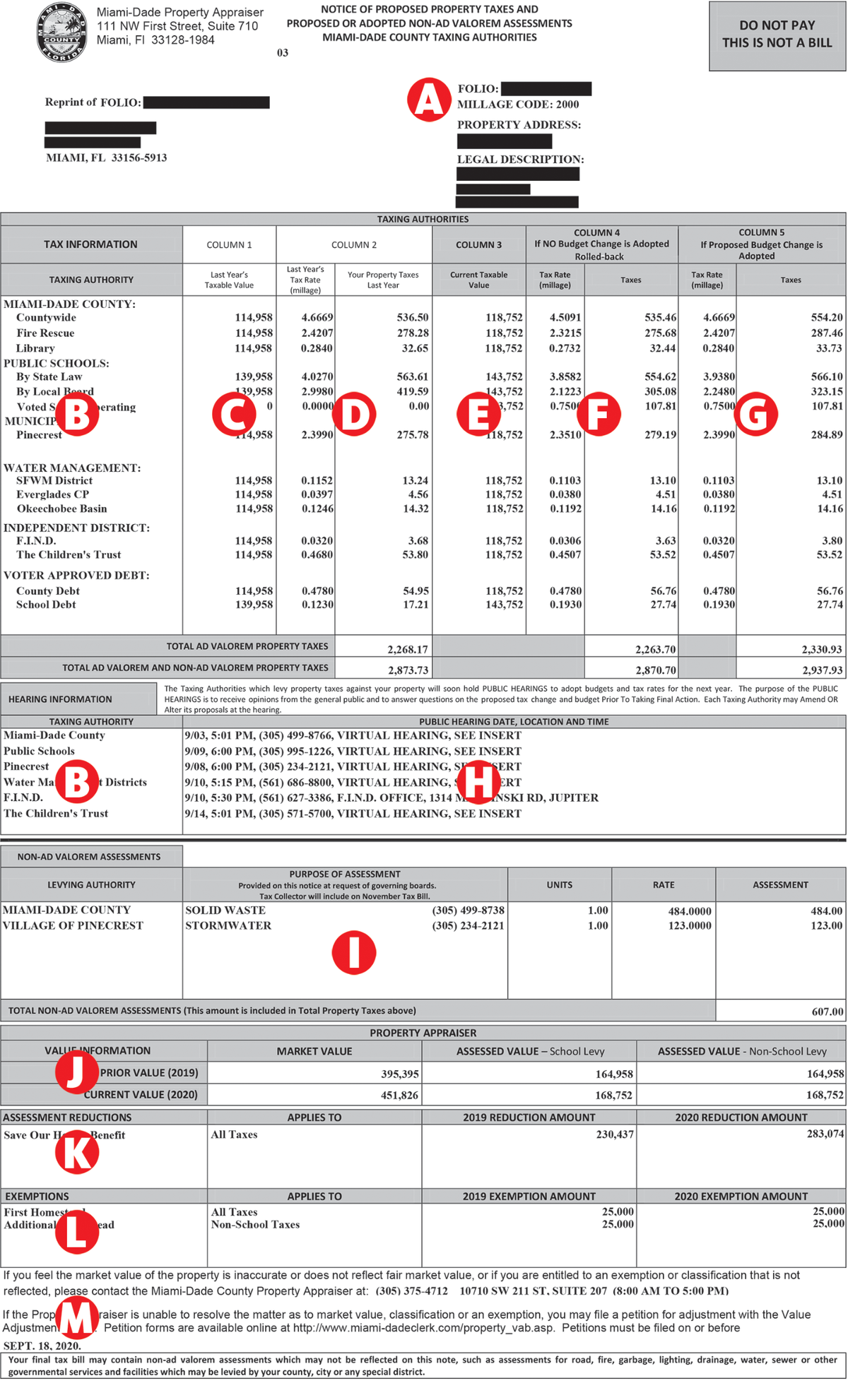
A: Your address, the 13-digit folio number and legal description that identify your property and the millage code, which helps identify the agencies that tax your home.
B: The government agencies and public programs that tax your property. They include your county, municipality, school district and regional entities like the South Florida Water Management District.
C: The taxable value of your property last year. You get that number by subtracting the exemptions that reduce your tax bill, like the Homestead Exemption Cap, from your property’s assessed value.
D: The tax rate and owed taxes imposed last year by each unit of government that taxes your property. The amount at the end of the column is how much money you owed.
E: The taxable value of your property this year.
F: The “rolled-back” tax rate is the rate each government entity would charge you to leave how much you pay in taxes unchanged from last year. The accompanying column shows what your taxes would look like if the rolled-back rate was adopted by the entities to which you pay taxes.
G: The highest proposed tax rates that each government entity will consider during public meetings in September, and what your taxes will be if those rates are adopted.
H: The dates, times and locations of the public meetings where government boards will vote to adopt their proposed tax rates.
I: These are fees for public services — such as solid waste collection, stormwater services and street lighting.
J: The market value and assessed value of your property last year and this year. You can compare the assessed value of your home both with and without Miami-Dade Public School taxes. The 10% Non-Homestead Cap, which limits increases in assessed values for properties without a homestead exemption, does not apply to School Board taxes.
K & L: Any property tax exemptions or reductions are listed here, as well as how much money they saved you last year and may save you this year, depending on final tax rates. This includes up to $50,000 in Homestead exemptions, exemptions for seniors and the “Granny Flat” exemption, as well as the Save Our Homes benefit, which keeps taxes down by limiting the annual growth in a home’s taxable value.
M: You may contact the Miami-Dade County Property Appraiser with any issues related to the listed market value of your property or if you are entitled to an exemption or other classification not reflected in your TRIM Notice. The phone number is (305) 375-4712. The office is located at 10710 SW 211 St., Suite 207 and it’s open from 8 a.m. to 5 p.m.
If the Property Appraiser does not resolve your issue, you may file a petition for adjustment with the Value Adjustment Board by the deadline listed in the TRIM Notice. You can contact the Board at (305)-375-5641. Petition forms are available online at http://www.miami-dadeclerk.com/property_vab.asp.
*Different counties may design TRIM Notices differently