Can these towers help an affordable housing crisis in Miami? Take a look at the plans
By Michelle Marchante and
Rebecca San Juan
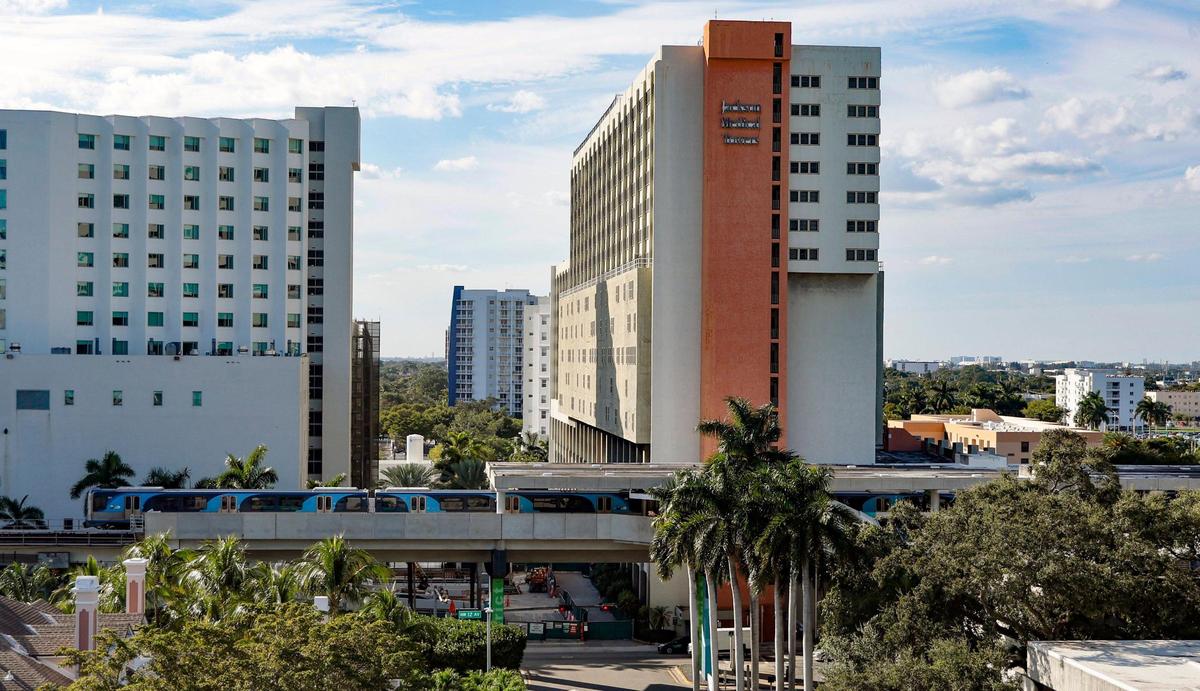
An aerial view of Jackson Medical Towers, at 1500 NW 12th Avenue in Miami, Florida on Thursday, January 2, 2025. The Public Health Trust of Jackson Health System has approved a deal with Related Urban to demolish two existing towers, known as Jackson Medical Towers, and construct affordable workforce housing and an extended stay hotel.
AL DIAZ
adiaz@miamiherald.com
A slice of Miami’s health district could be transformed into hundreds of new apartments to help workers live more affordably near their jobs, a challenge in a region with runaway housing costs.
The plan is a major change for Jackson Memorial Hospital, which would demolish two office buildings across from a Metrorail station in 2027 to make way for affordable and workforce housing in two towers filled with shops, a hotel and more than 800 apartments.
The future high-rises, including an 18-story hotel, in Miami’s Health District would be a few minutes’ walk from the campuses of Jackson Memorial, the University of Miami Health System and the veteran’s hospital. The pair of office buildings that face the wrecking ball are known as Jackson’s Medical Towers, 1500 NW 12th Ave.
A deal struck in late December by the governing body of Miami’s public hospital system and Related Urban, part of Miami-based real estate development firm Related Group, is designed to help make housing more affordable for healthcare workers and others in pricey South Florida, said Jackson Health CEO Carlos Migoya.
The agreement, which still must be reviewed and approved by the Miami-Dade County Commission, is expected to generate millions in revenue for Jackson, which provides care to patients regardless of their ability to pay or whether they have insurance.
“This project is very personal to me. ... I know when people have a stable place to live and more money in their pockets, they bring their best selves to work,” Migoya said during a recent public meeting with the Public Health Trust, a seven-person volunteer board appointed by the county to oversee the public hospital system.
In December, the Trust awarded the residential project to Related Urban, the only firm that submitted a proposal during a nearly year-long search for a developer. Before construction can begin, the project plans would need to be approved by county leaders. A county housing committee will hear the proposal on Jan. 14. If approved, it would go to the County Commission on Feb. 4.
Related Urban, which has developed residential projects for public agencies in the county, is owned by developer and philanthropist Jorge Pérez, namesake of downtown Miami’s art museum. Related Urban would pay the entire cost for the project and would pay Jackson rent for the county-owned land over a 99-year term, according to project documents.
Once people move into the apartments and the hotel is open, Jackson would get a 30% cut from the income, with Related Urban and the hotel operator getting the rest. Jackson would earn about a $1 billion from the project over the 99-year lease. The development project also includes $3 million to improve the neighboring Metrorail station.
For Jackson, which last fiscal year saw some of its toughest financial hurdles in over a decade, the extra revenue would be a welcome relief. While Jackson ended fiscal year 2024 with what CEO Migoya described as a “modest surplus” of $25.9 million, it wasn’t easy. The safety net hospital system last year had to cut costs as expenses climbed and revenue remained flat, including a hiring freeze for more than a dozen positions.
The housing complex planned for the Health District will set aside affordable housing for people who earn between 50% and 80% of the area median income. Workforce housing will be capped for those earning up to 120% of the area median income. Jackson and other healthcare workers, including from UHealth and the Miami VA, will get first dibs on apartments.
Area median income is the median income for a household in the county. Affordable housing is designed to house those who make up the backbone of the economy such as janitors and caretakers. Workforce housing is targeted to professionals in the public sector including teachers, lawyers, firefighters and nurses. Miami-Dade’s median income is $79,400, and set annually by the U.S. Department of Housing and Urban Development.
The remaining apartments would be priced according to the rest of the rental market. According to Zillow, the median rent for all types of rentals in Miami-Dade is around $3,000 a month.
Housing affordability in the Miami area remains a top concern for people who live in one of the most “rent-burdened” metropolitan areas in the country. While stable now, rents shot up shortly after the COVID-19 pandemic, with some areas seeing a doubling or tripling in rent after remote workers from across the country poured into South Florida. Many people already in the region decided to leave due to the increased cost of living.
“We need to be more focused to create affordable and workforce housing where the jobs are and near good transportation. It creates a much more resilient type of economy and creates a much higher quality of life,” said housing expert Ned Murray, who isn’t involved in the hospital housing project. “You’re close to Wynwood, downtown, the theaters, the restaurants — this is what good urban planning is all about. This is the solution.”
Murray leads the Jorge M. Pérez Metropolitan Center at Florida International University as its associate director. Pérez, the founder of development firm Related Group, the main branch of Related Urban, made a $1 million donation to the Metropolitan Center, which studies economic development and planning. Murray said neither Pérez nor Related influence his opinions on projects.
Details on new housing and shops in Health District
The two aging Jackson buildings are expected to be demolished in 2027, with construction expected to begin later that year. The first phases of the project are forecast to be completed by February 2030.
The first phase includes a 25-story multi-family residential tower with 447 rental units and a parking garage with 782 parking spaces. The complex will also have a daycare, retail space, and a park and promenade.
The second phase of the project is expected to be completed by February 2032. It will have a 27-story multi-family residential tower with 361 units and an 18-story extended-stay hotel with 128 rooms. Developers are searching for a hotel company.
The complex will be across from the UHealth/Jackson Metrorail station and will have a fitness center, two pools with private cabanas, a clubhouse, dog park and an outdoor children’s playground, according to the proposal.
A business center will have working spaces and a conference center for professional meetings, workshops and community events.
The hotel portion of the complex is expected to make it easier for families and friends of hospitalized patients to stay nearby, similar to the next-door hotel at Baptist Health in Kendall.
The 18-story extended-stay hotel built as part of the Jackson-Related Urban housing development would put families just a few minutes’ walk from Jackson’s main hospital, trauma center and other specialty care, including the Miami Transplant Institute, Christine E. Lynn Rehabilitation Center for The Miami Project to Cure Paralysis, UHealth’s Sylvester Comprehensive Cancer Center and Bascom Palmer Eye Institute. Families would also be a few minutes walk from the neighboring Miami VA.
The development project includes $3 million to improve the UHealth—Jackson Metrorail Station at 1501 NW 12th Avenue, east of Jackson Medical Towers in Miami, Florida. PHOTO BY AL DIAZ adiaz@miamiherald.com
Who is eligible for the housing and who will get priority?
A renter’s eligibility for affordable housing and workforce housing at the complex would be based on annual household income level.
For affordable housing, the applicant’s household income would need to be between 50% and 80% of the “area median income.” While it’s still too soon to know how much this could be once the units are available, in 2024, this would put the person’s household income between $39,750 and $63,600, according to data noted in the project report presented to the Public Health Trust.
For workforce housing, the applicant’s household income could be up to 120% of the “area median income.” While it’s still too soon to know how much this could be once the units are available, in 2024, this would put a person’s household income at or under $95,400, according to the document.
Jackson Medical Towers, at 1500 NW 12th Avenue, west of UHealth - Jackson Metrorail Station in Miami, Florida on Thursday, January 2, 2025. The Public Health Trust of Jackson Health System has approved a deal with Related Urban to demolish two existing towers, known as Jackson Medical Towers, and construct affordable workforce housing and an extended stay hotel. PHOTO BY AL DIAZ adiaz@miamiherald.com
How much is rent?
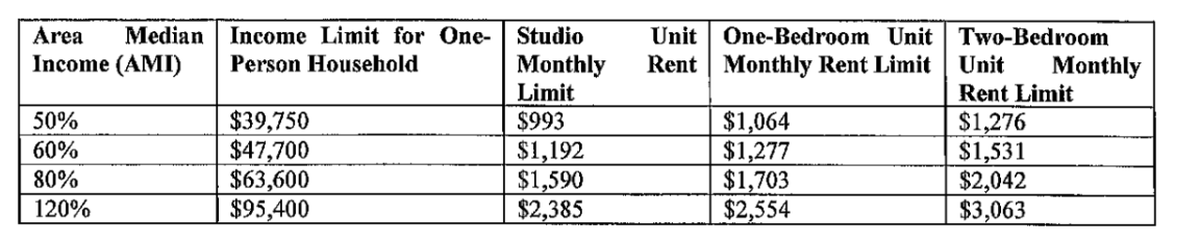
It’s still too soon to say how much rent will be by the time the residential towers are constructed. But the report gives an idea as to how much the affordable and workforce housing units would cost if they were available in 2024:
▪ Monthly rent for a person with a household income of $39,740, or 50% of the area median income, would pay a maximum of $993 to $1,276 depending on the size of an apartment, studio, one-bedroom or two-bedroom.
A renter’s eligibility for affordable housing and workforce housing at the complex would be based on their annual household income level and household size. This table, which was included in the proposal, illustrates how much of a person’s income would go to rent in the complex, depending on whether they want to rent a studio, one-bedroom or two-bedroom apartment based on the 2024 income limits and rent limits published by the Florida Housing Financing Corporation. Screenshot of proposal
▪ A renter with a household income of $63,600, or 80% of the area median income, the maximum allowed to be eligible for affordable housing at the complex, would pay a maximum of $1,590 to $2,042 a month.
▪ Someone with a household income of $95,400, or 120% of the area median income, the maximum allowed to be eligible for workforce housing at the complex, would pay a maximum of $2,385 to $3,063.
Migoya says the new towers will be a “game-changer for recruitment efforts.” The hospital system, he said, often encounters medical residents, nurses and other health professionals who pass up jobs at Jackson’s main campus because it’s difficult to find affordable housing nearby.
As part of the deal, Jackson employees will get first crack at available affordable and workforce housing apartments. Other healthcare workers, such as those who work at the Miami VA and UHealth, will also get priority.
About half of Jackson’s team works at the hospital system’s main Miami campus and half of those employees would qualify for the workforce units, according to a joint column by Migoya and Miami-Dade County Public Schools Superintendent Jose Dotres published in the Miami Herald last year on Miami’s housing crisis. Miami-Dade County Public Schools also has several affordable housing projects in the works for teachers and other district employees.
“While our past construction projects have focused on expanding patient care and services for the community, this one is different,” Migoya told the Miami Herald in an email. “It’s aimed at supporting Jackson’s most valuable asset — our employees — by relieving financial stress, improving work-life balance, and providing the confidence of an affordable, stable living situation.”
Economic and housing studies show the value of mixed-income communities and building dense neighborhoods close to employment hubs, said Murray, FIU’s housing expert.
“Creating housing within our job centers is absolutely critical; that is such an important aspect of this,” he said. “This sounds like the type of mixed use and affordable housing project that we would be recommending from the Metropolitan Center.”
The size of the plans are a big plus, Murray said, because Miami-Dade’s housing needs stretch into the hundreds of thousands of residences necessary to meet demand.
“It will take large scale efforts to make a dent in affordable and workforce housing problems that we’re having.”
This story was originally published January 10, 2025 at 11:24 AM.
Michelle Marchante covers the pulse of healthcare in South Florida and also the City of Coral Gables. Before that, she covered the COVID-19 pandemic, hurricanes, crime, education, entertainment and other topics in South Florida for the Herald as a breaking news reporter. She recently won first place in the health reporting category in the 2025 Sunshine State Awards for her coverage of Steward Health’s bankruptcy. An investigative series about the abrupt closure of a Miami heart transplant program led Michelle and her colleagues to be recognized as finalists in two 2024 Florida Sunshine State Award categories. She also won second place in the 73rd annual Green Eyeshade Awards for her consumer-focused healthcare stories and was part of the team of reporters who won a 2022 Pulitzer Prize for the Miami Herald’s breaking news coverage of the Surfside building collapse. Michelle graduated with honors from Florida International University and was a 2025 National Press Foundation Covering Workplace Mental Health fellow and a 2020-2021 Poynter-Koch Media & Journalism fellow. Support my work with a digital subscription
Rebecca San Juan writes about the real estate industry, covering news about industrial, commercial, office projects, construction contracts and the intersection of real estate and law for industry professionals. She studied at Mount Holyoke College and is proud to be reporting on her hometown.Support my work with a digital subscription