
Ludlam Trail plan in west Miami-Dade has lagged. But rail-to-trail project shows promise
Almost a decade ago, two groups of volunteers planted seeds for a separate-but-related pair of groundbreaking urban initiatives: the conversion into parks and trails of miles of unused strips of land cutting through some of Miami-Dade County’s densest neighborhoods.
The first, dubbed The Underline, has ridden a splashy wave of public, corporate and government enthusiasm to make considerable headway on its $120 million promise of a 10-mile trail and linear park stuffed with gardens and recreational amenities below the elevated Metrorail tracks along U.S. 1 and Miami’s Brickell district.
Last month, two and half years after the debut of the first completed section in Brickell, the county and its nonprofit supporters at Friends of The Underline broke ground on its third and final phase. A second phase now under construction will be done by the end of this year. And there’s a drop-dead completion date of end of 2025 for the whole thing.
Then there’s the Ludlam Trail. By comparison, this second effort has lagged in the weeds following an initial swell of equally fervent support.
The project, a conversion of about six miles of abandoned railway running parallel to Ludlam Road in West Miami-Dade into a lushly landscaped trail for people on foot and on bikes, is today barely under way.
All that exists of the planned Ludlam Trail: about a quarter-mile that runs between a pair of new apartment complexes built privately by developers under an ambitious county plan at the old rail line’s intersection with Bird Road.
And under a $100 million county plan that’s not yet fully funded, the next section won’t open until 2028 at the earliest — that is, if all goes as planned for a project that’s been plagued by delays.
However, there’s been meaningful planning progress on the Ludlam Trail.
In fact, the county and state are ready to take some big steps over the next several months that could lead to significant construction on portions of the trail beginning in fall of 2026. The Florida Department of Transportation just selected a consultant to design three bridges that will take the trail over major state road intersections, while Miami-Dade’s parks department is set to go out to bid next year for a designer for the trail itself.
County officials and supporters say the trail has proven to be a more complicated undertaking in some important ways than the Underline, but they say they remain committed to seeing it through to the finish before the end of this decade.
“This is a major project for the county, and it will be a real asset for the community,” said Alejandro Zizoid, chief of planning and research for Miami-Dade’s parks department, which is overseeing the Ludlam Trail project.
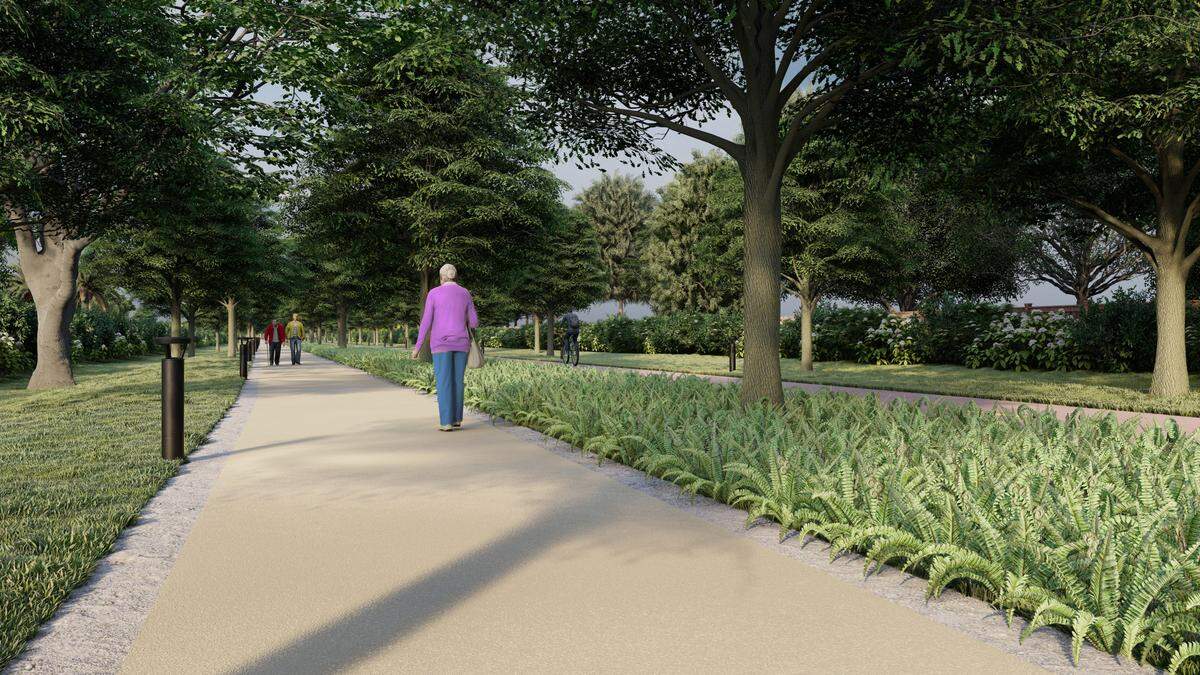
Supporters say they have faith in the project and are confident they will eventually see it finished and in wide use. The benefits for the about 30,000 people who live within two miles of the former rail corridor in unincorporated Miami-Dade and Miami’s Flagami neighborhood, which the trail’s north end will traverse, will make it worth the wait, they say.
“The wheels of government grind slowly,” said Victor Dover, a noted urban planner who worked for the county on a conceptual trail design and before that was part of a group of activists who came up with the idea and persuaded Miami-Dade commissioners and city of Miami officials to adopt it.
One major hurdle the trail project had to overcome: Because it will depend on significant assistance from the Florida Department of Transportation, which is federally funded, the county was required to undertake a comprehensive impact study that took years to complete. The resulting 200-page report was approved by the state only in May of this year.
Another obstacle was the trail’s ownership.
Unlike the land under the Metrorail tracks, which has been publicly owned for decades, the Ludlam Trail corridor was in the private hands of longtime owners, the Florida East Coast Railway, which at first sought to develop much of it. The company’s initial proposal, ultimately rejected by the county, gave rise to the trail idea when volunteers came up with a concept modeled on rail-to-trail conversions popular in other parts of the country.
Because the trail was zoned for railway use, it also required new rules to govern its future.
Prolonged negotiations between Florida East Coast and the county, and a series of sometimes contentious public hearings, resulted in a compromise plan to provide badly needed housing, as well as amenities along the trail.
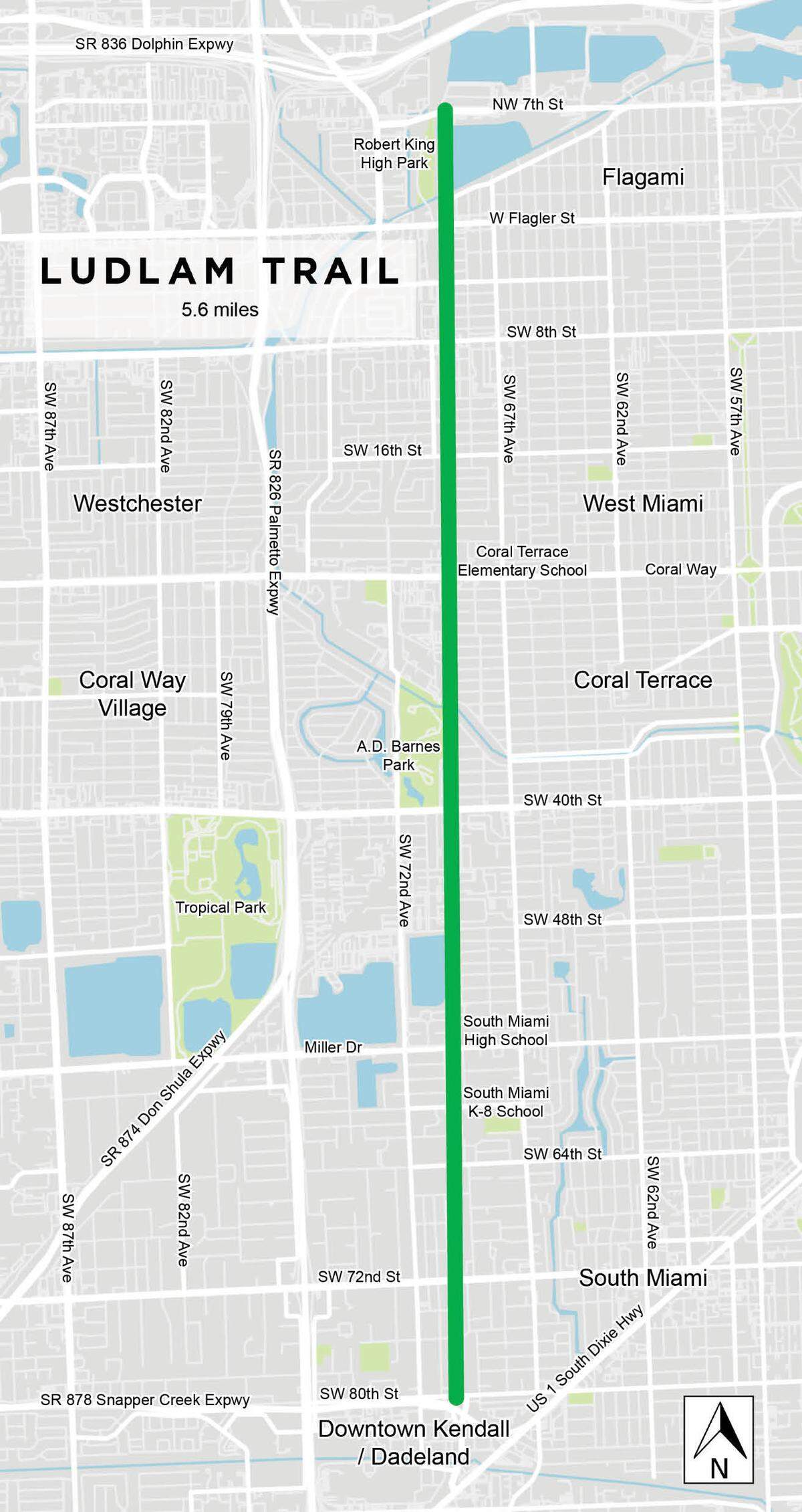
Under the plan, adopted by the county in 2017, FEC retained “nodes” at three major intersections for development, at Bird Road, Coral Way and Southwest Eighth Street. The company ended up selling those plots to housing developers, who are required to build the trail through their properties, while the county bought the rest, or about 5.6 miles, for $11 million in 2018.
Unlike the Underline, whose designers were able to forgo bridges at street intersections early in the planning in favor of improved crossings at ground level, the county had no choice when it came to the Ludlam Trail because it crosses major highway-like multilane roads — Bird, Eighth Street, Flagler Street and Coral Way. But the bridge construction project, a complicated endeavor requiring approvals from multiple agencies, could not commence until the federally required impact study was concluded.
Another setback was the discovery of soil contamination along the trail, mostly the result of spraying by the rail company for weed control. Though not unexpected, the discovery put an end to popular “activations” in which the trail — the rails were long ago removed — was opened for well-attended public events. The corridor, which was also used informally by local residents for strolls and dog walking, was fenced off and made off-limits.
Since then, the trail’s inaccessibility and relative invisibility have kept it largely out of the public’s mind.
But the success of the first two apartments buildings to open along the former railway, at Bird Road, have brought new awareness of the plan since the projects heavily promote their Ludlam Trail location. And the short section of completed trail at the designated Bird Road node hints at the project’s broader potential.
The trail is meant not just for recreational use, but also as a means of alternative transportation. It passes through residential single-family neighborhoods as well as industrial districts, and new and planned multifamily residential projects. Several schools, parks and shopping centers also sit along the trail, which cuts through a major county regional park on Bird Road, the popular A.D. Barnes Park.
Because it’s an expansive 100 feet wide for most of its length, which runs in a straight line from Southwest 80th Street to just north of Northwest Seventh Street, it can easily accommodate separate marked trails for cyclists and people on foot, as well as substantial landscaping.
The first of the two of the Bird Road buildings to open, developed by Alex Mantecon of MV Real Estate Holdings, fully leased its 312 market-rate apartments. Mantecon recently sold the completed project to new owners, who re-baptized it as Windsor Ludlam Trail. The ground floor will have a Sushi Sake outlet and a new Bike Tech shop.
“It’s on the trail, so we think it’s a great fit,” Mantecon said of the bike shop.
Across the new trail section, MiLine’s 338 apartments are now leasing. The project also includes a newly opened cocktail lounge and restaurant, Thorn, housed in a standalone, shed-like building whose design echoes the industrial ethos of the surrounding blocks. Two other planned dining spots will operate out of adjoining kitchens with a shipping-container theme and outdoor seating next to the trail.
Thorn is already drawing a daytime and evening crowd, and the bit of well-landscaped trail is seeing its share of dog walkers and people hanging out on benches.
“The demand was very strong,” Mantecon said of his project. “It was definitely successful. In this scenario, the fact that you’re abutting the trail will bring life and mobility to the trail. Kids can even ride to school.”
So confident is Mantecon in the concept that his firm is building two more apartment buildings along the Ludlam Trail. Both consist of affordable senior apartments, on either side of Coral Way, and are now under construction, with expected completion in October 2024.
The buildings feature an unusual design for the trail elements. They will be on sloping ramps running along the buildings’ second-floor apartments, which will open onto the elevated pathway 18 feet off the ground. All of it will be accessible for people with disabilities.
The ramps, built at MV’s expense, will connect to a bridge over Coral Way that Mantecon will build with public funding in collaboration with the county. That dollar amount is yet to be determined and will depend on a final approved bridge design, he said.
“It’s definitely going to be a beautiful bridge,” Mantecon said.
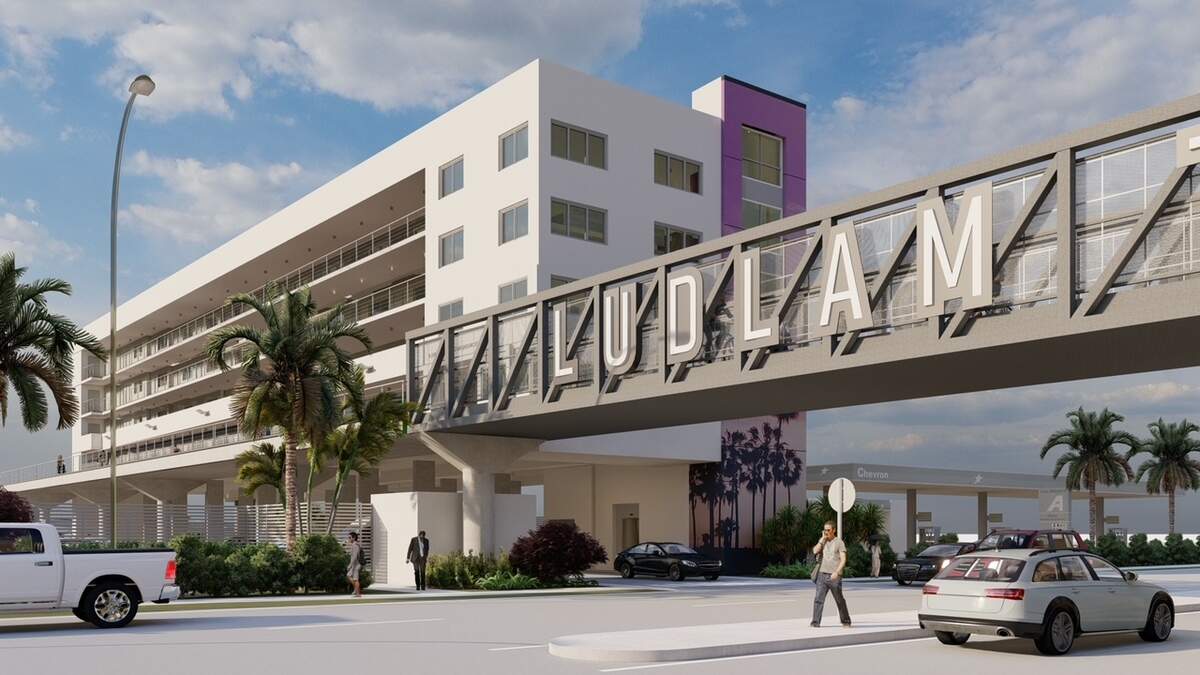
The Coral Way bridge is only one of six that must be built to fill gaps in the trail, state transportation and the county officials say. In addition to the three others spanning major roads, two existing bridges over canals must be replaced, the agencies say.
The state transportation department has hired national infrastructure engineering firm Hardesty & Hanover to design the three other roadway bridges, which are meant to have an “iconic” look, agency spokeswoman Cynthia Turcios said in an email. The design is due in 2026, and the bridges will be bid to contractors for construction in August 2026, with an opening scheduled for summer of 2029. The total estimated cost will be $40 million, the agency said.
By then, the county parks department expects to have the trail itself finished. The trail work will be done in three phases, with the first starting construction in fall of 2026, though the sections have not been identified yet. Each section will open for public use as soon as it’s done, the parks department’s Zizoid said. Soil remediation to cap or remove contamination would occur at the start of construction.
Eventually, the plan calls for the Ludlam Trail’s south end to be linked to the Underline’s southern terminus at the Dadeland South Metrorail Station. Zoning rules in the downtown Kendall urban district require developers to install pieces of the connection as they build, Zizoid said.
Even beyond that, planners are examining the possibility of linking the Ludlam Trail’s north end, which sits just south of State Road 836, to Perimeter Road, which runs along Miami International Airport, he said.
The aim would be to someday complete a “Miami Loop” by linking that future Ludlam-Perimeter Road connection to the Miami River Greenway, which has been under construction in bits and pieces for decades as new development occurs. That would close the loop at the Underline’s Brickell section, which ends at the river.