
The Ludlam Trail is finally moving forward. But don’t saddle up for a ride just yet.
A decade after a group of neighbors and activists first proposed turning an abandoned West Miami-Dade railway into a six-mile-long, park-like trail for walking and cycling, the improbable idea is now advancing to an almost certain realization — but don’t saddle up just yet.
On Thursday evening, Miami-Dade’s parks department will host the first public meeting in two years on the long-promised Ludlam Trail. It will be a key marker of progress in a planning process so prolonged that some backers can be forgiven for thinking it was never going to happen.
The good news for fans of the eagerly awaited plan: It is happening. The county has hired a team of engineers, planners and other consultants who have been busy for months drawing up plans and designs for the trail corridor, which runs in a straight shot from Southwest 80th Street in the Dadeland area to the edge of Miami International Airport and Blue Lagoon.
On Thursday, for the first time, residents and taxpayers will see renderings depicting preliminary but realistic designs for the paved and landscaped public trail, which is meant for use not just for recreation but also transportation. When complete, it will connect schools, parks and neighborhoods, shops, transportation hubs and three planned new residential and commercial “nodes” at major road intersections.
The not-so-great news: Construction won’t start before 2022, and the full trail won’t be finished until 2025.
That’s partly because work can’t begin until the state approves a complex, federally mandated review of environmental and development impacts that’s been underway since June of 2018 but won’t be finished until next year, county parks officials say. And it’s partly because soil contamination found along much of the old railway in 2017 will require a plan for remediation before trees are planted or the first bit of paving for the trail can be laid down.
But the county and its consultants are hoping for a well-attended virtual meeting at 6 p.m. Thursday at www.miamidade.gov/ludlamtrail, with lots of feedback from members of the public.
They also hope attendees will be jazzed up by what they see. Virtual tools include a new project website with the ability to zoom in on a smartphone or home computer on a trail map to see details during and after the meeting. Thursday’s livecast will include an instant survey.
“We have to remind people of the wonder of the trail and renew their sense of enthusiasm,” said Victor Dover, a principal at Coral Gables-based Dover Kohl & Partners Town Planners, which is designing the trail for the county as part of a team led by engineering giant AECOM.
The county will continue collecting public comments for 21 days after the meeting through its online project portal.
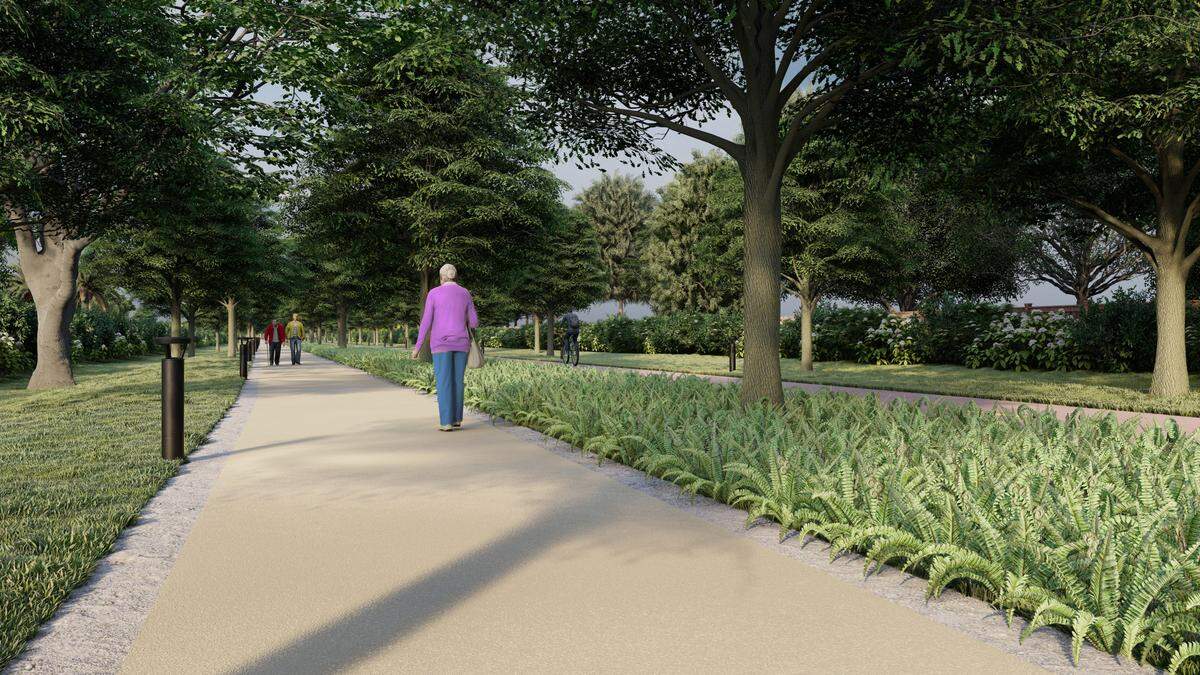
Where possible, Dover said planners are laying out separated paths for people on foot and those on bikes to lessen the chance of collisions. Most of the trail is as much as 100 feet wide, but it narrows considerably for stretches where separation is not possible. The plan calls for lots of shade trees and landscaping, including lush green buffers along the edges to screen out suburban backyards.
Because neighbors did not want groups of people congregating along the trail, there will be few structures except for occasional simple shelters for protection from rain or sun, Dover said.
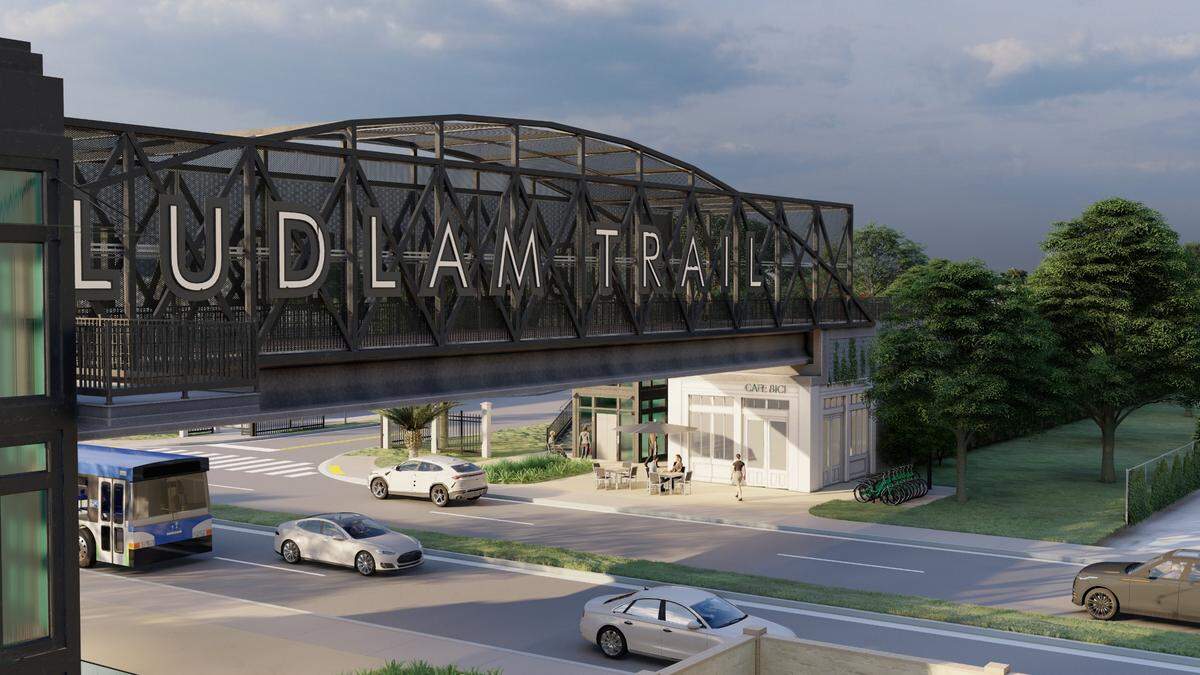
The team also has designed new crossings for 11 secondary streets, with bright markings and flashing lights activated by sensors or a button to warn motorists to stop. The trail also will require new bridges over canals and major roadways, including Bird Road, Coral Way, and Flagler and Southwest Eighth streets.
Early estimates put the full cost of the trail at around $120 million, including acquisition costs of $25 million, although parks administrators caution that construction figures are not yet final. More-precise cost estimates for construction and remediation will be developed once the current study and designs are completed, said Alejandro Zizold, a plan manager for the county. The trail will be paid for through a combination of local, state and federal funds, Zizold said.
Commissioner Rebeca Sosa, whose district includes most of the trail corridor, has played a key role in so far securing nearly $21 million in state and federal funding through the Florida Department of Transportation for land purchase and planning, design and construction, the parks department said. The county has so far kicked in $13.6 million toward the purchase cost.
The trail is a critical piece in a larger, ambitious blueprint for what’s been dubbed the Miami Loop — a continuous, paved multi-use pathway that could one day connect downtown Miami, Miami International Airport and the Dadeland area.
That loop would include the long-planned Miami Riverwalk, portions of which have been completed; as well as the Underline, the 10-mile path beneath the Metrorail line along U.S. 1 that’s undergoing conversion into a linear park. The Underline — whose first phase is nearing completion at the Miami River in Brickell — will eventually connect to the south tail of the Ludlam Trail near the Dadeland North metro station.
Completing the loop would require figuring out how to bridge two gaps — one between the north end of the Ludlam Trail and the airport perimeter road, and the other from the southern end of the trail to the Dadeland North metro station and the Underline.
“To have people walking and biking along the river and the loop, that would be wonderful,” said Xavier Suarez, another of the Miami-Dade Commission’s key Ludlam Trail backers. Suarez left office on Monday because of term limits.
Though straight as an arrow, the Ludlam Trail took a long and winding path to approval.
Once part of a cargo-rail network belonging to the Florida East Coast Railway, the tracks were removed 15 years ago after the company formally abandoned its use. As residents and activists pushed for trail conversion, the company floated plans of its own. It proposed an extensive rezoning that would have lined the corridor with narrow strips of residential and commercial development, with a skinny trail at its center.
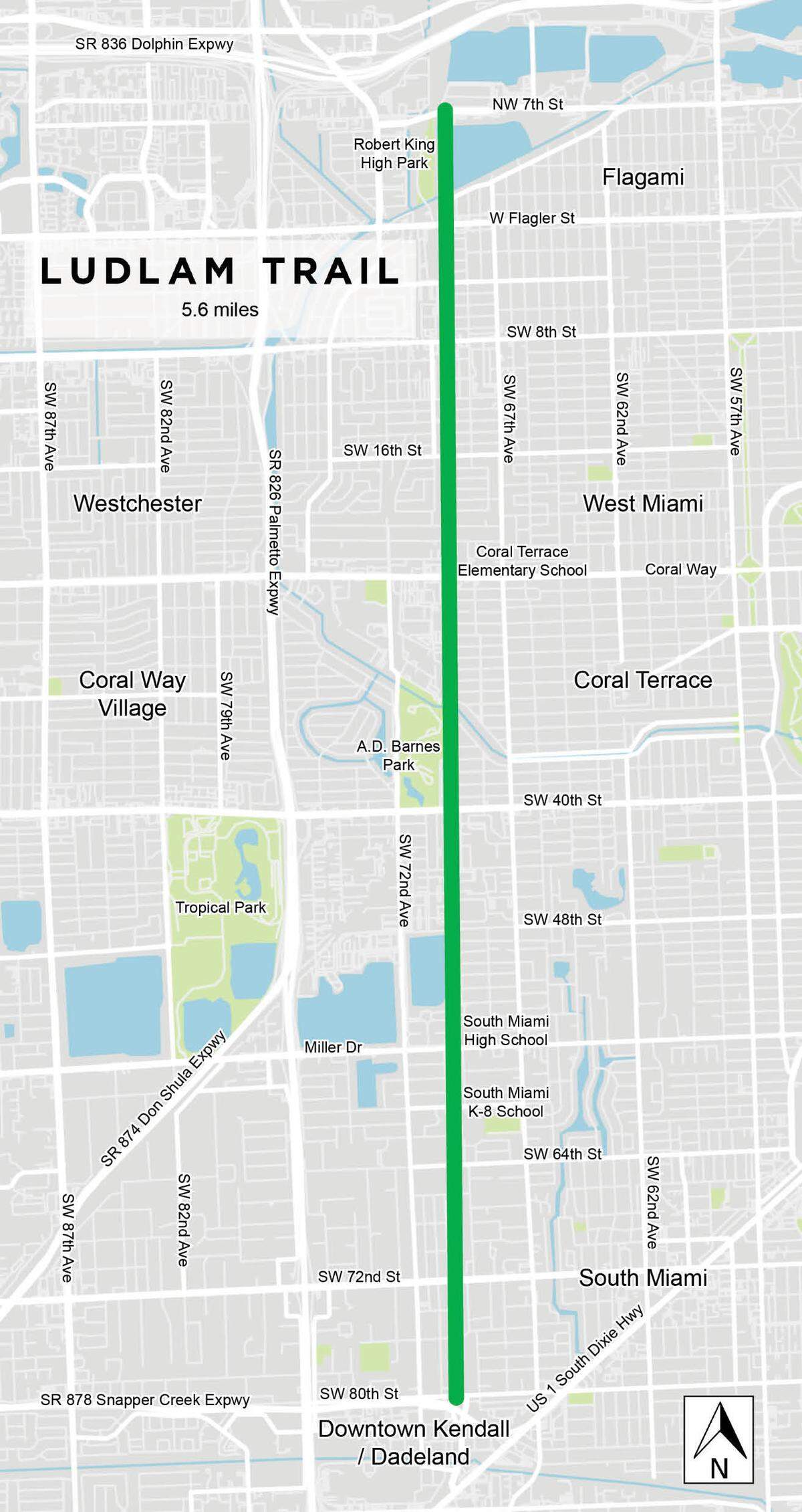
After intense public blowback, the county nixed that plan and, after long negotiation, came up with a mutually agreeable, stripped-back version. The zoning plan eventually approved by Miami-Dade commissioners allows development only at three so-called nodes — at Bird Road, Coral Way and Southwest Eighth Street. The county also purchased 5.6 miles of the corridor from FEC. The company retained ownership of land at the three nodes.
Although the county did not develop a master plan for the trail, Zizold and parks administrators say the planning now underway is based on years of input at public workshops and hearings, studies and trail guidelines drawn up by the agency.
“The whole thing seemed to work very well. It’s a success story,” said former commissioner Suarez. “The principal thing is, it will not be aggressively developed. The neighbors want something very passive, very much a linear park — a trail and landscaping. And that’s what they’re getting.”
The first private “node” project is already well under construction on the south side of Bird Road by a partnership that bought 13 acres of the land from FEC for $36 million. The group is erecting a residential and retail complex around a half-mile length of the trail, which the developers will build. That piece is now likely to be the first segment of the Ludlam Trail to be opened to the public.
Plans for projects at the two other nodes, meanwhile, have been submitted for review to the parks department to ensure they comply with county guidelines for the trail, county officials said.
The agreement between the county and FEC prompted a flurry of activities along the corridor, which the company cleaned up and regraded so it could be used as a packed light gravel and dirt trail. FEC and Friends of the Ludlam Trail, an activist group that pushed for its creation, organized a series of well-attended public events on the trail, including rides, movies at A.D. Barnes park and picnics.
But that public enthusiasm was considerably dampened in 2017, when contamination — likely remnants of chemicals used to control plant growth along the railway — was discovered. County environmental regulators ordered fences put up around the entire corridor’s perimeter, putting an end to the organized events. The fencing also ended years of informal use by residents, who had direct access from backyards or at intersections for dog walking and other activities.
Tony Garcia, a planner and co-founder of the Friends group, said he hopes the county can do remediation first, at least on a portion of the trail, and reopen the gravel path for public use to maintain public engagement and support.
But Zizold said that may prove impractical and expensive because it would require contractors to work on the corridor twice, instead of doing all in one efficient sweep. It’s also still undecided whether portions of finished trail can be opened to the public as they are done, or whether public access will have to await completion of the full trail.
This story has been updated to include figures for funds spent so far on the project.
This story was originally published November 18, 2020 at 8:00 AM.