AI is almost everywhere.
It answers customer service chats, edits photos in seconds, and powers voice assistants like Siri or Alexa.
But will it be taking over jobs like accounting now, too?
AI is not new, but it got loud in 2023. Now, the question is not just what AI can do, but what it means for careers that involve numbers, documents, patterns, and repeatable tasks. Accounting fits that conversation pretty easily. A lot of the work includes exactly the kinds of things AI can help with, so it is fair to wonder where that leaves accountants.
Today, I’ll walk through which accounting tasks AI may change first, which parts still need a person, and how students can prepare for the first few years of the job.
Key Takeaways
- Starter Work Is Changing: AI may make routine tasks faster.
- Review Skills Matter: Humans still check the numbers.
- The First Pass May Shift: AI may prepare more work upfront.
- Judgment Still Counts: Accounting basics are still important.
- Students Can Prepare: AI fluency can help in the first few years.
AI Is Changing Accounting, Not Erasing It
AI in accounting usually does not mean a robot taking over someone’s whole desk. It usually means software getting better at reading documents, finding patterns, matching records, and creating first drafts.
For entry-level accountants, the shift is pretty practical. AI may help pull details from invoices, connect receipts to transactions, or flag numbers that look unusual. That can reduce some of the manual setup time.
A simple way to think about it:
Old flow: Type it in → organize it → hand it off
Newer flow: Check it → question it → fix it → explain it
The job is still there. The starting point may just involve more review and less manual cleanup.
The Starter Tasks AI Can Handle Faster
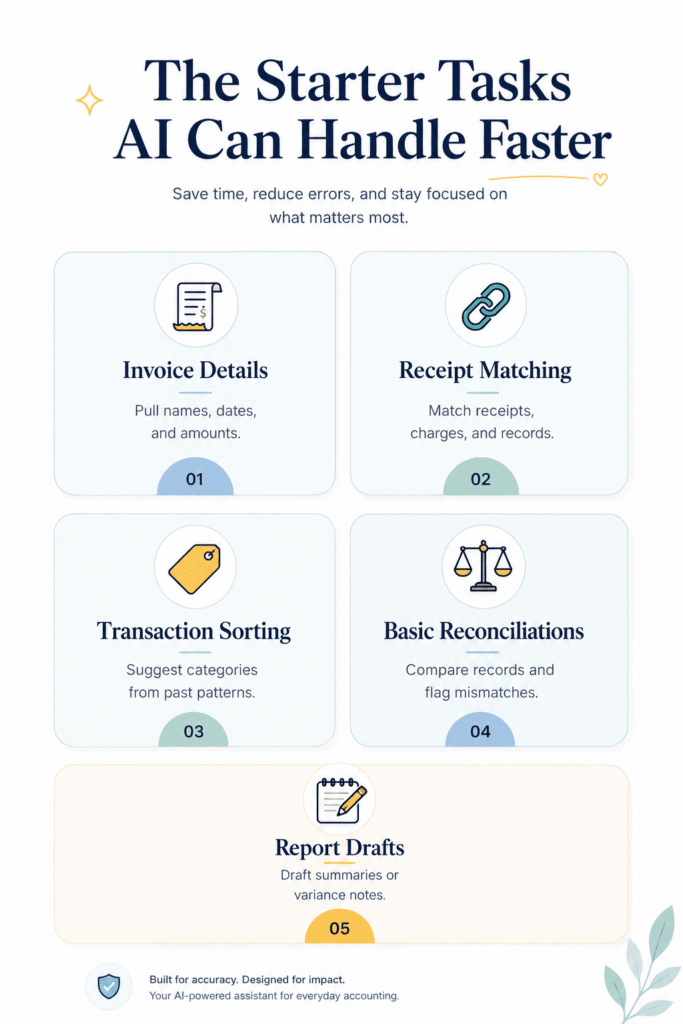
The first tasks to shift are usually the ones with clear rules and repeated steps. AI is strongest when the work follows a pattern.
That can include:
- Invoice Details: Pulling vendor names, dates, amounts, and invoice numbers.
- Receipt Matching: Connecting receipts, card charges, and bank activity.
- Transaction Sorting: Suggesting categories based on past records.
- Basic Reconciliations: Helping compare records and flag mismatches.
- Report Drafts: Creating a first version of a summary or variance note.
These tasks still matter! They keep accounting teams organized and accurate.
The difference is that accountants may not always start from a blank spreadsheet. They may start from the software output and then check whether it makes sense.
The New Accountant Job Flow
Accountants have already used AI-style features for years, even when the software did not label them that way. Transaction categorization is one example. Tools like QuickBooks can look at bank activity, past entries, and transaction details, then suggest where a transaction should go.
Now, the shift is getting bigger.
AI is not only helping sort transactions. It can scan invoices, summarize messy data, flag unusual activity, draft report notes, compare records, and point accountants toward items that need a closer look.
That changes the starting point for new accountants. The first pass may already be done by the software. The human part is checking whether that first pass is right, complete, and useful.
| Old Entry-Level Task | How AI Changes It |
|---|---|
| Enter transaction details | AI can suggest entries for review. |
| Match receipts and invoices | AI can connect records and flag exceptions. |
| Sort transactions by category | AI can suggest categories based on past patterns. |
| Build basic report notes | AI can draft summaries for accountants to edit. |
| Clean up spreadsheet data | AI can spot gaps, duplicates, or unusual changes. |
| Send work for review | AI can flag issues earlier in the process. |
That is the real shift. New accountants may spend less time preparing the work and more time understanding what the prepared work means.
Instead of just asking, “Did I enter this correctly?” the better question becomes, “Does this result actually make sense?”
The Skills New Accountants Need Now
The basics still matter. New accountants still need to understand debits, credits, financial statements, tax rules, audit concepts, and clean documentation.
But AI changes what “good entry-level work” looks like. It is not only about finishing the task anymore. It is about knowing how to work with the tool and still catch what the tool misses.
Useful skills now include:
- Prompting for Better Drafts: Asking AI for a cleaner report note, variance summary, or client-friendly explanation.
- Checking AI Logic: Looking at how the tool reached an answer, not just whether the answer looks polished.
- Reviewing Exceptions: Focusing on flagged items, mismatches, missing documents, or unusual transactions.
- Cleaning Data Before AI Uses It: Knowing messy inputs can lead to messy outputs.
- Translating Output: Turning an AI-generated summary into something a client, manager, or team can actually use.
AI fluency does not mean becoming a tech genius. It means knowing what to ask, what to check, and when the answer needs a human second look.
There are even AI tools in CPA prep courses like Becker, called AI Newt, that help you learn and study more efficiently based on what you ask the AI agent.
Where Humans Still Matter In Accounting
AI can make smart suggestions. It can flag weird numbers, summarize reports, spot patterns, and recommend what something might mean.
But accounting is not just about getting an answer. Someone still has to decide whether that answer can be trusted, explain it clearly, and take responsibility if something is wrong.
Humans are still needed for:
- Final Review: Checking whether the answer is actually right.
- Real-World Context: Knowing when a number changed for a business reason, not an error.
- Client Conversations: Explaining the issue without dumping a confusing report on someone.
- Compliance Risk: Knowing when something needs a closer look.
- Accountability: Signing off, answering questions, and fixing mistakes.
AI can help find the answer. Accountants decide what to do with it.
What This Means For Accounting Students
Accounting students do not need to panic. But ignoring AI is not a great plan either.
Think of it like building a “new accountant starter pack”:
- Accounting basics
- Software comfort
- AI review skills
- Clear communication
- Curiosity when something looks off
Student Sticky Note: The goal is not to know every tool perfectly. It is to understand the numbers well enough to check the tool, question the output, and explain what is happening.
My Final Thoughts
AI may replace some entry-level accounting tasks, especially the repetitive ones. But that does not mean entry-level accountants are disappearing.
The first few years of accounting may become less focused on manual setup and more focused on review, accuracy, and communication.
For students, the move is not “avoid accounting.” It is “learn the accounting, then learn how technology fits into the job.” That is the stronger path.
FAQs
No. AI can automate many routine accounting tasks, but it is not replacing accountants entirely. Human judgment, ethics, compliance knowledge, and client communication still play a major role in accounting work.
AI can help with transaction coding, invoice data extraction, expense categorization, basic reconciliations, duplicate detection, variance review, and first-draft client communications. These tools can speed up routine work, but accountants still need to check the output for accuracy and context.
AI is changing the kind of work new hires may do first. Some repetitive starter tasks can now be handled faster by software, so entry-level accountants may need stronger review, analytical, and technology skills earlier in their careers.
Accountants should build strong accounting knowledge, AI literacy, data analysis skills, clear communication, and professional skepticism. The goal is not just to use AI tools, but to know when the output makes sense, when it needs a closer look, and how to explain the results clearly.
Yes. Accounting can still be a strong career path, but students should expect the first few years of the job to look different. The best move is to learn the accounting basics, get comfortable with software and AI tools, and focus on judgment-based skills instead of only routine processing.





![Surgent EA CE Promo Code [Verified 2026 Discounts]](https://www.miamiherald.com/careers-education/wp-content/uploads/sites/2/2026/07/surgent-ea-ce-promo-code-1-1024x768.jpg)