
Insurance can get confusing fast.
One minute, you are learning basic policy terms. The next, you are expected to know the difference between indemnity, subrogation, consideration, and insurable interest.
Insurance licenses are handled by state regulators, so the exam and requirements depend on where you live, according to the NAIC.
But the best ways to prepare work almost anywhere. So, how do you actually study all that information and pass?
The plan below covers what to study, how to use practice tests, and how to know when you are ready for the real exam.
Key Takeaways
- Check Your State: Requirements and exams vary.
- Use the Right Course: Study material should match your license.
- Learn the Meaning: Do not only memorize definitions.
- Track Your Misses: Wrong answers show you what to review.
- Wait for Steady Scores: One good practice test is not enough.
Start With the Right Exam
There is no one insurance exam for everyone. You may need a Life, Health, Property, Casualty, Personal Lines, or a combined license. Each one covers different products, rules, and state laws.
The handbook covers the question count, time limit, accepted ID, passing score, fees, and retake rules. The content outline shows exactly which subjects appear on the test.
Use that outline to decide where your study time goes. A heavily tested section deserves more attention than a topic with only a few questions.
Pick One Main Study Course
A state-specific course is usually the easiest place to start.
A general insurance book may explain the basics, but it could leave out laws that appear on your exam. It may also include information you do not need.
Look for these features
Focus on the material that matches your specific exam.
Review the rules and requirements that apply in your state.
Check your understanding as you move through each topic.
Learn why an answer is incorrect instead of simply seeing the correct choice.
Test yourself with longer exams before the real test.
Confirm whether the course provides the documentation your state requires.
My review of the best insurance license exam courses can help you find the right fit based on your study needs.
Once you choose a course, use it as your main study source. Jumping between several programs can make the same topic feel more confusing.
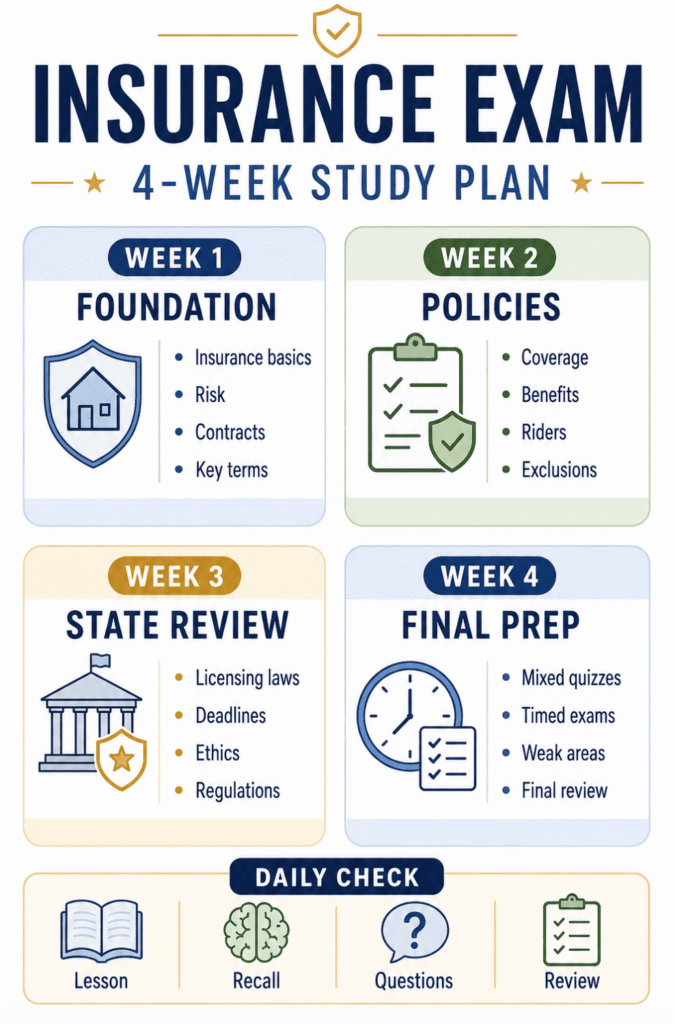
Keep Your Study Plan Simple
Insurance topics make more sense when you learn them in order.
Start with the basic ideas, move into policies, and save time for state laws. Then, use mixed practice questions to pull everything together.
| Study Stage | Main Focus |
|---|---|
| Foundation | Risk, contracts, and insurance basics |
| Policies | Coverage, benefits, riders, and exclusions |
| Rules | Claims, premiums, and policy provisions |
| State Review | Licensing laws and required deadlines |
| Final Prep | Mixed quizzes and timed exams |
Learn it, explain it, quiz it, then review it. Short, regular sessions are usually easier to manage than one huge cram day. The goal is not to rush through every lesson. It is to remember the material when the notes are gone.
Break state rules into small groups. They are easier to remember that way.
Know What to Memorize
Some insurance facts need to be memorized.
Deadlines, legal terms, policy provisions, and state rules are good flashcard topics. Larger concepts need more than a short definition.
For example:
A deductible is the amount paid before coverage applies.
You know who pays it, when it applies, and how it affects the policy.
After each topic, ask:
- What does this mean in normal words?
- Who does this rule protect?
- When would it apply?
- What similar term could be confused with it?
The exam may place a simple rule inside a short situation. If you understand what the rule does, a differently worded question will be much easier to answer.
Do Not Ignore State Laws
State laws are not the most exciting part of studying.
They are also easy to mix up because several rules may sound very similar. Leaving all of them for the final night is a bad plan.
Make one short review sheet for:
- Licensing deadlines
- Required notices
- Replacement rules
- Prohibited practices
- Continuing education
- Regulator powers
Review that sheet for a few minutes each day.
Make Your Practice Tests Actually Useful
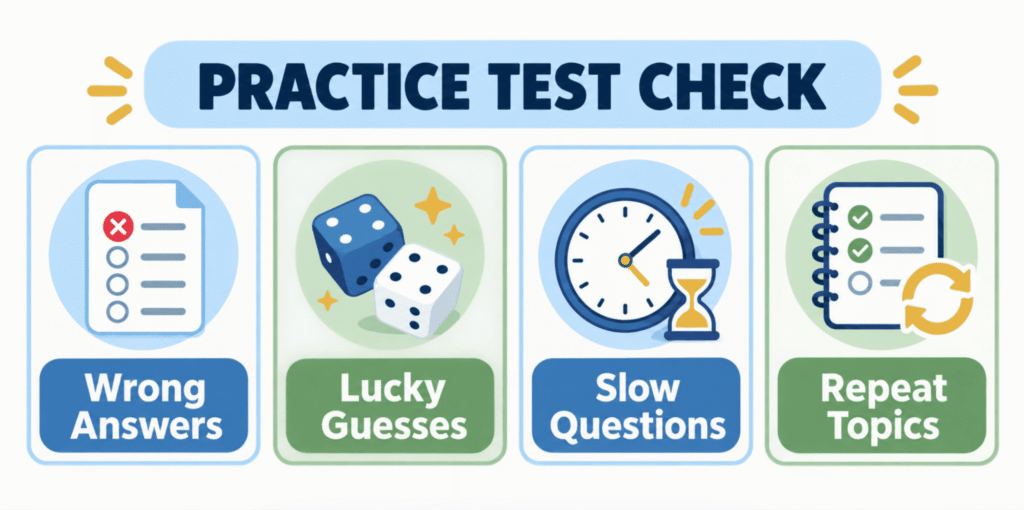
Practice tests are not only there to give you a score. They show you which topics still need work. Every wrong answer gives you something specific to review.
Check these:
- Questions you answered incorrectly
- Questions you guessed correctly
- Questions that took too long
- Topics you keep missing
A correct guess still counts as a weak area.
For every missed or guessed question, write down what was tested, why the answer was wrong, and why the other answer is right. That is faster than rereading the entire course, because you can go straight back to the policy, term, or state rule causing the problem.
Know When You Are Ready
One good practice score does not automatically mean you are ready.
Look for steady results across several new tests. You should also be able to explain why your answers are correct.
You are probably ready when you can:
There is no practice score that guarantees a pass in every state. Aim for a comfortable buffer above your required score. That gives you some room if the real test feels harder than your practice exams.
Keep Exam Day Simple
| When | What to Do |
|---|---|
| The Day Before | Confirm your time, ID rules, and testing location. If you are testing online, run the required system check early. |
| During the Test | Answer easy questions first and flag anything taking too long. Watch for words like not, except, and best. |
| Before Submitting | Return to flagged questions and check for blanks. Only change an answer when you find a clear reason. |
None of this is groundbreaking, I know. Still, this little game plan can keep one annoying question from eating up your time and throwing off the rest of the exam.
What Happens After You Pass?
Passing the exam may not make your license active right away. Depending on your state and license type, you may still need to:
- Submit a license application
- Pay a licensing fee
- Complete fingerprinting
- Pass a background check
- Send proof of education
- Receive an insurer appointment before selling insurance, if required
Follow the current instructions from your state insurance department. The exam is a major step, but it may not be the final one.
Related Guide
If your state requires a class before test day, the best insurance pre-licensing courses comparison shows which programs cover your line of authority and how their practice exams stack up.
My Final Thoughts
Passing the insurance license exam on your first try is completely doable when you study the right material and stop wasting time on topics your state does not test.
Start with the official outline, use one solid prep course, and take enough practice exams to see where you are actually struggling.
Do not panic if the terminology feels strange at first. It gets easier once the same rules start showing up in different questions.
Stay consistent, fix weak areas, and go into test day knowing you prepared with a plan.
FAQs
What is the first step when preparing for the insurance license exam?
Start by checking your state’s requirements and choosing the exact license you need. Then, download the current candidate handbook and exam outline. These will show you what is actually on your test.
How many hours should I study for the insurance license exam?
There is no perfect number for everyone. Your study time will depend on your state, license type, course, and experience. Keep studying until you can pass several new practice tests without using your notes.
Why are practice exams important?
Practice exams show you which topics still need work. They also help you get used to the question style, manage your time, and spot terms that you keep mixing up.
How much of the exam covers state laws?
It depends on your state and license type. Check the official exam outline to see how much weight state laws receive on your test. Do not assume every exam uses the same breakdown.
What should I do on the day of the exam?
Arrive early with the correct ID and any required documents. Read every question carefully, watch for words like except and not, and flag difficult questions so you can return to them later.
Is a pre-licensing course required?
Some states and license types require approved pre-licensing education, while others do not. Check with your state insurance department before enrolling in a course.
What practice score means I am ready?
No practice score can guarantee that you will pass. Aim to score comfortably above your state’s required passing score on several new tests, not just one. You should also understand why each answer is correct.


![National Council on Strength and Fitness (NCSF) Coupon Codes [Verified Discounts]](https://www.miamiherald.com/careers-education/wp-content/uploads/sites/2/2026/10/ncsf-promo-code-mh-1024x768.jpg)
![Course Hero Promo Code [Verified Discounts]](https://www.miamiherald.com/careers-education/wp-content/uploads/sites/2/2026/10/course-hero-promo-code-mh-1024x768.jpg)
![Learn Laugh Speak Promo Code [Verified Coupons]](https://www.miamiherald.com/careers-education/wp-content/uploads/sites/2/2026/10/learn-laugh-speak-promo-code-mh-1024x768.jpg)
![Education.com Coupon Code [Verified Discounts]](https://www.miamiherald.com/careers-education/wp-content/uploads/sites/2/2026/10/education-com-promo-code-mh-1024x768.jpg)
![AATBS Discount Codes [Verified Coupons]](https://www.miamiherald.com/careers-education/wp-content/uploads/sites/2/2026/10/aatbs-promo-code-mh-1024x768.jpg)