
Congratulations! You’ve decided to take the next step in your career by earning your life insurance license. And part of that excitement is preparing for the exam, where you’ll start building your foundation in the insurance industry.
Of course, that means sitting down with a stack of study materials and learning plenty of new terms and concepts along the way. But rather than viewing studying as something standing between you and your new career, think of it as your first opportunity to learn how the industry works.
If you’re completely new to the field, don’t worry. When I studied for my own exam, I had no prior experience in the insurance industry, so most of the material was new to me, too. Still, I found it much easier to learn than I expected.
Here are a few things worth knowing before you begin studying for the Florida life insurance license exam.
Key Takeaways
- Florida’s 2-14 life agent license requires state-approved pre-licensing education before you can sit for the exam.
- The exam covers life insurance products, policy provisions, state regulations, and ethical sales practices.
- Combining an online pre-licensing course with practice questions is the most common prep path.
- Passing the exam is one step — you still need a sponsoring appointment and background clearance.
- Continuing education requirements apply after licensure to maintain your Florida life insurance license.
What is the life insurance license exam?
The life insurance license exam is a state licensing test for people who want to sell or transact life insurance. Depending on the state and license type, the license may also cover products like annuities and variable contracts.
Most candidates start with structured prep — compare our guide to the before test day.
Because insurance is regulated at the state level, the requirements vary by state. That’s why you’ll often see the test referred to as a state life insurance license exam.
In Florida, someone pursuing the resident 2-14 Life Agent license can transact life insurance, annuities, and variable contracts. The Florida Department of Financial Services currently requires applicants to be at least 18, be Florida residents, and meet other eligibility requirements. Applicants generally must complete a 30-hour life and variable contracts prelicensing course within four years of applying, unless they qualify for an exemption or alternative qualification.
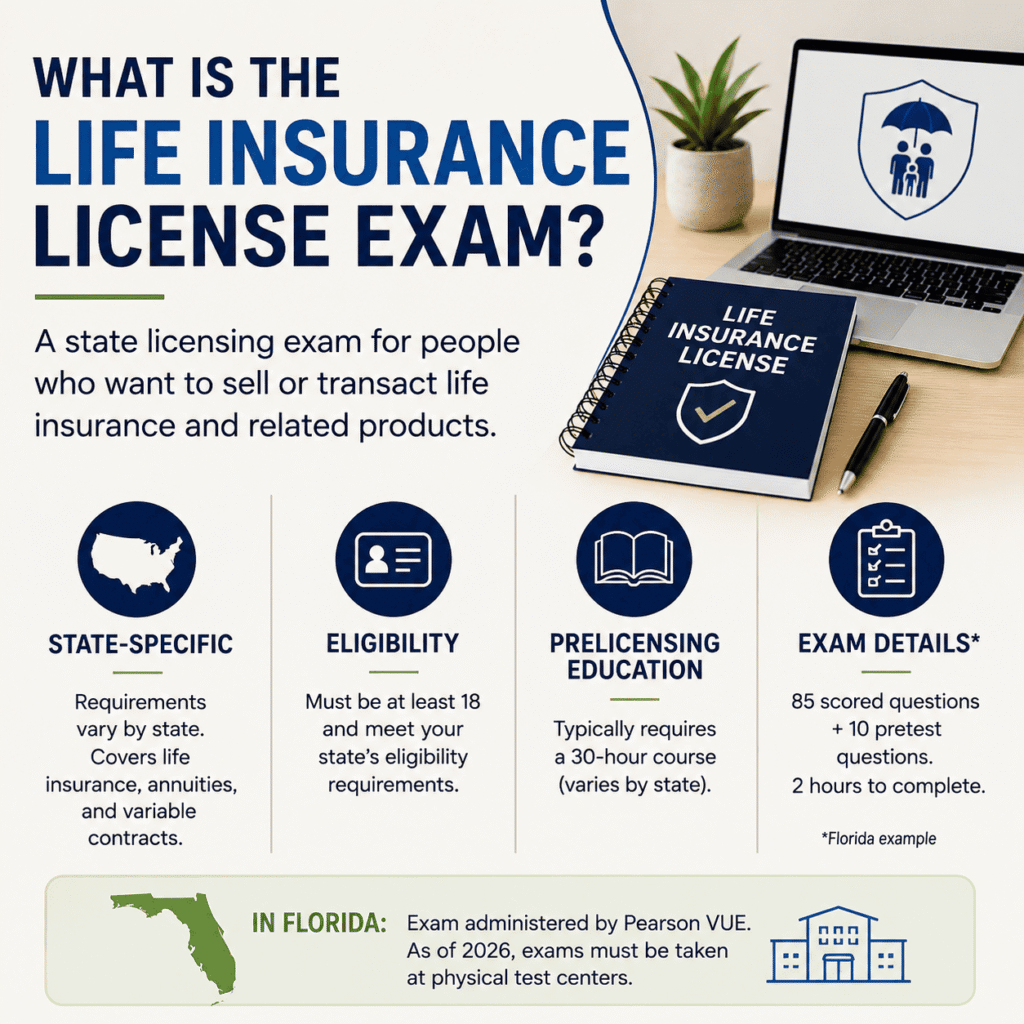
Florida’s current exam is administered through Pearson VUE. It contains 85 scored questions plus 10 pretest questions, with two hours allotted to complete it. As of 2026, Florida insurance candidates must schedule their exams at physical test centers; online OnVUE reservations are no longer available for new reservations.
Is it the same as the life and health insurance exam?
No. Florida offers several insurance license types, including a Life license (2-14) and a Health & Life license (2-15). The exams aren’t identical.
Someone pursuing the combined Health & Life license will study both life and health insurance material, while the 2-14 exam focuses on life insurance, annuities, and variable contracts. Florida’s current outline lists the combined Health & Life exam at 150 scored questions plus 15 pretest questions, compared with 85 scored plus 10 pretest questions for the life exam.
So before buying an insurance license exam study guide or signing up for a course, make sure you’re studying for the license you actually intend to get.
What do you learn for the Florida life insurance exam?
This is where the exam gets more interesting — and where I’d recommend spending more time understanding the concepts instead of just memorizing vocabulary.
Florida’s 2026 exam outline divides the 2-14 exam into several major areas. The largest include:
- Types of policies and features
- Policy riders and provisions
- Completing applications and underwriting
Here are some of the concepts you’ll want to understand.
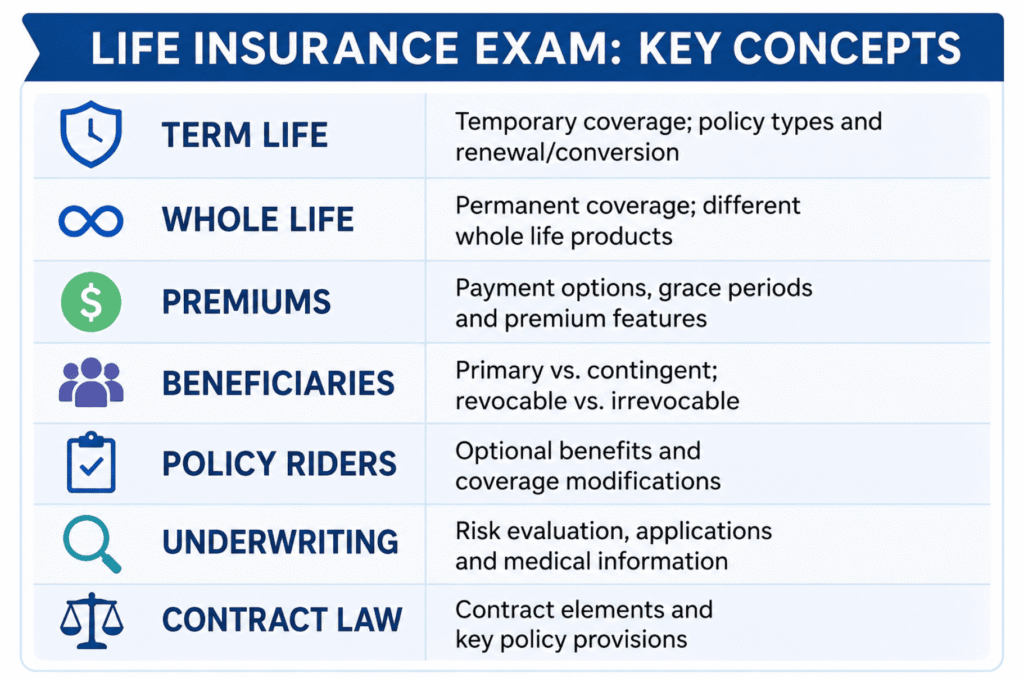
Term Life Insurance: Term life insurance provides coverage for a specific period, or term. For the exam, you may need to understand different types of term policies, including level, decreasing, return-of-premium, and annually renewable term insurance. You’ll also encounter concepts such as whether a policy is renewable or convertible.
Renewable and Convertible Policies: Renewable generally refers to the ability to continue coverage after a term ends, while convertible refers to the ability to convert qualifying term coverage to permanent coverage under the policy’s terms.
Whole Life Insurance: Whole life insurance is a type of permanent life insurance that provides coverage for the insured’s lifetime, as long as the policy remains in force. Florida’s exam outline includes traditional whole life products as well as limited-pay and single-premium life insurance. It also covers other permanent products, including universal life, variable whole life, variable universal life, interest-sensitive whole life, and indexed life.
Premiums: A premium is the amount paid for an insurance policy. For the exam, you may need to understand different premium payment modes, grace periods, automatic premium loans, and whether premiums are level or flexible.
Beneficiaries: A beneficiary is the person or entity designated to receive the policy’s death benefit. The exam can get more specific here, including primary versus contingent beneficiaries and revocable versus irrevocable designations. You need to understand how the different designations work rather than simply memorizing the definition.
Policy Riders: A rider is an optional provision that can add, modify, or provide additional benefits under a life insurance policy. The Florida exam outline includes riders such as waiver of premium, guaranteed insurability, accidental death, long-term care, disability, and cost-of-living riders.
Underwriting: Underwriting is the process of evaluating an applicant’s risk before an insurer issues a policy. The Florida exam covers topics including insurable interest, medical information, consumer reports, risk classification, and the Fair Credit Reporting Act. You’ll also learn about the application process, required signatures, replacement of existing policies, and what happens when an application is incomplete.
Contract Law and Policy Provisions: You may encounter terms such as consideration, offer and acceptance, competent parties, and legal purpose. You’ll also study provisions such as the free-look period, grace period, reinstatement, policy loans, nonforfeiture options, and incontestability.
How hard is the Florida life insurance license exam?
This is probably one of the first questions people have when they start looking into getting licensed.
The honest answer is that it depends on how you study.
If you have never worked in insurance, the terminology can initially feel like a completely different language. But that doesn’t mean you need years of industry experience to pass.
I was in that exact position. I had no previous exposure to the insurance industry when I started studying. I took an online course and supplemented it with a few in-person classes provided by my sponsoring company when I needed additional clarification.
For me, that combination worked well. When I reached chapters I struggled with, being able to ask questions in person helped me understand what I had missed online. I found the overall course very manageable and ultimately passed the exam.
My biggest lesson from the experience: Don’t mistake unfamiliar material for impossible material.
The vocabulary may be new, but once you understand the underlying concepts, you’ll start to connect the dots.
How to study for the life insurance exam
There’s no specific formula on how to pass the life insurance exam. But there are some practical ways to study more efficiently.

Complete the required course: If you’re applying for Florida’s 2-14 license, you’ll need to complete a 30-hour prelicensing course unless you qualify for an exemption or another form of qualification. But don’t think of those 30 hours as something you simply need to get through. The course is where you’ll start becoming familiar with the terminology and concepts you’ll see on the exam.
Give yourself a chance to practice: Practice questions can help you figure out which topics you actually understand and which ones need more attention. If you keep missing questions about policy provisions, for example, go back to that section of your course materials instead of simply memorizing the answer. Pearson VUE also offers a life insurance practice test, which can give you an idea of what to expect when you sit for the actual exam.
Don’t overlook the Florida-specific material: One thing I wouldn’t recommend doing is focusing only on the general insurance concepts. The Florida 2-14 exam also covers state laws and regulations, including licensing, agent responsibilities, ethics, marketing practices, prohibited practices, policy replacement, disclosures, suitability and best-interest requirements. There’s a lot to learn, so it helps to pay attention to the Florida-specific material as you’re working through your course rather than saving it all for the end.
Ask questions when something doesn’t make sense: This is one area where I found having access to additional instruction helpful. I took an online course, but I also attended a few in-person classes provided by my sponsoring company when I needed additional clarification. You don’t necessarily need to understand everything the first time you read it. If your course provider offers in-person classes, office hours or another way to ask questions, take advantage of those resources when you get stuck.
Focus on understanding, not just memorizing: There’s a lot of terminology, rules and requirements to remember, but simply memorizing definitions may not be enough. The exam can present a concept in a situation or wording that looks different from what you saw in your course. Once you understand why something is correct, rather than just remembering the answer, you’re more likely to recognize it when it shows up in a different form on the exam.
What happens after you pass the life insurance exam?
Passing your exam is a major milestone, but don’t assume you’re automatically ready to sell insurance the next day.
You’ll still need to complete the applicable licensing process with the Florida Department of Financial Services and satisfy any remaining requirements. Once you’re licensed, you may also need an appointment with an insurer before conducting certain insurance transactions.
Keep in mind, the learning doesn’t end when you pass the test. Florida requires continuing education for licensed agents, so you’ll continue learning about insurance rules and practices throughout your career.
Final Thoughts
The life insurance license exam can look overwhelming when you’re staring at a textbook full of terms you’ve never heard before. But you don’t have to walk into the process already knowing how insurance works.
Start with the required education, give yourself time to understand the material, and don’t be afraid to get additional help when a chapter isn’t clicking. Practice questions can show you where to focus, while Florida-specific study material is essential because state laws and regulations make up a significant portion of the exam.
And if you’re coming into the process with no insurance experience, don’t automatically assume you’re at a disadvantage. I didn’t have an insurance background when I studied for the exam, and with the help of an online course, in-person instruction, and consistent studying, I found the material manageable and passed with a score in the 90s.
FAQs
Is the life insurance license exam hard?
The difficulty varies from person to person. A structured course, practice questions, and focused review can make the material more manageable.
How many questions are on the Florida life insurance license exam?
Currently, the Florida life insurance license exam contains 85 scored questions plus 10 pretest questions, with a two-hour time limit.
Do you need experience to become a life insurance agent in Florida?
You do not need experience to become a life insurance agent in Florida. Applicants must meet the state’s eligibility requirements, complete prelicensing requirements or qualify for an exemption, and pass the state exam.
Can you take the Florida life insurance exam online?
No. You can not take the Florida life insurance exam online, as it is no longer available online for new reservations. The Florida Department of Financial Services now requires candidates to schedule their exams at physical test centers.
What should you study for the life insurance license exam?
For the life insurance license exam, you should study the exam content outline and your approved prelicensing course. Focus on policy types, provisions and riders, applications and underwriting, retirement and other insurance concepts, and Florida insurance laws and regulations.

![Aceable Promo Code [Verified October 2026 Discounts]](https://www.miamiherald.com/careers-education/wp-content/uploads/sites/2/2026/10/aceable-promo-code-mh-1024x768.jpg)

![National Council on Strength and Fitness (NCSF) Coupon Codes [Verified Discounts]](https://www.miamiherald.com/careers-education/wp-content/uploads/sites/2/2026/10/ncsf-promo-code-mh-1024x768.jpg)
![Course Hero Promo Code [Verified Discounts]](https://www.miamiherald.com/careers-education/wp-content/uploads/sites/2/2026/10/course-hero-promo-code-mh-1024x768.jpg)
![Learn Laugh Speak Promo Code [Verified Coupons]](https://www.miamiherald.com/careers-education/wp-content/uploads/sites/2/2026/10/learn-laugh-speak-promo-code-mh-1024x768.jpg)
![Education.com Coupon Code [Verified Discounts]](https://www.miamiherald.com/careers-education/wp-content/uploads/sites/2/2026/10/education-com-promo-code-mh-1024x768.jpg)