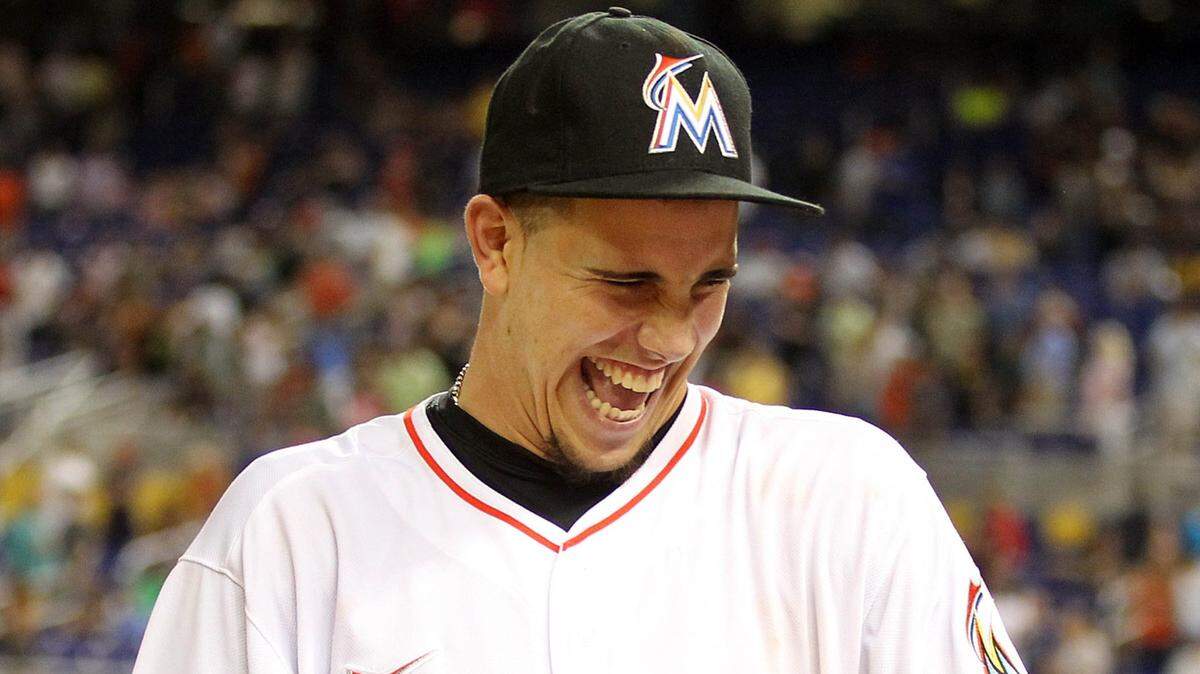
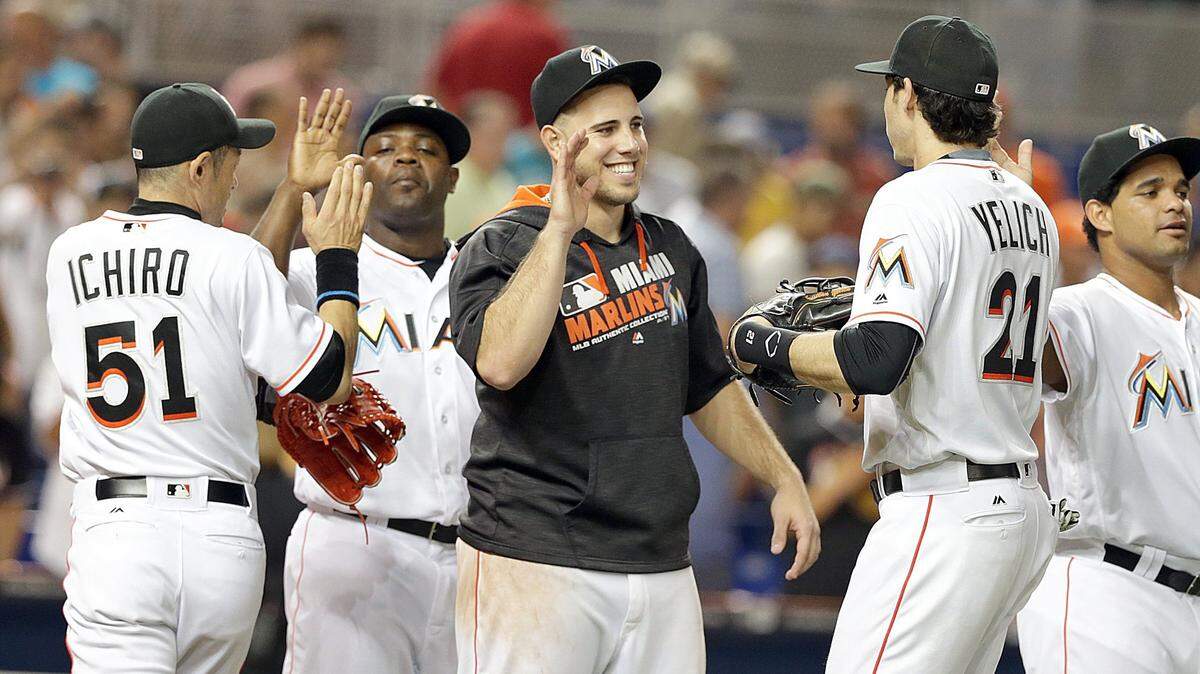
Her life revolved around Jose Fernandez — and still does five years after his death
READ MORE
Void on the mound, Void in their hearts
Jose Fernandez’s 2016 death devastated families, jolted fans and dealt the Miami Marlins a gut punch that they’ve spent five years trying to overcome.
Expand All
Every morning begins the same way for Maritza Gomez Fernandez.
She wakes up in her Kendale Lakes home and brews two small cups of Cuban coffee. One for her, and one for her late son Jose, the former Marlins’ star pitcher, who died at age 24 on Sept. 25, 2016, when his boat crashed violently into a rocky jetty off Miami Beach around 3 a.m.
She carries his cup carefully to a bedroom that she has converted into a memorial and places it next to a lit candle embedded with loving photos of the two of them, Jose flashing his megawatt smile. The candle says: “Nada es lo mismo sin ti, Delfy” (Nothing is the same without you, Delfy — his nickname).
Five long, torturous years. More than 1,750 days. More than 1,750 cups of coffee left untouched and dumped the next morning.
Saturday marks the fifth anniversary of that shocking day, when Maritza received the call from police at 6:15 a.m. Jose and two other young men perished in the crash. She could not believe what she was hearing. Surely, it was a mistake. When the police assured her that it was her son, her only child, that they found, she screamed and screamed.
Her mother, who had arrived from Cuba a few days earlier for a visit, awoke and held her grieving daughter in her arms.
Maritza and Jose were more than just mother and son. They were inseparable. His father was not in his life since he was an infant, so Maritza was Mom and Dad. They navigated many turbulent and joyous times together. He owed his life to her, and she owed hers to him.
Their journey from Santa Clara, Cuba, to the United States has been well documented: Jose tried unsuccessfully to defect three times and each time was imprisoned. On his fourth attempt in 2007, he escaped with his mother. At one point during the trip, she fell overboard and Jose dove after her and saved her life. They reached Mexico, and then went to Tampa in 2008.
She admittedly babied him the rest of his life, jokes that he had a bad case of “Mamitis.” She made him coffee every morning. She did his laundry. Even when he was a Major Leaguer, she packed and unpacked his luggage. She traveled on many Marlins road trips. He invited her to join him and his friends at nightclubs so she wouldn’t have to stay home alone.
Her life revolved around him, and still does.
“All I wanted to do was go out to the water, to the site of the crash, and see for myself, but they wouldn’t let me,” Maritza said. “I wanted to see him, touch him. They said it would take 48 hours to reconstruct him. `Why so long?’ I wondered. I didn’t realize how his body ended up. When I finally got there and saw him… [she starts to cry]... That was not him. That was not my Delfinsito. So, the way I see it, my son is still here with me.”
Within hours of the crash, news had spread all over South Florida and the baseball world.
“I cannot tell you how many people started showing up at my house that morning and the number of police officers that were there,” she said. “Over that first week I would guess 300 people came by the house. We had to keep the gate closed to keep people out.”
As the weeks, months and years passed, the visitors, phone calls, emails and texts dwindled.
“I have learned a lot over the past five years,” Maritza said, eyes brimming with tears. “I learned that when you are on top everyone wants to be around you. When you fall, for whatever reason, all those people you thought were at your side to support you, from one moment to the next, they disappear.
“When Jose died, there was a whole world of people around me. My house was packed. Today, I can count on one hand the number of people still left [holding up her well-manicured hand]. People who were around me then don’t know if I’m alive, if I’m not alive, if I’m in Miami, if I’m not in Miami.”
She paused to compose herself.
“It’s not that I want everyone to know everything about me because I’m not a public figure, I’m nobody, but this time has taught me that you can’t open your doors and arms to everyone because at the end of the day, time passes, the world goes on, everyone returns to their lives and people who were close to you are no longer there for you.
“Not even Delfi’s teammates have reached out to ask me how I’m doing. Not even a simple text. [Marcell] Ozuna once in a while, but that’s it. The team barber, Juice [Hugo Tandron], is the only one who keeps in touch.”
All those people who hugged and consoled her five years ago were not there in March 2018, when she was asked by the Marlins’ new owners to go to the stadium and retrieve boxes of Jose’s personal items from his locker, which had been preserved as a memorial by the previous Marlins’ leadership.
They were not there in 2019 when she lost the family house in foreclosure, suffered a stroke and was unable to drive or speak clearly for six months. They were not there when negligence lawsuits against Jose’s estate filed by the families of the two other victims were settled, leaving her emotionally and financially drained.
And they are not there when she heads out to the jetty many an early morning, walks over from a parking lot, climbs slowly onto the jagged rocks and weeps as she tosses flowers into the ocean.
Asked how her physical and mental health are now, Maritza walked across the room into the kitchen, opened a ceramic cookie jar and took out a large clear plastic bag filled with prescription bottles.
“This is how I get by,” she said.
“There are days I don’t even feel like breathing or getting out of bed, that I feel like leaving and joining my son. But I can’t do that for many reasons. First, Penelope. She is my reason for living, my motor, my strength, my everything. I remember one week before the accident, I was walking with Jose and he said, ‘Mami, you are going to help me raise Penelope.’ I will never forget that.”
Fernandez’s girlfriend, Maria Arias, was four months pregnant when he died. He knew it was going to be a girl, bought her a small baseball glove and they chose the name Penelope.
She will turn 5 in February. Though she never got to meet her father, she knows he was a baseball player, knows he wore No. 16 and that his last name was Fernandez.
According to her doting abuela, who has shown her YouTube videos of her dad pitching, when Penelope sees the No. 16 anywhere, on a sign or a license plate, she points and says “Papi!” When she spotted a photo of Fernandez at a Flanigan’s restaurant, she pointed and said, “Papi!”
When she visits Maritza’s house, she immediately goes to a life-sized poster of her father, hugs it and then Maritza lifts her up so she can kiss his cheek. She doesn’t know how he died. Maritza said she plans to tell Penelope more when she is 5.
In the meantime, she has taken her to the jetty to throw flowers in the water. She warns her to be careful around rocks, that they can be dangerous, and you could fall and get hurt.
“It breaks my heart when Penelope says, `I want to give my father a hug. I want to meet him in person.’ I tell her Papi is playing baseball in the sky. She is a carbon copy of her father with blue eyes and that smile.”
The walls in Maritza’s house are covered in photos of her son and her granddaughter, whom she calls “mi princesita” and “Delfinsita.”
David Samson, former president of the Marlins, was close with Fernandez. He said he spoke at length with him about becoming a father. When Fernandez died, former Marlins owner Jeffrey Loria set up a trust fund to pay for Penelope’s education. Samson is the trustee of the fund and is in regular contact with Arias and Penelope.
Arias declined to be interviewed, saying she wasn’t ready to speak publicly.
Samson said Arias works full time, goes to school and is “an unbelievable mother who knows her job is to give Penelope the best life possible. The kid’s happy, but she’ll never know her father except through articles and pictures and stories.”
He echoed what Maritza said about Penelope, that she is bright, full of personality and inquisitive.
“I’m excited to watch her grow up,” Samson said. “I promised that then, and there are plenty of people who made a lot of promises and they’ve all disappeared because Jose is no longer a money fountain. The expectation is that he would be a provider for 50 people forever and he would have been, but the true test are the people who are still there when there is no money, when there is no publicity, you’re just there out of love and compassion and care.”
Samson laments that Fernandez, who made $2.8 million his last season, declined a multi-year contract offer, reported to be around $40 million, in the months before he returned from Tommy John surgery in 2015. He was up for free agency in 2018, and figured as one of the game’s top pitchers that he would be worth far more by then.
“When he got hurt we tried to sign him long term to keep him through free agent years and offer his family permanent financial security and he turned it down,” Samson said. “I had lots of conversations with him about that and he said, `I’m betting on myself because I’m that good.’ And he was that good.”
Maritza’s fear is that once Penelope is old enough to read, she will Google her father’s name and find the details from the Florida Fish and Wildlife Conservation Commission investigation and the autopsy report, which found alcohol and cocaine in his system at the time of the crash. She says there is another side to the story that she wants her granddaughter to know.
The Fernandez family attorney Ralph Fernandez, no relation but who was a father figure to Jose, has conducted his own research through the years and insists that it was a botched investigation and that Jose was not at the wheel.
“Penelope will always know who her father was and everything that was written about him because you can’t hide anything these days, everything is on Google,” Maritza said. “I don’t have to tell her `Your father would have been a great Dad’ or `Your Dad was a great baseball player.’ She will read it herself and see all the commentaries. But I don’t want her to have a false negative image of her father in her head. I want her to read the whole story.”
She has become cynical of the media because she feels her family’s side of the story goes largely untold.
“Everyone wants to rehash the story of us leaving Cuba, me falling off the boat, Jose rescuing me, him becoming a baseball star and the crash. But nobody wants to publicize or talk about the investigation Ralph did. He worked hard for many years, I don’t know how many trips he took to Miami, how many people he interviewed, how many hours he spent documenting his findings because he was never convinced that what came out was accurate. I want the whole story to come out.”
She is tired of broken promises.
A Star of Fame was promised outside Versailles restaurant. Never happened.
A street naming was promised near Marlins stadium. Nothing.
A bronze statue was in the works. Canceled when the Marlins got new owners.
Media members and filmmakers have talked to her about books, documentaries, films. She’s still waiting.
The stadium wall where fans wrote messages was painted over in 2018.
The only sign of Fernandez at Marlins Park is a small plaque that does not include his name. It says “16,” 1992-2016, and a black ribbon.
“I was hoping they would at least retire his number, but at this point, I don’t care about statue or star or a street,” Maritza said. “What I want is that truth about my son comes to light and that his image be what it should be. He brought so much joy to this community, to young fans as well as the old men in wheelchairs. His legacy should be more than that crash.”
Samson agreed that Fernandez was a huge, generous community figure and the circumstances of his death should not mean he is erased from Marlins history.
“It’s sad because the story of Jose needs to be told again and again,” Samson said. “He was intoxicated by his freedom. He and I had long conversations about freedom. He always said `You’ll never understand what I went through.’ And I said `You’re right because I was born free. I didn’t have to get my freedom, I just had it. I never knew any other way.’
“It’s so important for people to understand the responsibility that comes with freedom, for people to understand the person he was, both good and bad.”
No matter how he died, Samson said, Fernandez’s story should be remembered.
“The story of Jose will always have to include how he died because that is part of the story. When you don’t explain to people the bad with the good, there’s no way to grow from that because it’s fantasy and people can’t aspire to something that’s unrealistic. You can’t hide from what happened and there’s a way to do it in a positive way because what he did during his lifetime should not, and is not, defined by the final act of driving that boat.”
Maritza asked the Marlins to send her recordings of all the memorial events that happened in and around the stadium. She has yet to watch them.
“It still feels so raw,” she said. “I have memories of him taking off his sneakers and jumping in the pool all sweaty, playing dominoes and cubilete and Monopoly. It has taken me a long time to accept he is really gone.”
As the fifth anniversary of the death approaches, people have asked her what she will do to mark the occasion.
“The same thing I always do — go out to the rocks early in the morning, throw flowers in the water, cry.
“For me, anniversaries and dates are not important. September 25th is not significant. Nor is July 31, his birthday. Or September 4, which is my birthday, the last one he celebrated with me. Thanksgiving? What is there for me to celebrate? Christmas? For me, all the days are the same. It’s not like I’m going to remember him more on September 25th. That’s when the public remembers him. I miss him every day.”
This story was originally published September 22, 2021 at 6:00 AM.