
After canceled 2020 season, Marlins affiliates ready to host minor-league games again
The Marlins have a new look on the farm with new affiliates in Pensacola and Beloit, Wisconsin, as well as a more geographically friendly setup to conduct roster moves and evaluate prospects with Jacksonville and Jupiter realigned to the highest and lowest levels in their system, respectively.
But before the 2021 minor-league season began on Tuesday, those clubs had to get creative to survive the COVID-19 pandemic that canceled the 2020 season.
Turning ballparks into AirBnB’s, hosting movie nights and setting up golf driving ranges were just a few of the ways ownership groups of Marlins affiliates made ends meet during the financial constraints of not having a minor-league season in 2020.
“I can tell you, I never would have imagined ever going through something like this,” said Ken Babby, owner and CEO of the Jacksonville Jumbo Shrimp — now the Marlins’ Triple A affiliate after 12 years as their Double A squad.
“I think all of us feel that way. But boy, we’re just ecstatic to be getting back to the ballpark.”
Here’s a closer look at the revamped Marlins’ minor-league system:
New faces
Following the cancellation of the 2020 minor-league season and billions of dollars of revenue losses, numerous minor-league clubs were not retained by their big-league parent clubs. Others were shifted around.
The biggest changes for the Marlins come at the middle two levels.
With the Jumbo Shrimp moving up to Triple A, the Marlins entered a partnership with the Pensacola Blue Wahoos to be their new Double A affiliate and the Beloit Snappers as their Class A Advanced squad. The Jupiter Hammerheads move down to Class A.
The Blue Wahoos franchise, previously known as the Carolina Mudcats, relocated to Pensacola in 2012. They were previously affiliated with the Reds and Twins before teaming up with the Marlins.
The club is owned by Pensacola businessman Quint Studer, the founder of a health care consulting company, The Studer Group. Studer also manages the Beloit franchise, which will be a Class A Advanced affiliate for the first time in its 39-year history. The Snappers most recently were affiliated with the Oakland A’s.
“We want seamless movement,” Studer said, “and the players will have that. We have a long-term relationship and that’s hard to develop.”
Pensacola started hosting events at the outset of the pandemic like movie nights and dinner nights at the ballpark as well as concerts. At one point with restaurants in the area at 25 percent capacity, their stadium became the largest outdoor dinner spot in the city, according to Pensacola team president Jonathan Griffith.
Pensacola retained its entire front office staff and employees and avoided furloughs despite losing roughly $3 million in revenue after paying rent and other expenses.
“Just not having baseball was the biggest challenge,” Griffith said. “You go from hosting 300,000 people per season to nothing. Our ownership pledged to keep everyone and they did. We paid all our employees. The hope is this year will be much better and we’ll have great support and have a great season.”
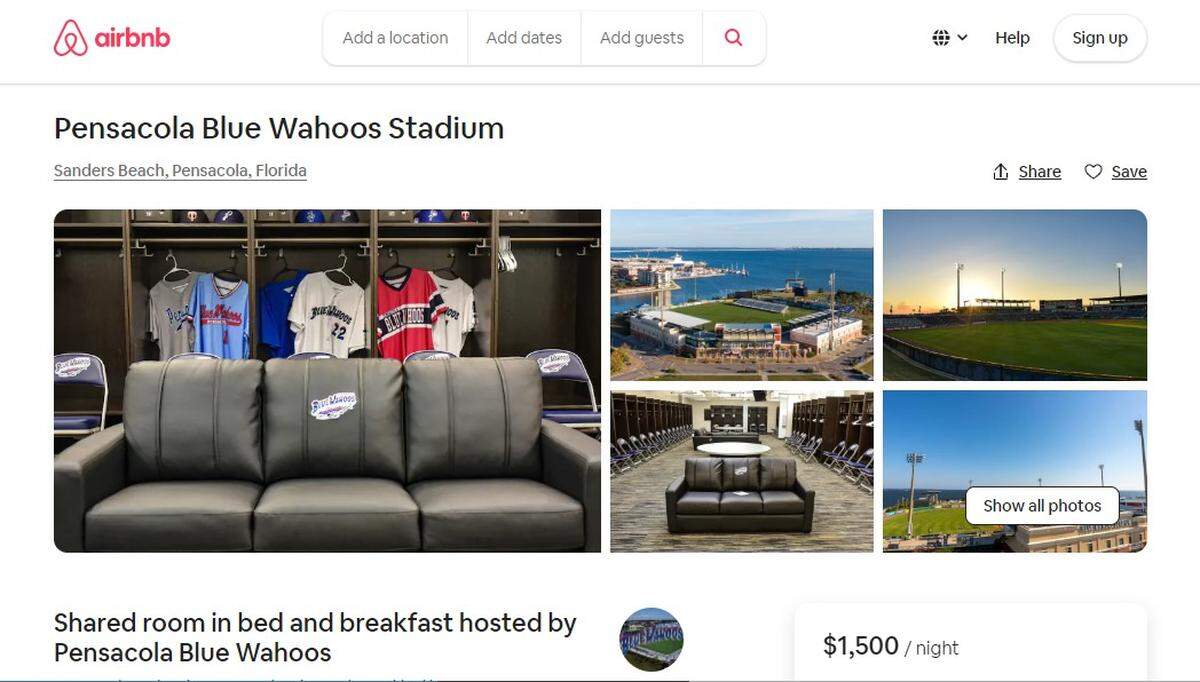
Pensacola reorganized its sales department into managing the stadium as an AirBnB for fans who wanted to stay at the stadium.
“It was really busy,” Studer said. “It would never make up for baseball obviously, but we had people from around 18 to 20 different states come down to stay here. We had another 20 or more employees and made them available to help with projects in the community. We went to every season-ticket holder and made sure to check on them to make sure they had what they needed.”
The Blue Wahoos hosted roughly 250 events and more than 80,000 people attended overall.
PGA Tour golfer Bubba Watson, one of the minority owners of the franchise along with NFL great Derrick Brooks, stayed at the stadium and later designed a disc golf course inside the park.
They also started a curbside meal service where families could stock up on a week’s worth of meals and groceries.
Pensacola recently announced it will host fans at 98 percent capacity at the 5,038-seat Admiral Fetterman Field. Griffith said Pensacola has roughly 2,000 season-ticket holders and only had one ask for a refund.
Beloit, meanwhile, nearly didn’t survive minor-league baseball’s restructuring, according to Studer.
The Snappers have a three-person staff and an older city-owned ballpark in Harry C. Pohlman Field (capacity of 3,501) that’s located in a residential area. They also dealt with stricter health restrictions in Wisconsin.
But the Snappers have something big to look forward to with a new ballpark being primarily funded by businesswoman Diane Hendricks under construction, which should be ready by August.
“When we decided to manage them, we didn’t realize we wouldn’t have a season,” Studer said. “We did some things like takeout meals and things like that. Just kept it on oxygen until we could get the approval for the new stadium and now we’re being more aggressive with promoting.”
Beloit will have 33 percent capacity at the beginning of the season and will have fans seated in pods, but Studer hopes to be able to host more fans at the new stadium.
“It’s a beautiful all-brick stadium right by a river downtown,” Studer said. “It’s spectacular and not as expensive as most of these minor-league stadiums. No suites. It’s more open and an opportunity for fans to co-mingle. Like Diane says, Beloit was behind in the bottom of the ninth with two strikes and she hit a grand slam.”
Familiar places
When Jacksonville hosts Norfolk on Tuesday, it will be the Jumbo Shrimp’s first game at 121 Financial Ballpark — located right across from the Jacksonville Jaguars’ EverBank Field — in more than 600 days.
Babby feels the move up to Triple A will help invigorate a fan base which has long supported their franchise. On weekends in recent years, the Jumbo Shrimp often drew crowds in excess of 10,000 and more than once outdrew the major-league club’s attendance in Miami on the same night.
“Jacksonville is a big-league city and I feel very, very strongly that Jacksonville should be a Triple A market,” Babby said. “We’re one of the fastest-growing markets in the country.
“Jacksonville belongs on center stage.”
Jacksonville has not had a Triple A team since the initial seven years of existence of the Jacksonville Suns from 1962-1968. After the original franchise was moved to Norfolk, Virginia, baseball returned to the city with a new Suns team in 1970 as a Double A team and remained so for the next 51 seasons.
As part of their reorganization, the Jumbo Shrimp has also been the host site of the Marlins’ alternate training site. In their new alignment, fans in Jacksonville will be able to see players on rehab assignments and top prospects face the highest levels of competition in the minors.
The Jumbo Shrimp, like Pensacola and Beloit, managed to retain its workforce and avoid furloughs during the pandemic.
The Jumbo Shrimp hosted more than 60 events overall last year, according to team executive Vice President/General Manager Harold Craw.
While they weren’t coming near the crowds they typically draw for games, which at times had ranged between 7,000 to 10,000, the events helped stem some of the financial burden.
Jupiter, which will now play in the lowest level of the four full-season classifications, had previously served as the Marlins’ Class A Advanced affiliate since 2002.
Hammerheads general manager Jamie Toole said they are taking the classification drop in stride, adding that it makes sense logistically and noting Jupiter will still host many of the Marlins’ top prospects.
“With the Marlins drafting the way they have and getting all these quality kids into the system,” Toole said, “we’re excited to see them sooner rather than later. It makes sense that we would have the Low-A players at the spring training facilities versus sending them out to Beloit and then back to Jupiter. The shuffle probably makes more sense for the clubs.”
Jupiter faced a different challenge to compensate for financial losses than the other Marlins’ affiliates. The Hammerheads weren’t able to hold events for the public during the pandemic because they hosted the Marlins’ alternate training site, where the club’s pool of available players not on the active roster practiced.
“That sort of tied out hands a little bit and rightfully so,” Toole said. “That was a fun thing to host, but as a whole, we were working remotely and like many people still trying to navigate how things were looking. A lot of planning, a lot of looking at things like being active in the community. We did a big food distribution in December. So while we didn’t do a whole lot of activities or programming at the stadium, we tried to stay involved in the community and ultimately be a part of bringing baseball back.”
Toole said at the start of the pandemic they assumed they’d only be dealing with a delay of perhaps one or two months. They were shocked when the decision came down to cancel the season.
“It was just a sad feeling,” Toole said. “It felt like we were sort of losing a part of who we are here at the ballpark.”
Toole did not comment specifically on furloughs or layoffs, but noted “we had sacrifices here at the stadium.”
The Hammerheads will be at 21 percent capacity to start the year at Roger Dean Chevrolet Stadium — same as spring training — with hope to expand as the season progresses.
“It was just such an unusual year across the board and in many ways it sort of continues to be a little bit unique and unusual,” Toole said. “I don’t know if we’ll ever be at normal again, but it’s certainly one of those experiences that makes you appreciate the things that maybe you didn’t appreciate as much in the past.”
This story was originally published May 4, 2021 at 10:47 AM.
.JPG)