
A look at how the Marlins overhauled their bullpen and the competition that has followed
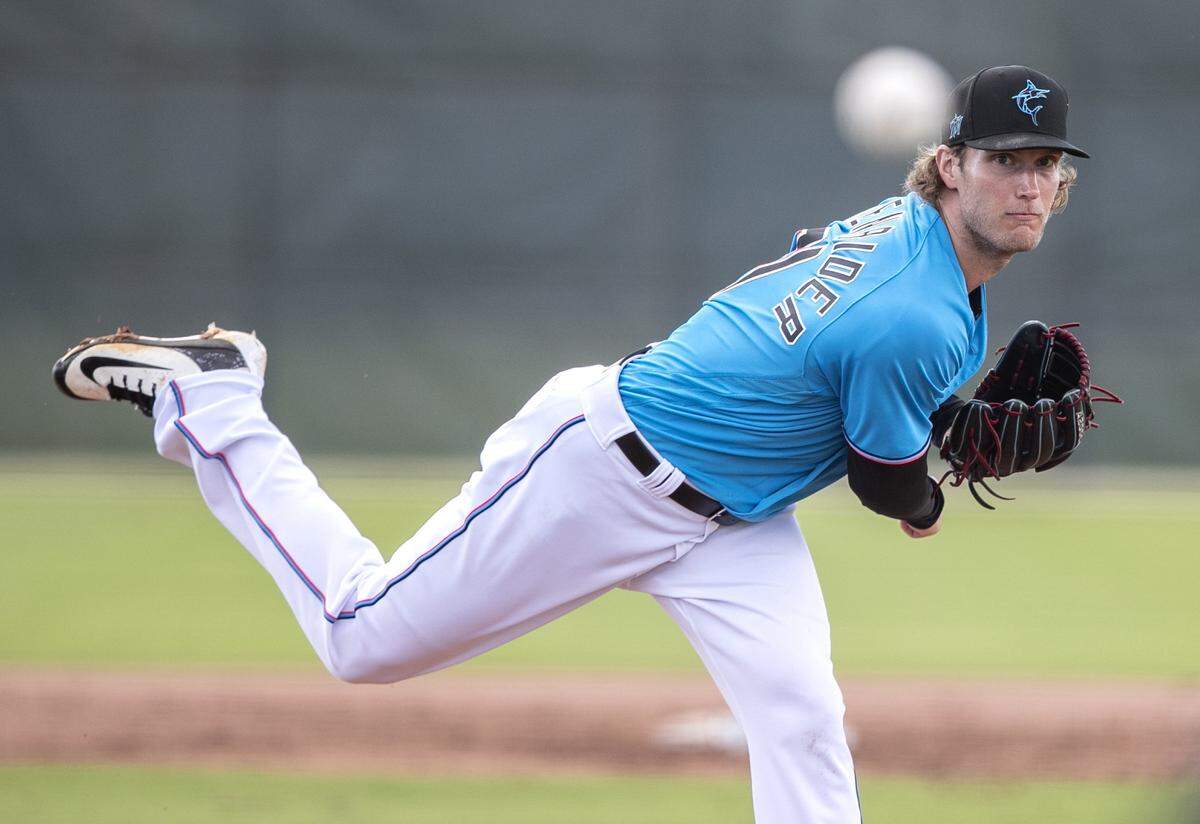
Ryne Stanek is normally a slow developer it in spring training. The 28-year-old relief pitcher with a fastball regularly in the high 90s typically likes to be methodical early on, honing in on a certain pitch or a certain mechanical issue in the early parts of camp and spring training games before becoming results-oriented as the regular season approaches.
He doesn’t have that luxury this spring training with the Miami Marlins. And he knows it.
While improving the offense has been the biggest priority for the Marlins this offseason, revamping their bullpen was a very close second. Miami’s relievers collectively were among the worst in Major League Baseball, prompting the organization to overhaul the entire unit.
And that means all eight spots are up for grabs this spring training.
“You have to be on your stuff earlier,” Stanek said. “It definitely locks you in. I can’t just say ‘Oh, I have to go work on this today.’ It’s ‘I have to work on this ... But I have to get outs, too.’”
What went wrong
The surface numbers say a lot about what went wrong with Miami’s bullpen last season.
The collective 4.97 ERA from Marlins relievers was the fifth worst in MLB last season. They were also the fifth worst in strikeout-to-walk ratio (2.11), save percentage (55.1) and wild pitches (39) while having a 1.45 walks and hits per innings pitched that ranked in the bottom 10 of the league.
But the Marlins’ bullpen struggles really became evident after the July 31 trade deadline. At that point, they shipped their top two relievers — Sergio Romo to the Minnesota Twins for first base prospect Lewin Diaz and Nick Anderson to the Tampa Bay Rays as part of a package for Stanek and outfielder prospect Jesus Sanchez.
During the final two months of the 2019 season, Miami’s bullpen posted a 5.31 ERA and converted just six of its 18 save opportunities.
“Our bullpen just wasn’t good enough,” Marlins president of baseball operations Michael Hill said back at MLB’s annual winter meetings in December. “You can give guys opportunities and they have to take advantage of it. If they can’t take advantage of it, then we have to do what we need to do to get better.”
As a result, the Marlins began removing relievers from their roster this offseason. One by one during a three-month span, the purge took shape.
Wei-Yin Chen. Tayron Guerrero. Tyler Kinley. Kyle Keller. Austin Brice. Brian Moran. Jose Quijada. Jarlin Garcia.
Eight pitchers no longer part of the organization.
A common thread among the majority of those pitchers: walks. More specifically, too many of them.
The Marlins bullpen walked 9.8 percent of the batters it faced, the fifth most in MLB last season.
From the group above, all except Keller and Moran faced at least 100 batters. The results weren’t pretty. Of the remaining six:
▪ Guerrero had the sixth-highest walk rate (16.7 percent) among 311 relief pitchers who faced at least 100 batters. Quijada had the eighth-highest rate (16 percent), Kinley 12th (15.4 percent).
▪ Garcia’s 50.2 percent first-pitch strike rate was the eighth-lowest among MLB relievers within those parameters.
“It just puts everyone in a difficult position,” Hill said of the high walk rates. “You lose rhythm. It puts your defense on its heels. You can’t defend it.”
Chen struggled overall in his move from the starting rotation to the bullpen and was a casualty of Miami wanting to improve its 40-man roster even though the Marlins are on the hook for just about all of the $22 million they owe him this season. Brice, Moran and Keller fell into the same boat without the gaudy price tag.
The survivors
Just four members of the Marlins bullpen from last season remain in Stanek, Adam Conley, Drew Steckenrider and Jeff Brigham.
They all had their lumps as well last season, but the Marlins saw enough in each of them to keep them around at least for spring training.
Stanek, an opener for the Rays before being traded to Miami, struggled early in his transition back to the high-leverage spots of the bullpen. But the former first-round pick has a four-seam fastball that averages nearly 98 mph complemented by a slider and split-finger fastball that had swing-and-miss rates of 45.5 and 57.3 percent, respectively last season.
Conley, the Marlins’ second-round pick in 2011, is the longest-tenured Marlin in the bullpen despite posting some of the worst surface statistics on the team last season (6.53 ERA, .308 batting average against, 1.73 walks and hits per inning pitched — all second worst on the team). Mattingly points to Conley’s inability to use his changeup last season — opponents hit .411 against Conley’s breaking ball in 2019 — which essentially made him a fastball-only pitcher.
“When you get a guy down to one pitch,” Marlins manager Don Mattingly said, “he’s in trouble.”
Steckenrider was used in high-leverage situations early last season and was potentially going to be tested as a closer, but an elbow flexor strain that never healed shut him down for the final five months of the season. Overall, Stekenrider pitched just 14 1/3 innings. If healthy, Mattingly said Steckenrider will return to one of those high-leverage roles, potentially splitting time with Stanek as the setup guy. Steckenrider relies primarily on a fastball that averages 95 mph and supplements it with a low-80’s curveball that got opposing batters to swing and miss 36.4 percent of the time in his limited playing time last year.
Brigham, moved from a starting role to the bullpen last year, had a strong finish to 2019, giving up just three earned runs during his final 16 appearances. However, he’s likely starting the season on the injured list due to a right biceps injury that has prohibited him from throwing for most of camp.
The new faces
While the Marlins liked those four enough to bring them back for spring training, the returning relievers are anything but guaranteed of a job.
Especially if Miami’s new reinforcements have anything to say about it.
Brandon Kintzler, a 10-year MLB veteran, is a front-runner to be the Marlins’ closer. He has the most experience of the group in that spot, with 49 career saves and almost 90 percent of his career innings pitched coming in the seventh inning or later.
Yimi Garcia, a free agent signing in December previously with the Los Angeles Dodgers, has impressed the most this spring, throwing five perfect innings with eight strikeouts and no walks. He regularly induces weak contact, which results in easier outs, and he held opponents in 2019 to a batting average under .190 with each of his three main pitches — his four-seam fastball (.160), curveball (.189) and his slider (.154).
Stephen Tarpley and Sterling Sharp round out the relievers on the 40-man roster. The Marlins acquired Tarpley as part of a trade with the New York Yankees for third base prospect James Nelson. He’s a lefty with experience as a starter and reliever and could fit a long-relief role.
Sharp, primarily a sinkerball pitcher, was selected in the Rule 5 draft, which means he has to be on the 26-man roster for the entire season (outside of injury) or else he will be returned to the Washington Nationals.
“He’s a different look,” Mattingly said. “He’s long and lanky. ... A guy that’s pretty poised, it looks like.”
And then there are the nonroster invites to camp who are trying to make enough of an impression to crack the eight-person bullpen.
Chief among them: Brad Boxberger, the 31-year-old righty and one-time All-Star who led the American League in saves in 2015.
Other names to watch: prospect Alex Vesia, who has not allowed a run in a competitive game since July 13; and candidates for the starting rotation who don’t crack one of the five spots, including Elieser Hernandez and Robert Dugger.
“It’s competitive,” Mattingly said. “We have a number of spots out there that are available. We’ll see.”
.JPG)