UM’s new offense at the (almost) midpoint: What’s working and what’s not so far in 2020
The Miami Hurricanes are nearly at the midway point of the 2020 season and the offense, in its first year led by Rhett Lashlee, still remains somewhat of a mystery.
It’s clear the offense is far better than it was a year ago, but the past three games have all been drastically different levels of performance.
Last month, Miami piled up a season-high 517 yards in a blowout win against the Florida State Seminoles and then followed it up with a season-worst 210 yards in a blowout loss to the No. 1 Clemson Tigers on Oct. 10. On Saturday, the Hurricanes basically split the difference with 331 yards in their 31-19 win against the Pittsburgh Panthers.
The ups and downs still bear out a promising picture for No. 11 Miami. The Hurricanes are averaging 407.0 yards per game — their best mark since 2016.
“We’re learning about our guys each week — what we do well, what we think we could be good at — so a little bit of that is just us evolving and trying to figure out what fits for our personal,” Lashlee said. “Five games in, we have a better idea.”
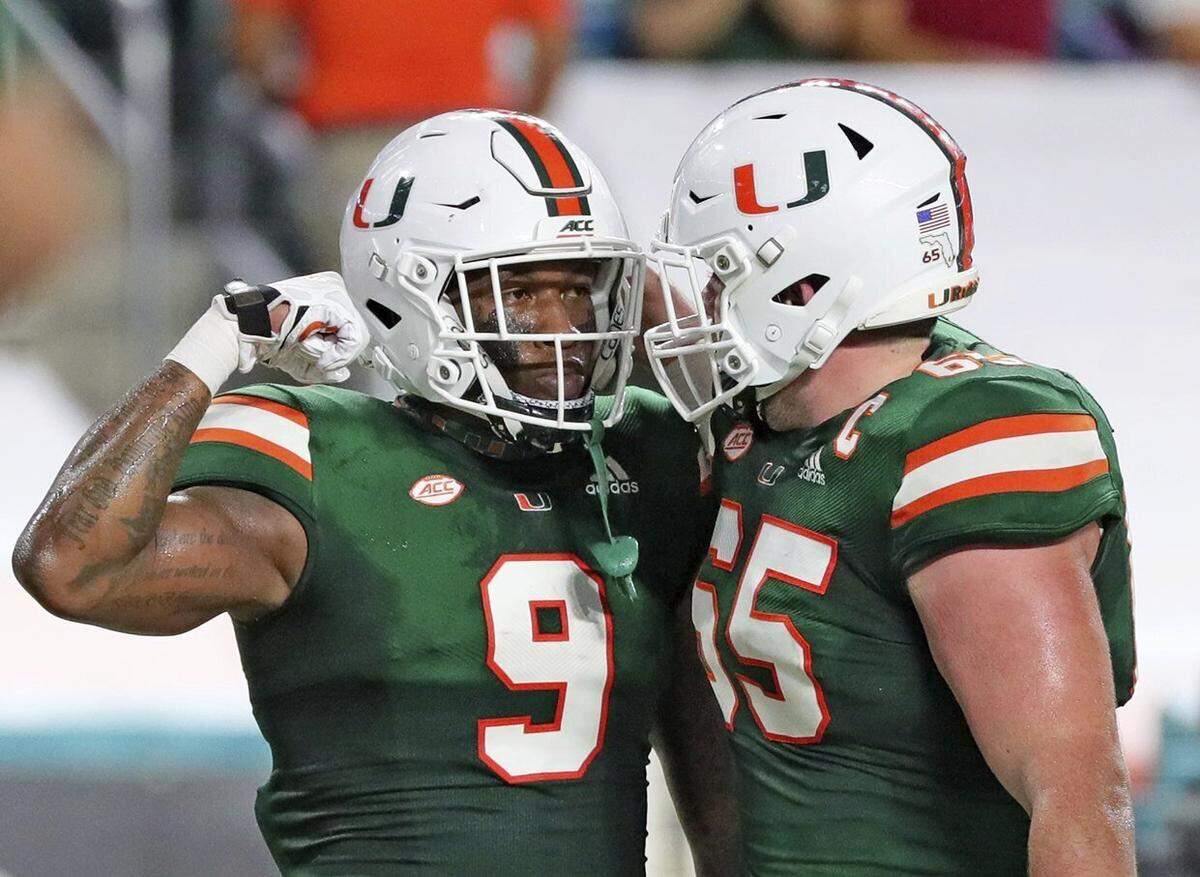
The good: Playing to strengths
The Lashlee offense so far has three major defining characteristics. The most obvious is the tempo, as Miami (4-1, 3-1 Atlantic Coast) has cracked the 70-play mark three times already. Next is the explosive plays, which are accounting for nearly half of the Hurricanes’ touchdowns this season. Lashlee’s third tentpole is game-to-game variance, and finding something that works and sticking with it.
In Week 1, Miami ran all over the UAB Blazers. In Week 2, the Hurricanes threw all over the then-No. 18 Louisville Cardinals. With his wide receivers now struggling, Lashlee changed up his offense again Saturday to utilize the running backs in the passing game and more than a third of Miami’s targets went to either tailbacks or tight ends. Mark Pope still led the Hurricanes with six targets, but half of those were screens as the wideouts have struggled making contested catches.
Lashlee doesn’t use a traditional playbook. There’s no massive binder filled with hundreds of plays. Instead, it’s an evolving organism, ready to add new formations or personnel packages at any moment as Lashlee better understands his players strengths and weaknesses.
Miami, for example, used a full-house formation for the first time this weekend, with two tights and a running back in the backfield, and Lashlee said it was added to compensate for some apparent issues, including injuries to star tight end Brevin Jordan and offensive lineman Jarrid Williams.
“I’m not as worried about like the volume of stuff,” Lashlee said. “People are always like, Hey, we’ve got ‘X’ percent of our playbook in. We don’t even have a playbook. We have guys with iPads and we send them stuff, and we kind of build around what we do.”
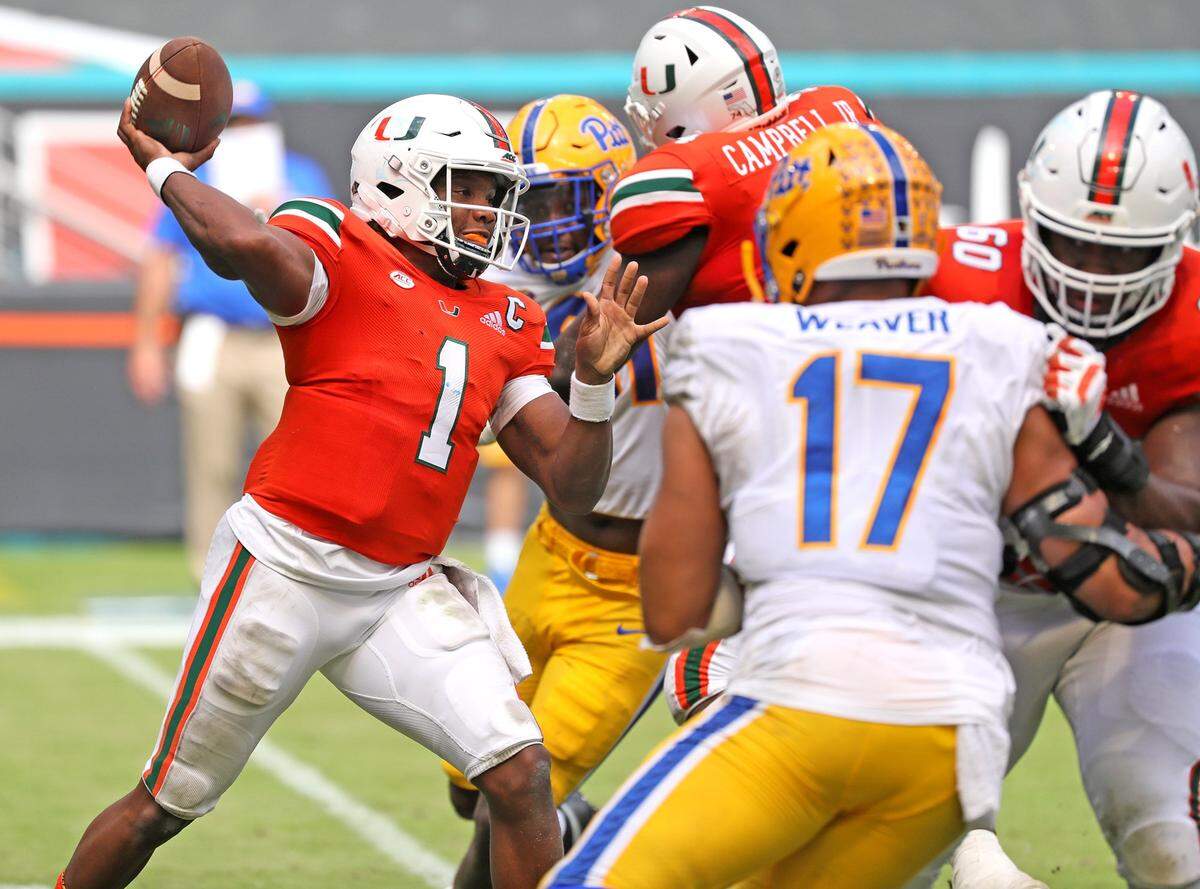
The bad: Third downs and efficiency
In the first three weeks, third-down success helped buoy the offense. The Hurricanes converted 52.2 percent of the time in the first three games, which would’ve ranked second in the nation in 2019.
Now the number has dipped to 43.2 percent after Miami went just 4 of 28 against Clemson and Pittsburgh. It’s still a major improvement from last season, when the Hurricanes finished last nationally at 26.0 percent, but it has been the difference between the No. 6 scoring offense and No. 19.
The problem the last two weeks has been the third-and-long situations. Against the Tigers, Miami’s average second-down to-go yardage was more than 11. Against the Panthers, the Hurricanes went 4 for 8 on third-and-10 or shorter, and 0 for 5 on third-and-11 or longer.
There were signs of this problem early in the season. Miami ranked in the bottom 10 nationally in success rate in the first two games — meaning the Hurricanes frequently failed to gain at least 50 percent of necessary yardage on first down and 70 percent of necessary yardage on second — but D’Eriq King thrives in third-and-medium situations to compensate for the lack of efficiency.
“Third downs have been up and down. I think the last two weeks have been really poor,” Lashlee said. “The negative plays have just absolutely killed us, kept us off schedule the last two weeks.”
The improving: Explosive plays
The other way Miami has compensated is through explosive plays.
Nine of the Hurricanes’ 21 offensive touchdowns this year have come on plays longer than 20 yards, eight have been longer than 30 yards and five have been on plays for 40 yards or more. Three of Miami’s four touchdowns Saturday were pass plays for longer than 30 yards and all were schemed up by Lashlee to get player uncovered down the field without winning a 1-on-1 matchup
“One of my jobs is, when maybe we’re needing a shot in the arm, having a couple things we can go to each week,” Lashlee said. “You kind of get a little stale. You’ve kind of got to find something to restart the engine a little bit. Our guys have done a good job of executing those kinds of things when just the base system isn’t flowing.”
These explosive plays are happening despite King actually struggling to connect with receivers on deep balls. The quarterback frequently underthrew teammates in the first few weeks of the season, although Lashlee felt he was much better Saturday. At least two or three deep passes hit receivers in the hands, only they couldn’t haul in the over-the-shoulder catches.
Ultimately, Lashlee doesn’t feel the abbreviated spring practice hurt in terms of installing his offense. Those plays, however, are where expects Miami to keep improving because those 11 missed practices and a summer of missed optional workouts mean King is still building chemistry with his receivers.
“Those guys would’ve been out throwing and doing those things that we’ve done all spring on their own,” Lashlee said, “and that’s when, really, you develop a lot of timing and continuity that are on the deep balls, on things that are just, right now, a hair off.”