When working harder isn’t enough: Lessons from my aunt’s pioneering path in sportswriting | Opinion
READ MORE
We’re not going back
Women were hit the hardest by the pandemic. Now things have to change. Here’s what the Miami Herald Editorial Board says needs to happen next in South Florida.
.
Expand All
I grew up hearing about my trailblazing aunt, Mary Shane, who broke stereotypes for women in sports journalism and refused to let the sexist world of professional athletics get the best of her. People called her a pioneer, and she was, in broadcasting and print — but it came at a cost.
So I was so glad when I got a call earlier this year from a Slate magazine editor asking about her life story for a podcast. For all her achievements in the ‘70s and ‘80s, her story isn’t well known.
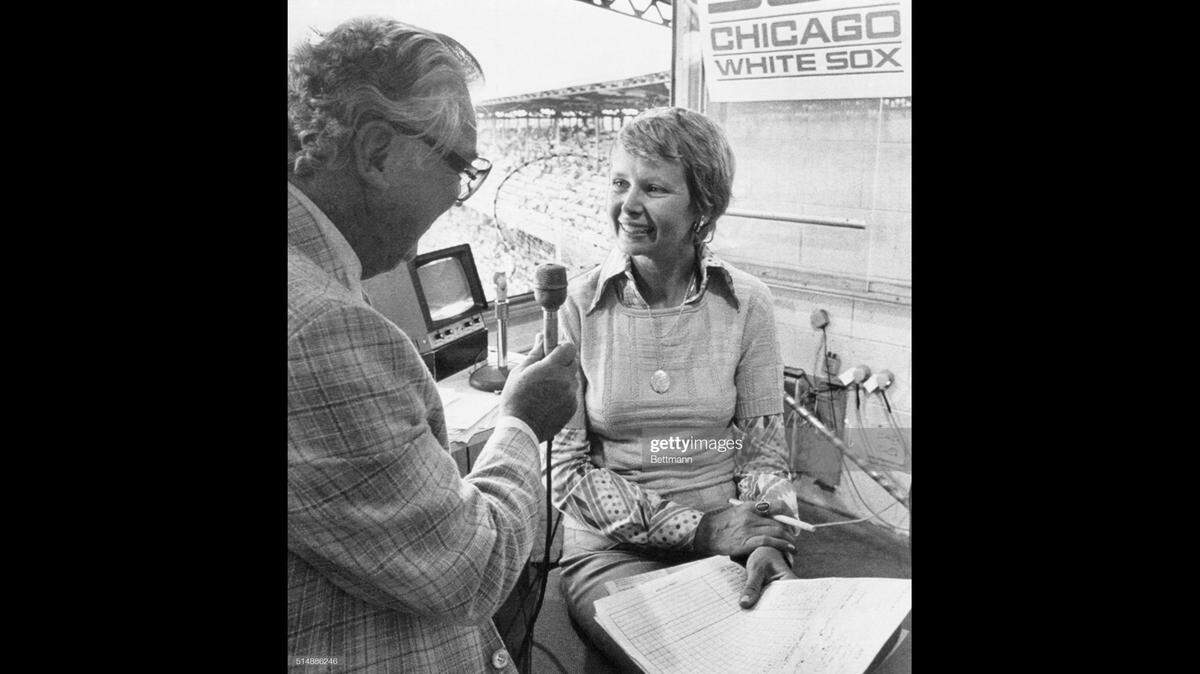
Mary Shane was the first woman to hold the job of a regular Major League Baseball play-by-play broadcaster, a wildly improbable trajectory for a 31-year-old former Milwaukee high school English and history teacher. She called games in Chicago for a single season, 1977, for her beloved White Sox, sharing the booth with none other than renowned Windy City legend Harry Caray.
It didn’t last. There was talk about her voice being too shrill or irritating — yes, that old complaint that so many women hear — and she wasn’t given much support or training to break into that boys’ club. Stories written at the time focused on the astonishing idea of a woman doing baseball play-by-play while also often noting her size — 5-foot-3 — and her blond hair. One story was headlined, “Beauty in the Booth.” Another called her Caray’s “sidekick.”
When her contract wasn’t renewed, she turned that setback into yet another stereotype-busting move: She became the first female sports writer for the Worcester Telegram in Massachusetts, and covered the Larry Bird-era Boston Celtics.
I learned about her perseverance and grit in the face of rejection or outright hostility during family get-togethers and from my dad, who was also a journalist. When I chose the same field, I remembered her work with pride. “I’m a second-generation journalist,” I told people, “and my aunt was a pioneer for female sportswriters.”
But what I didn’t fully appreciate — until that call from Slate’s Josh Levin, who created a podcast episode called “Mary Shane’s Rookie Season” — was what my Aunt Mary was up against in 1977, and later, too. And how much her struggles still resonate today — for me personally, for female journalists and for women in a lot of workplaces.
Enduring hostility
She landed the broadcasting job after meeting Caray in 1976 when she was covering the Milwaukee Brewers for an all-news radio station. He was surprised to see a young woman in the press box and asked her if she wanted to do color commentary. She did well enough, with no experience, for additional broadcasts and then, eventually, a contract.
It was clear at the time that she felt the weight of what she was doing.
“I think initially people will be interested to hear what I sound like,” she told The Associated Press. “Some will be listening very carefully to hear me make a mistake. I have found that many people can be won over ... if the woman knows what she’s doing. I really can’t afford to make mistakes. I think that’s one of the burdens of doing it. I can’t make the mistakes that men can make.”
She’d loved everything about baseball since she was a kid, and she knew the game inside and out. She loved the work, too, especially with Caray. But she struggled, in part because the Sox and her station didn’t give her a regular schedule — working just 35 home games — which made it hard to get into a groove. She also didn’t get much air time on the games she called, and one of the other announcers, Lorn Brown, talked over her — mansplaining, in today’s language.
She did have her supporters. She can be heard on one recording of a game, with the White Sox hosting the Royals on July 31, 1977, thanking “all those nice fans who have been writing in” asking why she wasn’t on the air more.
‘Male outpost’
It’s hard to know what would have happened if she’d had training, another season and full backing from management — and her colleagues in the booth — but in the end, she was out of a job.
That didn’t stop my aunt, whose Midwestern friendliness couldn’t disguise sheer determination. She moved to Moline, Illinois, with her son and her mother, to cover high school sports. And she worked her way to the next opportunity, at the Worcester Telegram, a newsroom that gave her a role — and the respect — that she deserved.
The battles weren’t over, though. When the Celtics decreed that, as a woman, she would not be allowed into the locker room, she demanded and received the same access as her male colleagues, forging yet another new pathway for women. Before that, she’d been relegated to conducting her interviews in a storage closet so tiny that when 6-foot-10 Hall of Famer Kevin McHale came in, “his arms wouldn’t fit,” as she wrote in a first-person account of her work for her newspaper’s Sunday magazine in 1986.
The team eventually got robes for the players, but they didn’t always wear them. Aunt Mary didn’t care; she was in the room with the other reporters, and that’s what counted.
The Celtics may have adapted relatively easily to her presence, but the Red Sox clubhouse was less pleasant, she said. And then there was the ugly run-in during her first time in the New England Patriots’ locker room when a Patriots player — one she called a “bad apple” — but did not name when she wrote about it later, objected to her presence. He snarled “no women in the locker room” as 44 football players watched in silence. When she refused to leave, the player threatened to drag her out. A tense silence ensued as they stared at each other. Then he relented. Only kidding, he said.
She told another story to her family and, later, to her readers in a 1986 article, “A woman sportswriter in the last male outpost,” about being in the locker room of the Milwaukee Admirals, a minor-league hockey team, a decade earlier. She’d walked into the clubhouse to find one player sprawled on his back on a bench, naked.
She wrote this:
“Watcha lookin’ at?” he asked, his smile turning into a leer. Beginning to think I had chosen the wrong profession, fighting a desire to walk out and never come back, I decided there was only one way to handle it.
“Nothing much,” I said.
She was funny. She was smart. She was a meticulous writer, an absolute stickler for accuracy — and she died much too young, at 42, of a brain aneurysm in 1987. That morning, she’d been getting ready to interview tennis star Chris Evert, a personal hero and another woman who had broken a lot of barriers.
Invisible scars
Sports journalism may have been — and still is, in many ways — a male bastion, but it’s by no means unique in journalism or any other workplace. When I think about my aunt, I think about what so many women in the workplace have endured.
That includes me. The cop I was interviewing who bragged about making another female reporter walk across a room so she would be silhouetted against a window in a see-through white skirt. The clerk who followed me surreptitiously back to my hotel from a courthouse in Pittsburgh because, apparently, I had been friendly as I requested documents for a story. The important source on a story who refused to talk to me until I flew to Baltimore and had dinner with him, and then he conveniently forgot that he’d left the papers he’d discussed with me in his hotel room.
The harassing and sexually explicit messages sent to me on a company pager (when we carried those) that had to have come from one of my colleagues. The judge who asked me — in his courtroom, from the bench, when I was there to cover a case — to get him a Coke. The editor who stonewalled me whenever I asked for help or even acknowledgment, though I reported to him, and then confessed on the way out to a new job that he thought he had “a problem” with women.
Like my aunt, and so many women, I brushed off those moments and so many more. Focused on the work. Sometimes recast them as funny stories. Developed a thick skin. Learned to speak up. And vowed to work harder so there would be no question of whether I had earned my place.
I’m acutely aware of the women who came before me, probably in ways men rarely — or never — think about. My news organization has had female leadership in recent years, a long time coming and heartening when it finally happened. I’ve been lucky to have good female and male bosses who treated me equally, and some wonderful, fearless female colleagues who have been role models and advisers.
But it took a Slate editor’s call — and the reconsideration of my aunt’s life — to show me how much I still stand on the shoulders of the women who came before me, including the late, great Mary Shane.
You could say her rise in the patriarchal sports world was something of a Cinderella story, but that wouldn’t really be true.
Sure, her journey from high school teacher to sportswriting pioneer sounds a bit like the kid from a no-name college hitting a three-pointer at the buzzer to knock off a top-ranked team. But my Aunt Mary was no fluke. Once she got a real shot, she played her heart out and earned every last point.
Amy Driscoll is deputy editorial page editor for the Miami Herald.

This story was originally published September 5, 2021 at 7:00 AM.