
Cuba’s future can’t hinge on U.S. courtrooms when citizens remain handcuffed | Opinion
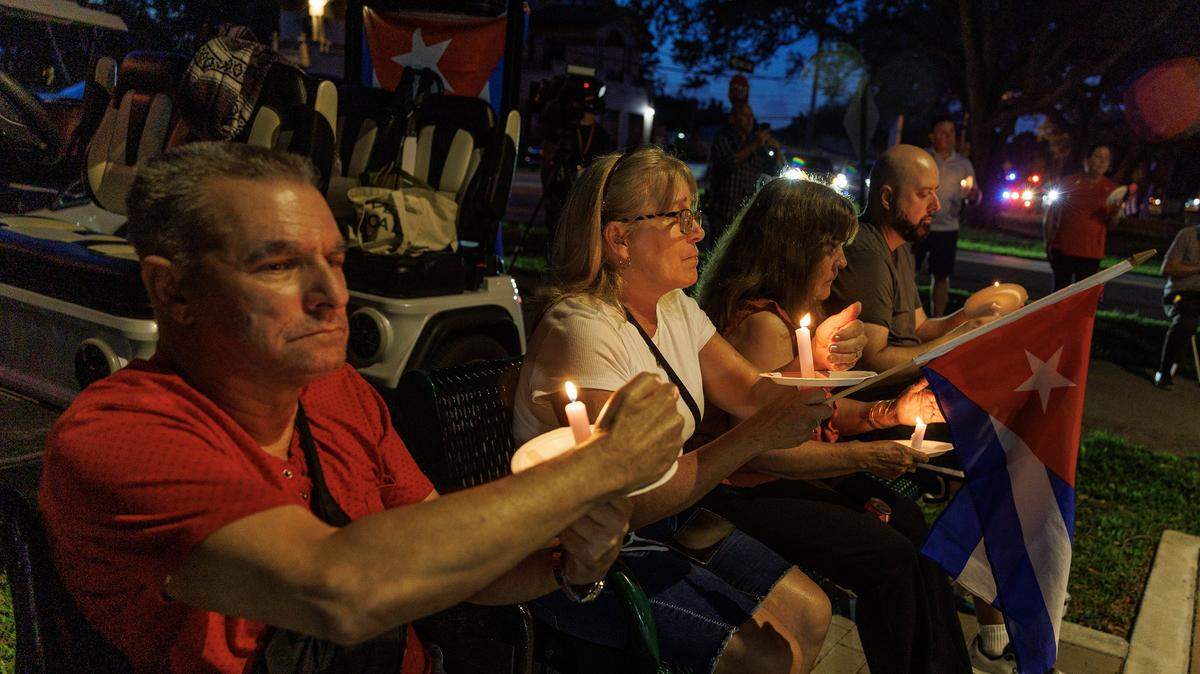
Cuba’s future
The U.S. indictment of Raúl Castro, although delayed by decades, constitutes a politically and symbolically significant event. On its own, however, it is insufficient to prompt a structural transformation of Cuba’s regime.
U.S. Secretary of State Marco Rubio’s speech, directed at the Cuban people, has been interpreted as a denunciation of the humanitarian and political situation in Cuba, highlighting the existence of resources designated for food assistance while questioning the regime’s refusal to allow a political transition.
In this context, a central question persists: What are the real options for change in the immediate future — if there is any plan at all — while Cuban citizens’ hands are tied?
Delia de Varona Garcia,
Miami
Forever remembered
Memorial Day is a day to remember, respect and bring empathy for the many who died in military service during war and the many more who died at home from the physical and mental injuries received from war.
When entering military service, one takes an oath, a binding pledge, to defend the U.S. Constitution against all enemies, foreign and domestic, maintain allegiance to the country, and with the understanding that death can occur in doing so.
Memorial Day is also a message to not have wars. Instead, to imagine and create peace through communication. Each day we can say a prayer, we become stronger in recognizing the sacrifices of many for a cause. Then one day we wake up to being a people who do not believe in violence and war; we are ready to find a way to live in common safety on this Earth.
Louis Cohen,
Vietnam Veterans of America,
Chapter 23,
Tamarac
Alexanders’ rep: Proof absent
The Miami Herald’s May 19 online article, “Alexander brothers’ abuse began in high school, women, feds say. No one stopped them,” is a powerful piece of narrative journalism. It is also a troubling example of how emotionally charged allegations — many of them decades old, anonymous, uncharged, uncorroborated and never adjudicated — can be woven together in a way that effectively asks the public to render judgment without the safeguards our legal system requires.
The article repeatedly blurs the line between allegation, rumor, hindsight interpretation and established fact. Readers are presented with retrospective memories from more than 20 years ago, often involving admitted intoxication, fragmented recollection, social hearsay, or assumptions that someone “must have been drugged,” despite little or no forensic evidence. Yet the cumulative presentation gives the impression of certainty.
That distinction matters.
The Herald is entitled to investigate and report, but investigative reporting carries an equally serious responsibility to distinguish between what can be proven, what was alleged, what was inferred later and what remains unresolved. The article relies heavily on anonymous sources recounting events from adolescence that were never charged, never litigated, or were previously declined for prosecution due to evidentiary concerns. The article acknowledges many of those limitations, but only after constructing an emotionally overwhelming narrative that leaves little room for skepticism or nuance.
Most concerning is the growing tendency today to treat the volume of accusation itself as proof. Once enough allegations are assembled into a coherent storyline, the public is subtly encouraged to view the narrative as settled history regardless of evidentiary weaknesses, inconsistencies or the inability to fairly test claims through cross-examination and due process.
There is also a broader societal issue here. Retrospectively reinterpreting the conduct, language, culture and social dynamics of teenagers from more than two decades ago through the lens of today’s standards requires caution and precision, not simply emotional certainty. Serious allegations should always be taken seriously, but seriousness also requires fairness.
The public deserves reporting that informs rather than prosecutes by accumulation.
Juda S. Engelmayer,
public relations representative for the Alexander brothers,
president and CEO,
HeraldPR,
New York, NY
Slush fund quagmire
After reading the Miami Herald’s May 19 article, “Trump DOJ creates a $1.7 billion fund for ‘victims’ of legal weaponization, prompting outrage,” I was again disappointed by our government’s lack of checks and balances. Donald Trump’s unchecked defiance and temerity in the eyes of the world only emboldens him further.
To expect U.S. taxpayers to foot the cost of funding Trump’s Jan. 6, 2021 insurrectionist criminals and friends, while also extorting the IRS, is nothing short of the epitome of chutzpah.
Trump stands to personally gain from this, in violation of the Constitution’s Emoluments Clauses. The members of Congress who’ve lost their moral compasses have given fealty to their “King” by endorsing this. Shame on Congress.
H. Allen Benowitz,
Miami
Outrageous grift
I’m sure I’m not the only one outraged at the idea of a $1.7 billion slush fund “settlement” for payments to President Trump’s allies, hangers-on and convicted criminals. Seemingly daily or weekly, Trump brings a new and more outrageous action. This one, however, will be tough to top.
The premise of this settlement was Trump’s bogus $10 billion lawsuit against the IRS for a leak of his tax returns. Never mind that all presidential candidates before him have released their tax returns. It is axiomatic that you cannot sue yourself. Further, Trump had no damages.
After the leak, he was elected and has only increased his net worth. He dismissed the suit so that he could settle with himself, as no court would approve it. At least some congressional Republicans are not on board with this.
Hopefully, this time he will have pushed their loyalty too far. Their record is not encouraging. We can only hope.
Norman Segall,
Coral Gables
Less talk, more action
In the wake of the San Diego mosque terrorist attack that left three innocent people dead, it’s great to see private support from outside the Muslim community, like interfaith groups (Mosaic) and local synagogues, but it would be even better if these groups would support us when our beliefs, advocacy and events come under attack in South Florida.
For example, when Gov. Ron DeSantis unilaterally declared our largest civil rights organization (CAIR) a terrorist organization and when groups tried to shut down the South Florida Muslim Federation conference earlier this year, some outside the Muslim community could have publicly stood with us, but they didn’t.
Until we root out the source of violent tropes against Muslims and whatever prevents others from stepping up in real ways to stamp out hate, the private support doesn’t offer much more than lip service.
Katherine Shehadeh,
Coral Gables
Animal lover
Kudos to Ron Magill for his very enlightening presentation of the American Flamingo, in response to another reader’s opinion of the Northern Mockingbird as a better choice for Florida’s official state bird.
In relation to birds, bees and other fauna, there is no one more passionate and knowledgeable than Magill, now Goodwill Ambassador for Zoo Miami.
Sylvia Viyella,
Coral Gables
Seeing the light
I enjoyed reading Lauren Schuster’s April 22 online article, “5 Days in Paris: A Day-by-Day Guide to Dining and Exploring in the City of Lights.” However, I winced slightly at the familiar translation of Paris as “The City of Lights.”
While commonly used in English, the French expression “La Ville Lumière” historically refers not merely to the city’s physical illumination, but to Paris as a center of intellectual and cultural enlightenment — the light of ideas, art, philosophy and reason. A more faithful rendering might therefore be “The City of Light,” or perhaps even “The City of Enlightenment.”
Parisians, in my experience, are often quietly amused when Americans reduce the phrase to a reference to glittering nighttime boulevards and electric lights. A small point perhaps — but one that reflects the deeper soul of Paris.
Gordon K. Soper,
officier,
French Legion of Honor,
Alexandria, VA