
South Florida’s Cubans made their wishes clear and that must weigh heavily on Rubio | Opinion
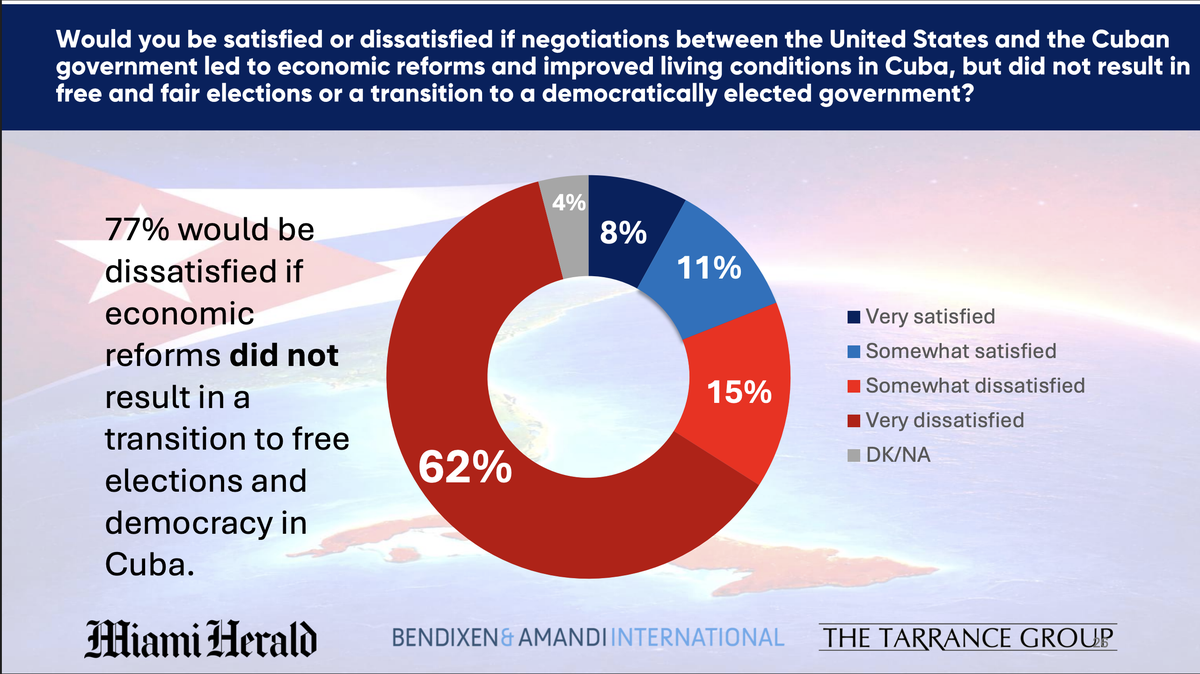
A vast majority of Cubans and Cuban-Americans in South Florida oppose allowing the island’s regime to stay in power in exchange for economic reforms, according to a poll conducted for the Miami Herald released Thursday.
That’s not a surprise. For people who fled Cuba and their descendants, the prospect of negotiations without real change is unacceptable. Allowing the Castros and their associates to escape accountability for the oppression, poverty and suffering they have imposed for decades isn’t an idea that many Cuban Americans can stomach, even if they support the Trump administrations taking action in the Caribbean nation.
According to the findings of the poll, 67% of respondents approve of President Trump’s handling of Cuba but support drops to 46% when the question is about negotiating directly with Cuba’s socialist government. Only 19% would be satisfied with economic reforms without regime change. The survey was conducted from April 6-10 and covered 800 randomly selected Cubans and Cuban Americans living in Miami-Dade, Broward, Palm Beach and Monroe counties. It has a margin of error of plus or minus 3.5 percentage points.
These results should weigh the heaviest on Secretary of State Marco Rubio, who grew up steeped in Miami Cuban exile culture and whose career has been built, in part, on opposing the regime. Rubio has had back-channel conversations with Raúl Castro’s 41-year-old grandson, and Rubio’s team met with him on the sidelines of an annual meeting of Caribbean leaders in Saint Kitts in February, the Herald reported.
A Caribbean diplomat told the Herald in February that Rubio had made it clear that “the U.S. was pretty close to getting the Cubans to change their system.” But Cuba’s President Miguel Díaz-Canel has said he won’t leave power and vowed to resist pressure from the Trump administration.
At this point, it’s unclear what the plan for Cuba may be. An overwhelming majority — close to 80% — of poll respondents support some type of U.S. military intervention there. But that’s a risky option, and it brings up the question of how far America should go to enact change in any country. With the U.S. fighting an unpopular war in Iran, the prospect of military action in another country would be a political risk so close to the midterms — not that Trump seems to be acting with the American people’s desires in mind. The U.S. should be wary of forcing regime change, considering how that’s historically gone wrong.
Of course, opinion polls shouldn’t dictate American foreign policy. And it’s very likely that the results of this poll differ greatly from how other groups of people in South Florida, and Americans in general, feel about tactics in Cuba.
But the survey may be a window into a conundrum Rubio could be facing. The approach the U.S. used in Venezuela — of capturing Nicolás Maduro but leaving his government and vice president mostly in power, at least for now — would probably be unpopular in Rubio’s hometown. At the same time, Rubio’s role as secretary of state is to represent the interests of an entire nation; and he reports to a president who has a transactional approach to foreign policy.
Cuban-American voters have been reliable Republicans and helped Trump win Miami-Dade in 2024 — the first time a GOP presidential candidate carried the county since the 1980s. But, according to the poll, many disagree with some of Trump’s immigration policies, with 68% saying they strongly or somewhat disapprove of the Trump administration’s deportations of undocumented Cubans without criminal records. They also overwhelmingly support allowing Cubans to legally immigrate to the United States. This can’t be dismissed as an anti-Trump liberal wish — of the respondents who were registered voters, 57% were Republicans and 17% Democrats.
It would behoove the administration and Rubio, who’s mostly supported Trump’s anti-immigration moves — such as ending Temporary Protected Status for Venezuelans, despite previously supporting it — to pay attention to these results. If even some of the president’s loyal supporters have concerns about part of his immigration policies, that’s a sign the administration has gone too far.
When it comes to addressing Cuba, a poll of 800 people obviously won’t be the deciding factor, but it shows that, for Cubans living in South Florida, the most important goal should be freedom.
BEHIND THE STORY
MOREWhat's an editorial?
Editorials are opinion pieces that reflect the views of the Miami Herald Editorial Board, a group of opinion journalists that operates separately from the Miami Herald newsroom. Miami Herald Editorial Board members are: opinion editor Amy Driscoll and editorial writers Isadora Rangel and Mary Anna Mancuso. Read more by clicking the arrow in the upper right.
What's the difference between an op-ed and a column?
How does the Miami Herald Editorial Board decide what to write about?
The Editorial Board, made up of experienced opinion journalists, primarily addresses local and state issues that affect South Florida residents. Each board member has an area of focus, such as education, COVID or local government policy. Board members meet daily and bring up an array of topics for discussion. Once a topic is fully discussed, board members will further report the issue, interviewing stakeholders and others involved and affected, so that the board can present the most informed opinion possible. We strive to provide our community with thought leadership that advocates for policies and priorities that strengthen our communities. Our editorials promote social justice, fairness in economic, educational and social opportunities and an end to systemic racism and inequality. The Editorial Board is separate from the reporters and editors of the Miami Herald newsroom.
How can I contribute to the Miami Herald Opinion section?
The Editorial Board accepts op-ed submissions of 650-700 words from community members who want to argue a specific viewpoint or idea that is relevant to our area. You can email an op-ed submission to oped@miamiherald.com. We also accept 150-word letters to the editor from readers who want to offer their points of view on current issues. For more information on how to submit a letter, go here.