
Cuban Americans split from Trump on deportations, treatment of Cuban migrants, poll shows
Cubans and Cuban Americans living in South Florida want the Trump administration to ease up its aggressive crackdown on immigrants from the island, according to a new Miami Herald poll, signaling a rift over immigration policy between the president and some of his staunchest supporters.
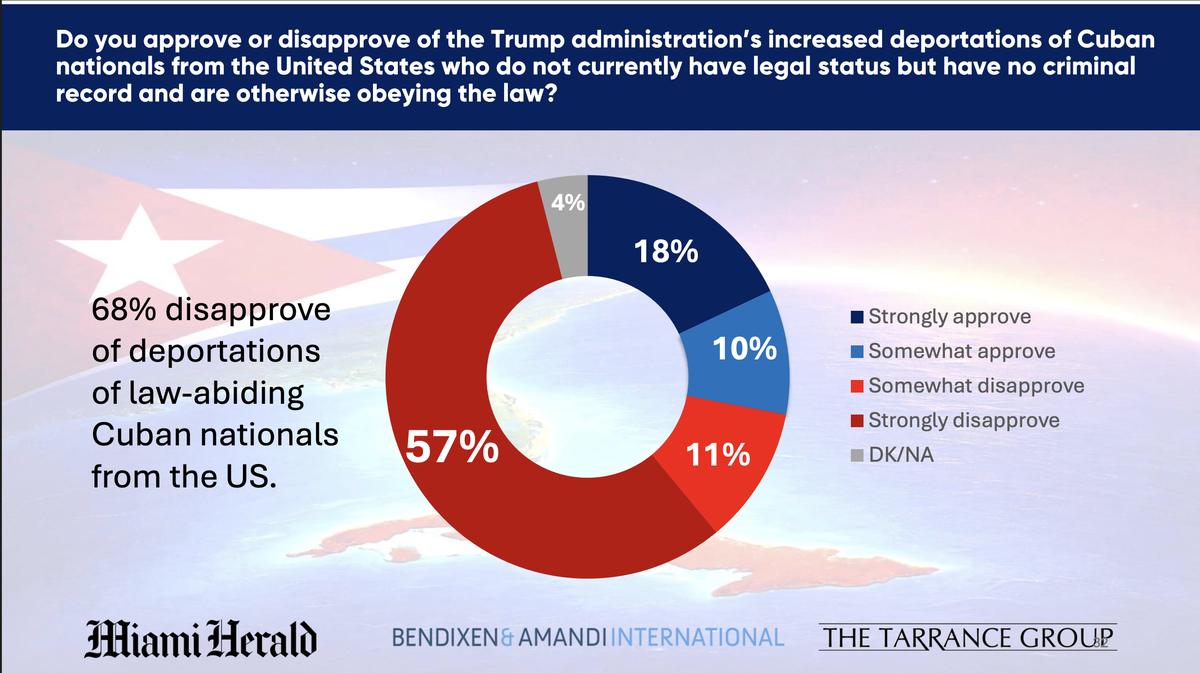
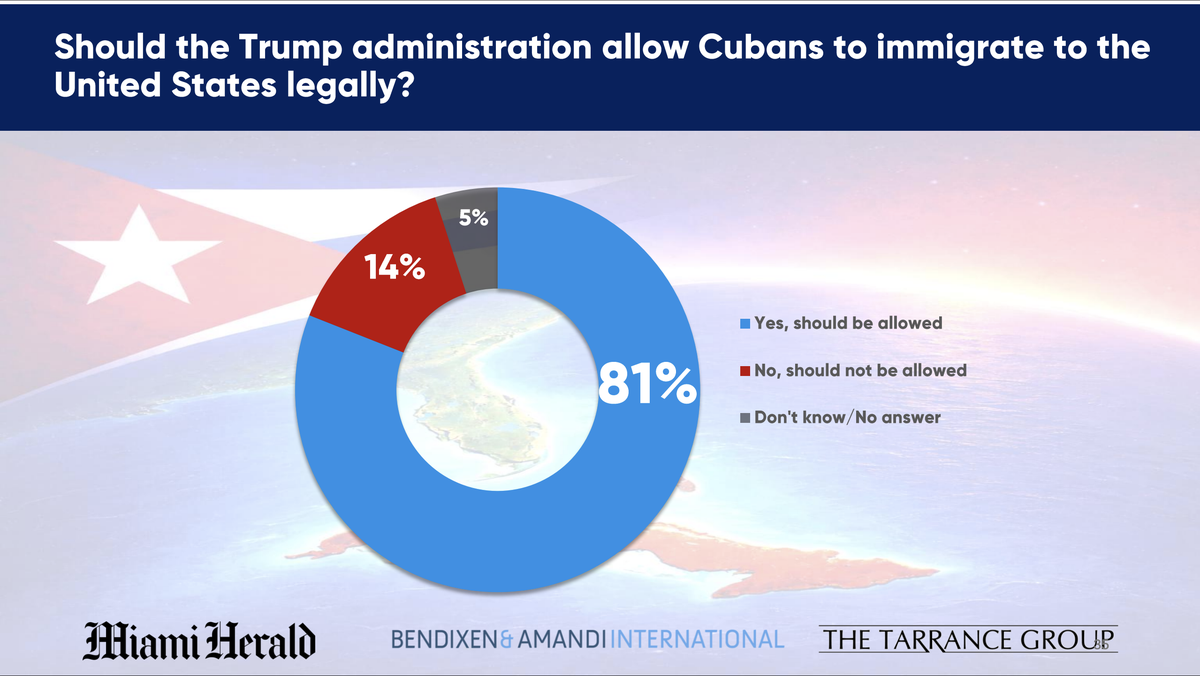
According to a poll conducted for the Herald by Bendixen & Amandi International and The Tarrance Group, 68% of Cubans strongly or somewhat disapprove of the Trump administration’s increased deportations of undocumented Cubans without criminal records. They also overwhelmingly — at 81% — support allowing Cubans to legally immigrate to the United States.
The survey results reveal that while 67% of Cuban Americans back President Donald Trump’s handling of U.S. policy towards Cuba many appear to disagree with his administration’s treatment of Cuban immigrants — many of whom are in legal limbo in South Florida — in pursuit of mass deportations.
Idalmis Alba and her husband, Nelson Emilio Martín, both 41, left Cuba three years ago. While they back a military and humanitarian intervention on the island to bring about democratic change, they oppose Trump’s approach to deportations.
“We left Cuba fleeing,” said Alba, one of the poll’s respondents. “We are in favor of allowing those who wish to prosper to stay. As for those who came just to ‘scheme’—they can be deported.”
Alba said the deportation process is not being selective: “They are deporting everyone without considering that many have not committed any crimes.”
The poll, conducted from April 6-10, surveyed 800 randomly selected Cubans and Cuban Americans living in South Florida, from the Florida Keys to Palm Beach County. About three-quarters of those surveyed were born on the island, while the rest were born in the United States. The survey has a margin of error of plus or minus 3.5 percentage points.
READ MORE: Cuban Americans support U.S. military attack on Cuba, reject economic deal, poll shows
Poll respondent Albert Rodriguez, a 33-year-old administrator born and raised in Miami-Dade County, is strongly against Trump’s handling of U.S. policy towards Cuba — reflecting the results of those in the 18-34 age group, where 53% strongly or somewhat disapproves. Besides being opposed to interventionist policies like the recent U.S. oil blockade on Cuba, he disagrees with Trump’s immigration policies.
“We have a moral responsibility to take in the victims of our own policy,” said Rodriguez, referring to the long-standing embargo and the wider U.S. strategy towards Cuba.
Historically, Cubans have enjoyed immigration privileges other nationalities have not had, including a fast track path to green card and citizenship through the Cuban Adjustment Act. The 1966 legislation allows Cubans who are admitted or paroled into the U.S. to apply for permanent residency a year and a day after arriving.
But the immigration landscape has rapidly evolved for Cubans over the last few years. For decades the “wet-foot dry-foot” policy also generally allowed Cubans who arrived by sea and land to stay, although the policy ended under President Barack Obama in 2017. And many Cubans who arrived during the Biden administration could not apply for green cards under the Cuban Adjustment Act because the paperwork they received when they arrived through the U.S.-Mexico border has been interpreted by immigration courts to make them ineligible.
During his second term in office, Trump eliminated a Biden-era parole process that allowed Cubans, Nicaraguans, Haitians and Venezuelans to come and live and work in the U.S. for two years as long as they had financial sponsors and passed background checks.
New visa charges, entry bans and freezes on benefit applications have plunged both Cubans in the U.S. seeking a more stable immigration status and those still on the island hoping to emigrate into deep uncertainty. Trump has frozen ongoing applications for green cards, asylum, citizenship and work permits.
Currently, there are nearly a million immigration-benefits applications from Cubans on hold, according to the Cato Institute. That includes nearly 36,000 Cubans with naturalization applications on hold and 157,000 plus people currently in the United States trying to get green cards, nearly all of them through the Cuban Adjustment Act.
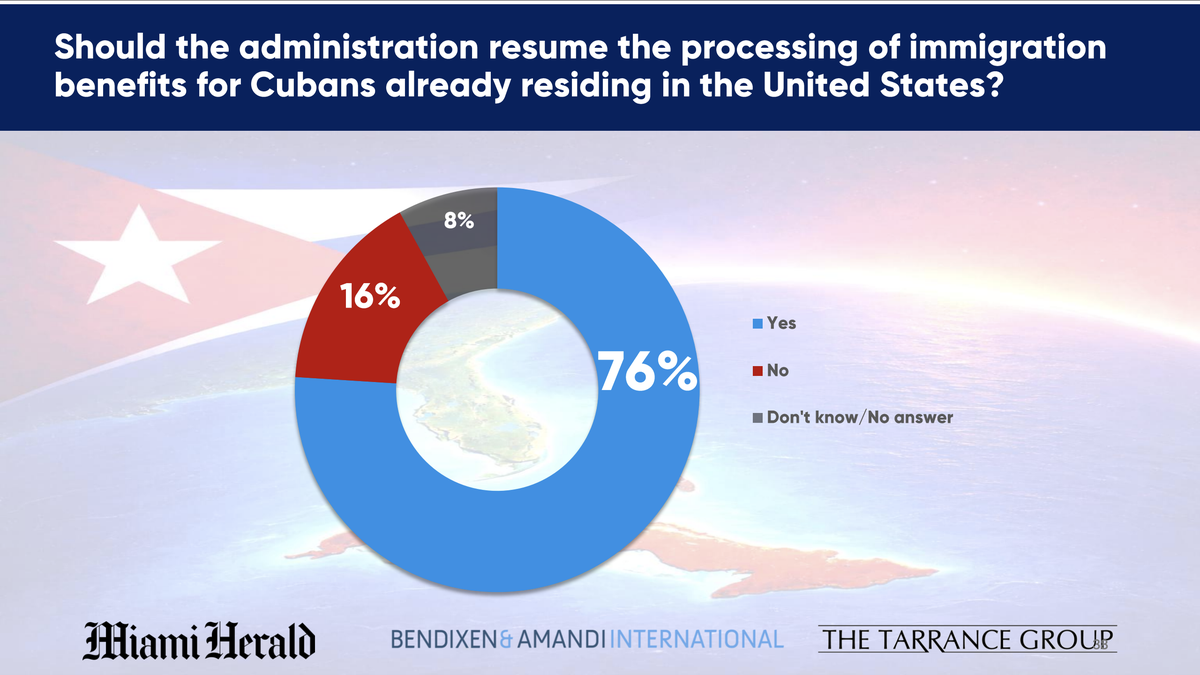
The poll found that 76% of Cuban Americans surveyed believe the administration should resume the processing of immigration benefits for Cubans already residing in the United States.
“The benefits should start again. It’s cruel,” said poll respondent Alan Lau, a 67-year-old real estate agent who came to the U.S. from Cuba in 2000.
READ MORE: Million-plus immigration-benefits applications from Cuba, Haiti, Venezuela frozen
There were some differences in immigration attitudes between recent arrivals and earlier waves of Cuban exiles. Generally, the longer someone has been in the United States, the more likely they are to support Trump’s immigration policies towards Cubans, according to the poll. But even a significant majority, 71%, of those who arrived in the 1960s say they favor resuming the processing of immigration benefits.
Among those earlier arrivals, 72% believe the Trump administration should allow the Cubans to immigrate legally, compared to 84% of those who came in the 1970s, 76% of those who arrived in the 1980s, 84% of those who arrived in the 1990s, and 86% of those who arrived after 2000. ck
Poll respondent Miguel Riveron, a 75-year-old executive who lives in Miami-Dade County, told the Herald that cases of Cubans who come illegally to the United States should be considered on a case-by-case basis. Riveron came to the United States in the 1960s at age 11. He was a “Pedro Pan” kid, one of 14,000 children whose families sent them alone from Cuba to the United States after the Fidel Castro revolution. He came with his cousins and reunited a year later with his parents.
“It’s difficult to answer. Because the law is the law, but every single case is different,” Riveron said, adding that people should be vetted through the channels of the immigration system.
Other results
The poll also showed that nearly three-quarters of South Florida Cubans blame the Cuban government for the current economic crisis and humanitarian crisis on the island, and they favor a strong-handed approach from the U.S. towards Cuba; 69% said they “strongly disapprove” of any agreement between Washington and Havana towards economic reforms if the current government stays in place.
A strong majority, 79% support military intervention to remove the current government, address humanitarian needs, or both. Those results come in the wake of the Trump administration forcefully removing Venezuelan leader Nicolás Maduro in January and starting a war against Iran — foreign policy moves that the Cuban community, many of whose exiles have been waiting for change in Cuba for decades, may be interpreting as administration openness to direct intervention against the Cuban regime.
READ MORE: Deportations, Castro negotiations: where Trump-loving Cubans disagree with him, poll says
Lau, the real estate agent, said he wants the government to change but that he does not favor forceful intervention. A rare Cuban Democrat, he said he favored the Obama administration’s approach towards the island nation.
“When you attack a country, the bullets go everywhere and the innocent die,” he said.
Additionally, 68% of Cubans say they support the U.S. restrictions on oil shipments to Cuba. In recent months, Cuba’s humanitarian crisis has worsened as the Trump administration choked its oil supply and threatened petroleum-supplying nations with sanctions if they helped Havana.
“The community is drawing a bright red line. They want pressure on the regime, they want the removal of the regime. If a negotiation props up the communist government, most Cuban Americans would rather see no negotiation at all, even if it means blowing the process of relief for their own family members on the island,” said Bendixen & Amandi President Fernand Amandi.
But while a majority of Cubans surveyed support a heavy-handed approach towards Cuba’s government, many would like to see a softer strategy towards its people who have come to the United States.
“I support taking action against individuals who are criminals, but not abuse”, said poll respondent Haydee Freire, 76, who arrived in 2005. “What has happened to many immigrants from Cuba, Mexico, and other countries is that they have been subjected to abuse—and even killed. And that is a crime. There are families who have been in the United States for 20 years, working here, who have built a decent life for themselves.”
El Nuevo Herald staff writer Sarah Moreno contributed to this story.
This story was originally published April 16, 2026 at 5:30 AM.