Broken Promises: Black residents in Northwest Dade have waited 30+ years for Metrorail. Surprised? | Opinion
READ MORE
Broken Promises: Miami has a trust problem. Here’s why
The vows sound so convincing — a waterfront park, economic revival in a historic Black neighborhood, a new rail line. Decades later, the pledges remain unfulfilled. Elected leaders and developers move on, hoping voters and taxpayers will forget. What happens when no one is ever held accountable? The Miami Herald Editorial Board wanted some answers.
Expand All
In the many and varied ways the taxpayers of Miami-Dade County have been betrayed by their leaders over the years, one stands out for the sheer, galling longevity of the duplicity: the failure to build the North Corridor extension of Metrorail.
For almost 40 years, the Black communities in the northern end of the county have been waiting for the rail line that our leaders promised them if they voted for mass transit back in the late ‘70s. Residents have been shafted for so long, children have been born, grown up and had children of their own. The Metrorail extension isn’t just late. It’s a generation or two late.
So now there’s some positive-sounding news about construction possibilities. A new pot of federal money might make the difference — again! We hope it turns out to be true. But we cannot be dazzled by visions of dollars wafting in from Washington anymore. We won’t believe it until the track is being laid and the stations are rising from the earth. We don’t expect Black voters to believe it, either: Decades of being slighted and overlooked have taught us all that bitter lesson.
The failure to build the promised stretch of track from the core of Miami up to the northern county line isn’t just about transit, critical as that is to our community. It’s also about injustice, the kind that breeds distrust in public officials and institutions and undermines democracy, something we can ill afford.
So we’ll say it again: The people of northern Miami-Dade were promised transit. They voted for it. They deserve to get it. Or, at the very least, their children and grandchildren do.
Getting around
A lack of easy, smart transportation is one of the biggest and most persistent drawbacks to living in Miami. Getting around still is far too difficult for a place that aspires to be a world-class city or even just a livable one. There are efforts underway that may help, at least a bit: Tri-Rail will, eventually, connect to downtown Miami. A Bus Rapid Transit line in southern Miami-Dade is being built, though it has fallen behind schedule. The too-costly monorail to Miami Beach is dead, to be replaced by a more common-sense expansion of the Metromover from the mainland.
And higher-density housing near rapid mass transit hubs is also being constructed, at long last, downtown and farther south, along the original Metrorail corridor.
It all takes too long and costs too much, but there’s no real choice. If this region is going to grow, we have to handle transportation in a modern way. More cars are not the answer.
Now there’s the possibility of progress on Metrorail’s North Corridor, too. In November, the county announced an expedited plan to build a leg of the elevated train from 79th Street north to the Hard Rock Stadium — where the Dolphins have actually chalked up some wins lately and World Cup games will be hosted in 2026. The rail would be completed first, and at a faster pace than contemplated before. Seven additional stations would supposedly be added later, between 79th Street and the stadium.
A train to a World Cup match or a Formula 1 race or a big-time concert sounds great — world class, even — but there’s also a real danger that building the lone stadium stop before the other stations could result in something we don’t want to see: richer, whiter fans being ferried right past the poorer, working-class communities, with the needs of billionaire team owners being served before the rest of the community that voted for the North Corridor in the first place.
If the county builds the stadium-only extension first, what credible guarantee will North Corridor residents have that the stations designed to serve them will be built? After all, they were told — and believed — that a Metrorail extension was coming their way a long time ago. Those additional stations can’t be one more insulting broken promise. The county must follow through here, and quickly.
As always, it comes down to money. A 2018 estimate of construction costs for this new rail line was about $1.8 billion, and it’s likely to be more now. County officials tell us they think they can snag federal dollars to pick up as much as 45% of the costs, with state and local money covering the rest.
Setting aside our skepticism about whether Miami-Dade really will be able to get that federal money — a suspiciously familiar refrain — we hope the county is right when it says the best way to secure that help from the feds is with this new, speedier Metrorail extension plan. The Miami-Dade project could qualify for U.S. Department of Transportation money as soon as next year. Construction could follow within 12 months, they believe.
A year? That would be an astonishing feat, considering the long and tortured history of this project. We still remember the other administrations and other elected leaders who made similar pledges to get this project done and then didn’t do it — when Metrorail was first built, for example, and, again, two decades ago, when county voters approved a half-penny transit tax that ended up paying for a backlog of maintenance work rather than promised new rail lines including the North Corridor.
The Miami Herald’s archives are replete with headlines from the distant past about yet another attempt to finally — finally! — extend Metrorail north to the Broward County line, pledges that never were fulfilled.
Metrorail became ‘Metrofail’
When the heavy rail system opened in 1984, it was planned in phases that included a northern leg of track along 27th Avenue, pretty much the same one we’re talking about today. But Metrorail quickly turned into “Metrofail” with soaring construction costs, dismal ridership, a blatant failure by the government to figure out a source for annual operating and maintenance revenue and the damning conclusion that the lines went places where people didn’t much need to go.
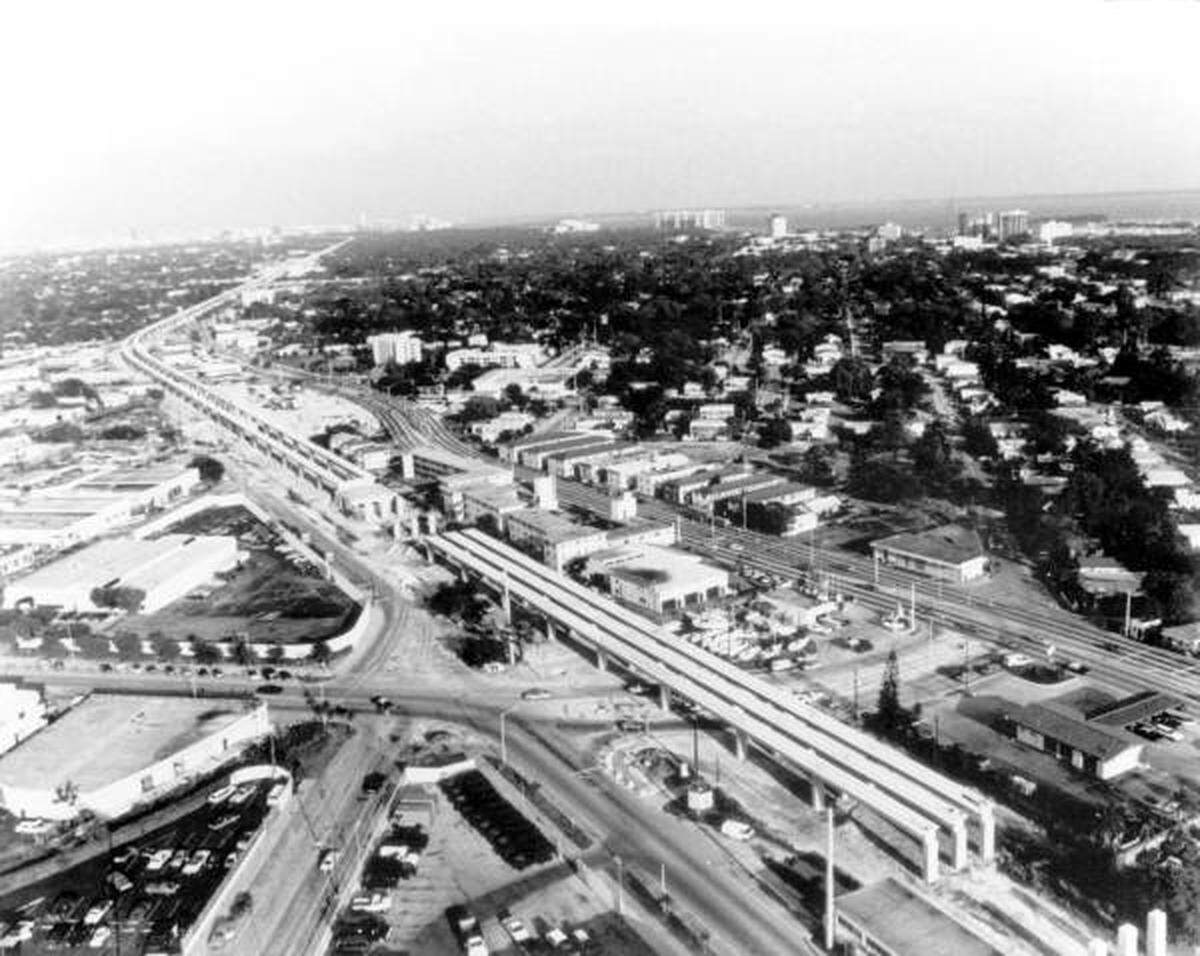
Metrorail became the subject of national ridicule. President Reagan infamously called it “a billion-dollar mistake,” saying the system had so few riders, “it would have been a lot cheaper to buy everyone a limousine.”
Not surprisingly, discussions of extending Metrorail north — or anywhere else — withered away.
The conversation about transportation in Miami has changed enormously since then. The pressure of growth is making mass transit more critical, and housing prices are driving a conversation on increasing density, especially along those all-important rail and bus corridors. We have TriRail and Brightline. Interstate 95 has been widened and widened. We have toll lanes that offer “express” service. We have Uber. We do not, however, have the North Corridor on Metrorail.
Let’s be clear. The promise of a 27th Avenue track wasn’t just an idea or an optional add-on. It was a promise, made to the Black community in 1978 to win votes for Metrorail. And it worked. The referendum was a squeaker, with just 50.34% voting for mass transit. Black voters were credited with putting it over the top.
New segments of Metrorail have been built since then, for reasons both political and practical — to Hialeah and to the airport, finally. Not the North Corridor, though.

Disastrous transit tax
But the North Corridor insults don’t stop there. In 2002, 66% of voters approved the half-penny sales tax for transit, but that didn’t help, either. In fact, it was disastrous. The referendum for the People’s Transportation Plan misleadingly sounded like a cure-all for much of what ailed, and still ails, Miami-Dade’s transportation grid. There was something for everyone: more bus service, coordinated traffic signals to reduce congestion, improved roads, including drainage and a pledge of “building rapid transit” to places including Miami Beach, Florida City and, yes, specifically, “North Dade.”
The whole thing was wildly unrealistic and quickly became a bitter disappointment to taxpayers. The original plan had called for a full penny tax, and the list of projects had been based on that. When polls showed the full penny might not pass, the referendum was trimmed to a half penny — but the project list wasn’t cut. Most of the money has been spent on deferred maintenance of the existing transit system. Here we are, 20 years since that vote, and the North Corridor is among the many promises that remain broken.
The new plan for the North Corridor, unveiled by Miami-Dade Mayor Daniella Levine Cava in November, would run the track north from the Northwest 79th Street station, and is part of the county’s SMART Plan, a process that launched transit studies for six of the county’s busiest commuting corridors, most of which were promised new rail lines with the 2002 sales tax campaign.
Levine Cava said she understands the hard feelings that just the mention of the North Corridor can trigger. “We’re trying to make up for lost time and trust” in a community that has “felt left behind,” she said, calling the project “truly transformational.”
That’s if it really happens, of course.
Miami-Dade Commission Chairman Oliver Gilbert, who represents Miami Gardens, where the new track would run, says he’s “cautiously optimistic” that this time really will be different. He pushed to kill an ongoing request for private rail proposals for the North Corridor in favor of the new plan by the county, helping to clear the way for Miami-Dade’s application to the federal government for funding.
“It shows that we’re serious,” Gilbert told us.
That does seem like an important thing to establish in this case, to put it mildly. Perhaps, though, voters are the ones who need to hear it — and believe it — most.
Over the years, objections to building rail along this corridor have been repeatedly raised on grounds it will not produce enough riders to make the investment worthwhile. But public transit is already highly subsidized. And there’s another argument: If our goal is to create more housing by increasing density along transit corridors, something Gilbert — who is also chairman of the Miami-Dade Transportation Planning Organization — believes will help relieve housing pressures in the county, then this makes sense. Gilbert said Miami Gardens is among the cities that would be able to build higher density housing along the rail without much complication.
The North Corridor could also connect to rapid transit in Broward, Gilbert notes, something that was discussed back in the late ‘90s. That’s longer term planning, something South Florida is notoriously bad at, but it should be considered. If Miami wants to be a great city, it needs to include plans for regional transportation, beyond its own parochial interests.
Miami-Dade has decades of bad history to overcome on transit. The voters have been deceived, fleeced and lied to, with the transit tax as Exhibit A. There’s not much trust left, understandably. And there’s a special rancor — that has been fully earned — when it comes to the North Corridor.
This is a chance to, finally, start evening up the ledger, just a little bit. The Metrorail extension, with all of its stations, needs to be built to a part of the community that has been pushed aside for too long, whose hopes were disregarded and to whom promises didn’t matter.
The people were promised rail. They didn’t get it. Almost 40 years later, it’s beyond time to get it done.
BEHIND THE STORY
MOREWhat's an editorial?
Editorials are opinion pieces that reflect the views of the Miami Herald Editorial Board, a group of opinion journalists that operates separately from the Miami Herald newsroom. Miami Herald Editorial Board members are: opinion editor Amy Driscoll and editorial writers Isadora Rangel and Mary Anna Mancuso. Read more by clicking the arrow in the upper right.
What's the difference between an op-ed and a column?
How does the Miami Herald Editorial Board decide what to write about?
The Editorial Board, made up of experienced opinion journalists, primarily addresses local and state issues that affect South Florida residents. Each board member has an area of focus, such as education, COVID or local government policy. Board members meet daily and bring up an array of topics for discussion. Once a topic is fully discussed, board members will further report the issue, interviewing stakeholders and others involved and affected, so that the board can present the most informed opinion possible. We strive to provide our community with thought leadership that advocates for policies and priorities that strengthen our communities. Our editorials promote social justice, fairness in economic, educational and social opportunities and an end to systemic racism and inequality. The Editorial Board is separate from the reporters and editors of the Miami Herald newsroom.
How can I contribute to the Miami Herald Opinion section?
The Editorial Board accepts op-ed submissions of 650-700 words from community members who want to argue a specific viewpoint or idea that is relevant to our area. You can email an op-ed submission to oped@miamiherald.com. We also accept 150-word letters to the editor from readers who want to offer their points of view on current issues. For more information on how to submit a letter, go here.
This story was originally published December 28, 2022 at 4:00 AM.