
Welcome to Florida, where COVID-19 is rampant, but mask mandates are the enemy | Editorial
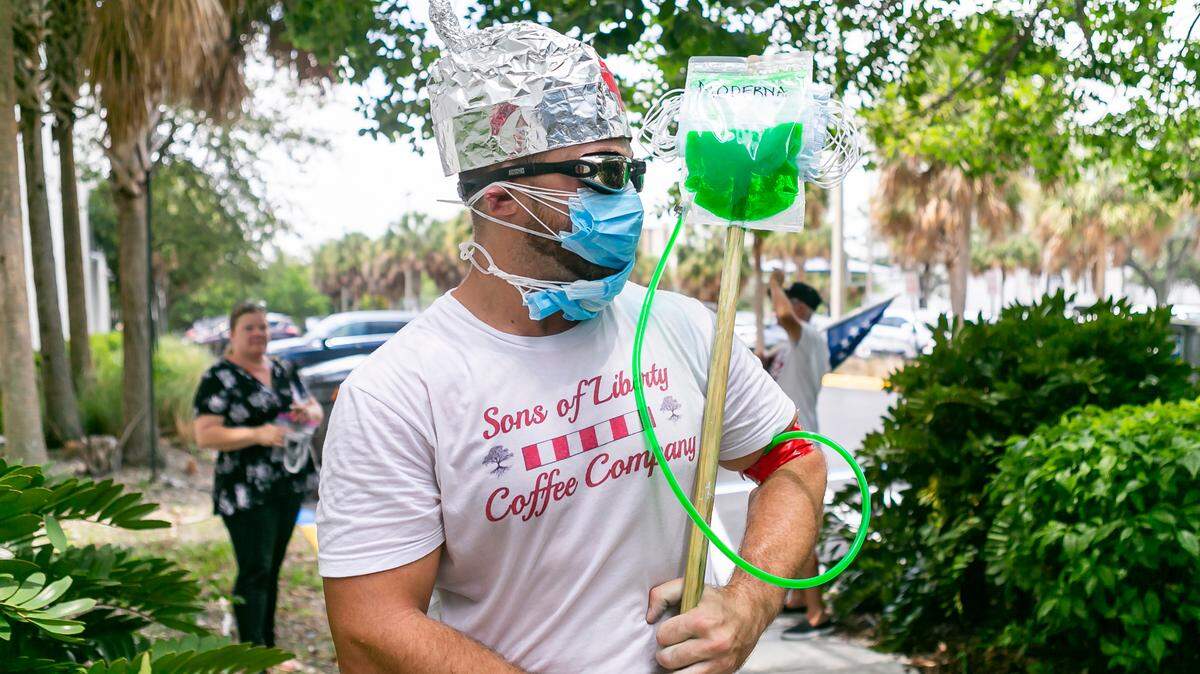
It’s like the overwrought plot of a B movie.
New COVID-19 cases have reached numbers never seen in Florida since the beginning of the pandemic. Hospitalizations have reached a record high. More children in the Sunshine State were hospitalized with confirmed or suspected COVID-19 infections on Tuesday than in any other state in the country.
The real threat to public health?
The delta variant of COVID-19. That’s what most hospital officials, doctors and epidemiologists have been saying.
But not in Florida — if you look at the recent actions by state officials.
As soon as the virus is exposed to the Sunshine State’s magic dust, something special happens. Guidance about the efficacy of masks to prevent transmission — from the Centers for Disease Control and Prevention and the American Academy of Pediatrics, among others — might work for other states, but we got our own medical experts here: Gov. Ron DeSantis and the State Board of Education.
They are telling us that the real threat to public health, in particular to children, isn’t the coronavirus. It’s mask mandates. And the villains? Educators armed with disposable face coverings.
It’s a perversion of public health. The playbook turns one of the weapons in the fight against COVID into a threat so serious it requires government intervention. For instance, DeSantis signed an executive order threatening school districts that require masks with funding cuts. But that same government washes its hands from fighting the real threat — you know, the one that has killed close to 40,000 Floridians and put more than 12,000 people in hospitals as of Tuesday.
Friday, the state Board of Education, appointed by the governor, will consider a proposed emergency rule that encapsulates that very attitude. The rule would allow parents to use school vouchers to transfer kids out of schools “when a school district’s COVID-19 health protocols, including masking, pose a health or educational danger to their child.”
The proposal would use the Hope Scholarship program, created by the Legislature to allow children who are bullied to transfer to another public or private school. The rule appears to equate mask mandates with “harassment; hazing; bullying; kidnapping; physical attack; robbery; sexual offenses,” which are some of the types of scary incidents covered by the program.
It’s unclear whether parents who don’t want to send their children to a school without a mask mandate could use the program as well. That would be only fair. The proposal’s language was still being crafted by the Department of Education as of Thursday evening, the Herald reported.
We’ve got to give DeSantis and his troupe credit for their astuteness. They have created the perfect political antagonist: one that is in your face — and on it — easy to understand and spurs freedom-seeking protesters at school board meetings. Yes the masks can be uncomfortable and inconvenient, especially for kids and teens. But the real enemy is microscopic, complex and ever-changing as new variants develop and new data comes out, forcing the CDC to change its recommendations — creating some public mistrust.
The passion that a simple piece of cloth stirs in some people can be easily capitalized in campaign fundraisers and in political rallies with crowds of maskless supporters.
Why should they listen to the CDC and most pediatricians and epidemiologists? People like Dr. Aileen Marty, an expert in infectious disease and disaster medicine at Florida International University, who has advised the school district and other local organizations during the pandemic?
As Marty told the Editorial Board on Thursday: Masks do protect people, including children.
“When everyone is wearing a mask, even if there’s one individual who has the virus … that person is shedding less [virus] into that atmosphere, and those who are breathing that atmosphere are less likely to get it.”
Listen to Marty. Unlike state leaders, she knows the true enemy when she sees it.
BEHIND THE STORY
MOREWhat's an editorial?
Editorials are opinion pieces that reflect the views of the Miami Herald Editorial Board, a group of opinion journalists that operates separately from the Miami Herald newsroom. Miami Herald Editorial Board members are: opinion editor Amy Driscoll and editorial writers Isadora Rangel and Mary Anna Mancuso. Read more by clicking the arrow in the upper right.
What's the difference between an op-ed and a column?
How does the Miami Herald Editorial Board decide what to write about?
The Editorial Board, made up of experienced opinion journalists, primarily addresses local and state issues that affect South Florida residents. Each board member has an area of focus, such as education, COVID or local government policy. Board members meet daily and bring up an array of topics for discussion. Once a topic is fully discussed, board members will further report the issue, interviewing stakeholders and others involved and affected, so that the board can present the most informed opinion possible. We strive to provide our community with thought leadership that advocates for policies and priorities that strengthen our communities. Our editorials promote social justice, fairness in economic, educational and social opportunities and an end to systemic racism and inequality. The Editorial Board is separate from the reporters and editors of the Miami Herald newsroom.
How can I contribute to the Miami Herald Opinion section?
The Editorial Board accepts op-ed submissions of 650-700 words from community members who want to argue a specific viewpoint or idea that is relevant to our area. You can email an op-ed submission to oped@miamiherald.com. We also accept 150-word letters to the editor from readers who want to offer their points of view on current issues. For more information on how to submit a letter, go here.
This story was originally published August 6, 2021 at 6:00 AM.