
Miami-Dade schools chief to follow science on masks. Too bad DeSantis won’t do the same | Editorial
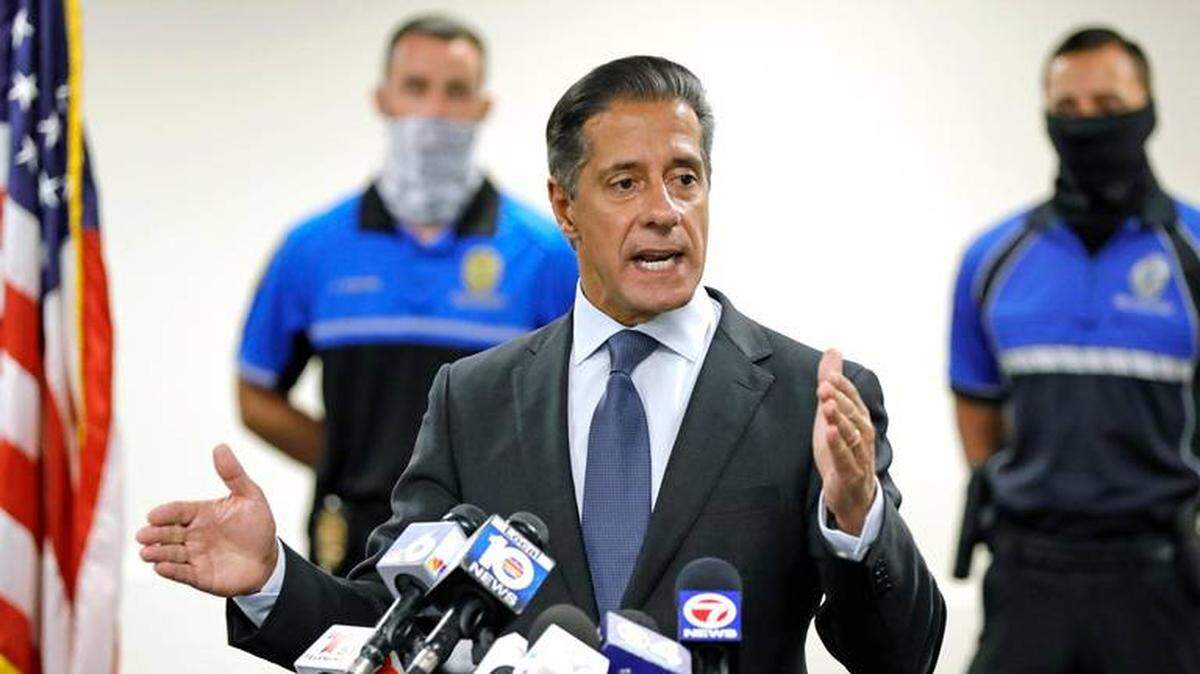
Miami-Dade County Public Schools Superintendent Alberto Carvalho vowed to be guided by “science, by medical experts and public health experts” before deciding on a mask mandate for the next school year.
Good. That’s what you’d expect from the leader of Florida’s largest school district in a county with high transmission rates in a state where COVID-19 cases and hospitalizations reached record numbers over the past week.
However, Gov. DeSantis is forcing Carvalho and other school-district leaders to make these decisions based on the governor’s interpretation of public health, which means we’re all in trouble.
Friday, DeSantis signed an executive order that essentially bans school mask mandates, prohibiting districts from violating “parents’ right . . . to make health decisions for their minor children.”
School boards that dare to cross the governor can lose state funding. In other words, the governor is willing to knee-cap school districts in order to make his constituents deathly ill.
Just hours before DeSantis’ announcement, Carvalho told the Herald Editorial Board he would consult with the district’s medical task force, which will meet before school starts on Aug. 23. He will also look at what the Centers for Disease Control and Prevention and the American Academy of Pediatrics have recommended. Carvalho previously had said masks would be optional, but that was in late June, before Florida became the pandemic’s epicenter thanks to the highly transmissible delta variant.
An internal CDC document obtained by the Washington Post, based on still-unpublished data, states delta might lead to more serious illness and that it’s as contagious as chickenpox and more contagious than the Ebola virus or common colds. That prompted the federal agency to advise fully vaccinated people to go back to wearing masks indoors.
Universal masking
The CDC and the Academy of Pediatrics also reached a consensus: Schools should be open, and universal masking is recommended for children older than 2 “because a significant portion of the student population [under the age of 12] is not yet eligible for vaccines, and masking is proven to reduce transmission of the virus and to protect those who are not vaccinated,” the Academy of Pediatrics wrote in a July 9 advisory.
Carvalho said it’s “probably a fairly accurate prediction” that the task force would end up recommending a mask mandate. Among the experts advising Carvalho is U.S. Surgeon General Vivek Murthy, a Miami Palmetto Senior High graduate.
“We have been a district that’s well informed by science, by medical experts and public health experts and that will not change under my leadership,” Carvalho told the Editorial Board. “The CDC has opined, the American Academy of Pediatrics has opined and the [Florida Chapter of the American Academy of Pediatrics] has opined as well. And, you know, they all agree in terms of protected and preventive measures.”
If only school districts could base their decisions on the needs of their communities, by looking at infection rates in their back yards instead of being forced to follow an irresponsible blanket state policy that applies anywhere from rural to urban counties.
“I’ve been very clear I believe that generalized pronouncements via executive order, or state statute, that basically don’t differentiate between conditions — which may vary significantly from South Florida, Central Florida, the Panhandle — that don’t take into account how different those conditions may be and the impacts they may have, may not necessarily be in the best interest of our communities,” Carvalho said.
DeSantis’ order is nothing more than a governor throwing a tantrum after the Broward County School Board approved a mask mandate last week. The tantrum worked: the School Board now says it will comply with his order and is considering mandating masks only for employees, parents and visitors.
It’s now up to districts to figure out how to please a governor who’s not afraid to use his executive powers to punish communities while protecting the health of students and staff.
“In light of the release of the Executive Order, we certainly hope to be able to craft protocols that ensure full funding of our children’s education, while simultaneously protecting their and their teachers’ health and well-being,” Carvalho said in a statement released Saturday.
Parents’ rights
Local control makes sense, right? Well, not in Florida.
DeSantis’ reaction to the pandemic has gone from vowing to protect the economy against shutdowns to making a mockery of a virus that’s killing Floridians (38,900 and counting). At least he says vaccines are effective, which is way more than what some Republicans will dare to profess.
At a recent speaking engagement in Utah, DeSantis made fun of mask wearing. He opened up his speech at the American Legislative Exchange Council by looking at a mostly unmasked crowd and saying:
“Did you not get the CDC’s memo?” our governor asked. “I don’t see you complying,” Politico reported.
His Friday announcement happened at a Cape Coral restaurant where — surprise!— most people were not wearing masks, the Sun Sentinel reported. That’s typical fashion for a governor who sells campaign drink koozies and T-shirts emblazoned with “How the hell am I going to be able to drink a beer with a mask on?”
DeSantis doesn’t have to like masks and he can tour the country all he wants mocking them.
But playing off parents’ rights against the right of Floridians to live in good health will likely hurt the very people whom he’s working hard to accommodate — to say nothing of the rest of us.
Editor’s note: This editorial has been updated to add a statement from Superintendent Alberto Carvalho about Gov. Ron DeSantis’ executive order.
BEHIND THE STORY
MOREWhat's an editorial?
Editorials are opinion pieces that reflect the views of the Miami Herald Editorial Board, a group of opinion journalists that operates separately from the Miami Herald newsroom. Miami Herald Editorial Board members are: opinion editor Amy Driscoll and editorial writers Isadora Rangel and Mary Anna Mancuso. Read more by clicking the arrow in the upper right.
What's the difference between an op-ed and a column?
How does the Miami Herald Editorial Board decide what to write about?
The Editorial Board, made up of experienced opinion journalists, primarily addresses local and state issues that affect South Florida residents. Each board member has an area of focus, such as education, COVID or local government policy. Board members meet daily and bring up an array of topics for discussion. Once a topic is fully discussed, board members will further report the issue, interviewing stakeholders and others involved and affected, so that the board can present the most informed opinion possible. We strive to provide our community with thought leadership that advocates for policies and priorities that strengthen our communities. Our editorials promote social justice, fairness in economic, educational and social opportunities and an end to systemic racism and inequality. The Editorial Board is separate from the reporters and editors of the Miami Herald newsroom.
How can I contribute to the Miami Herald Opinion section?
The Editorial Board accepts op-ed submissions of 650-700 words from community members who want to argue a specific viewpoint or idea that is relevant to our area. You can email an op-ed submission to oped@miamiherald.com. We also accept 150-word letters to the editor from readers who want to offer their points of view on current issues. For more information on how to submit a letter, go here.
This story was originally published July 30, 2021 at 7:21 PM.