The last stand of Champlain Towers South. Computer model, witnesses reconstruct the tragedy
READ MORE
Seven minutes to collapse
Witness accounts, visible damage and a computer model offer insights into how a pool deck cave-in spread, resulting in the catastrophic failure at Champlain Towers.
Expand All
The last stand of Champlain Towers South. Computer model, witnesses reconstruct the tragedy
The collapse reconstructed: Ten witnesses describe what they saw and heard
‘Lives would have been saved’: Fire alarm didn’t go off before Surfside tower collapse
The Herald built a computer model to explore how Surfside tower fell. Here’s what it showed

The team that built the Herald’s engineering models for Champlain Towers
It began with a loud boom, boom. Then, a thunderous throoom, punctuated by the crash of concrete.
Champlain Towers South creaked and groaned but held.
Minutes passed. Four. Five. Six. Seven.
Suddenly a tremendous roar fractured the eerie stillness, like an impossibly loud explosion, as the 12-story concrete structure seemed to melt downward from the middle, almost like sand flowing through an hourglass at high speed.
It was unprecedented and seemingly unexplainable — at least at first.
The tower was neither ancient and nearing its projected life span nor brand new and born with immediately fatal defects, a distinction that separated what happened in Surfside from most building failures in the past. There was no earthquake or hurricane or gas leak or terrorist attack to blame.
Champlain South just fell, in the middle of an otherwise unremarkable week night, six months shy of its 40th birthday, for no obvious reason.
Federal investigators with the National Institute of Standards and Technology are just beginning what promises to be a years-long effort to identify exactly what went wrong and why — a high-stakes mystery that impacts millions of high-rise dwellers around the world who don’t know what characteristics their own homes might share with the ill-fated condo.
In the months since the collapse on June 24, the Miami Herald reconstructed the event through the eyes of 10 key witnesses: a security guard, a tourist, a home health aide, a family of night owls, a couple coming home from dinner, a woman with a guardian angel and a model who watched the structure cave in around her.
Guided by what each person saw, what they didn’t see, and especially what they heard, the Herald worked with engineering professor Dawn Lehman from the University of Washington to identify where the collapse could have started, and how it spread to become one of the deadliest building failures in modern history.
Lehman is an expert in seismic design and evaluation of concrete, steel and composite systems. Over her 30-year career, Lehman has developed various methodologies for modeling the behavior of structural elements in complex, reinforced concrete structures.
Lehman said the witnesses’ collective memory, along with computer models informed by the building’s history and damage observed after the tragedy, suggest that the collapse likely began when corroded steel reinforcement fractured in the first-floor slab, at or near the southern edge of the pool deck.
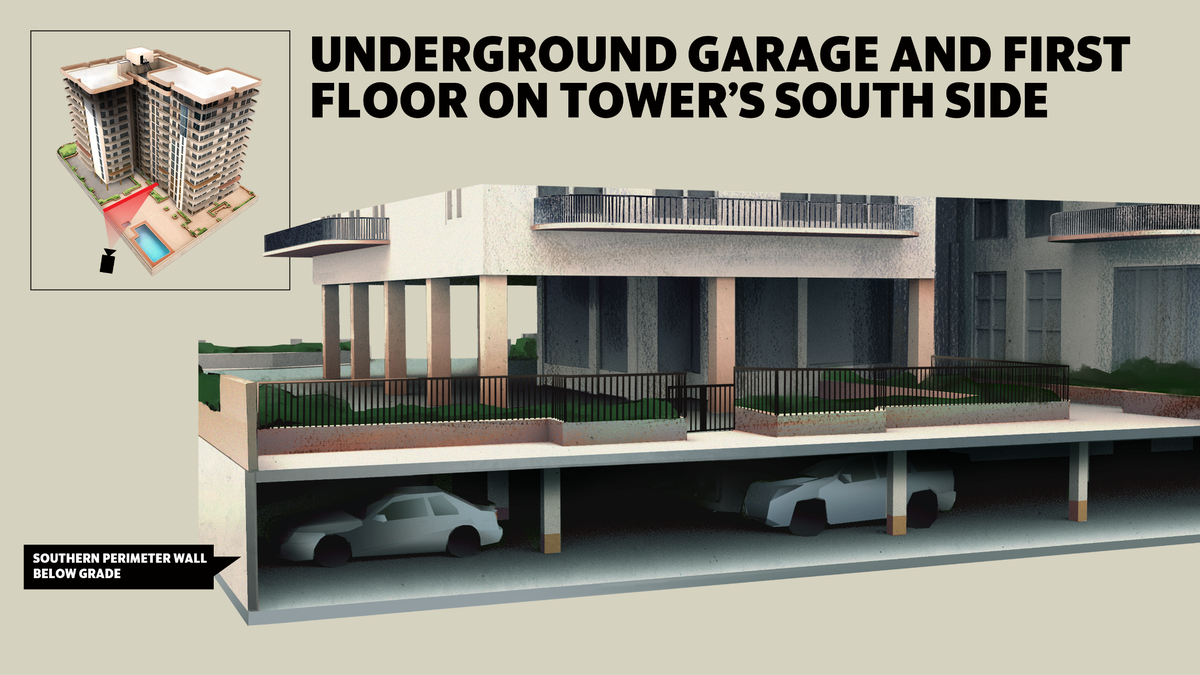
Their stories call into question prior theories built on the assumption that the collapse began when concrete — either slab or column — began to crumble on the northern side of the pool deck.
The collapse might not have been so deadly if not for an apparent malfunction in the alarm system, the Herald investigation found.
The fire alarm was triggered seven full minutes before the tower fell, giving residents on any floor ample time to escape had they acted quickly. But no one interviewed by the Herald heard a siren warning them to evacuate the building. The alarm is not sounding in the background of videos and emergency calls from inside the tower at the time.

SURFSIDE INVESTIGATION
The collapse reconstructed: Ten witnesses describe what they saw and heard.
The tower’s night security guard, Shamoka Furman, provided the framework for the Herald’s forensic investigation into the collapse sequence just minutes after the tower fell.
Police body-camera video shows Furman repeatedly explaining to first responders that the collapse sequence involved three distinct failures over a period of minutes. One small, the next large, the final unspeakably brutal.
The Herald corroborated the account through other witnesses, as well as time-stamped video and emergency calls.
Including Furman, the Herald identified six people who described hearing the first strange sounds — “like a boom boom,” Furman later told police. Those noises represented the first localized failure in the structure, Lehman said. But no one who heard them knew where they were coming from.
Four people on the first floor heard the booms but didn’t see anything unusual, although at that point none of them were looking directly at the pool deck, the Herald found. Two other people in the underground garage, located directly under the deck, also heard a “strange noise” but saw nothing.
Whatever made the first, distinct booming noises wasn’t big, or obvious or dusty — so, probably, it was not a large chunk of concrete falling from the pool deck into the garage below, Lehman said.
She began to look for a less obvious starting point.
“Something that makes sound but you can’t see is almost always reinforcement — rebar — failing [inside the concrete],” Lehman said.
Within a minute or so of the loudest booms, a second, more thunderous noise began — like a wave of concrete. All together, nine people described the noise. Four who searched for its source saw that the pool deck had collapsed into the garage.
Then, seven minutes after the deck collapsed, a horrific crash — both indescribable and unmistakable, those who heard it said — left 98 people buried in a concrete tomb.
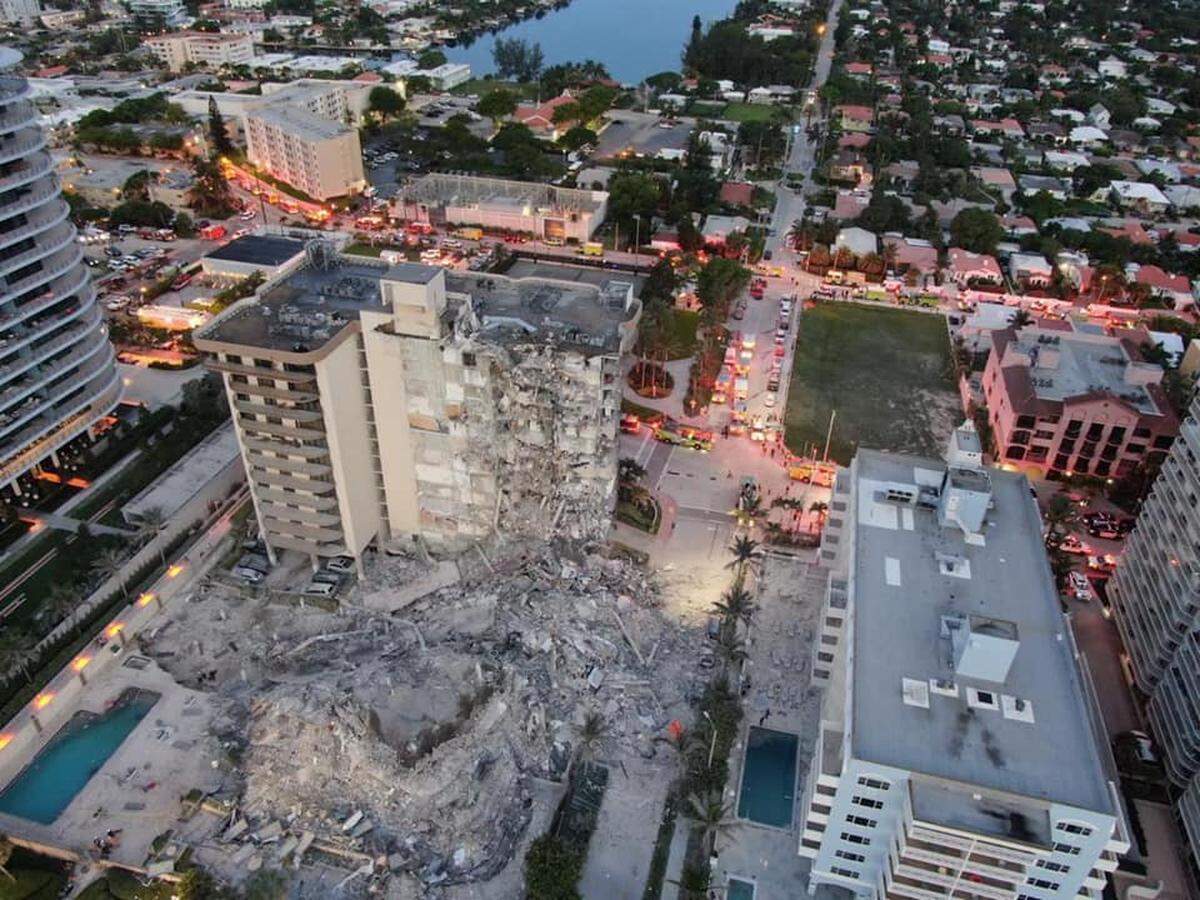
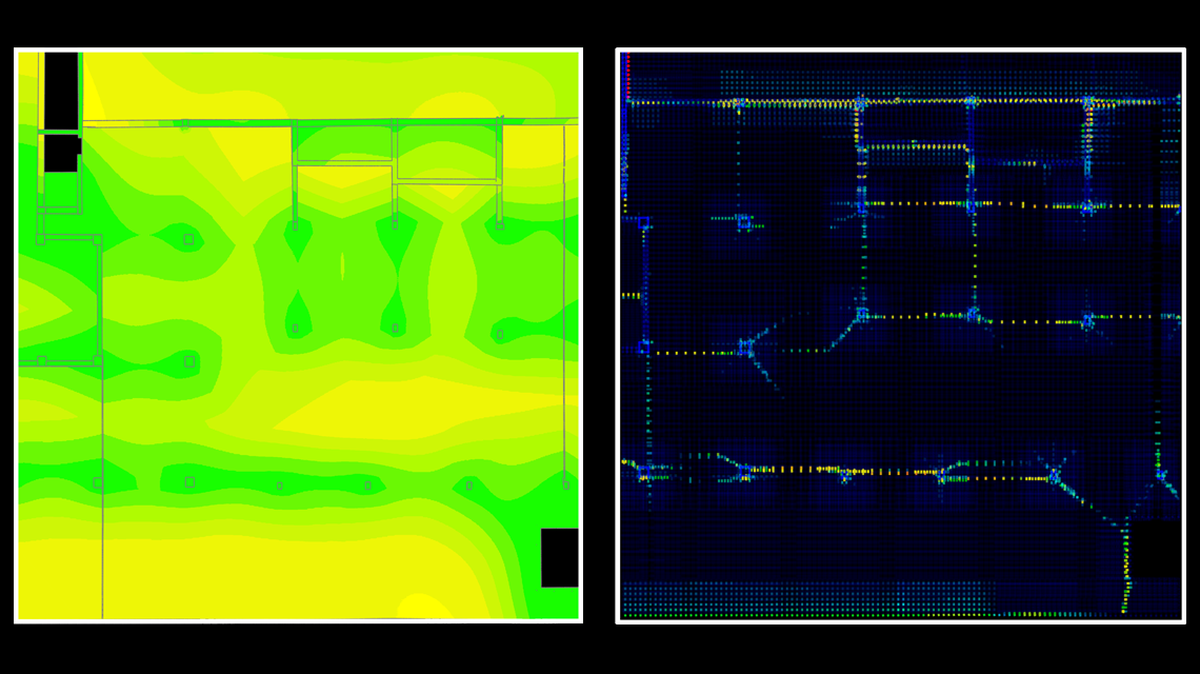
Lehman worked with a team at the University of Washington to build a complex computer model to identify pre-existing stresses in the structure and test various collapse scenarios based on the observed damage and the experiences of those who witnessed the tragedy firsthand.
Through a process of trial and error, the team zeroed in on the connection between the pool deck slab to the perimeter wall along the south side of the structure, where one witness told her husband she saw a sinkhole form.
While a failure beginning almost 100 feet from the southern edge of the tower that fell was not the most likely starting point for the progressive failure, it seemed possible due to the complex interconnected nature of the structure, Lehman said. And post-collapse photos showed enough problems in the area to justify running a simulation, she said.
Most curiously, the photos, when magnified, show several gaps along the southern perimeter wall where it should have been connected to the first floor slab with strong steel reinforcement.
Computer simulations showed pre-existing connection problems along the southern wall would have caused the tower’s perimeter beam on the north side to twist. The sliding door to a first floor unit that residents said started to stick in the months leading up to the collapse was likely a result of that beam twisting, which would have caused the track to pinch, Lehman said. Residents also noted sagging floors in areas predicted by the model of pre-collapse conditions.
“As long as [the computer simulation] is predicting what the photographs and videos show, we have nominal confidence in this model,” said materials expert David Lange, professor emeritus at the University of Illinois.

SURFSIDE INVESTIGATION
Read more about the computer model and see the results.
Computer simulations that coupled the missing connections noted along the wall with moderate levels of corrosion in the remaining bars resulted in damage spreading across the pool deck and into the tower beyond.
First, the simulation showed the rebar connection between the slab and wall would have fractured piece by piece, along the southern wall to the Jacuzzi — a damage pattern visible in post-collapse photos.
After that connection was severed, the computer model showed stress and damage would have propagated across the deck straining the connections between the slab and columns below. The damage also progressed into the north wing of the tower through a design flaw just behind the elevator at the corner of the gym, at the base of the section of the tower that was first to fall.
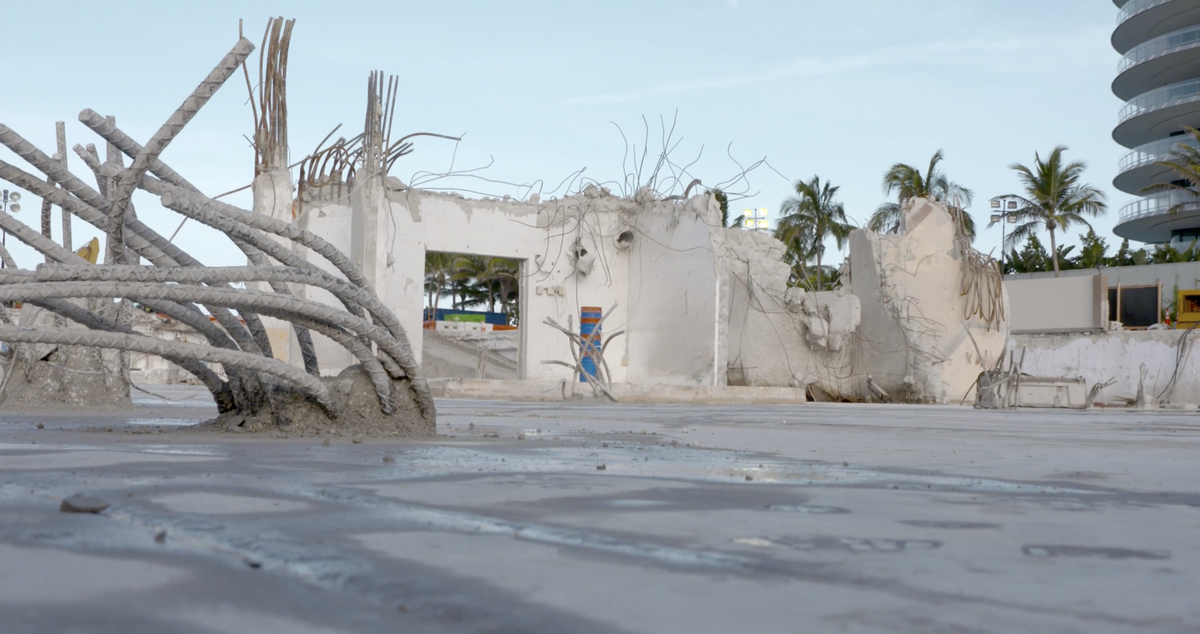
While it’s too soon to say with certainty what happened and new details could still emerge that might point to a different origin, nine engineers who reviewed the Herald’s findings all agreed that an initial failure of steel reinforcement along the southern edge of the pool deck was a plausible initiation point.
“If the slab lost support on the southern edge where it was sitting on the wall, then there could be an unzipping effect because you get more force on the nearby rebar,” said Shankar Nair, a professional engineer based in Illinois with more than 50 years of experience designing large structures.
The resulting progression would have looked and sounded just as witnesses described, Nair said.
Reconstructing the collapse
Sara Nir and her two children Chani, 15, and Gabe, 25, had a busy Wednesday. By the time they headed home after religious services, babysitting and a visit to the gym, respectively, the calendar had changed over to Thursday.
It was just after 12:30 a.m. when Gabe Nir backed the family car into its usual spot — number 14 — next to the stairwell just to the east of the entrance ramp to the underground garage. Nothing happened to suggest that the ceiling directly in front of him would cave in less than an hour later.
Everything looked normal, he told the Herald. There were no strange sounds. No burst pipes. Just the usual puddles that formed on the floor every time it rained, a constant reminder of the structure’s urgent need for major concrete repair work scheduled for later in the year.
The first indication of anything unusual came as the family settled into its ground-floor, two-bedroom unit overlooking the pool deck. Gabe was in the kitchen cooking salmon. Chani jumped into the shower. Sara sat with her back to the sliding glass doors that led out onto their private patio on the north side of the pool deck and opened her computer to send some emails.
Just before 1 a.m. the family began to hear strange knocking sounds — almost like an intermittent hammering on tiles, Gabe Nir told the Herald. Sara Nir thought it sounded like a neighbor hanging pictures. None of them could say with certainty where the noise was coming from, even thinking it might be from the apartment above theirs.
“Maybe I was thinking it was from above but it was really from below,” Sara Nir said.
At the same time, somewhere in the building, a sprinkler system running along the ceiling also flagged a slight, but unusual movement, records from the fire system show.
For the next 15 minutes, the Nirs said the sounds echoing in their apartment got progressively louder and more alarming.
After a final, particularly loud bang, Sara Nir set down her phone where she had been chatting with friends over WhatsApp and went to the night security guard to complain. By that point she was convinced that her neighbors were engaged in middle-of-the-night renovations.
“I was really mad,” Sara Nir told the Herald.
It was just after 1:14 a.m. — the time her friends said she last checked WhatsApp.
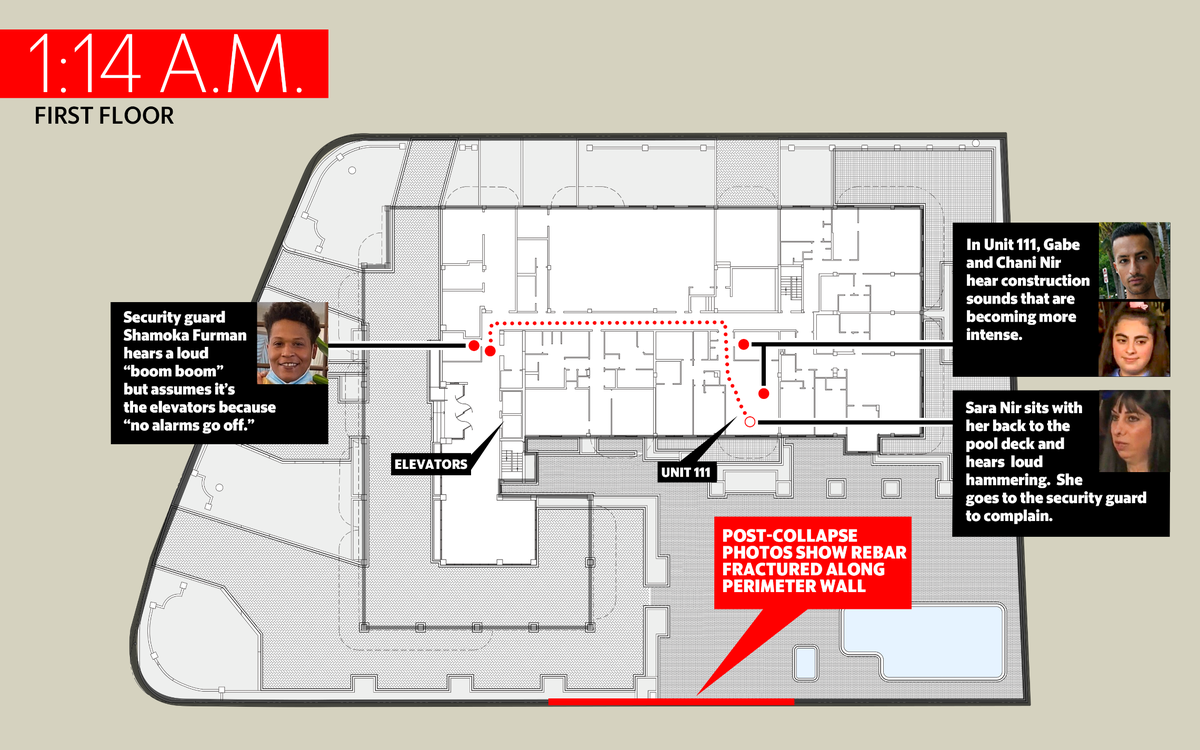
Furman, the security guard, had heard the sounds too — a loud “boom, boom,” she said later — but thought it was the elevator. No alarms had gone off to suggest something more serious, she said.
But it wasn’t the elevator.
Down in the underground parking area, Argentinian soap opera stars Nicolás Vázquez and Gimena Accardi had just parked their car after a late dinner with friends when they also heard the “strange noise,” Vázquez said in a recorded statement for the press.
They saw nothing that would explain what they heard.
So the duo got in the elevator to head up to bed, Vázquez said.
Experts consulted by the Herald agreed that what witnesses described — a loud series of bangs but no visible damage above or below the pool deck slab — was likely steel reinforcement fracturing inside the slab’s connection to walls and columns.
“Fracture energy is converted into acoustics,” said Khalid Mosalam, director of the Pacific Earthquake Engineering Research Center at the University of California Berkeley.
Given the pattern of damage along the pool deck, Mosalam said the initial fractures could have been at the top of a column near the southern wall, or the connection to the wall itself, where post-collapse photos show enough rusty rebar snapped down the line to make the kind of progression of sounds that the Nirs described.
“Rebar and tensioning failing is a big boom,” said Lange, the University of Illinois professor. “When you do it in the lab, it’s a shock that pounds up through the whole building. You can hear it everywhere.”
None of the engineers interviewed by the Herald were surprised the witnesses couldn’t identify the source of the noise.
Fractured rebar at a slab connection to the perimeter wall would not have been immediately visible even in the basement, said Atorod Azizinamini, director of the Moss School of Construction, Infrastructure and Sustainability at Florida International University.
“If the rebar fractures and there’s a friction between the wall and the slab, that friction will hold [the deck] up a little bit,” Azizinamini said, explaining why Vásquez and Accardi had time to get into the elevator after hearing the initial strange noises. “But it’s going to give way.”
It did. The deck failed in a rapid progression less than a minute after the final loud booms, a comparison of witness accounts and emergency calls showed.
The thunderous crash came just as the elevator carrying the actors reached its usual, mandatory stop in the lobby. They were blasted with a cloud of smoke.
“We didn’t understand if it was a tornado, an attack. It was like a movie,” Vázquez said.
From a ninth-floor apartment overlooking the deck where she worked as an overnight home health aide, Janeth Rodríguez felt the deck collapse more than she heard it. It sounded like the pressure on your ears when you jump into the ocean, Rodríguez said.
“I swore that it was like a wave, it felt like a wave, like when you go into the water and you feel like the waves are moving you like whoom, like that,” Rodriguez said. “At the same time it also felt like a bomb.”
Gabe and Chani Nir heard the noise from the living room area of their family apartment on the first floor. Gabe Nir described it as a “loud splash of concrete.” In the lobby, Sara Nir and Furman heard it too. It sounded like “thrrrrroom,” Furman later told police. To Sara Nir it was more like a deafening “shhhhhhhhh.”
“I ran toward the noise to see where it came from,” Sara Nir said. She peered through the ocean-facing windows at the southern end of the lobby, overlooking the valet parking area. What she saw felt like a horror movie.
“I see the car deck, pool [deck], everything collapsed,” she said.
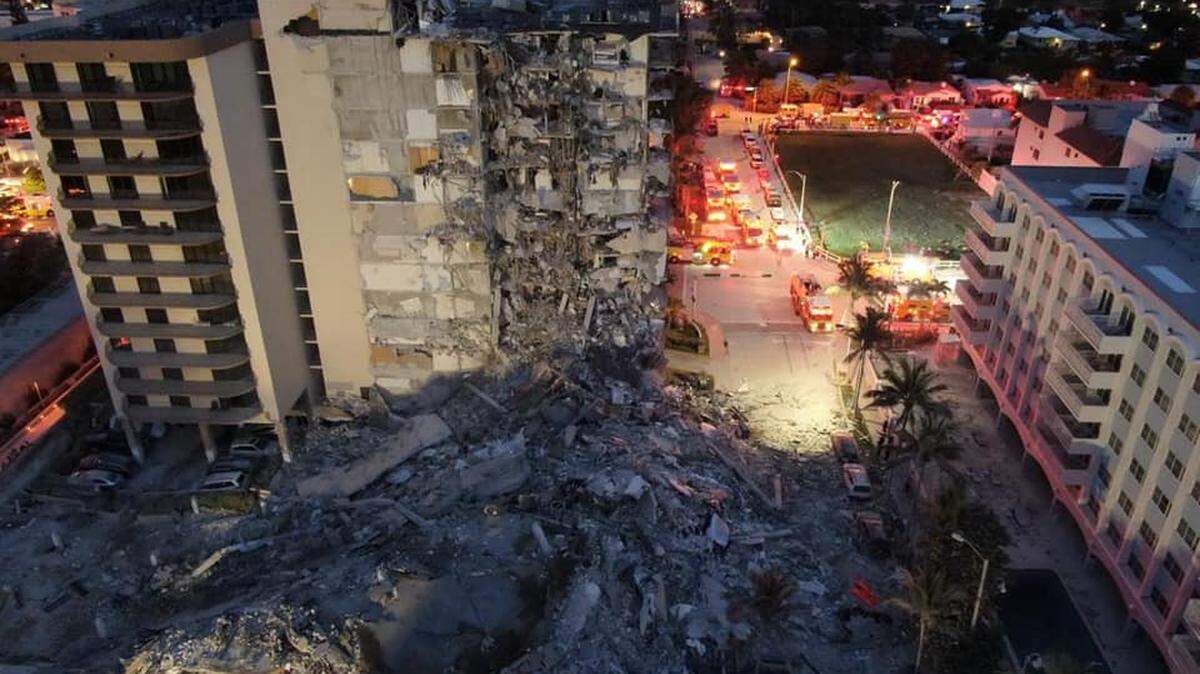
Images from later in the day show a 94-foot length of pool deck between the structure’s southern perimeter wall and the edge of the north wing of the “L-shaped” tower collapsed into the underground garage below.
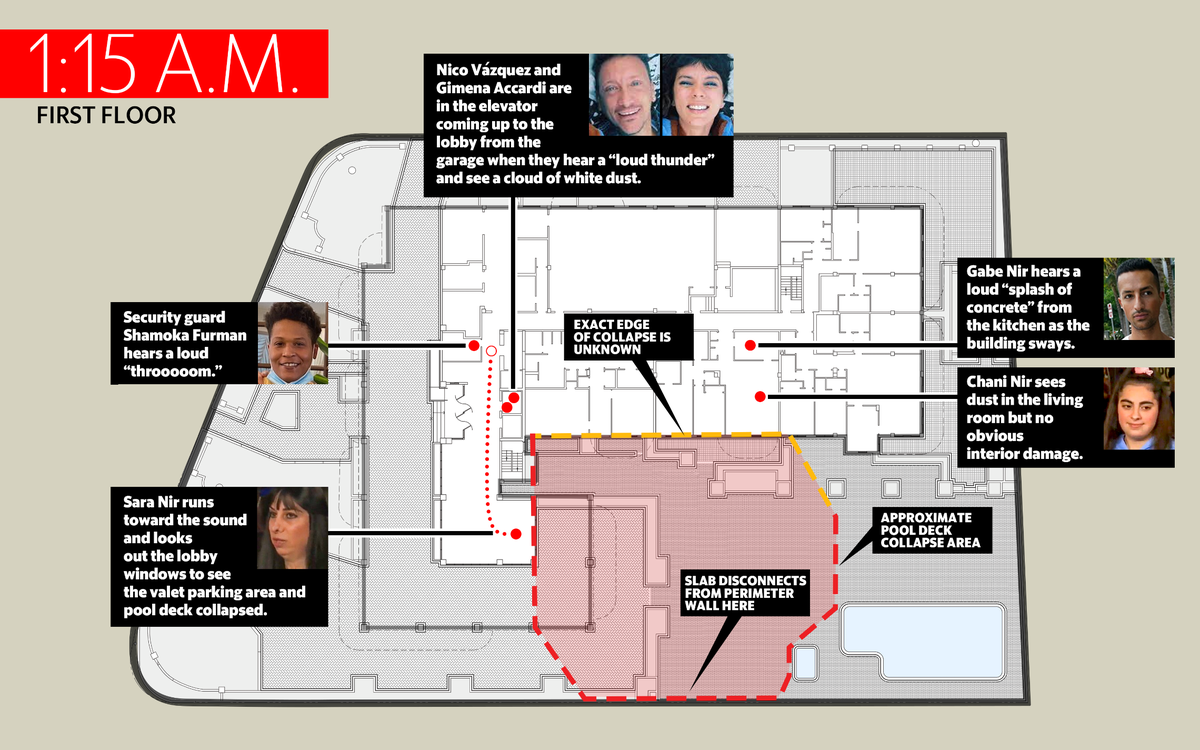
Photos show the collapse extended west into the valet parking area and expanded east until it was diverted by the strong walls of the Jacuzzi and pool, its momentum ultimately cut off at a construction joint.
Columns poked through the deck, which computer modeling showed had been sagging and cracking since day one. The slab simply slid off its steel fastenings as if they weren’t connected to the columns at all — something engineers agreed was an indication of pre-existing degradation and poor design.
Dust from the pool deck billowed into the Nir’s apartment through the patio doors and small chunks of plaster rained down from the ceiling. But the power stayed on and Gabe and Chani Nir did not notice any major damage inside of the tower as they ran out of their apartment into the lobby.
“Earthquake!” Sara Nir yelled from where she stood in the lobby as the building swayed. “Pull the fire alarm,” Nir told Furman before she and her children evacuated through the front doors.
The alarm was triggered at Champlain South at 1:15 a.m., according to the system log.
“I told security to pull the fire alarm so people will know,” Sara Nir told the Herald, disputing the idea that it was triggered automatically by the collapse of the deck.
But no one inside the tower remembered hearing an alarm, although one should have sounded, according to the system log. Condo board records from 2020 noted that at least one pull station in the lobby was “faulty” and needed repairs. It’s unclear from the records obtained by the Herald if the problem was ever resolved. Premier Fire Alarms and Integration Systems, the company responsible for the system, told the Herald it functioned properly that night.
Vázquez and Accardi hopped off the elevator into the dust and chaos of the lobby. They followed the Nirs out to Collins Avenue, only later realizing how close they had come to being in the garage when the ceiling fell.
Furman, the guard, did not run with them to safety.
“I couldn’t leave. I didn’t feel right,” Furman told the Herald. She called the police to report an “explosion” at 8777 Collins Avenue.
It was 1:16 a.m., according to emergency call records from Miami-Dade County. She called a second time a minute later, explaining there might have been an earthquake that caused the garage to collapse. Then Furman said she started to call down a list of residents to tell them to evacuate.
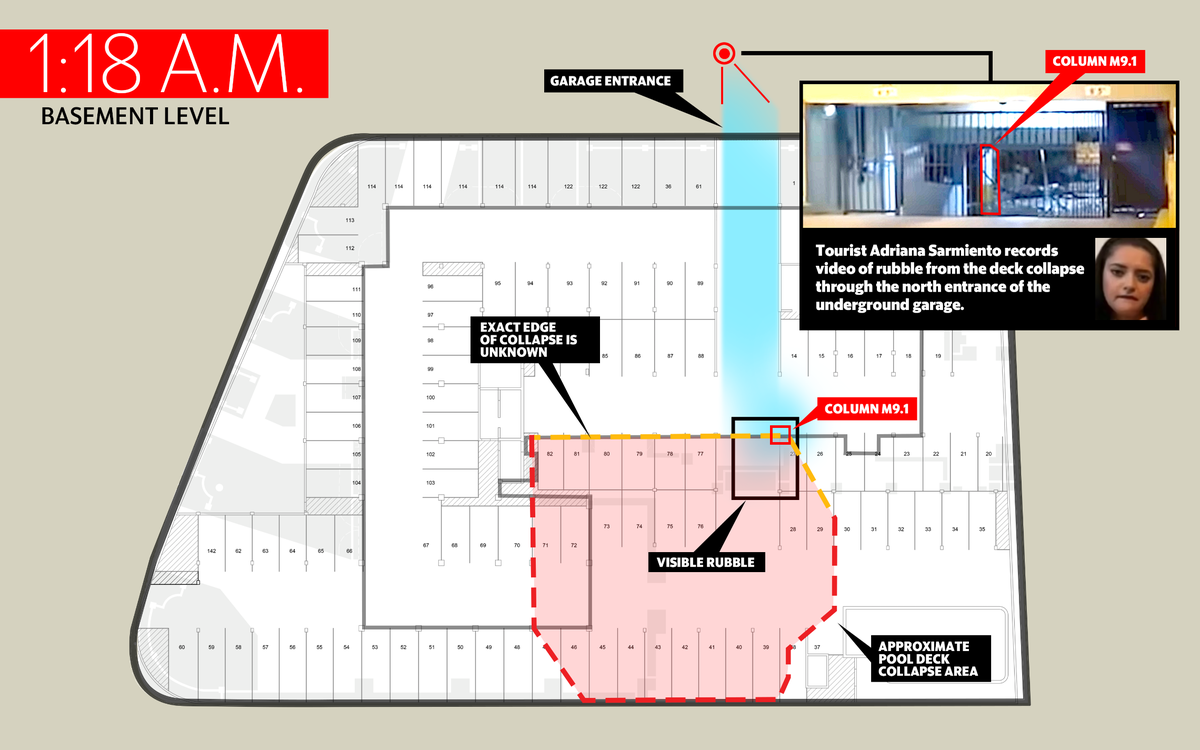
Adriana Sarmiento was sitting with her husband on the south-facing pool deck of the neighboring Solara Surfside Resort when she felt a gust of wind and heard the thunderous noise of the deck collapse.
Drawn by blaring car alarms and sounds of water gushing from broken pipes, Sarmiento walked across 88th Street toward Champlain South.
As they approached, Sarmiento peered into the underground garage through the entrance ramp where Vásquez and Accardi had driven just minutes earlier.
“I see the roof of the parking area — practically all of it — in pieces on the floor,” Sarmiento told the Herald.
Someone called 911 as she pointed her phone camera at the large chunks of concrete illuminated by an emergency floodlight. No alarm can be heard.
The time stamp on the grainy video reads 1:18 a.m.
The northern boundary of the initial deck collapse is unknown, buried beneath the tower that fell minutes later before anyone had time to document its full extent. But a comparison of the two columns visible in Sarmiento’s video with building plans shows the chunks of concrete likely fell from the underside of the large planters outside the Nirs’ apartment, suggesting the initial deck collapse extended almost to the edge of the tower.
As Sarmiento stood at the base of the tower, she watched lights begin to go on in the lower floors. A few people came out to their balconies to look for the source of the noise, Sarmiento told the Herald. They could not see the damage from the north side of the tower. She yelled up to them that the garage ceiling had collapsed, that they needed to get out, before she backed away.
“This building is going to fall,” she told her husband.
The deck collapse also woke Cassie Stratton in Unit 410, a fourth-floor apartment with a south-facing balcony overlooking the pool deck. At 1:20 a.m., Stratton called her husband, Mike, who was out of town, and told him the building was shaking. She thought it was an earthquake and went to investigate.
Looking out over the balcony, Stratton told her husband that the pool deck near the southern wall directly across from their unit had caved in.
“She said that she saw a sinkhole forming and it was coming towards the building and that there was water in it,” Mike Stratton told the Herald. Only later would Mike Stratton wonder whether the deck collapse was a byproduct of the water he frequently saw running into that wall from the landscaping along the easement outside.
Cassie Stratton was telling her husband she was glad their 2015 Porsche Macan was in the shop that day and not the garage when the building began to shake again.
Two floors up and one stack to the east, in Unit 611, Iliana Monteagudo said she was coaxed out of bed by an otherworldly force. She heard the distant sounds of car alarms from the pool deck — but no fire alarm — as she watched a two-inch crack form in her living room wall from ceiling to floor.
“That crack, as it advanced, split the wall in two,” Monteagudo told the Herald. “Then that’s when my mind started to talk to me and to tell me that you have to leave because this is going to fall down.”
Monteagudo ran to the stairs next to the elevator and made it to floor four before she heard the roar.
Outside, Vázquez, Accardi and the Nirs had just crossed the street when they heard it too — “a tremendous crash, impossible to explain because it was like nothing we’d ever heard,” Vázquez said in his press statement.
In a conversation caught on a body camera, a resident on the 12th floor later told police it sounded like a jet flying through the building. To Sarmiento, it was an “explosion.”
Mike Stratton was still on the phone with his wife. All he heard was her scream. Then the line went dead.
“And that was it,” Mike Stratton told the Herald. Cassie Stratton died when the floor fell out below her.
The call dropped at 1:22 a.m.
The violent crescendo of concrete was captured in the background of a time-stamped emergency call.
Someone called in to emergency dispatch: “The whole building is down.”
In reality, only the north wing — the long leg of the “L” shaped tower along 88th Street — had fallen. The shorter leg that ran along Collins Avenue survived, bolstered by the strong elevator shaft and more robust columns. In total, 81 of the 136 units were either partially or completely destroyed.
Surveillance footage shows the first units to collapse were above the gym, just east of the elevator — the stack of units with numbers ending in “10” where the Strattons lived. The easternmost, ocean-facing units, including a 13th-floor penthouse, stood for just a few seconds longer before falling on top of the pile of debris.
Simulating a domino effect
Without an obvious trigger — like a gas line explosion — engineers began looking for an improbable “perfect storm” of circumstances to explain why a building that stood for 40 years would suddenly collapse.
Interviews with dozens of people familiar with the building, along with a review of thousands of pages of records, including building plans and construction permits, illuminate a series of design and construction failures followed by years of degradation and damage that lined up like dominoes to create the improbable combination of conditions that reached a critical threshold just after 1 a.m. on June 24.
Take a few dominoes out of the chain, Lehman, the Herald’s consulting engineer, said, and you might have a localized cave-in but not the catastrophic and deadly failure of the tower — or maybe there would have been no collapse at all.
Lehman and her team at the University of Washington created a computer simulation of Champlain South to explore possible collapse scenarios and start to understand what went wrong more specifically.
Built in LS Dyna, the model isolated various elements of the structure — the concrete, steel, and bond between the two — in order to test possible collapse sequences by mapping how each element responded to changes in conditions in the structure like damage or corrosion.
“This is a very complicated system. As things crack or yield or fracture, it really changes the way the forces are distributed,” Lehman said.
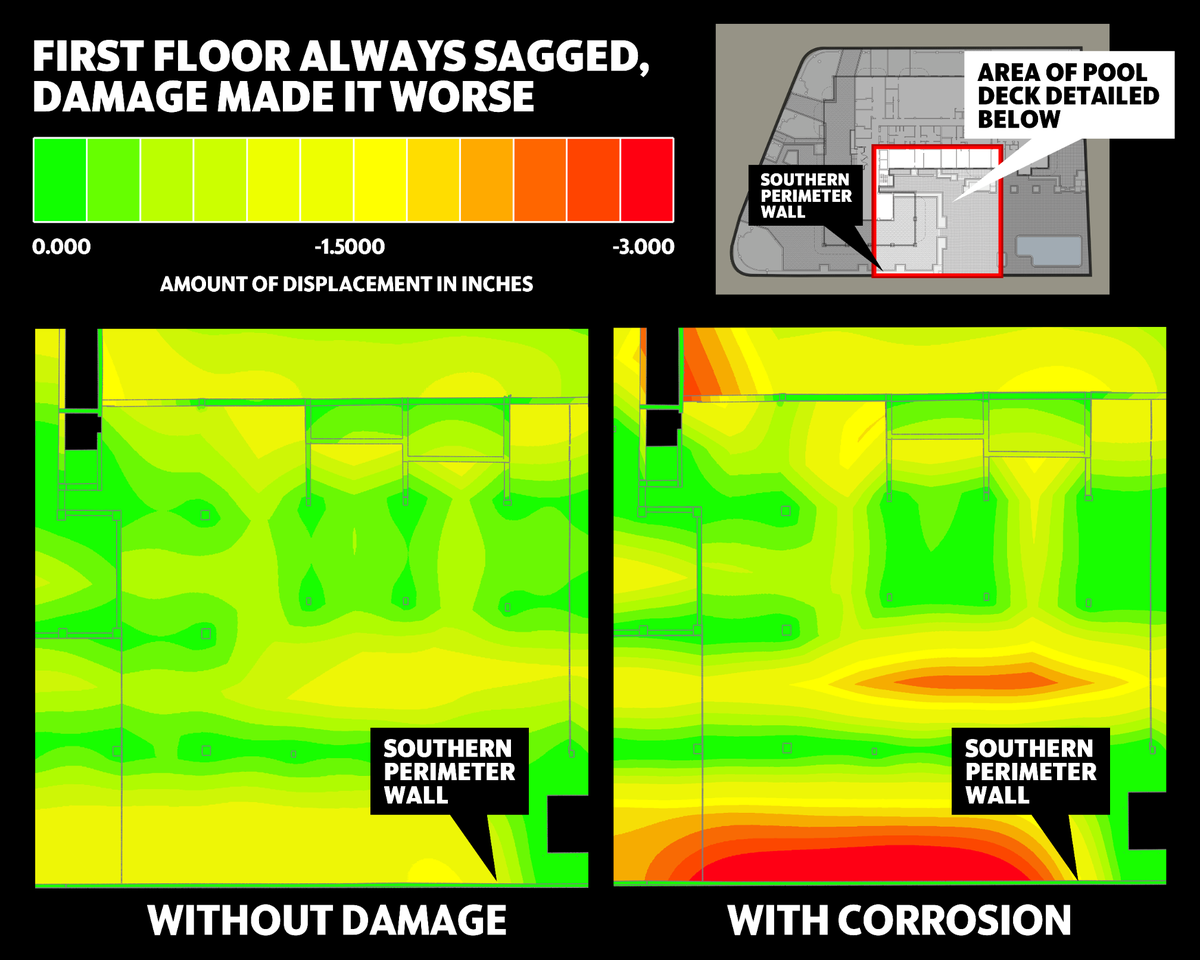
Test scenarios were derived from eyewitness accounts, observable conditions in photographs and videos from before and after the collapse, and records from the condo board and Surfside building department.
A model was rejected if it resulted in damage patterns that did not match those visible on the pool deck in photographs taken after the collapse. It was also rejected if the resulting damage was inconsistent with the experiences of eyewitnesses — like a collapse in an area where residents had been standing at the time the failure supposedly occurred.
Initially, Lehman explored whether the damage visible in Sarmiento’s video through the garage entrance could have precipitated a broader deck failure. But a computer simulation showed that losing part of the slab in that area did not cause damage to spread across the pool deck to the southern wall. Neither did losing a column in that area — calling into question a theory raised in the amended complaint filed in the victims’ class-action lawsuit.
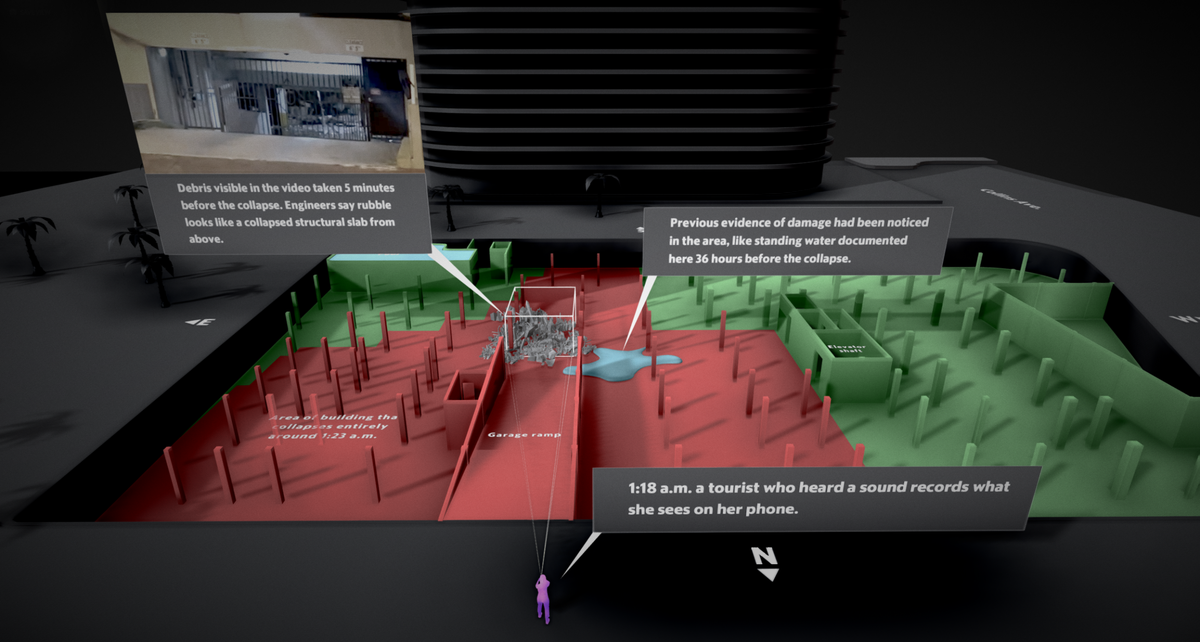
Ultimately, both scenarios were inconsistent with what Sara Nir and Cassie Stratton both described — a collapse on the south side of the pool deck, minutes before the rest of the tower collapsed.
A months-long reconstruction of the timeline eventually undermined all scenarios that put initial concrete failures on the northern edge of the deck. Sarmiento’s video, which prompted the speculation about an initial concrete failure at the north side of the deck, was taken after the deck collapsed, so the visible debris could easily have been a result of the cave-in rather than a cause. And the first sounds of collapse were heard as Vásquez and Accardi drove into the garage, through the exact area where the assumed concrete failure would have occurred.
So Lehman and her team shifted their focus farther south, to an area of the pool deck burdened with heavy planters that were not supported by beams, where the collapse revealed significant problems along the southern perimeter wall, a below-ground-level structural element made of reinforced concrete.
Problems at the Southern Wall
The pool deck at Champlain South was too thin, cracking and bowing over the large spans between the columns holding it up, computer modeling showed. Lehman’s model showed the sagging was particularly severe in the middle of the deck and along the southern wall, where water used to pool causing problems for the structure, according to construction permits and records from the condo board.
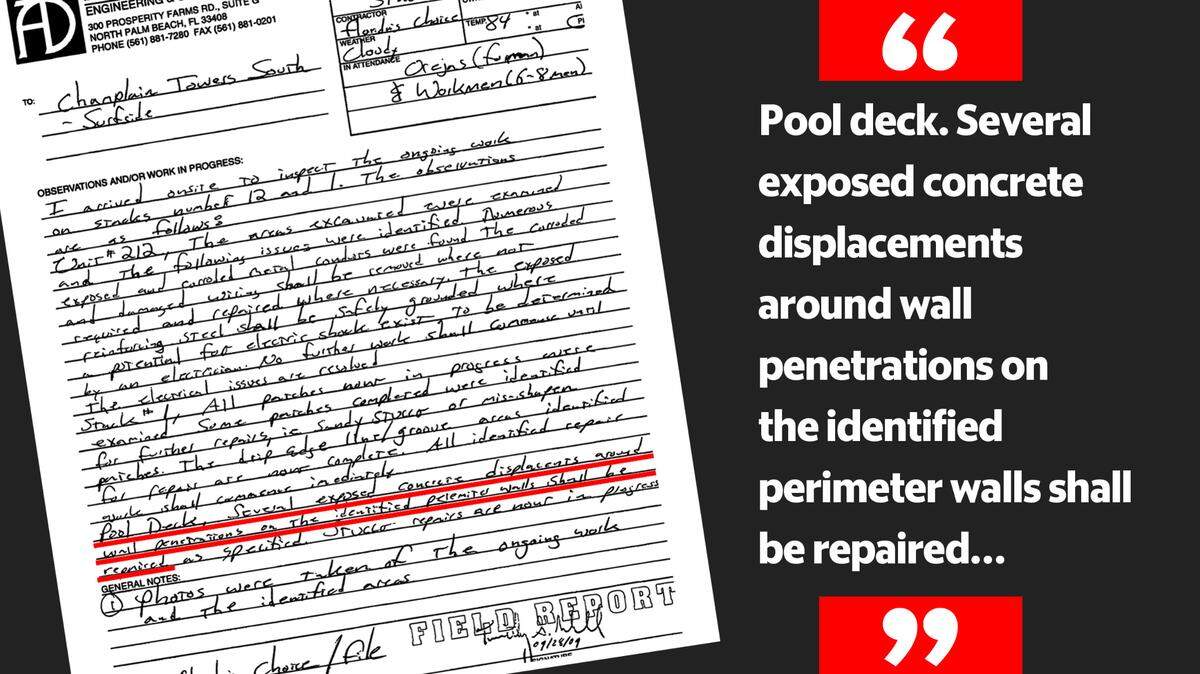
In 2009, an inspector noted “several exposed concrete displacements around wall penetrations on the identified perimeter walls” needed to be repaired. Simply put, the deck was sagging along its connection to the wall. The subsequent repair was not the first needed in the area. In 2002, permits indicate rebar was added to the south pool wall as part of a larger concrete restoration project. The exact locations of the problem areas and resulting repairs were not indicated in records obtained by the Herald.
The collapse also exposed other problems in the slab-to-wall connection.
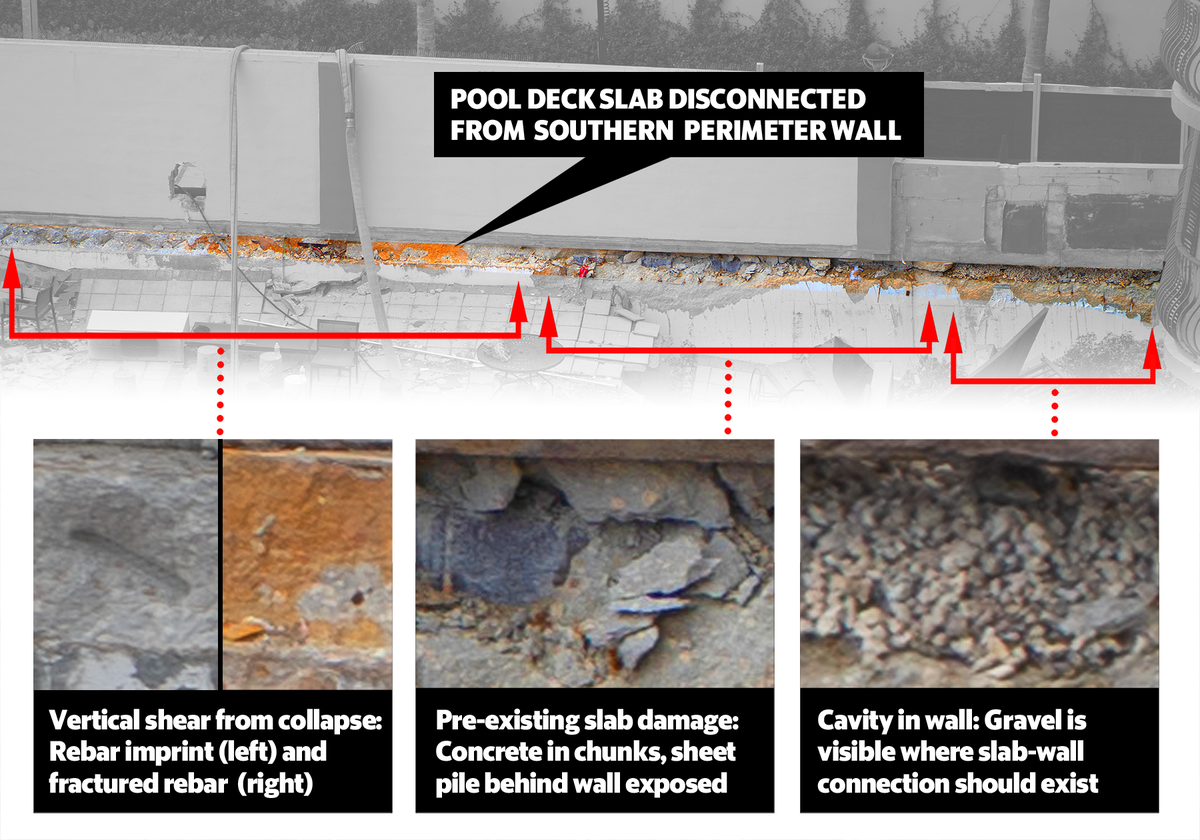
Along the valet parking area, the slab pulled off of the wall entirely, leaving a 9.5 inch gap between the property’s privacy wall — a non-structural, concrete block wall that blocked public access to the pool — and the top of the perimeter wall below.
“The floor slab is thicker and should be stronger than the wall. It’s somewhat surprising that the slab fell in and didn’t bring the wall with it,” Nair said. The only reason that would happen is if the slab was not properly connected to the wall either due to problems with original design and construction, or damage over time, Nair said.
In the area next to the gap, on the westernmost side of the pool deck, the slab appeared to have shattered into small chunks indicative of previous damage to the concrete.
“It’s hard to say that all these chunks that you see … are only caused by the failure,” said Khalid Mosalam, the earthquake expert at the University of California Berkeley.
“It must have been poorly compacted concrete at the top layer of this wall,” Mosalam said.
Lehman said the way the concrete broke into flaky chunks was indicative of damage caused by vibrations.
In 2016, vibrations from the installation of sheet piles — materials driven into the ground to provide earth retention — at Eighty Seven Park, an 18-story luxury high-rise condo constructed just to the south of Champlain Towers, exceeded a target limit, set by developers based on mining industry standards. While the readings were still not extremely high, experts told the Herald it was possible even low levels of vibrations could damage a fragile structure.
The piles were driven with a vibratory hammer just 13 feet from the southern perimeter wall, in the middle of what used to be 87th Terrace, a dead-end street that marked the border between the sleepy town of Surfside and the much bigger city of Miami Beach.
The street was torn out and replaced with a much narrower walkway to the beach as part of the Eighty Seven Park project. For years, equipment used for demolition and construction drove back and forth along the wall. On at least one occasion, equipment scraped along the privacy wall, putting gouges in the non-structural concrete block wall around the pool area, engineers Jonathan Bain and Frank Morabito noted in a 2020 report conducted on behalf of the Champlain South condo association.
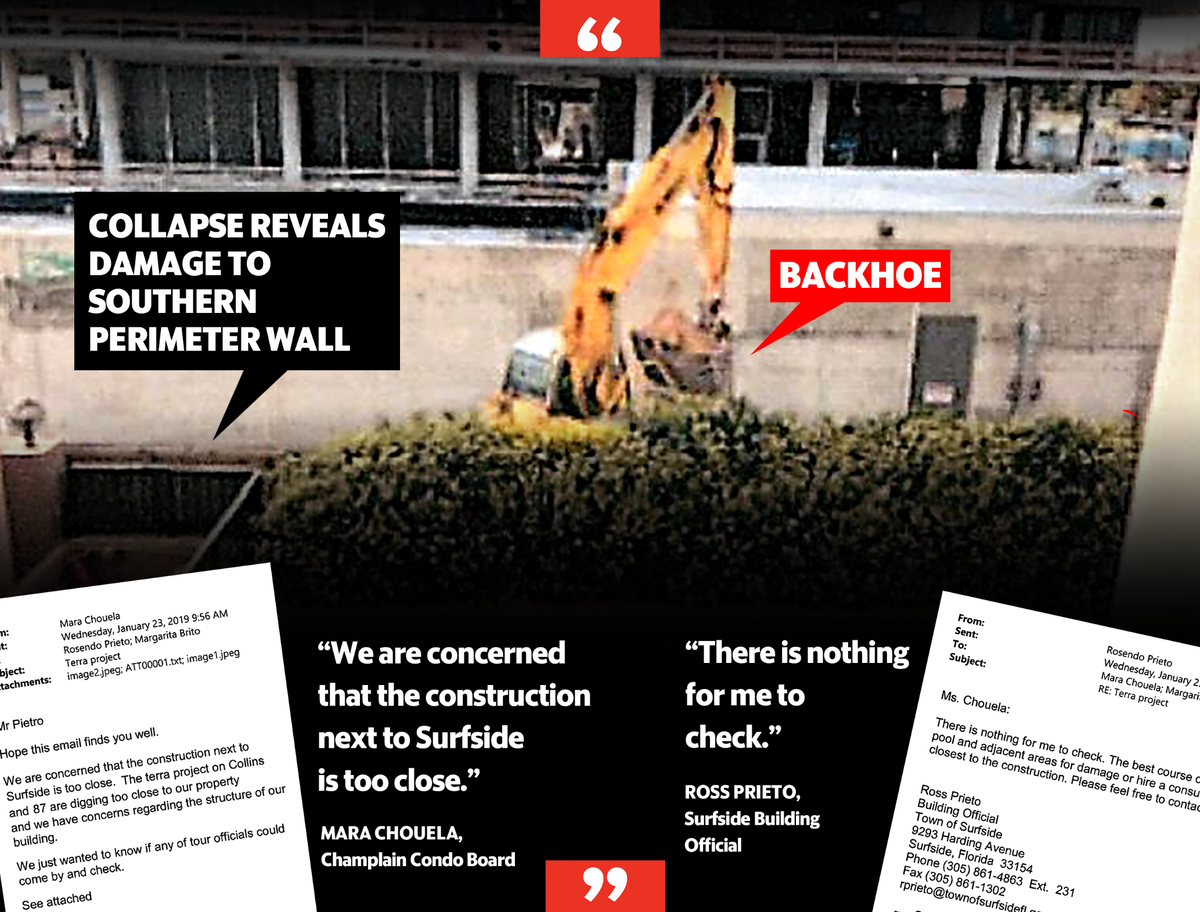
The previous year, condo board member Mara Chouela sent an email to the town of Surfside complaining that developers of the project next door in Miami Beach were “digging too close to our property” causing residents to have “concerns regarding the structure of our building.”
Attached were two photos of a backhoe. The heavy machinery appears to be digging along the wall in the area where pre-existing damage was noted. However, photos of the Champlain South perimeter dated later that year did not appear to show damage to any structural elements in that area, although the images provided limited view of the wall.
A spokesperson for the developers of Eighty Seven Park said their construction project did not contribute in any way to the building falling years later.
A review of the pre-condition survey produced by developers in 2016 prior to construction showed the southern wall had already been showing signs of cracking and strain.
Miami real estate giant David Martin was the face of development group, 8701 Collins Development, which has been named as the primary defendant in a class-action lawsuit filed on behalf of the victims of the collapse.
“The mechanics of the structural collapse confirm that the Defendants — specifically including those involved in the development and construction of Eighty-Seven Park — caused and contributed to this unfathomable loss of life, safety, and property,” according to the amended complaint.
But experts consulted by the Herald said any single-cause theory is an oversimplification.
“There’s just too many things. You can’t just pinpoint one and idealize it and say that’s it,” said Dan Abrams, professor of engineering at the University of Illinois.
Regardless of cause, it’s clear from photos taken after the collapse that there were limited connections between the wall and western portion of the pool deck even before the collapse.
Lehman and her team simulated the problem by removing the connecting rebar between the slab and wall in the model in the area where photos show the chunky concrete and gap where the slab pulled away.
The modifications prompted existing cracks in the pool deck slab to expand. New cracks penetrated into the residential tower, straining already overburdened steel connecting the north side of the tower to the strong structure around the elevator shaft.
“In the end, what it means is that just losing some bars at the southern perimeter wall increases the deflection [sagging and cracking] in the building,” Lehman said.
That model with some of the connecting steel removed was likely more representative of the actual state of the building just before the collapse than the reference model built solely from the plans, Lehman said.
Assuming the modified model accurately represented the pre-collapse conditions of the building, the remaining steel reinforcement in the slab-to-wall connection would have been strained to a near breaking point.
Corrosion from years of water intrusion could have put it over the edge, the model showed.
“What we think happened is that the reinforcement connecting the slab to the southern perimeter wall was exposed to water,” Lehman said. “And that water was gradually over time, as it does, causing corrosion of that reinforcement.“
Pool deck stands for 40 years, then suddenly fails
Water had always been a problem on the Champlain South pool deck, records show.
For 40 years, salty air and water ate away at the reinforced concrete.
After rainstorms, puddles formed on the pool deck, which was built without the proper drainage slope, according to a 2018 inspection report. Inspecting engineer Frank Morabito noted an urgent need for repairs on “major structural damage” caused by the water on the deck.
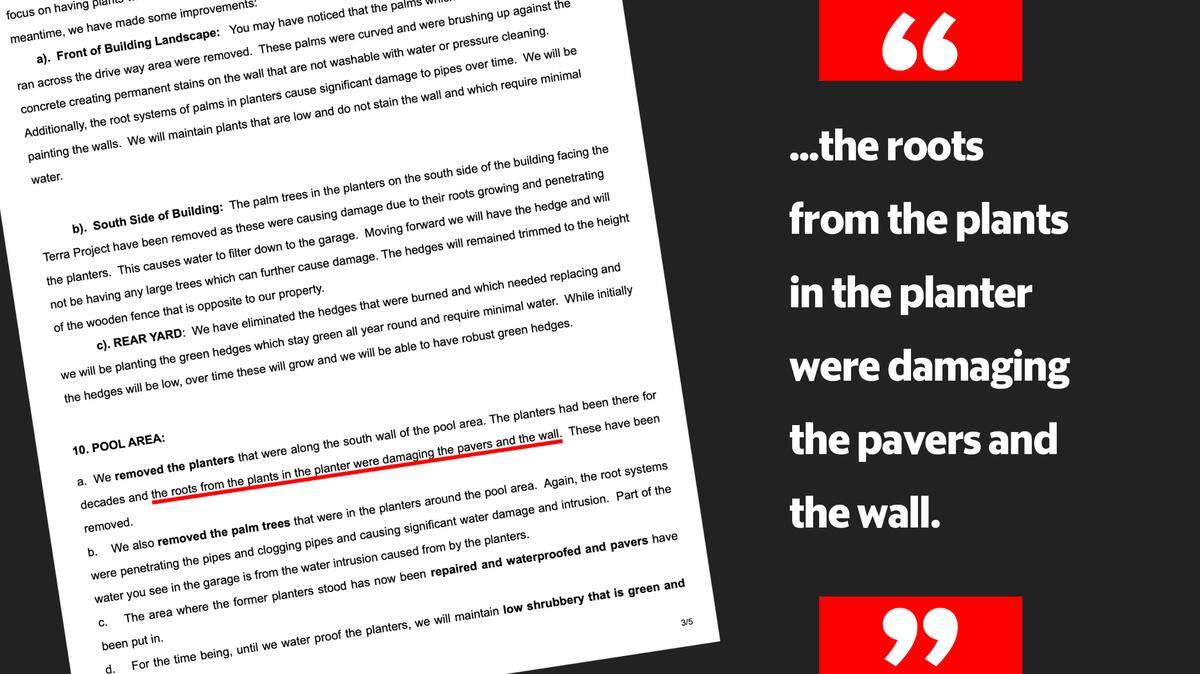
Opportunistic palm roots escaped the confines of their poolside planters, penetrating up to 12 feet into drain pipes and damaging the deck slab, including along the southern wall, condo board records showed. The trees were there for 22 years, leaking water into the slab connection to the southern wall, before someone noticed the problem and had them removed.
In 2020, Morabito returned to document extensive water damage on the property. Most, he said, was the result of years of environmental stresses and poor maintenance, but his survey also pointed a finger at the beach access path constructed on the other side of the wall as part of the Eighty Seven Park development. A limited field survey showed the path pitched toward the southern perimeter wall.
“The runoff can travel down and infiltrate the Champlain Towers sub-garage,” Morabito noted.
A spokesperson for the developers denied the allegations, saying that the report was inconclusive and failed to account for a protective sheet pile between the perimeter wall and the water drainage plane in the walkway.
In some areas where the deck sheared cleanly off the wall, stains indicated water intrusion in pre-existing cracks. Rusty rebar appears to have fractured or pulled out as the deck fell away from the wall.
Lehman’s team simulated corrosion on bars along the perimeter wall and a construction joint running north-south in the middle of the pool deck where photos taken after the collapse show the internal reinforcement had rusted.
“Once we did that, what we found was, when one bar started to fracture, it propagated all the way along the length of the southern perimeter wall to the Jacuzzi,” Lehman said.
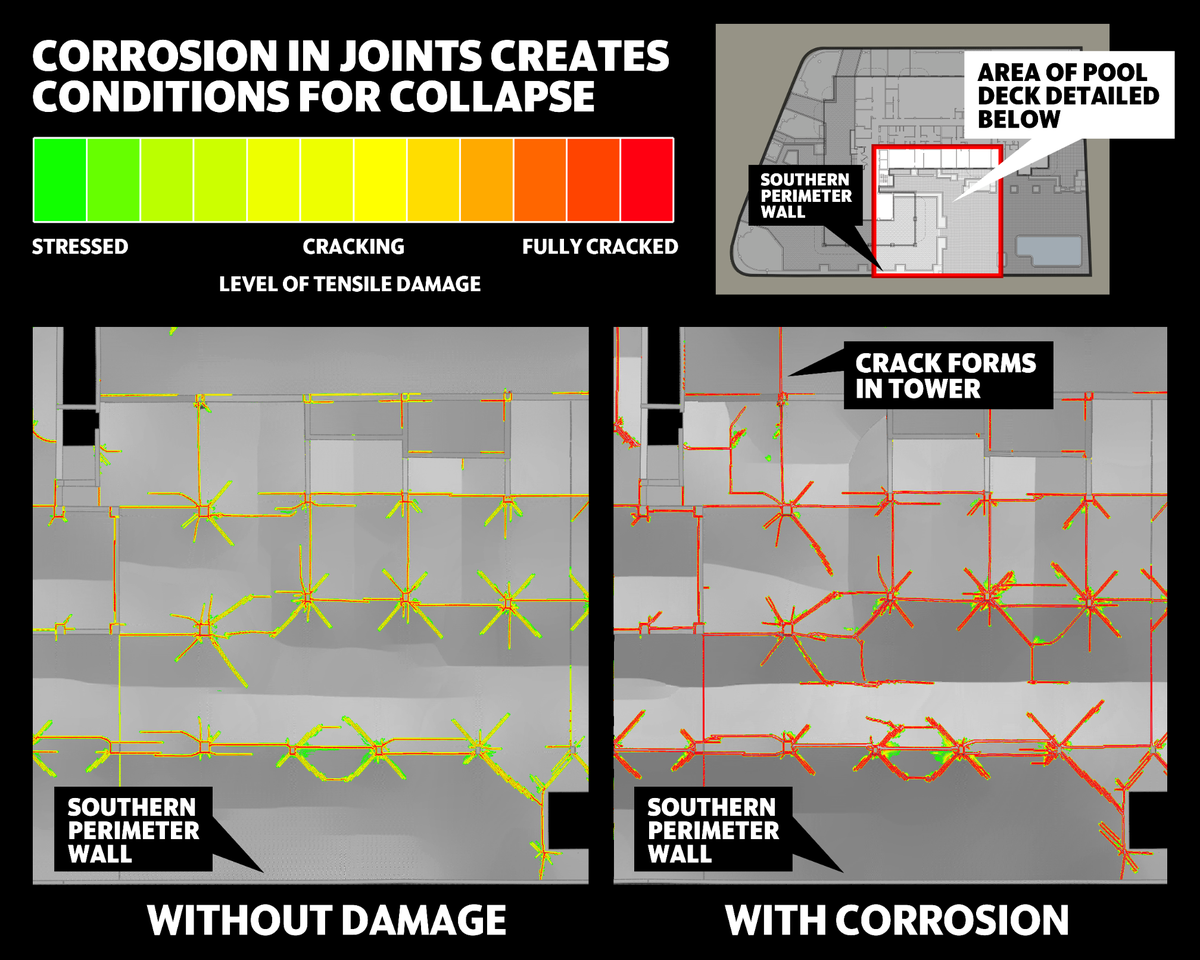
Whether that connection to the wall was the first thing to go, or something else tipped the scale first, the pool deck disconnecting from the southern wall could have been enough to cause a progressive failure across the pool deck and surface level parking, the model showed.
The pool deck — which sat on top of narrow, 12-inch-by-16-inch columns placed sometimes up to 30 feet apart — had been at risk of punching failure, according to load calculations performed by numerous engineers consulted by the Herald.
“Even without any sort of material deterioration, we’re already seeing that the slab is over-stressed, it’s in a state that we wouldn’t expect under this level of load,” Lehman said. The perimeter walls around Champlain South clamped the slab from all sides, a restraint that took some of the strain off the column-to-slab connections, she said.
It works almost like holding up your phone by pressing two open palms against the edges. The pressure alone is enough to hold it up. But remove one hand and unless there is something also supporting it from below, the phone will immediately fall to the ground.
“As long as the whole system was still intact, we have a state of equilibrium that was allowing the building to remain standing,” Lehman said.
Pool deck falls into the garage in “punching shear” failure
Eyewitnesses saw the pool deck collapse, shearing off completely from the southern perimeter wall of Champlain Towers South minutes before the tower came crashing down. Photos from the collapse site show that narrow columns from the parking garage below poked through the pool deck as the slab sagged — a dangerous type of failure called “punching shear” which experts say is known to cause sudden collapse.

A loss of the perimeter wall connection resulted in reduction of that critical restraint, computer modeling showed. Deep cracks would have started form across the deck around the tops of the columns, a precursor to the type of punching failure seen in photos taken after the collapse.
“If the slab lost support at the southern edge, I could see that failure moving northward, and then I would expect punching shear at the columns,” said Nair, the Illinois-based engineer.
Once one column poked through, the progression to others nearby would have been rapid — and loud — as the weak connections failed one by one, he said.
Original sin
Cassie Stratton and Iliana Moteagudo were less than 40 feet from each other when the tower collapsed. Monteagudo was in the stairwell to the west of the strong, reinforced concrete core wall in the elevator shaft. Stratton was still in her apartment, on the other side of the wall to the east.
They were standing on two sides of a fault line in the building, on either side of the “L-shaped” tower’s elbow, where Lehman’s simulation showed damage would likely first propagate from the pool deck into the tower.
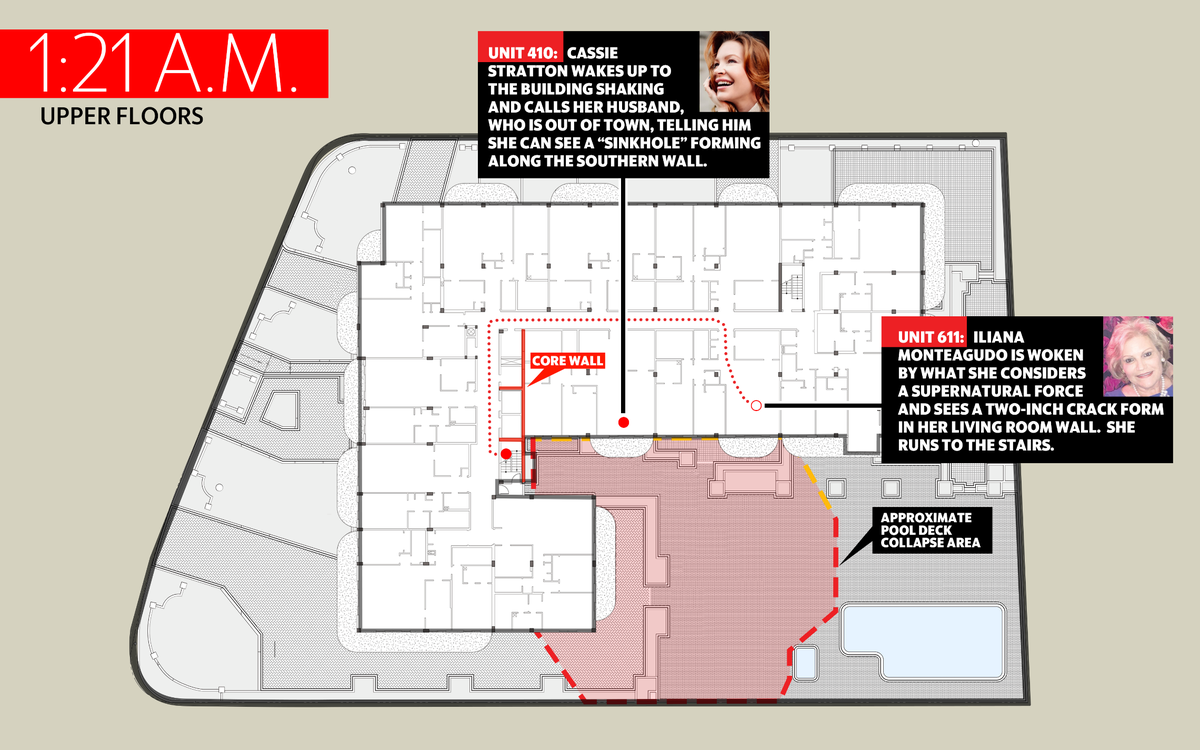
Computer modeling pinpointed a vulnerability where the core wall, gym floor and pool deck meet — right below where Stratton stood.
“That’s a weak point,” said Abieyuwa Aghayere, professor of structural engineering at Drexel University. An “L-shaped” tower wants to twist and the connection between the two legs is under the most pressure.
“The tendency for there to be a tear right at this spot — as you have loads applied, trying to tear that connection apart — is very high,” he said.
According to Aghayere, the steel reinforcement connecting the beam and slab to the reinforced concrete wall behind the elevators was inadequate to withstand the high demands at that critical juncture. It is a design flaw that could have been the difference between the tower standing or falling, he said.
“I think the connection needs to be looked at because typically when you look at a structure like this, they are counting on the walls for lateral support,” he said.
The limited rebar that was called for in the plans was the only thing connecting the north wing of the tower to the only structural walls running in an east-west direction, Aghayere said, and a loss of that connection would mean a loss in lateral support to the columns at the edge of the building.
After the pool deck collapsed, Gabe Nir, a resident of the unit next to the gym, described feeling the building start to move, as if it was an unstable folding table on spindly legs.
“If we lose that connection to that wall, I can see how we have almost like a table that is rocking that has no lateral support,” Aghayere said.
“When the connection of that slab at the lobby level dislodges from this wall, that would destabilize the columns along the [tower’s edge] and I could see how that description by that witness fits the mode that I’m describing here,” he said.
.png "Beam illustration digital (1).png")
Even without a full deck collapse, computer modeling suggested that once the rebar connecting the pool deck to the southern perimeter wall fractured, the steel rebar connecting the tower’s first floor to the eastern face of the core wall would become over-stressed as the floor of the gym sagged three inches down along the edge.
That level of deflection could cause the beam at the perimeter of the tower to twist, which then would cause the slab to sag more, a cascading effect that could result in the failure of parts of the beam and slab, most likely near the elevator shaft, Lehman said.
“Once that happens, you can imagine that each of these other slab segments are going to have to pick up more load and the floor is probably going to start caving in,” Lehman said. “You’re going to start losing restraint to the columns, you’re probably going to lose restraint to the rest of the perimeter beam, and you can imagine how the damage could progress into the building.”
The Herald did not model the upper floors of the tower and did not simulate the final stages of collapse. Engineers interviewed for this project agreed that as the slab fell away, there was little to support the narrow columns in the north wing of the tower.
Photos from the collapse show the columns buckled as the slab fell away.
Unsung hero
At 1:22 a.m. on June 24, Furman, the night security guard, was alone in the lobby trying desperately to alert residents to what was happening.
“I can’t knock on everybody’s doors so everybody I was calling ‘get out, get out, get out,’ ” Furman later told first responders.
Then, the world imploded.
“Things broke around me,” Furman said. “Things started to collapse around me.”
The mail room behind her, to the north and east of the elevators, caved in, she said. Only the middle section of the lobby where she stood remained undamaged.

The power went out. Water from burst pipes soaked the floor and live wires sparkled in front of her. Monteagudo climbed out of the stairwell.
The front doors were blocked by debris so Furman helped the other woman out a back door to the pool deck. But it wasn’t there. All they saw in its place was rubble.
“It looks like I’m literally in hell,” Furman said.
Furman took Monteagudo’s hand, helping her traverse the debris, scaling tops of cars that had fallen into the basement from the valet parking area, and ultimately scaling the perimeter wall to safety. She went back for a few others who had started coming down from the remaining portion of the tower.
It was only when they were all safely out that Furman began to throw up.
This story was reported by Miami Herald investigative reporter Sarah Blaskey and colleagues Ben Conarck, Aaron Leibowitz, Ana Claudia Chacin and Nicholas Nehamas and written by Blaskey.
BEHIND THE STORY
MOREThe project model and approach in support of the Miami Herald’s forensic investigation into the collapse of Champlain Towers South were designed and supervised by the Herald’s consulting structural engineer, Dawn Lehman.
Lehman is a professor of civil and environmental engineering at the University of Washington. The professor has extensive experience in nonlinear analysis of concrete structures and has published this experimentally validated modeling approach for reinforced concrete members and connections. She is an expert on earthquake damage.
The Herald/UW model was built by Nicolette Lewis and Ray Yu under Professor Lehman’s supervision. Lewis is a PhD student at the University of Washington, where she also works as a graduate research assistant focusing on fluid-structure interaction. Yu is a recent graduate from the University of Washington whose master’s research focused on minimum design requirements for insulated concrete form systems.
Expert Consultants
Dawn Lehman, professor of structural engineering at the University of Washington, was hired by the Miami Herald as a lead consultant for its ongoing forensic analysis of the Champlain Towers South collapse.
Nine other engineers rerviewed the Herald’s findings for this story:
▪ Dan Abrams is professor emeritus at the University of Illinois’ Grainger College of Engineering. He specializes in structural engineering.
▪ Abieyuwa Aghayere is a professor at Drexel University’s College of Engineering. He researches structural design, including the analysis of structural failures.
▪ Atorod Azizinamini is the director of the Moss School of Construction, Infrastructure and Sustainability at Florida International University. He specializes in the design and engineering of bridges.
▪ David Lange is professor emeritus at the University of Illinois’s Grainger College of Engineering. His primary research focuses on construction materials.
▪ Khalid Mosalam is the director of the Pacific Earthquake Engineering Research Center at the University of California Berkeley. He researches the assessment and rehabilitation of essential facilities such as bridges and electrical substations, and fields related to building energy efficiency and sustainability.
▪ Shankar Nair is a structural engineer with more than 50 years of professional experience and a member of the National Academy of Engineering. He is the former chairman of the Council on Tall Buildings and Urban Habitat.
▪ Three others spoke on background.
This story was originally published November 21, 2021 at 7:05 AM.