
Surfside tower was flawed from day one. Designs violated the code, likely worsened collapse

Champlain Towers South was poorly designed, even for the 1970s when the plans were originally drawn and codes were less rigorous, according to an analysis of building plans, applicable building codes and photos of the debris performed by the Miami Herald in consultation with four engineers and a general contractor.
Most of the column designs were too narrow to safely accommodate the amount of reinforcing steel called for in the plans at the basement and ground floors, especially at the critical areas where the columns connected to the slab, engineers’ calculations based on the building code requirements at the time show.
As a result, experts said the Champlain Towers contractor would have been forced to choose between squeezing in bars without the minimum clearance specified in the code — risking air pockets in the concrete — or leaving out some of the planned reinforcement from the connection. Photos of the debris reviewed by engineers and an independent contractor as part of the Herald analysis indicate that the original building contractor may have opted for the latter, an observation first reported by The New York Times.
Either way, experts consulted by the Herald said the column-to-slab connection would likely have been weaker than if it had been designed and built to code.
The 1979 building plans by the now-defunct engineering firm Breiterman, Jurado and Associates also show potential design flaws in the pool deck area, engineers interviewed by the Herald said. Plans call for a uniform concrete slab cover — the distance between the rebar and the top or bottom of the slab — of three-quarters of an inch, half the required depth for outdoor elements. Assuming the deck was built to plan, a shallow cover could have shortened the expected life span, experts said.
The deck — which sat on skinny columns to maximize parking space below — was barely designed with enough strength to support a pool party, much less the layers of pavers and standing water that loaded it down over the decades, calculations by engineers using figures from the 1970s show.
“All of these factors, not having many of these things to code, banded together and I believe contributed to the collapse,” said Abieyuwa Aghayere, professor of structural engineering at Drexel University who reviewed the building plans and performed calculations for the Herald.
While original design flaws alone were unlikely to have initiated the collapse that happened 40 years after construction, engineers consulted by the Herald said the deficiencies, in combination with concrete deterioration, could have been the difference between a single floor caving in and the kind of progressive collapse that killed 98 people on June 24.
Collapsed portion of building wasn’t designed to code
The Champlain Towers South design violated building codes at the time of original construction. On the northern side, under the portion of the tower that collapsed, the columns were too narrow to accommodate all of the vertical and horizontal rebar called for in the plans while maintaining clearance required by the code. The pool deck had narrow columns and inadequate load bearing capacity, engineers consulted by the Herald found. Only columns beneath the surviving structure were fully compliant with the code at the time.

“If the building was so weak it couldn’t carry the loads, you would have known that early on,” said Dawn Lehman, professor of structural engineering at the University of Washington and consultant to the Miami Herald. But given the limited number of rebar seen connecting the column and the slab, Lehman said, “it’s amazing to me that something didn’t [fail] earlier.”
Lehman said the original design also provides insight into why the structure failed on one side but not the other. Structural drawings show significant differences between the half of the building that catastrophically failed after the pool deck collapsed and the half that survived.
Narrow columns that were not up to the building code standards of the time were clustered below the part of the structure that experienced progressive collapse. In contrast, larger, code-compliant columns featuring twice the amount of concrete as the others were located under the western structure and withstood the buckling stresses of the initial pool deck collapse — bolstered by a reinforced elevator shaft and second-floor beams located only in that half of the building.
“That part of the building remained standing because of the additional structure it had,” Lehman said.
A ‘faulty’ design
The concrete used to build Champlain Towers South was mixed and poured on the construction site and reinforced with steel bars. Everything from bar size, to how they are spaced, connected, spliced and covered in a protective layer of concrete is covered in the building code.
Placing rebar in concrete is an exact science and any slight alteration to any detail can affect the overall strength of the structure, engineers told the Herald. That’s why an engineer inspects the rebar placement in the mold prior to contractors pouring the concrete and signs off that it was done to code.
Too little rebar, and the structure will be brittle and weak. But too much can also cause problems. Concrete — a mix of water, sand and stones in addition to cement — can be difficult to pour between rebar placed too closely together, causing air pockets and weakening its bond to the rebar.
The American Concrete Institute sets a minimum and maximum ratio of steel to concrete in columns. But at Champlain Towers, most column designs did not meet the requirement — sometimes nearly doubling the maximum limit in areas where the largest steel bars were overlapped in the condo’s lower floors.
Overcrowded, noncompliant column design
The American Concrete Institute’s 1977 code required a rebar-to-concrete ratio of no more than 8% to prevent overcrowding, which can make the column difficult to properly construct and reduce its overall strength. All but two column types in the Champlain Towers South plans were noncompliant where rebar overlaps in the basement and lobby levels. The overcrowded columns were clustered under the north portion of the condo that collapsed on June 24, 2021.

“The design was faulty,” said Eugenio Santiago, a licensed structural engineer and retired chief building official for Key Biscayne who inspected more than 3,000 buildings during his 52-year career.
“If you have too much reinforcing in the column, it will crack as it dries. Concrete shrinks and the rebar doesn’t,” Santiago said. “What this means is all of the columns were cracking from day one.”
When water and air get into the cracks, rebar inside the structure rusts, weakening it over time and also causing the bar to expand, further cracking the concrete. Once they begin, these problems tend to worsen at an exponential rate, the engineers agreed.
Condo records show a history of cracks in the concrete in the Champlain Towers’ garage, including a photo from a recent inspection showing a column with a crack at its base.
“If you have too much rebar, that’s going to happen,” Aghayere said about the photo. “Those air pockets are going to allow the saltwater to get to your rebar even quicker.”
The weakest part of the column design was where the column and slab connected, according to engineers consulted by the Herald.
Champlain Towers featured a common, two-way slab design in which a flat plate of reinforced concrete between 8 and 9.5 inches deep was held up at each corner by columns. Rebar runs horizontally through the top of the slab and is particularly concentrated in areas around and through the columns, which are placed at specific distances, to counteract the slab’s natural tendency to bow.
“If you imagine the slab wants to bend, the column prevents it as much as it can with the amount of reinforcement that connects them,” Aghayere said.
The design also had to maintain a minimum clearance between bars in order to avoid overcrowding.
Again, the Champlain Towers design violated the code at many of the column connections, especially in the northeast part of the structure, between the basement and lobby levels, calculations by engineers showed.
Design violated minimum spacing requirements for connecting steel
Some structural elements in the collapsed portion of Champlain Towers South did not meet minimum spacing requirements for reinforcing steel set by the American Concrete Institute at the time the condo was designed. For example, at Column I-4 between the basement and first floor, building plans required four pieces of horizontal rebar through the column in both directions to connect it to the slab. If built to plan, the column was too narrow to fit all of the rebar with the required spacing.
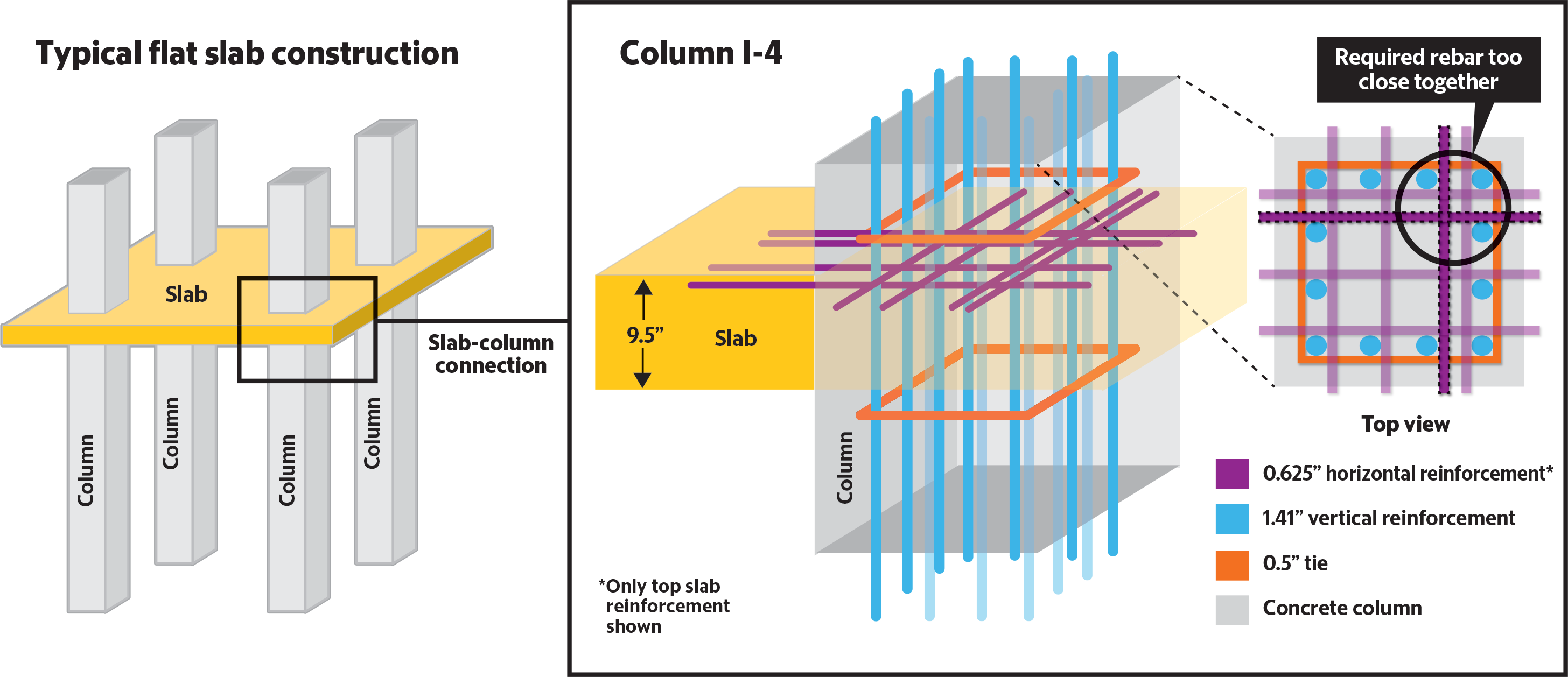
Section 7.6.1 of the ACI 318-77 code required a minimum of 1 inch clearance between parallel reinforcement. In the example of Column I-4, two pieces of horizontal rebar in each direction would have been less than 1 inch apart, making the column-slab connection difficult to properly construct and potentially reducing its overall strength.
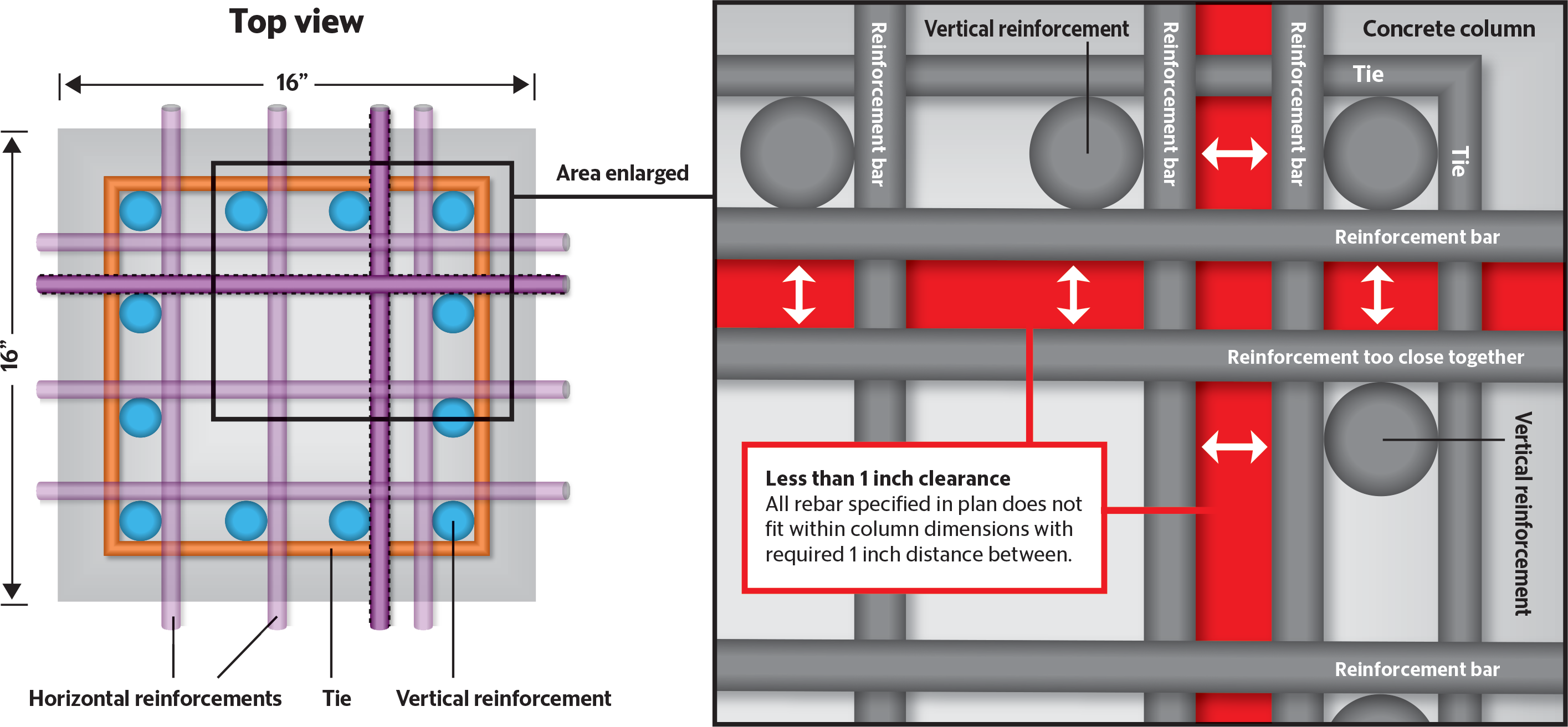
Without a change in the plans, the contractor would have had to choose between overcrowding or under-reinforcing the connection between the column and slab.
“That would have been an occasion for a request for a change [by the contractor],” Aghayere said. “Maybe those columns needed to get bigger.”
Instead, the original engineer and contractor inadvertently designed and constructed a weak point in the narrow columns in the north side of the building — one that Aghayere said would be especially prone to buckle when, for unknown reasons, the pool deck caved in on June 24.
“If an engineer gets this wrong, the contractor is supposed to pick up on it,” said Gregg Schlesinger, a contractor and attorney from Fort Lauderdale who reviewed the Herald’s analysis.
“All of this is bad, it’s wrong, it’s shocking to me,” Schlesinger said.
A weak structure and a progressive collapse
Although the trigger is still unknown, there is a growing consensus that the Champlain Towers’ progressive collapse was initiated by a first-floor slab failure.
Between 5 and 10 minutes before the north side of the condo pancaked down, eyewitnesses and a cellphone video suggest the pool deck began to sag. The spindly columns supporting it poked through the slab — a failure called “punching shear.”
Punching is the most common failure mechanism for flat-slab construction featured at Champlain Towers and should have been anticipated at the time of construction, the engineers said. Load calculations based on the 1977 standards published by the American Concrete Institute show the pool deck design was inadequate and did not have the required capacity at the time of construction to mitigate the risk of punching failure.
“My calculations show that the capacity was lower than the load that was imposed at these pool deck columns,” said Aghayere, the engineer from Drexel University. “So I would have added drop panels to increase the shear strength.”
Drop panels, a thicker slab just around the top of the columns, are not explicitly required in the code, Aghayere said. But even 40 years ago the American Concrete Institute had explicit punching shear requirements.
“[Drop panels are] not mandated, but it is what you can use to reduce the punching shear demand so that you meet the punching shear requirement,” Aghayere said. There is no indication of drop panels in the original building plans, he said.
.png "certificate of compliance 2 (1).png")
Renovation plans from 2021 by Frank Morabito, a structural engineer who was contracted by the Champlain Towers’ condo board to oversee the building’s 40-year recertification process, show he intended to add drop panels in the building. And the engineer flagged a different “major error” in the design — lack of slope and proper drainage on the deck — that he said degraded the structure over time. His reports did not directly reference any deficiencies in the shear capacity of the pool deck.
“Morabito Consultants performed its duties at Champlain Towers South Condominium consistent with industry standards,” company spokesperson Brett Marcy told the Herald in a statement. Marcy did not directly respond to the Herald’s questions about whether Morabito performed load calculations as part of his inspection, but said the firm’s inspection did not “indicate that the building itself was at risk of complete structural failure, that it was at imminent risk of collapse, or that it should be deemed unsafe for occupation.”
The slab collapsed before Morabito’s team reached that phase of construction where drop panels would have been added.
Champlain Towers featured an intentionally asymmetrical design that prioritized ocean views and parking space. The underground parking extended to the edges of the property footprint. On top of the garage sat a ground floor pool deck, driveway and valet parking area along with a 12-story “L-shaped” tower featuring a 13th floor oceanfront penthouse addition on the northeast corner.
Unlike frames built with beams and columns, in Champlain Towers the floor slabs provided most of the structure’s lateral stability, engineers who reviewed the plans told the Herald. The only other lateral support in the design was provided by reinforced concrete walls, called “shear walls,” at the stairwells and elevators, they said.
“The shear walls are very small. They are pitiful,” said Santiago, the former building inspector. “They don’t seem to have enough shear walls in one direction.”
When the first floor slab sagged around the columns, the whole structure became unstable and the tower began to sway.
Gabe Nir was in his family’s first-floor condo on the north side of the pool deck when he started hearing banging around 1 a.m., almost like a neighbor was engaged in late-night renovations, he said.
“I started feeling like this whole building started to move left and right,” Nir said. He said it felt like a cheap folding table swaying from side to side.
The crash of concrete as the crumbling slab ultimately sheared off from the southern perimeter wall sent him, his mother and sister running for the building’s exit.
“I saw the white dust,” Nir said. “I remember my mom screaming ‘earthquake!’ ”
The family escaped just minutes before the tower crashed down on top of their condo.
Pool deck falls into the garage in “punching shear” failure
Eyewitnesses saw the pool deck collapse, shearing off completely from the southern perimeter wall of Champlain Towers South minutes before the tower came crashing down. Photos from the collapse site show that narrow columns from the parking garage below poked through the pool deck as the slab sagged — a dangerous type of failure called “punching shear” which experts say is known to cause sudden collapse.

As the first floor slab fell away, the columns around the perimeter of the pool deck would have been put under extreme bending pressures. “As the slab pulls down it’s pulling on the columns, horizontally,” Aghayere said. Generally, the smaller the column, the less equipped it is to handle lateral load, he said.
The unequal distribution of shear walls in Champlain Towers also resulted in the narrower, noncompliant columns to the north experiencing more extreme lateral movements than the stronger columns to the west.
Although the shear walls around the elevator were small — and in one case, poorly connected to the slab — they provided critical stabilization to the western side of the building, experts consulted by the Herald agreed. The west side was also bolstered by second-floor beams, built to support the open-concept, ground-floor-level valet parking located only on that side of the building.
“[The beams] will help. Even if they weren’t designed for that, they will pitch in,” Aghayere said. The beams also prevented the slab from falling away from the column.
“If you have a beam supported structure, you don’t have punching at all,” Aghayere said.
There were no beams in the north side of the tower and only one small shear wall. That shear wall, located on the side of the stairwell, provided support in a north-south direction, but nothing in the design provided a strong brace against east-west movement after the pool deck collapsed.
“Without the adequate shear walls, that destabilizes the structure. That propagates,” Aghayere said. “Instead of being isolated like a local failure it just propagates into progressive collapse.”
As the building shifted side to side, the narrow, noncompliant columns on the north side began to fail, experts said.
“When you see a column that’s overcrowded with reinforcement you know it’s really small,” Aghayere said. “The columns were not designed to take more loads.”
The debris piles were littered with damaged columns, looking like sausage links — evidence, Aghayere said, that the columns buckled when the slab fell away at each floor.
The design weaknesses could have been exacerbated by construction failures, engineers consulted by the Herald said. Photos suggest that in various locations around the structure, the contractor left rebar out of the poorly designed and otherwise congested connections between the columns and slabs.
Expected rebar appears missing from column-slab connections
Engineers who compared the Champlain Towers South plans to photos of the post-collapse debris saw examples in various parts of the structure where rebar designed to connect the column to the slab appeared to have been left out during construction. For example, in this column from the north side of the tower, plans called for at least three pieces of horizontal rebar in both directions to connect the column and the slab at the joint pictured below — six pieces of horizontal rebar total. Only two of the expected six are visible in the debris.

Exposed connections in damaged columns in the pool deck, as well as in both sides of the high-rise structure, appeared to have fewer pieces of horizontal rebar than called for in the plans, said the engineers, who reviewed hundreds of photos of the debris and compared the visible columns to building plans.
“It is possible that the rebar broke off and that’s why we don’t see it,” said Lehman, the University of Washington engineer. But the debris photos, especially those from the pool deck, suggest a construction error, she said.
“It’s pretty clear to me that the required slab reinforcement did not go through that [pool deck] column given the way it should be spaced,” she said.
Aghayere, who reviewed the photos provided by the Herald, said he saw no evidence that the rebar pulled out during the collapse.
“If you have the rebar, you won’t have the concrete just falling away, just like we saw on the pool deck,” he said.
Modern building codes call for stronger steel reinforcement connecting the bottom of slabs to columns and more durable concrete, especially for buildings exposed to seawater, all of which experts say could have helped at Champlain Towers South.
Still, standard construction practices and building codes in the late 1970s should have been enough to prevent a progression of the collapse despite the dramatic cave-in of the pool deck, the engineers consulted by the Herald agreed.
It’s difficult to know if any one thing — more rebar or shear walls, larger columns or drop panels — would have been enough to prevent the progressive failure of the north side of the structure without spending years modeling the exact conditions of the structure, Aghayere said. But he and other engineers consulted by the Herald said the combination of poor design and construction likely contributed to the worst-case scenario in half the tower.
“If it’s not designed to code, what happens is in collapses you don’t find one thing that brings down the building. It’s a number of factors,” Aghayere said.
“It’s tragic when I think about it because this should have been caught,” he said.
The National Institute of Standards and Technology is putting together teams of forensic engineers to determine both the trigger of the collapse as well as any contributing factors that may have made it worse. Agency spokesperson Jennifer Huergo declined to comment on the Herald’s analysis, or on how much the original design might factor into the agency’s investigation.
“The National Construction Safety Team will collect and analyze any and all information that might help them determine the likely cause of the collapse,” Huergo told the Herald in a statement.
The engineer ‘gives the go-ahead’
Throughout the design and construction process, someone should have noticed the problems, all five experts agreed.
“This is a piece of junk, this building,” said Schlesinger, the contractor who reviewed the analysis. The problems with the design “should have been picked up by everyone,” he said.
Engineers for renovation projects over the past decade should have run calculations to test the punching shear capacity of the pool deck, Schlesinger said. And, he said, on the original job site, the engineer and contractor shared the responsibility for ensuring that all the planned rebar was placed with enough clearance, according to the code.
If a building official inspected the site, he or she probably should have noticed the congested columns before the concrete was poured, too, experts interviewed by the Herald agreed. It was unclear from town records whether there had been such an inspection by the town at the time.
Inspections are important, the consulting experts agreed, because once the concrete is poured, it is difficult and expensive to confirm the location of rebar. The process is time-consuming and requires special scanners.
“The contractor obviously doesn’t read the code. That’s why the engineer goes to the site,” Aghayere said. “Typically before the concrete pour the engineer is the one that gives the go-ahead.”
Ultimately, it was the job of the lead engineer, Sergio Breiterman, to verify the designs met the code and perform any necessary calculations. Those calculations would have shown the columns, as designed, were overcrowded, and the pool deck was barely adequate for the load it would bear, as found by the engineers who performed calculations for the Herald analysis.
A plans examiner for the town should have also run the calculations before the permit was issued in 1979, according to Surfside’s current building official, Jim McGuinness, who reviewed the Herald’s analysis. But the review would not have been as rigorous then as it is for modern construction, said McGuinness, who has been on the job for less than a year.
So far, the town has not found any records of calculations by Breiterman or a plans examiner. Town officials were also unable to find any records of original job-site inspections.
“We can only hypothesize at this point about what happened — actually the design and construction happened more than 40 years ago,” McGuinness said.
“This was 1979, 1980 — era of the oil embargo [on Iran],” he said. “Kind of a wild and woolly time.”
The building plans kept by the town were haphazard, and some critical pages appear to be missing, including structural drawings for the Jacuzzi and the penthouse added during original construction, limiting the possibility of a comprehensive and conclusive analysis. McGuinness said that at some point, more drawings likely existed but that the town did not seem to have them in storage anymore.
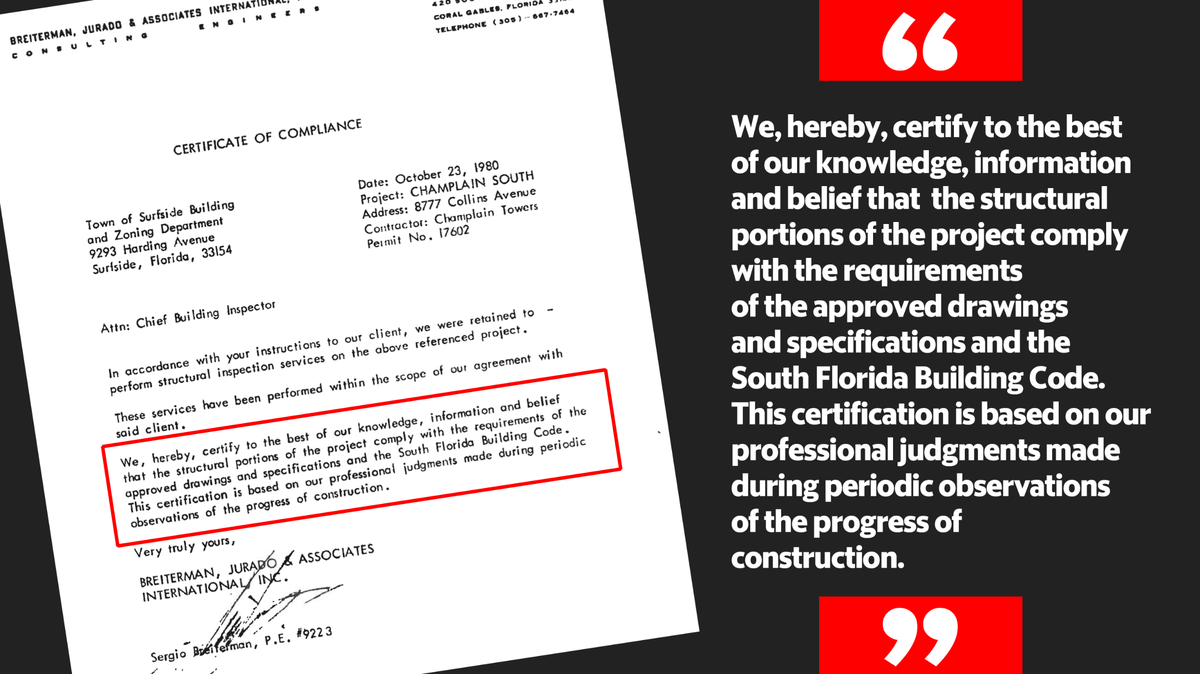
Among the few records that still exist in the town’s files is a letter from Breiterman, who is now deceased, to the local building department in 1980. It was an official certification of the structure, saying that, based on Breiterman’s periodic inspections, Champlain Towers’ design and construction met all of the requirements of the building code at the time.
“We have evidence that clearly it doesn’t,” said Lehman, the Herald consultant. “That is really problematic.”
Breiterman’s former business partner, Manuel Jurado, did not respond to the Herald’s request for comment.
Breiterman was also the lead engineer for the Champlain Towers North, a very similar 12-story reinforced concrete condo located one block away. Constructed around the same time, Champlain North shared the same architect and contractors as its fraternal twin. A review of the column designs showed they were likely similarly overcrowded as drawn.
Allyn Kilsheimer, a structural engineer contracted by Surfside after the collapse, told reporters his initial inspection of Champlain North did not raise any red flags.
“I would let my kids and grandkids stay in this building,” Kilsheimer told reporters on July 12. “And, if I find something that would not let me do that, the first thing I would do is tell you, ‘you have to get out of here.’ We have not found anything that concerns me at all on the exposed and visible conditions or on the testing we’ve done so far.”
Later, Kilsheimer told reporters he had subsequently looked at the building designs and structural drawings but stood by his assessment that it is safe for occupancy. He declined to review the Herald’s analysis or provide comment for this story.
This report has been updated to fully list the ingredients in concrete.
Researcher Shane Gore contributed to this report.
BEHIND THE STORY
MOREWhile federal and local investigations are underway, there is an urgent need for the public to understand what went wrong at Champlain Towers South.
The Herald worked with four engineers and a general contractor who reviewed a trove of records to better understand the circumstances of the collapse. The documentation included structural drawings and design plans of Champlain Towers South provided by the town of Surfside, high-resolution photographs of the collapse debris, and decades’ worth of construction and renovation permits, inspections and other records, including communications from the condo board.
Expert Consultants
Dawn Lehman, professor of structural engineering at the University of Washington, was hired by the Miami Herald as a lead consultant for its ongoing forensic analysis of the Champlain Towers South collapse.
Other experts who performed calculations and reviewed photos and building plans for this analysis included: Abieyuwa Aghayere, professor of structural engineering at Drexel University; Eugenio Santiago, a licensed structural engineer and retired chief building official for Key Biscayne; and Gregg Schlesinger, a contractor and attorney from Fort Lauderdale. One other structural engineer provided analysis of plans and reviewed calculations on background only.
Engineers performed calculations to test rebar spacing requirements, rebar-to-concrete ratios for columns, and the punching shear of the pool deck. These calculations were based on the American Concrete Institute’s 1977 code, ACI 318-77, and the 1976 South Florida Building Code –– the two governing building codes at the time of design and construction –– in combination with details specified in Champlain Towers’ Aug. 22, 1979, structural drawings or their most recent revisions, as provided by the Surfside building department.
Understanding the building plans
Surfside provided over 300 pages of building plans, but records for Champlain Towers still appear incomplete. For example, revisions to architectural drawings also show a Jacuzzi and feature a different pool shape that was not in the original design. The changes were never made to the structural drawings provided by Surfside.
Current Surfside building official Jim McGuinness told the Herald that’s enough reason to believe other structural drawings exist. “The construction company would need structurals to know what to build. They’re not going to wing it,” McGuinness said. But, he said, the plans do not appear in the town archives.
McGuinness said the town does not expect to find any more plans in storage.
Updated structural drawings could include different details than the ones used in the calculations performed by engineers for this analysis.
This story was originally published August 8, 2021 at 5:00 AM.