DeSantis asked Legislature for wins that appeal to GOP base. It gave him everything.
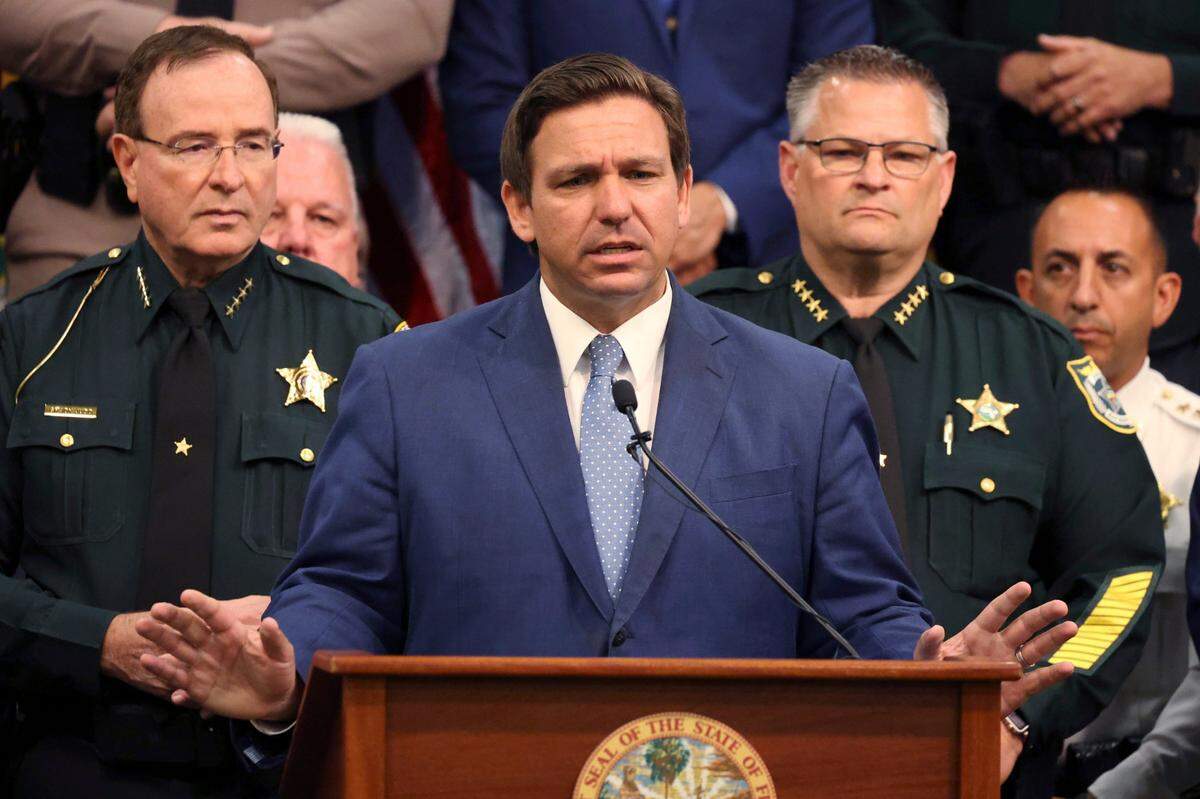
.JPG "Surrounded by lawmakers, Florida Gov. Ron DeSantis speaks at the end of a legislative session, Friday, April 30, 2021, at the Capitol in Tallahassee, Fla.")
The passage of the bills was perfectly timed.
An hour before Gov. Ron DeSantis was to appear on Fox News’ Laura Ingraham Show on Thursday night with four other Republican governors dubbed “red state trailblazers,” the Florida House sent him the final collection of his priority bills aimed squarely at the conservative cable show’s audience.
The bills — imposing fines and penalties on social media companies that remove users and restricting mail-in voting — emerged from last November’s presidential election and were the end cap to a carefully crafted legislative agenda aimed less at the needs of the governor’s home state and more at the national Republican base.
His other legislative session victories were also pointed squarely at the polarized nation’s culture wars: passage of the “anti-riot” legislation that the governor called for after last summer’s nationwide racial justice demonstrations, a bill to ban businesses, government and schools from requiring so-called “vaccine passports,” and a ban on transgender athletes from competing in girls’ and women’s sports.
“We have a very long list of policy successes,” DeSantis said after the Legislature adjourned Friday afternoon. “They’re things that I think have been transformational that no one’s really even talking about.”
Add to the mix the $101.5 billion budget, loaded with more than $23 billion in federal stimulus money and $200 million in tax cuts, and Florida legislators ended their annual session Friday delivering to the governor all the victories he needs to launch his re-election bid. If he succeeds, he is expected to position himself for a 2024 presidential run.
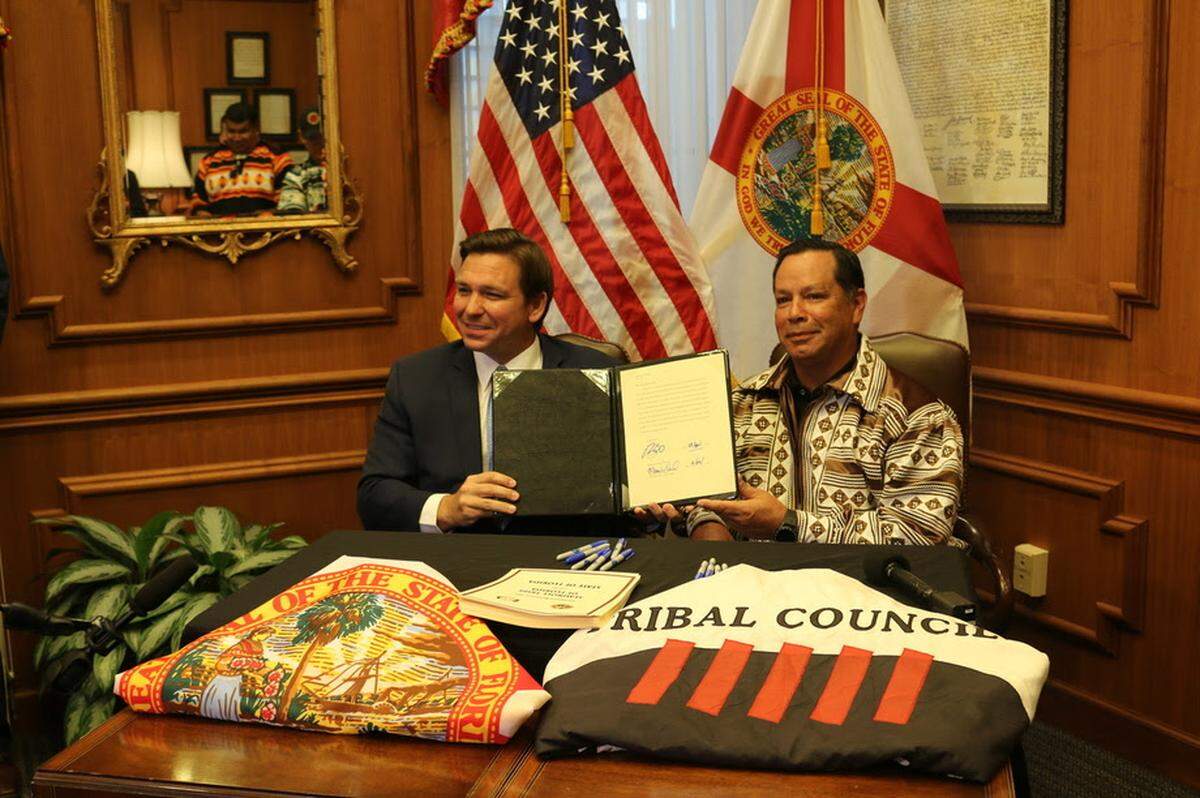
In two weeks, legislators also will return for a special session in which they are expected to approve a final gift to DeSantis: ratification of a multi-billion dollar gaming deal with the Seminole Tribe of Florida that the governor was instrumental in negotiating.
The first-term governor is expected to launch his re-election bid after the special session, and Democratic rivals are already emerging.
Congressman Charlie Crist of St. Petersburg is expected to make his announcement Tuesday to challenge DeSantis for governor next year. Congresswoman Val Demings of Orlando is also expected to announce she is running. And Agriculture Commissioner Nikki Fried has dropped a series of online spots critical of DeSantis’ management of the pandemic as she also positions herself for a Democratic primary.
Fried said legislators are already punishing her.
They cut her agency’s budget by $11 million, leaving the Florida Department of Agriculture and Consumer Services the only one in state government not to receive additional funding from the super-sized budget this year.
“This is the most disheartening session I’ve ever watched,’’ she said. “You’re in the middle of the healthcare pandemic and instead of talking about access to healthcare and making sure that our people are taken care of instead they are passing laws about how businesses are mandating vaccines. We haven’t talked about raising unemployment compensation, fixing unemployment systems.”
Fried said that because the governor treats the pandemic as if it’s behind us, “he has created a regime that people can’t protest, can’t speak up against him, and if you do, there’ll be retribution to be paid. Look at what’s happened to my budget, because I’m outspoken and a check on the Republicans.”
National celebrity
Democrats, however, worry that DeSantis’ growing national celebrity and his legislative bag of goods may make him unstoppable heading into 2022 and as he considers a 2024 presidential run.
National media appearances were more common than meeting with state lawmakers on some days, according to his public schedules. DeSantis was a regular guest on Fox News during the two-month lawmaking session, up until the last day of session.
On five separate occasions, he was a guest on evening shows hosted by conservative media darlings Sean Hannity, Tucker Carlson and Ingraham. He also appeared on “Fox and Friends” three times and did a radio interview with Mark Levin.
Republican leaders often touted his leadership when shepherding his priorities.
House Speaker Chris Sprowls described DeSantis as a “hands-on governor” and said his priorities were pushed through the Legislature because leaders in both chambers shared his philosophy.
“I like that the governor is going on the evening news and talking directly to Floridians,” Sprowls told reporters during the last week of session. “I think it is important that they actually get the fact as to what our bills do.”
The governor, whose campaign for governor in 2018 was catapulted forward by the endorsement of then-President Donald Trump, has embraced many of the same tactics as the former president, tapping into grievance politics and declaring war on “corporate media.”
Much of what DeSantis achieved this session is also a reflection of a national movement by Republicans in response to losing the White House and Congress last year.
As a testament to the strategy, the governors from Texas, Iowa, Nebraska and Mississippi joined DeSantis and told the Fox News audience Thursday that they too had adopted or are pursuing restrictions on vote by mail, social media companies and banning businesses and schools from requiring proof of vaccinations.
Although the Republican push to tighten voting laws in Florida ended up not as extreme as the proposal pushed by Republicans in Georgia, the move to limit drop boxes by allowing them only at early voting sites during their open hours and requiring voters to request a vote-by-mail ballot before every general election has already become a lightning rod for Democrats and civil rights activists.
‘Greedy and gluttonous’
The scope and tone of the agenda left Democrats, who still account for 100,000 more voters in Florida than Republicans, feeling dispirited.
“It was greedy and gluttonous,’’ said Sen. Jason Pizzo, a Miami Democrat. “They put together a nice little rostrum of red meat for mailers for DeSantis in his future runs, and that’s all it was. It was completely overreaching.”
The Republican leadership spent so much energy on passing legislation in politically divided votes, he said, they failed to focus on issues facing average Floridians, such as affordable housing, evictions and getting unemployment claims filed.
At the governor’s request, legislators did select some Floridians for $1,000 direct payments — teachers, police, firefighters and paramedics — but they did not increase unemployment benefits or address other policy decisions that contributed to the failure of the state’s unemployment system last year.
Nor did the Senate’s select committee on pandemic response review DeSantis’ executive orders or pandemic-related spending, as Senate President Wilton Simpson, R-Trilby, said it would.
“Whose life is better off after this session?’’ Pizzo asked. “Corporations are better off. Companies better off...I did a keyword search on my own social media last year and the most often used words were: COVID, vaccine, death, ventilators, PPE, PPP, and masks. There’s nothing about protests. There’s nothing about trans athletes. There’s nothing about de-platforming on social media.”
Pizzo blamed the governor for being behind the Senate’s 19-19 defeat of an amendment barring businesses and schools from telling people not to get the COVID-19 vaccine.
The amendment was targeted at Centner Academy, the Miami private school that said it would not employ vaccinated teachers and staff. The school is operated by Leila and David Centner, who on April 2 gave $30,000 to DeSantis’ political committee, according to campaign finance records.
Rep. Anna Eskamani, an Orlando Democrat, along with Reps. Carlos Guillermo Smith and Omari Hardy, sponsored a stream of amendments to the voting, transgender, anti-riot, social media and vaccine passport bills in the House.
Their efforts failed, but they said their goal was to expose how the intent of the legislation was not about addressing majority concerns, but putting permanent constraints on the democratic process.
“They created boogeymen, slayed them, and then proclaimed victory,’’ Eskamani said. “Just a bunch of fake enemies that they are conquering in the name of freedom.”
The agenda, however, is not without risk.
Expected lawsuits
Legal challenges on constitutional grounds are expected in nearly every one of the governor’s priority issues.
HB 1, the “anti-riot” bill has already drawn a legal challenge over arguments that the law infringes on the First Amendment rights of peaceful protesters. Other challenges are expected on the vote-by-mail restrictions and on a bill capping contributions to political committees attempting to get a citizen initiative on the ballot. Critics have also argued the transgender athlete ban DeSantis intends to sign could be discriminatory and unconstitutional.
The governor said he expects them and is not worried.
“I think there’s a cottage industry of lawsuits,’’ he said Friday. “That’s what happens when you do this.” He cited a court decision that left in place a law implementing the felons voting rights amendment, and another court ruling that upheld his firing of former Broward County Sheriff Scott Israel. “There’s always going to be challenges. But I think they were really attentive to some of their pitfalls, and I think that’ll pass muster as well.”
DeSantis told the Fox News audience he also wasn’t worried about candidates and causes going after him for signing the “anti-riot” bill.
“We’re also making sure that we’re holding people accountable if they’re engaged in violent activity, so I think it’s going to serve as a deterrent,’’ he said. “...If they want to be running against that, I mean, be my guest.”
The Republican arguments, however, sometimes contradicted each other.
They argued the state’s voting laws needed to protect voting by mail from fraud, an issue Republicans have long ignored and which wasn’t a problem in 2020. Then they spent much of the session refusing to accept a provision addressing the only arrest for voter fraud last year — where a Republican operative is accused of recruiting a no-party candidate to siphon votes from the Democratic incumbent in Senate District 37.
In the final day of session, the Senate pushed through a change the House accepted that requires that a person be registered to vote without a party affiliation for a year before running for office as one.
Strengthening power
Among the “transformational” things DeSantis referred to was a stream of bills that strengthen the power of the Republican controlled executive and legislative branches by stripping local governments of their authority over clean energy regulation, police budgets, Key West cruise traffic, home-based businesses, and the ability of cities and counties to respond to public health emergencies and natural disasters.
“Having dealt with COVID, I think some of these local governments have overplayed their hands,’’ DeSantis said Friday.
The governor said he will review the local preemption bills and then ask: “Is there a core state interest involved?”
He earned environmental bona fides in his first year when he vetoed a bill to preempt local governments from banning plastic straws, but last year when legislators passed a bill preempting the city of Key West from banning sunscreen lotions that contain certain chemicals they said were harming the reef, he signed it.
Included in one of the preemption bills, SB 2006, which limits the emergency powers of local governments in a natural disaster or future public health emergency, legislators also quietly used it to put some checks on the executive branch.
Throughout the pandemic the Legislature, which is the sole branch of government authorized to appropriate state revenues, remained on the sidelines as DeSantis exercised an unfettered ability to enter into contracts and make emergency spending decisions through his Division of Emergency Management. The bill now requires the governor to regularly report to legislative leaders.
DeSantis now enters the final 18 months of his term with more money, a significant number of the elderly population fully vaccinated, and a state budget that has ballooned by more than $23 billion in large part because of the administration of President Joe Biden. Add to that more than 300 people a day moving to Florida, and a rebounding economy.
“We share the governor’s philosophy,’’ Sprowls said. “He worked on things that he cared about, and his priorities we shared and we included them when we could.”
The governor’s “philosophy” included $50 million for teacher salary increases, $500 million to start planning for the effects of flooding and sea level rise, $1.2 million in executive pay raises for his agency heads and renewing the “Governor’s Medal of Freedom” — something Senate budget chair Kelli Stargel said the governor personally asked to keep.
DeSantis also avoided some of the nastiest budget fights of the session.
His initial budget, which anticipated hundreds of millions in extra federal Medicaid dollars, never included cuts to state hospitals. The House and Senate budgets did include cuts, resulting in weeks of hand-wringing by some of the most powerful special interests in the state.
In the end, the heartburn was for naught. The federal money came in as DeSantis expected, and the budget passed by both chambers did not include any cuts to hospitals.
The Legislature also gave DeSantis programs and policies he didn’t ask for but are popular among the Republican base, such as dramatically expanding Florida’s school choice program and offsetting a $1 billion increase in sales taxes on online purchases with cuts to business unemployment taxes.
The governor took credit for it all on Friday as Sprowls and Simpson stood at his side. He made no mention of the federal government’s financial injection that turned Florida’s budget from a deficit to a surplus.
“If you look across the board, I think this Legislature is addressing people’s concerns,’’ he said. “I’m proud of being able to accomplish what we set out to do.”
Hardy, who is now a candidate for Congress, said Democrats shouldn’t care if DeSantis takes the credit.
“President Joe Biden and a Democratic Congress saved Gov. DeSantis’ hide, taking a lot of tough decisions off of his plate,’’ he said. “It’s our responsibility to tell that story to the community. We shouldn’t care about Gov. DeSantis claiming credit because at the end of the day it’s our constituents who are going to benefit from it.”
Tampa Bay Times Tallahassee Bureau reporters Lawrence Mower and Kirby Wilson contributed to this report.
This story was originally published May 1, 2021 at 1:33 PM.