Abduction of Haiti security official, 6-year-old daughter shows kidnapping crisis
The cabinet director and inspector general at Haiti’s Defense Ministry was kidnapped this week, along with his wife and their 6-year-old U.S. citizen daughter while seeking medical care in Port-au-Prince for their ailing child, according to two sources familiar with the incident. James Boyard, a Haitian police officer and security expert, was abducted Thursday morning in Raimbol in the Bourdon neighborhood as the family traveled through the capital to see a doctor after a restless night caring for their sick daughter.
The kidnapping has sent shock waves through Haiti’s security sector and underscored the continued reach of armed gangs despite ongoing efforts by Haiti’s national police, the country’s fledgling army and private security contractors overseeing drone strikes to reclaim territory controlled by armed groups.
The high-profile abduction follows a series of other kidnappings, including that of a senior staffer in the Foreign Affairs Ministry who was freed after spending more than a month in captivity and the payment of a hefty ransom; a mother of a six-year-old who was grabbed on March 28 and remains captive; and a Russian and Turkish who were kidnapped on May 1 aboard a cargo vessel anchored in the Bay of Port-au-Prince after gunmen boarded their ship. Both remain captive.
The insecurity crisis is frustrating business owners, human rights defenders and regular Haitians who are forced to navigate a capital that is largely controlled by criminal gangs.
U.N. secretary-general to visit Haiti on Tuesday
On Tuesday, United Nations Secretary-General António Guterres is scheduled to arrive in Port-au-Prince. He is expected to meet with Prime Minister Alix Didier Fils-Aimé who was on his way back to the country on Sunday from Boston after attending Haiti’s national soccer team FIFA World Cup opener, where Haiti lost to Scotland. Guterres is also expected to meet with human rights advocates, humanitarian providers, U.N. personnel and members of the U.N. authorized, U.S. backed Gang Suppression Force.
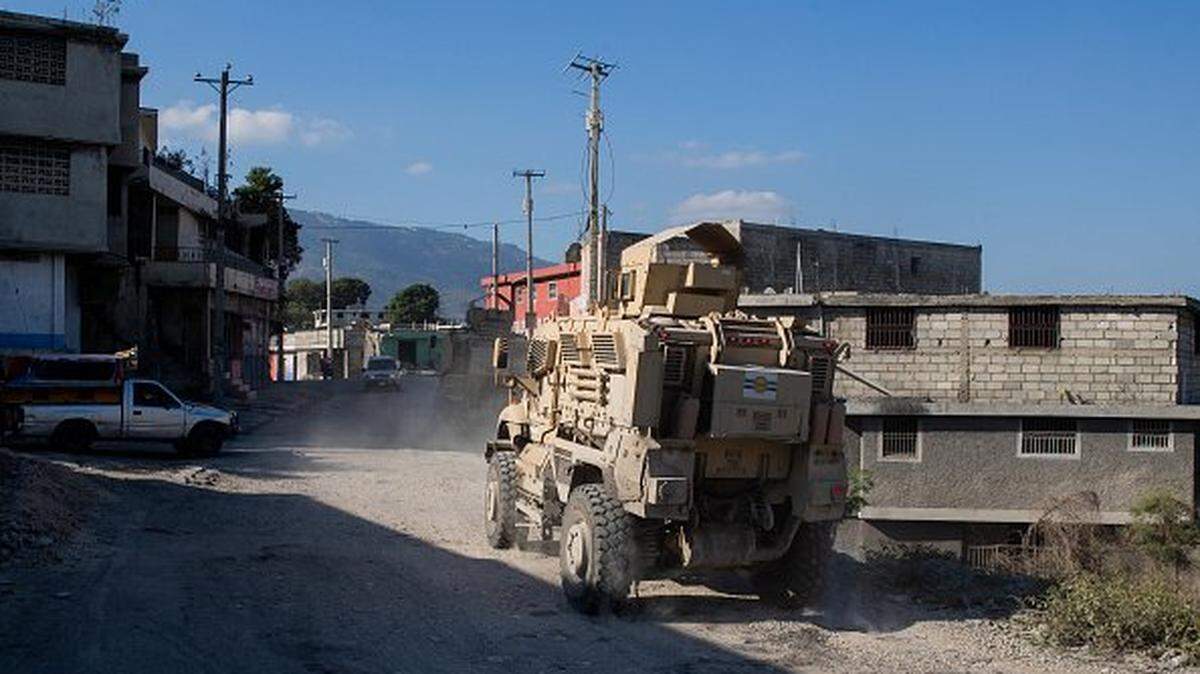
The force is the latest effort by the international community to help Haitian authorities confront terrorizing gangs. But deployment of its planned 5,500-member contingent, composed largely of military personnel, has proceeded slowly. Newly deployed Chadian soldiers only began patrolling the capital this month.
READ MORE: What you need to know about the new Gang Suppression Force deploying in Haiti
Reginald Delva, a former head of national security and analyst of Haiti’s security crisis, said the kidnapping of Boyard and his family “is deeply concerning,” given the reported location, timing and method of the abduction. He also feels that kidnappings are not a priority for the government.
“I have no doubt they have great intel,” Delva said of gangs. “Based on victims’ testimonies, gangs have great intel on the potential targets that they have.”
Delva said at least three kidnapped victims had told him that gang leaders showed them surveillance videos documenting how long they had been monitored before being abducted. “Based on what I’m seeing, it’s not going to stop, because victims don’t want to report what’s going on,” he said.
Victims, he said, are not reporting their abductions and instead choose to flee after being released. The reason is because they do not have confidence in the police, and increasing there are reports that gunmen are dressing as police officers and using police vehicles.
“Nothing has been done as far as police vehicles being marked,” he said. “One simple measure can change the dynamics for the gangs if all the vehicles used by the by [Haiti National Police] are marked and the population knows exactly who can stop you.
“If you don’t see a marked vehicle, do not stop. That’s all they have to say,” he said.
Haiti has an anti-kidnapping unit within the national police force, but it does not release statistics. In recent years, the unit has also lost cops and Delva said officers assigned believe that neither kidnappings nor the unit itself are priorities for the government.
“They didn’t add more cops to it, showing that they understand the urgency. There’s no technology that I would say to improve the work of the [anti-kidnapping] unit. So that’s my concern,” he said. “You don’t feel that the kidnappings are considered to be a serious threat.”
“If you ask anyone from the diaspora what is the main reason we don’t go to Haiti, kidnapping is number one,” he added. “It’s a serious threat, and we don’t see the government taking any action.”
Another issue is the lack of communications from the government. While Fils-Aimé and Deputy Secretary of State Christopher Landau who visited Haiti recently tried to convey that progress is taking place on the security font, after the latter visited the grounds of the national palace, incidents like Boyard’s kidnapping have Haitians questioning the messaging.
“We don’t know what’s going on,” Delva said. “They don’t inform the population on gang’s ammo.
“You don’t feel the sense of urgency,” he said.
Intensified police operations against gangs
Since December, Haitian security forces have intensified operations in metropolitan Port-au-Prince, while the Defense Ministry recently launched a recruitment drive to expand the ranks of the country’s small army. Those efforts, however, have been overshadowed by renewed gang warfare in Cité Soleil and Croix-des-Bouquets, and continuing attacks in the neighboring Artibonite region by allies of the powerful Viv Ansanm gang coalition.
The fighting has fueled additional killings, rapes and for-ransom kidnappings. In May, two seafarers aboard a cargo vessel anchored in the Bay of Port-au-Prince were kidnapped after gunmen boarded their ship. Both remain in captivity.
The U.N. has noted that between December 2025 and May of this year, nearly 95,000 people have been newly displaced across the country. In the Port-au-Prince metropolitan area, violence drove displacements to record levels following the armed clashes in Cite Soleil in March and again in May.
The violence has continued to force families in the Artibonite to flee, contributing what the U.N. describes as a worsening humanitarian crisis with an unprecedented nearly 1.5 million people now displaced by gangs.
Sandra Pellegrini, senior analyst for Latin America and the Caribbean Armed Conflict Location & Event Data Projects, or ACLD, said recent clashes among gangs do not necessarily signal a collapse of Viv Ansanm, which took shape in September 2023 and consolidated its power in February 2024.
“Gangs are likely to preserve their resources ahead of the full deployment of the Gang Suppression Force,“ Pellegrini said.” The fighting does highlight the fragile nature of territorial arrangements within the alliance, especially among groups operating in close proximity and competing over the same sources of revenue.
“Ultimately, civilians are the most affected by gang rivalries and escalating violence. They are often caught in the crossfire or deliberately targeted by rival gangs,” she said. “Many are also unable to return home, as gangs have increasingly relied on scorched-earth tactics in recent years to expand territorial control.”
This story was originally published June 14, 2026 at 5:33 PM.