
U.S. talks, energy, exiles, Ecuador: Top takeaways from Miguel Diaz Canel address
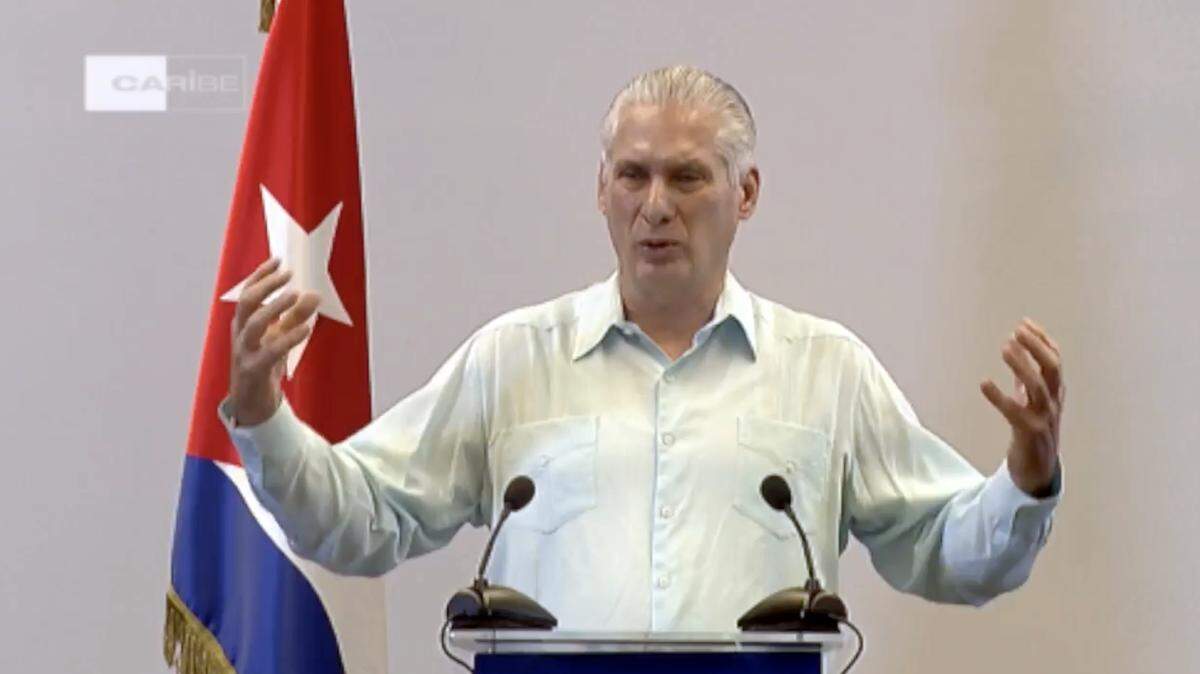
Amid Cuba’s official acknowledgement Friday of ongoing negotiations with the Trump administration, leader Miguel Diaz-Canel described the talks as preliminary, but they could mark a turning point in tense relations between Havana and Washington.
Diaz-Canel also addressed other pressing issues in Cuba, including the ongoing oil crisis that has left much of the island in the dark for days at a time, the role of Cubans abroad in the island’s economy, and the deadly clash between the country’s coast guard and a Florida-registered speedboat.
Here’s a closer look at Diaz-Canel’s remarks.
Negotiations with the United States
In a meeting with top officials of Cuba’s Communist Party televised Friday morning, Diaz-Canel said Havana and Washington are engaging in talks about future relations. “These conversations have been geared towards finding solutions through dialogue about the bilateral differences between the two countries,” he said.
In a follow-up press conference, Diaz-Canel described the dialogue as sensitive, discreet and prelminary. He compared the ongoing negotiations to the face-to-face talks between Raul Castro and Barack Obama, which resulted in the thawing of U.S.-Cuba relations after five-plus decades from 2014-16.
READ MORE: Cuban leader Miguel Díaz-Canel confirms talks with the Trump administration
“This implies finding areas of cooperation with which we can face threats and guarantee peace and security in both our country and region,” he said.
President Donald Trump has struck a very different, harder-edged tone in his public comments about Havana’s leadership. During a Doral summit of Latin American leaders on March 7, he said that “Cuba’s at the end of the line.” And as he welcomed Inter Miami players at the White House last week, he said Cuba was very eager to make a deal and told a Cuban-American club co-owner he’d be able to fly to Cuba soon.
The U.S. has been in conversations with the Cuban government for several weeks, sources close to the talks have told the Miami Herald. The two sides met on the sidelines of the annual Caribbean leaders’ meeting in St. Kitts and Nevis.
READ MORE: Trump says Havana wants deal, change may come to Cuba in as little as two weeks
Cuba’s energy crisis
No oil tankers have arrived in Cuba for three months, Diaz-Canel said, after the United States’ move to choke off the island’s oil supply as a way to pressure its government to undergo significant reforms. In recent months, President Donald Trump has threatened tariffs on countries that supply oil to Cuba and blocked Venezuelan oil tankers from delivering crude to the island. Mexico has stopped shipping oil to Cuba as well.
In late 2024 and throughout 2025, Cuba’s power grid entirely collapsed multiple times as a result of an aging and neglected electric system. Cubans in recent years lived with frequent, hours-long power cuts even before the island’s energy crisis deepened under U.S. policies.
On Friday, Diaz-Canel blamed the “energy blockade” squarely on the United States and said the electricity deficit now was exacerbated and worsening as a result. He described some of its impact, including rendering water pumps inoperable, disrupting academic life at schools and universities, and leaving radio stations without the ability to operate.
“This has an impact on all the daily activities of Cubans,” he said.
United Nations officials, independent journalists,and social media influencers have described a worsening humanitarian crisis on the ground, including impacts on distribution of food and water and essential services like education and transportation.
International airlines have been unable to refuel at the island’s airports and hospitals have canceled scheduled surgeries. On Friday, Diaz-Canel said there were “tens of thousands” of patients waiting on surgical procedures, including children. He described it as “the perversity of this energy blockade.”
Though the daily blackouts are forcing health professionals to work without X-ray equipment, electrocardiograms ultrasound and CT machines, doctors on the island have said they had already been dealihg with severe medicine shortages, crumbling facilities and overwhelmed emergency rooms before the oil crisis.
‘Many will die’: Cuba’s health system is on the verge of collapse, doctors warn
To address the energy shortage, Diaz-Canel said electrical workers have been working tirelessly to maintain energy generation going. He also shared extensive statistics on crude oil and renewable energy in Cuba and mused how other countries would respond in a similar situation. He said solar-powered systems had been installed in over 6,700 homes, 2,200 private businesses and 900 plus state-owned companies.
“And I want to emphasize that at no point have we relinquished our sovereign right to have imported oil supplies in Cuba, which are still necessary even with everything we are setting up; we need oil to ensure greater vitality in all aspects of national life,” he said.
Cubans abroad
Diaz-Canel said that there has been a long-standing dialogue between Cubans on the island and those abroad, and he emphasized the latter’s vital role to play in the island’s social and economic development. Acknowledging that more Cubans than ever are living abroad, the Cuban leader said that many of them are professionals who have maintained close cultural and family ties to the island. He also said that new measures to make it easier for Cubans abroad to do business on the island would be announced next week.
Whenever Cuba’s officials visit other countries they make a point to meet with Cubans living there, and there are important conferences that bring Cubans from abroad to the island, Diaz-Canel said. He also mentioned that there have been meetings with the government agencies to listen to Cubans living abroad about their ideas and concerns on how to participate in the island’s economy.
“Undoubtedly, the number of Cubans residing abroad — or extending their stay — has been on the rise recently. This population is substantial; therefore, it is our responsibility as a government to welcome them, listen to them, attend to their needs, and facilitate a space for their participation in the economic and social development of our country,” he said.
Government repression, economic instability, food insecurity and staggering inflation have driven many Cubans to leave their home country in search of a better life. Cuba’s top statistics official said that between 2022 and 2023 alone, over a million people had left the island. Recent arrivals from the island in recent years have also described to the Herald being targeted for opposing the government or extreme poverty driving them to leave.
Diaz-Canel did not acknowledge the country’s historically tenuous relationship with Cubans abroad, many who fled to Miami starting in the 1960s because of political persecution, property expropriation and economic instability after the Cuban revolution.
The boat incident
Regarding the men who had been aboard a Florida-registered boat that Cuban authorities accuse of being terrorists, Diaz-Canel said that the FBI might send agents to the island to help with the investigation. On Feb. 25 Cuba said one of its coast guard vessels had been involved in a shootout at sea with the vessel, and that four people aboard had been killed. The rest have been charged with terrorism-related crimes.
“We’re waiting for a possible visit...of FBI experts to participate in the clarification and the investigations with personnel from our Interior Ministry,” Diaz-Canel said. “There is information and cooperation with our American counterparts.”
The FBI office in Miami declined to comment and referred the Herald to the State Department.
Like other Cuban officials, Diaz Canel described the men on the boat as heavily armed, said the operation was financed from within the United States, and that the men had traveled to Cuba to commit terrorist acts. He said they planned to attack social institutions and military facilities. He also dismissed claims that they had come to the island to pick up family, given the presence of weaponry and the lack of space on the vessel.
“All of them have acknowledged their participation and that they were the ones who first shot at the Coast Guard boat,” Diaz Canel said. “They have provided very interesting details... about who recruited them, who prepared them, who organized them, who financed them, where they trained.”
Four of the men appear to be dead, based on Cuba’s multiple statements about the death toll, and six have been charged with terrorism. Diaz-Canel said the criminal case was ongoing and that accused would be afforded due process.
So far, the United States has not verified Cuba’s version of events and said little about the matter. Diaz-Canel said that Havana has been cooperating with Washington in the wake of the incident, that the injured received medical care, and that the relatives of the deceased have been notified.
In a statement to the Herald on Friday, a State Department official said that there multiple parts of the Trump administration working to verify elements of the story.
“The majority of the facts being publicly reported are those by the information provided by the Cubans. We will verify that independently,” the official said.
In the context of “infiltrations and enemy plans,” Diaz-Canel also mentioned the recent arrest of 10 Panamanians for writing anti-government graffiiti, who he said had access to their families and consular services while in jail.
Ecuador’s expulsion of Cuban diplomats
Responding to Ecuador’s recent expulsion of Cuba’s diplomatic mission, Diaz-Canel said that Cuba had good relationships with countries around the world and that the expulsion had “no justification” and “violated international laws.” Cuba has since shuttered its embassy there. Diaz-Canel said he still held out hope for improved future relations.
Earlier this month, Ecuador declared Cuba’s ambassador persona non-grata and said that the mission had 48 hours to leave Ecuador. In a recent interview on Radio Sucre, Ecuadorean President Daniel Noboa accused Cuba of “interference” in political activities and dissidence. He also said there was involvement in some “violent activities,” though he did not offer more details.
“With enough evidence we said, ‘Go back home’,” Noboa said.
On social media, Noboa published a video of what he said was the burning of documents at the Cuban Embassy in Quito, Ecuador’s capital. Noboa characterized the action as suspicious because diplomatic documents have international protections.
“They were definitely hiding something or it was evidence of things that are not correct for diplomatic missions,” Noboa said. Diplomatic missions around the world have previously burnt documents after abrupt closures or crisis situations. The U.S. State Department states in its foreign affair manual that “classified material is normally destroyed by burning.”
Towards the end of the press conference, Diaz-Canel also described his government’s recently announced liberation of 51 prisoners as a gesture of “good will” towards the Vatican. “It simply responds to our humanitarian attitude,” said Diaz-Canel, noting that the prisoners to be released had behaved well while in custody.
READ MORE: Cuba announces release of 51 prisoners amid increased tensions with the U.S.
Miami Herald staff writer Nora Gámez Torres contributed to this report.