From selling cars to building community, Miami philanthropist Ron Esserman dies at 93
Ron Esserman’s daughter, Dr. Laura Esserman, remembers growing up in a home in Miami-Dade where the rim of the ceiling was lined with some of her father’s favorite sayings.
“My dad was such an optimistic person and my niece always liked this saying: ‘One reason the front window is twice the size of the rear window is so that you will always look forward.”
That, in a large sense, describes Esserman, the family patriarch.
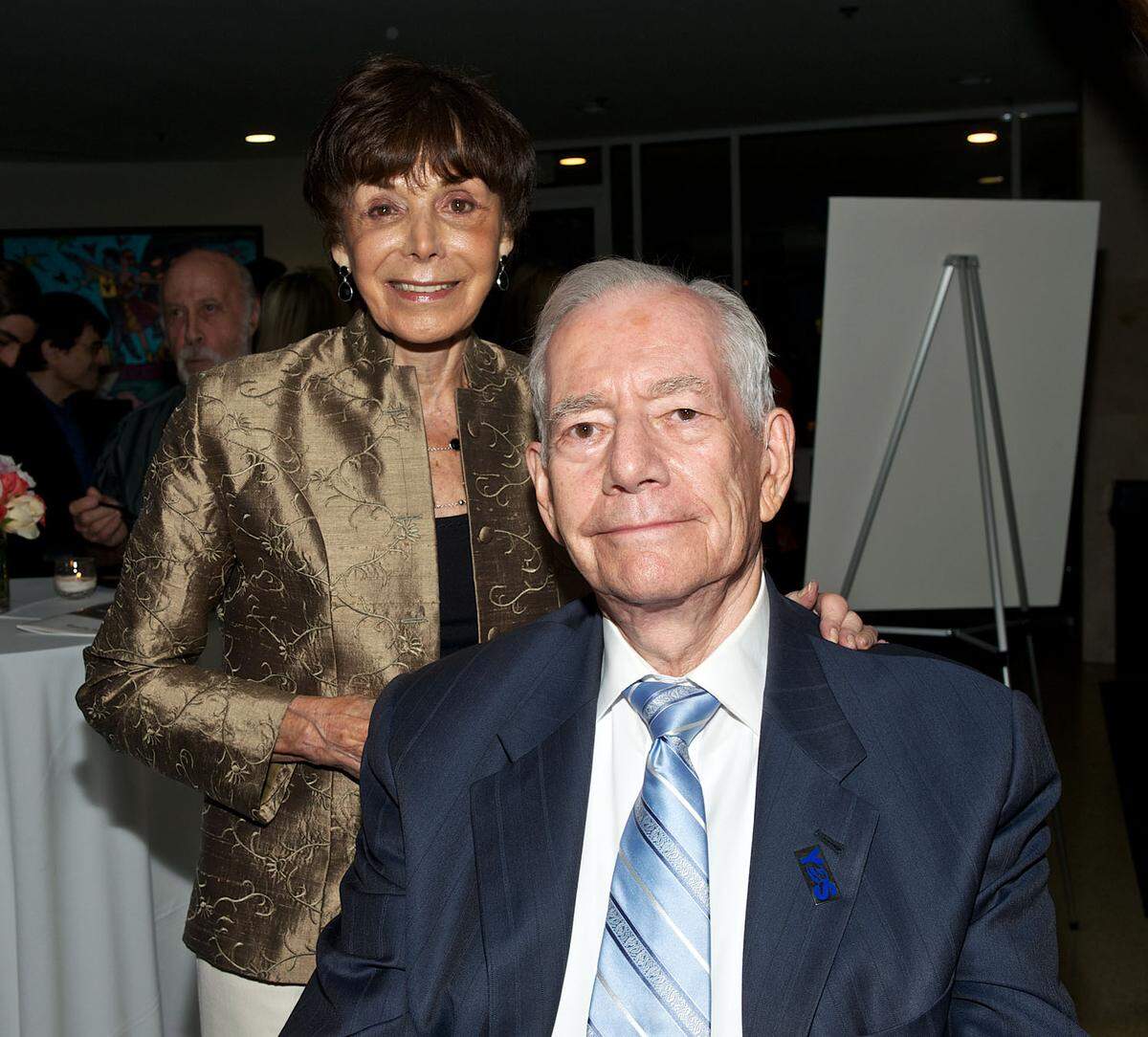
The Miami auto dealer, philanthropist, and arts and culture supporter died Monday at 93 of natural causes, his daughter said.
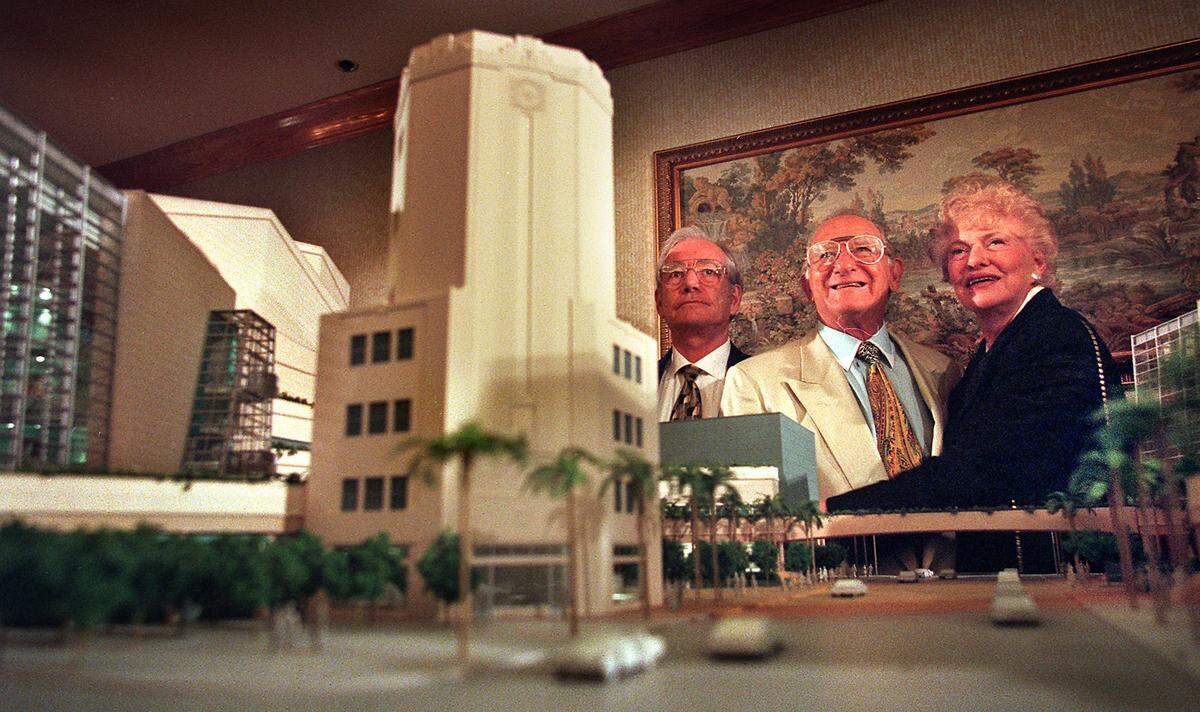
The footprints he left in South Florida were not only business-oriented through his successful car dealerships — the “Esserman International” logo on a license plate frame has been a familiar sight on roadways for decades. He also altered the landscape of the cultural community and remade downtown Miami thanks to his crusading efforts to get a performing arts center built, beginning in the late 1990s.
A lover of the arts and zoology
The resulting Adrienne Arsht Center for the Performing Arts, opened in 2006, is a part of Esserman’s legacy.
He was a man who loved the arts — always singing at home and at work, his wife, Charlene, recently said.
Esserman was a devotee of the Miami City Ballet, his daughter added. He, after all, helped lure founding artistic director Edward Villella to the company, a role the dancer and choreographer held from 1985 to 2012.
“It is by far the most spectacular performing arts form in the entire state. I call it an engine of prosperity,” Ron Esserman told the Miami Herald about the Miami City Ballet in 1994, when he was president of its board of trustees. “If we are going to get the businesses and the people that we want to relocate to Miami, they need institutions like this [for] . . . the quality of life.”
Things like the arts were important if Miami was going to play on the world stage, Esserman believed. So the auto dealer helped change downtown with that vision.
“When I was growing up no one would go downtown, it was so dangerous,” Laura Esserman recalls. Her father did not think that should be Miami’s public face to the world.
“That’s why he worked so hard on the performing arts center,” she said. “He thought it would be transformative. He said it’s what it always should have been, an outdoor paradise — except in the time of COVID,” Esserman adds, noting the pandemic’s impact on the temporary closing of Biscayne Boulevard’s Arsht Center.
But Esserman, she believes, would keep looking through that front window. So do leaders in the Arsht Center organization and at Zoo Miami, another institution Esserman helped make possible as one of the founders of the Zoological Society of South Florida.
“Ron Esserman was a pillar of this community and a lifelong champion of the Arsht Center,” said Tony Argiz, Arsht Center Foundation board chairman. “He was one of the earliest supporters of the dream for Miami that would become the Adrienne Arsht Center. His legacy lives in our halls, on our stages and with the five million people that have enjoyed a live performing arts experience at the Arsht Center.”
Says Zoo Miami spokesman Ron Magill: “I was extremely privileged to know and work with Ron Esserman throughout my 40-plus years at Zoo Miami, back when we first opened and when it was known as Miami Metrozoo. His generosity was overwhelming and I can say without hesitation that he is one of the founding fathers of this institution and that anyone who loves Zoo Miami owes Ron Esserman a tremendous debt of gratitude for playing such a major role in making it a reality.”
Supporting local journalism
Earlier this year, with an eye toward the future, Ron and his wife of 71 years, Charlene Esserman, and their family, established The Esserman Family Fund for Investigative Journalism at the Miami Foundation. The Essermans pledged $2.5 million to help fund investigative journalism in South Florida.
“We want to galvanize people to stand up for change, and that’s what a free press does,” Charlene Esserman told the Miami Herald in February.
The Esserman gift, combined with input from the John S. and James L. Knight Foundation, helps fund an annual $10,000 top prize and two $1,000 honorable mention prizes for South Florida’s “best accountability” reporting. The Essermans’ gift also supports a $50,000 yearlong investigative reporting fellowship at the Miami Herald for early-career reporters.
In June, The Esserman-Knight Journalism Prize was presented to the Miami Herald’s Julie K. Brown and Emily Michot for Perversion of Justice, their investigative series on the case of sex trafficker Jeffrey Epstein.
Christina Saint Louis, a recent graduate of the Columbia University Graduate School of Journalism, was the first recipient of the fellowship.
“Ron Esserman’s legacy dots the landscape across our community and imbues many of the most important institutions in South Florida. But perhaps his most enduring legacy is his remarkable family, who continue to champion his commitment to service for the greater good,” said Aminda Marqués González, Miami Herald publisher, president and executive editor.
A family man
Esserman’s drive and optimism also fueled his family.
Three of his children became prominent physicians, and a fourth, a diplomat, earned the title of ambassador as deputy U.S. Trade Representative under President Bill Clinton.
Laura Esserman, a breast cancer oncologist in San Francisco and 1974 Miami Herald Silver Knight General Scholarship winner, still applies her dad’s lessons in her practice, she said.
“I have lots of his sayings around my office today, including one that says ‘the person who says it can’t be done will soon be passed by the person doing it.’ Dad always said, ‘Do your work with integrity and quality and put your best effort forward. That is the measure and care of your community and the measure of success.’
“He was someone who believed that,” Esserman continued. “That is how he ran his business and did things to reflect those values. His efforts in the community were all about these values — building the zoo, the performing arts center, making contributions to the community during hurricanes, making sure people could come back to work. He loved ballet, he was integral to the success of that organization.”
Esserman calls her father’s trait “the power of optimism.”
She said Ron Esserman had “a fierce belief that things can happen and are possible. He was one of those forces. When you have a vision of things and fiercely go about making them happen — through dedication, persistence, no matter the obstacles, that’s an amazing quality he had. The enthusiasm and optimism can generate its own energy to make things happen. I certainly have that quality in spades and I definitely attribute that to him.”
Building an automotive enterprise
Ron Esserman had his own challenges to overcome to get to that point in life.
Born Jan. 8, 1927, in Oak Park, Illinois, and a graduate of the University of Illinois in Champaign, Urbana, where he sang as lead tenor for a group that serenaded sororities, he had polio as a child. The disease caused a weakness in his legs and it would bother him later in life to the point he eventually had to get around in a scooter.
‘But he was determined not to be limited, going to work every day in a suit and tie until the day he passed away,” his family said in their obituary.
“Ron was a giver all his life. Loved our community, loved good newspapering, loved life itself — and made lives better for so many,” said David Lawrence Jr., chair of The Children’s Movement of Florida and former publisher of the Miami Herald.
When a downturn in the fortunes of Chrysler and Dodge caused his business in Chicago to fail, he moved to Miami in 1966 and built an automotive enterprise. A friend, Charlie Goldstein, had brought Esserman to Miami to manage Volkswagen South, then a “sleepy business on Route 1,” his family recalled.
He lived upstairs in his office with a sofa, hotplate and bathroom to make sure everything would work out before bringing the rest of his family to Miami in 1967.
From there, he acquired 17 franchises and turned the enterprise into an automotive giant, South Motors, for which he served as president from 1968 until selling the business in 1988.
But he couldn’t stay retired for long. Just a couple weeks, actually. Esserman turned around and established the Esserman Automotive Group in South Florida.
Esserman, who loved sailing, too, served as the president and chief executive officer of the group, which included Esserman Acura, Kia, Volkswagen, Largo Honda and Esserman Nissan from 1989 until his death.
His artistic eye went so far as designing all of the buildings for his businesses and the family home that was destroyed when Hurricane Andrew rampaged through South Miami-Dade in August 1992, his family said.
“What good is a good deal without a good dealer,” was Esserman’s tag line, his family said.
Progressive causes and community concern
When the zoo was devastated by Hurricane Andrew, Esserman had trees planted for each car sold.
A lifelong Democrat, Esserman worked on the campaigns of Adlai Stevenson and Otto Kerner in Illinois and, in Florida, supported Reubin Askew, Lawton Chiles, Bob Graham and Bill Nelson.
Among the organizations he joined: the American Civil Liberties Union and the Anti-Defamation League. He also worked alongside his wife on progressive causes, like the Equal Rights Amendment, his family said.
His business may have been selling cars, but he also backed Miami-Dade’s efforts in building mass transit and the national emergence of hybrid and electronic cars. “He warned that business had to support efforts to reduce global warming, even before [Al Gore’s] ‘An Inconvenient Truth’ was published,” his family said.
Survivors and services
Esserman’s survivors include his wife, Charlene, and their four children, Dr. James Esserman, Ambassador Susan Esserman, Drs. Lisa and Laura Esserman and their spouses, and nine grandchildren.
There will be a private family service on Thursday, July 23, and a celebration of life either later in the fall or early spring when COVID-19 conditions permit.
Charlene and the family request that any donations be sent to the Esserman Family Fund for Investigative Journalism.
“He would be honored for the community to join him helping to ensure that accountability journalism survives and thrives at the local level and keeps the fire of democracy burning,” his family said.
This story was originally published July 21, 2020 at 4:42 PM.