How bad is the sargassum in South Florida today? Here’s a way to check
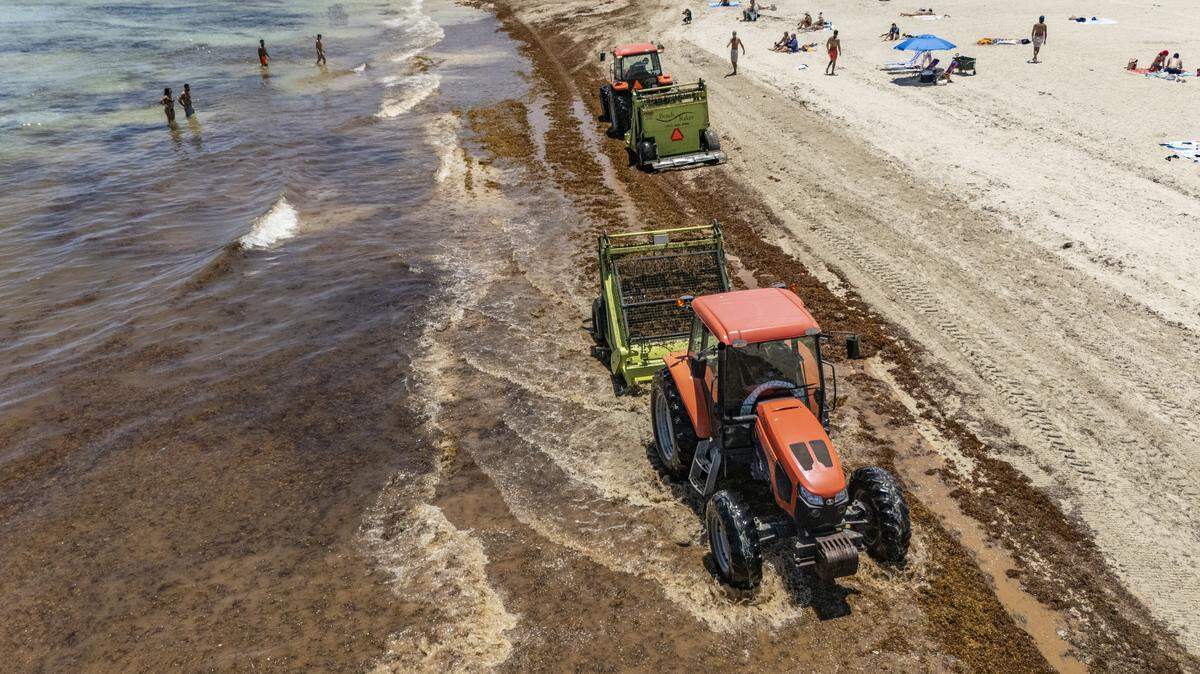
Massive amounts of seaweed are washing up on South Florida beaches, though how bad it is can vary dramatically depending on the beach and the day.
Researchers eventually want to be able to forecast how much sargassum is coming and which beaches it’s going to hit, helping governments make better decisions about where to deploy their expensive clean-up resources, and tourists to decide where they want to go swimming.
For now, the closest thing available to predict where sargassum is going is a new tool from the National Oceanic and Atmospheric Administration that estimates the likelihood of sargassum inundation along coastlines each day.
The tool uses a color-coded system to show risk levels along Florida and Gulf Coast shorelines: red indicates high risk, orange medium, yellow a warning and blue low risk. But it’s not yet precise enough to predict exactly which beaches will be affected.
.png "GOMF (2).png")
Joaquin Trinanes, a NOAA researcher who helped develop the inundation tool, said scientists are continually refining the models.
The forecasts are still imperfect. If satellites detect sargassum close to shore, the model assumes it is likely to wash ashore. But winds and ocean currents can shift quickly, altering the seaweed’s path before it reaches the coast.
“We think that, okay, if the sargassum is close to the shore, there is a probability that the sargassum can reach the shoreline,” Trinanes said.
.JPG "MIA_2026-05-07AD0141seaweedscavengerhunt (1).JPG")
There are also days when no sargassum data is available because cloud cover blocks the satellites’ view.
NOAA began tracking sargassum in 2010, partly by accident. Scientists were trying to locate free-floating oil during the Deepwater Horizon oil spill when large patches of seaweed kept appearing as false positives in the data.
At the time, researchers did not yet fully understand the growing significance of sargassum, but it led them to develop an early tracking system using radar and optical sensors.
Later, NOAA partnered with scientists at the University of South Florida to incorporate their satellite data into their modeling, too. The maps are created by combining satellite imagery that detects sargassum in the open ocean with models that track ocean currents.
The modeling also uses crowdsourcing to get information directly from people at the beach. Trianes said you can help make their model more accurate by submitting photos to a reporting form.
Eventually, Trianes said scientists should be able to plan months in advance.
Sargassum has become an increasingly expensive nuisance for coastal communities, and as blooms become larger due to warming water temperatures because of climate change and fertilizer run off providing blooms with endless nutrients, the problem will continue to mushroom. Taxpayers in Miami-Dade County spend nearly $4 million each year for tractors to remove sargassum from the shore. But clean-up and processing is just one of the costs of dealing with sargassum. When the seaweed drives visitors away, losses ripple through hotels, restaurants and bars, experts say.
Ashley Miznazi is a climate change reporter for the Miami Herald funded by the Lynn and Louis Wolfson II Family Foundation and MSC Cruises in partnership with Journalism Funding Partners.
This story was originally published May 13, 2026 at 3:09 PM.