The future of Miami-Dade’s coast: tall walls, landscaped barrier islands or both?
Politicians and residents of Miami-Dade County are mostly on board with the now $6 billion federal proposal to protect the vulnerable coastal community from future storm surge strengthened by climate change.
They like the idea of elevating thousands of private homes, and floodproofing thousands of businesses and the county’s hospitals, fire and police stations.
The one concept nobody in Miami-Dade wants? Installing flood-protection walls — in some places up to 20 feet high — along the coast of Biscayne Bay.
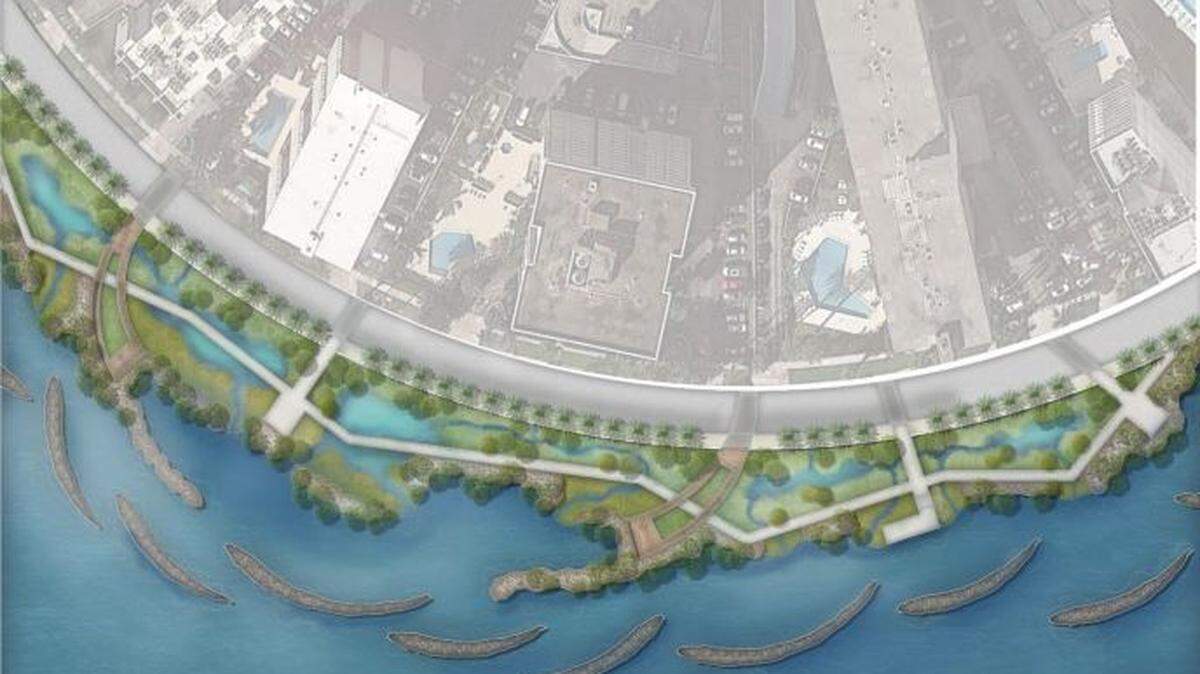
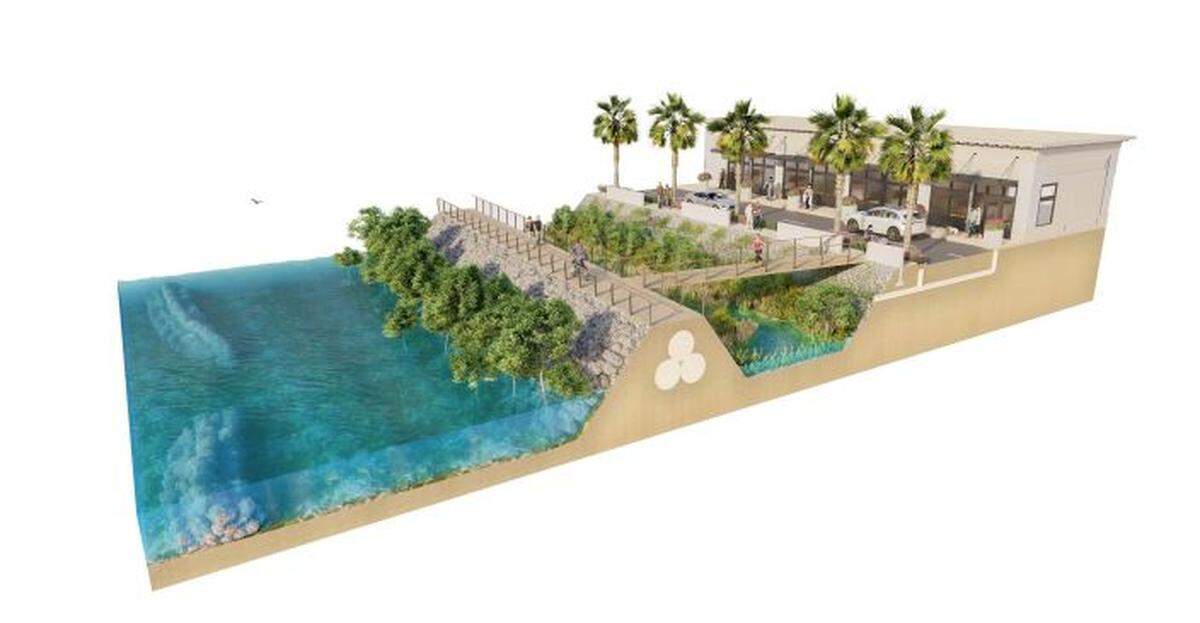
An alternative vision — released this week and promoted by Miami-Dade, Miami and private businesses — would be an even more radical redevelopment of the Biscayne Bay coast. Instead of drab gray walls, the plan shows drawings of a giant earthen dune between the city and bay, speckled with mangroves and ringed with oyster reefs, natural features proven to slow down approaching waves. Between the dune, called a berm, and the city is a moat of sorts, filled with seagrass and more landscaping designed to break down storm surge.
It would look more natural and attractive, but also come at an environmental cost, chewing up acres of existing bay bottom.
Still, advocates say it’s a better alternative than trading scenic bay views for imposing walls.
“Our residents, our stakeholders wouldn’t and shouldn’t accept the wall as currently proposed,” said Miami Commissioner Ken Russell. “If we get it right, we will not be reversing the unintended consequences of this plan 40 years from now.”
Residents don’t want to be cut off from Biscayne Bay or see their neighborhoods sliced up. Environmentalists object to the mile of the wall that would go directly through the bay, and developers, business owners and politicians worry about the impact on property values.
Ever since the Army Corps of Engineers, the builders of the federal government, proposed its draft plan last summer, Miami-Dade and Miami have been working furiously to convince the Corps to shorten the walls and add more natural solutions, like mangroves or a coral reef. The county is expected to make a decision to move forward with the project or take a more expensive route to a preferred plan next week.
On Monday, politicians and chief resilience officers met with the Corps to debut their alternate vision, designed by engineering firm Moffatt & Nichol and paid for by a major developer in downtown Miami, Swire Properties.
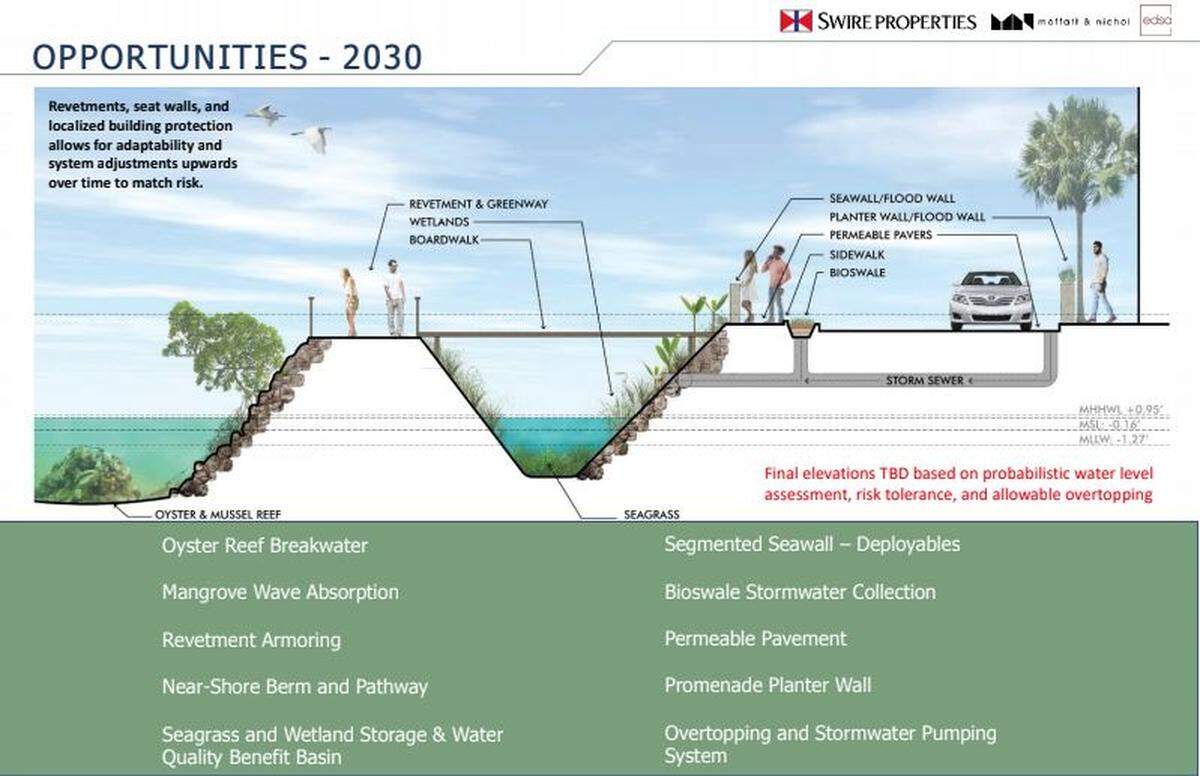
Unlike the walls, proponents say this version of coastal protection could also be adapted along the way without needing to rip up the foundation and start anew. A berm could be piled higher in a few decades as needed, and the mangroves and oysters would grow bigger naturally. It also wouldn’t completely cut off access to the bay, giving pedestrians and others scenic views.
The land side would still have sea walls, but the presentation didn’t hazard a guess at how tall they would be, or how much the total project could cost.
“The magic works because it’s all together as a dynamic system,” said Lynette Cardoch, the director of resilience and adaptation at Moffatt & Nichol, who helped present this version of coastal protection to the Corps. “We weren’t just saying we’ll plant a tree and leave, we’re acknowledging that this has to be a structural solution.”
‘A balancing act’
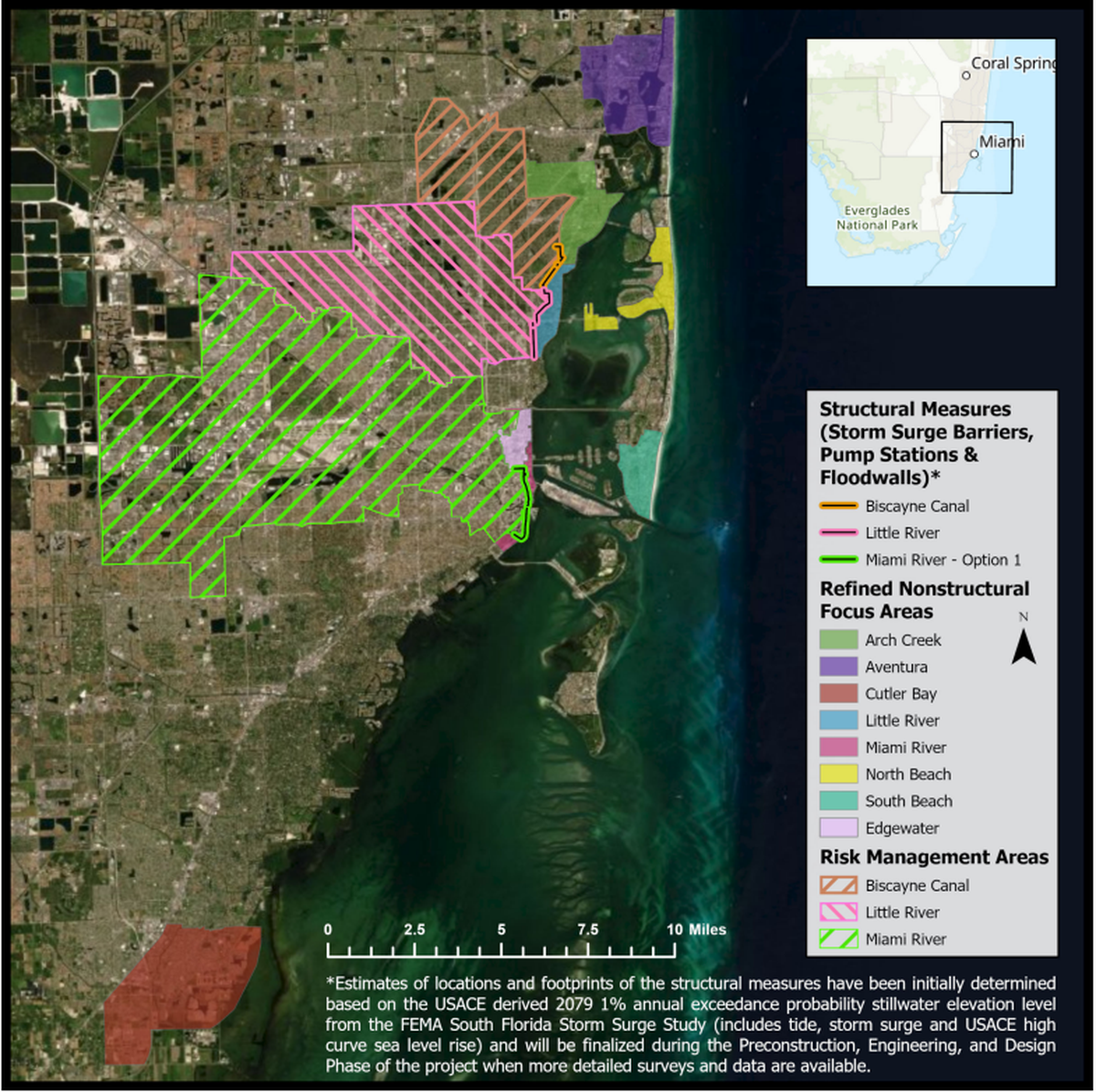
The Corps has already changed its draft plan since it debuted for public comment in June. The price tag has risen to $6 billion, and it now includes two flood gates in Coral Gables, on the Coral Gables waterway and Snapper Creek, in addition to the ones on the mouth of the Miami River, Little River and the Biscayne Canal. The newer plan would also floodproof even more government buildings and sites, including the Virginia Key sewage treatment plant.
Miami-Dade is hoping the Corps will agree to one more change: lower walls coupled with nature-based solutions to make up the difference in protection.
The deadline is fast approaching. The Corps needs a verbal thumbs up from Miami-Dade, the local partner of the project, by Feb. 18. Miami-Dade needs to formally approve the project by April if it has a hope of getting federal funding in the next few years, otherwise, it could risk long delays.
The county has several options. It could approve the plan as-is and risk seeing the walls eventually built, or it could pursue a waiver from the government that freezes the process for as long as a year. That gives the county time to come up with whatever alternative it wants and convince the Corps that its plan is affordable and effective.
But a pause would likely mean that whatever alternative to the walls that Miami-Dade, or its consultants, come up with would be paid for entirely by the county.
The way Army Corps projects work is the federal government pays for 65% of the project, and the local sponsor, in this case, Miami-Dade, pays for the rest. The latest estimate for this project is more than $6 billion, putting Miami-Dade on the hook for more than $2 billion.
Any changes Miami-Dade makes to the final Corps plan, like a walking path along the wall or landscaping, counts as a “betterment” and would be fully charged to the county.
If Miami-Dade can convince the Corps to change the walls to something it likes better in the original plan, it can avoid shouldering more of that already hefty bill.
“We do not want these things to be betterments. And if we don’t get the agreement from them, we’ll continue to pursue the waiver,” said Miami-Dade District 5 Commissioner Eileen Higgins. “It’s a balancing act. You don’t want to walk away from a lot of money, but we can’t accept this money if it doesn’t help our residents and our environment.”
Nik Hallberg, project manager for the Back Bay study, said that discussions were still ongoing between the Corps and county, but he stressed that the Corps’ calculations showed walls provided Miami-Dade the best protection for the lowest cost.
He said the Corps is working with Miami-Dade to tweak the language used in the final report to potentially allow for changes that would offer more access to the waterfront without compromising on safety.
“There’s not going to be language in there going from an 18-foot wall to an 8-foot wall … that’s something that would dramatically change the nature of the project,” he said. “There are opportunities for what I would call enhancements that the Corps could work on in partnership in the future, as long as they meet our engineering regulations and requirements.”
This story was originally published February 11, 2021 at 12:49 PM.