Feds have $4.6 billion plan to protect Miami-Dade from hurricanes: walls and elevation
The federal government wants to build a wall to protect coastal Miami-Dade from hurricanes, which are expected to only get stronger when fueled by future climate change.
Actually, it proposes walls in several places, six miles of them in total ranging from merely one foot to 13 feet high — storm surge protection that would change the landscape of some expensive but also very vulnerable neighborhoods. The walls are the centerpiece of a $4.6 billion draft plan by the Army Corps of Engineers released Friday that is designed to protect tens of thousands of homes and businesses from flooding.
The plan also calls for movable barriers at the mouths of three waterways, elevating and floodproofing thousands of buildings throughout the county and restoring mangroves near Cutler Bay.
After Hurricane Irma flooded sections of downtown Miami and other coastal areas, Congress asked the Corps, the federal government’s engineering arm, to come up with solutions to protect the 2.8 million people and $311 billion of property value at risk from increasingly destructive hurricanes. The Corps drew up a plan envisioned to hold up to a storm in 2080, when it predicts South Florida could see at least three feet of sea level rise.
“What this study strives to do is prevent economic damages and threats to life and properties,” said Holly Carpenter, project manager for the study.
Despite the nearly $5 billion potential cost, this plan is only designed to block storm surge from a 1 in 100 year storm surge event by 2079, with the extra storm surge that comes with the three feet of sea rise by then. Thomas Ruppert, a coastal planning specialist with Florida Sea Grant, pointed out that won’t do anything to protect homes and streets from the tidal floods that are already becoming more common and worse.
“People see a wall and think safety, but what it provides safety from is the issue,” he said.
The latest version of the draft plan walks back some of the costs and solutions the Corps had previously proposed — most notably, the notion of buying out hundreds of homes and turning them into parks or open spaces.
That helped drop the total proposed cost down to a projected $4.6 billion, instead of the $8 billion price tag on the September version of the plan. The federal government would pay 65 percent of that, and Miami-Dade would cover the rest.
The new draft also consolidates the most controversial aspect of the plan — walls built along the coast and inland Miami-Dade to protect from hurricane-driven storm surge. There are only two stretches of wall now: two miles from the Miami River through Brickell and four miles from Biscayne Canal to the Little River.
Brickell and Downtown Miami could see walls akin to Interstate 95 sound barriers stretching anywhere from 6 to 13 feet high a block or so inland. In Little River and Miami Shores, the new plan calls for much smaller walls, at points only a foot and a half high, largely tracing Biscayne Boulevard.
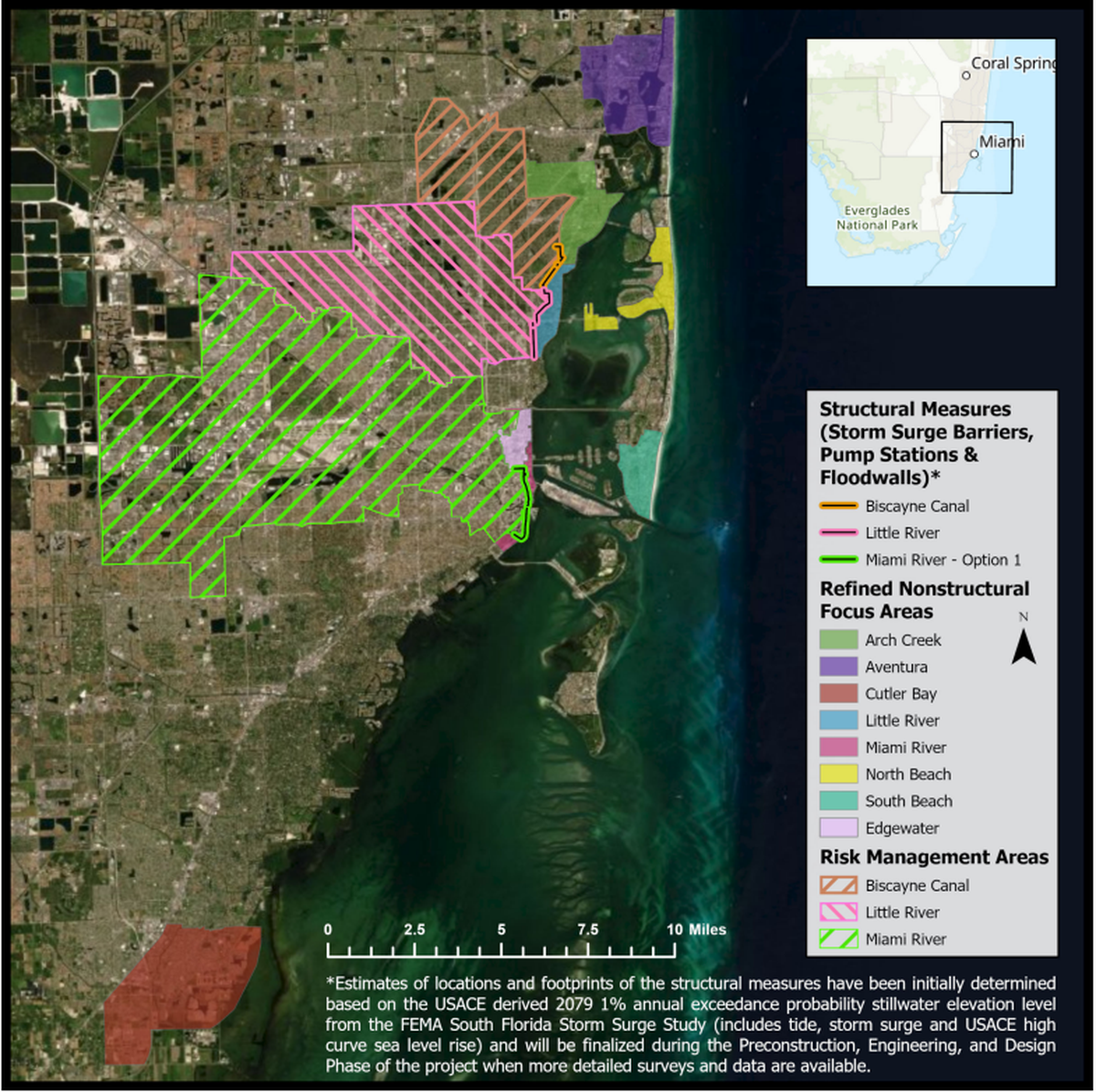
A potential wall through Edgewater was scrapped after Corps calculations showed it would be more cost-effective to elevate and floodproof buildings in the area.
The Corps’ plan no longer calls for buying out individual homes in Miami-Dade. That process obviously would be controversial, because Army Corps policy would require seizing land through eminent domain if a property owner did not agree to voluntarily sell. But building the flood walls and surge barriers would still require land the county doesn’t already have.
“For the construction of the structures, acquisition will likely be necessary,” Carpenter said.
The Corps did not estimate how many properties would be needed or where they would be located, as the final placement of the walls wouldn’t be clear for many years down the road. But Miami-Dade is on the hook for all easements and land purchases for the walls and flood barriers, which the Corps expects to be a $405 million expense.
A September version of this plan said that the county would need to buy 350 properties, but that included the Edgewater wall, so the new number would likely be lower.
The project’s projected $9 billion in benefit to the region is largely in avoided losses from stronger hurricanes. A map of storm surge flooding the county now versus with the proposed structures sees far less damage.
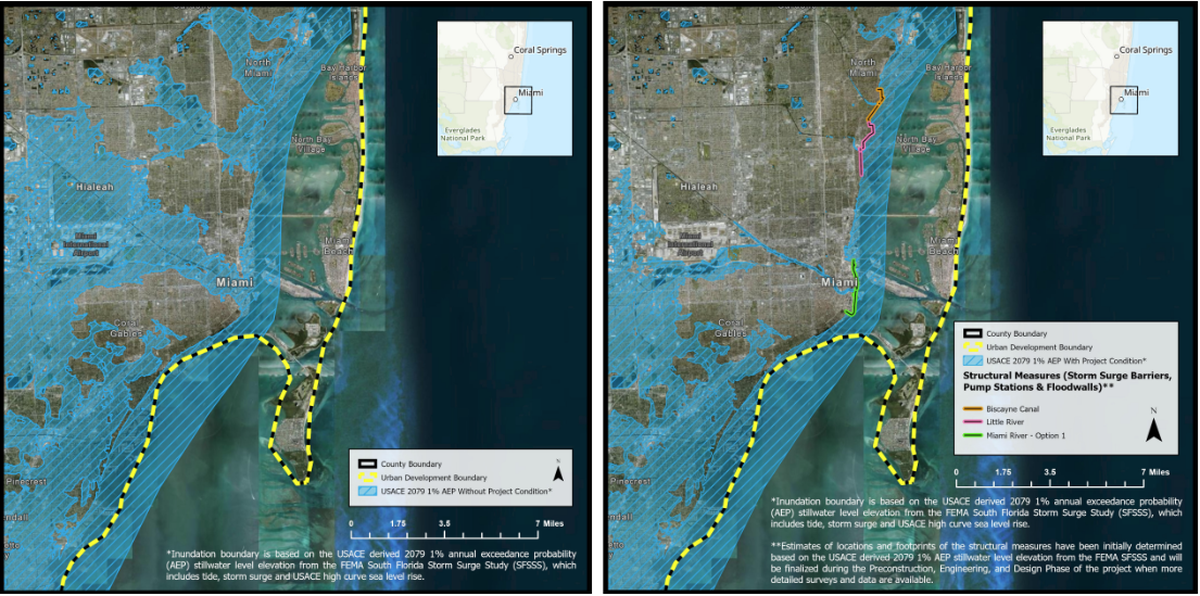
But the report does not take into account property value — either the higher prices newly protected land might fetch or the lower prices for properties that suddenly find themselves on the wrong side of the wall.
“It’s a little too complex for us to predict the impact on property values from the project implementation,” Carpenter said. “There are too many factors that influence property value.”
Research shows that climate change-driven flooding is likely already lowering the value of flood-prone homes in Miami-Dade County, and vulnerable properties could see a 15 percent drop in value by the next decade.
The proposed walls are tallest near Brickell, where their height is so notable the draft admits they could obstruct the view and bring down property values. Mooring or boating wouldn’t be allowed along the mile-long stretch of wall.
The miles of flood walls would be joined with movable barriers at intersections, similar to those in Norfolk, Virginia.
At the Miami River, Little River, and Biscayne Canal the walls would be integrated with surge barriers that could be closed before a storm arrives.
The plan also doesn’t address sunny day flooding, the phenomenon where parts of the city flood due to rising tides, not rain. That’s handled by cities individually and usually involves bigger pipes and more water pumps.
The other half of the plan would do double duty in making the community safer from storm surge as well as sea rise. It calls for raising individual homes, like in the Keys, or making small fixes to make the ground floor of bigger buildings flood-resistant, like watertight doors or temporary flood barriers.
In September, the Corps’ plan slated 10,000 homes for elevation and 7,000 businesses for floodproofing. This version calls for elevating 2,300 homes and floodproofing 3,850 buildings, the vast majority of which are condominiums and apartments. Aventura would see the most home elevations at 650 and South Beach would see the most floodproofing at 1,400 buildings.
Elevation would involve raising a home a maximum of 13 feet off the ground, which for a 1,400-square-foot ground level home would cost around $133,000, according to Corps calculations.
The plan also calls for floodproofing “critical infrastructure” all around the county, which includes police and fire stations, hospitals and water treatment plants.
A laundry list of species, including manatees, crocodiles, sea turtles, grouper and sawtooth fish, would be “adversely impacted” by the surge barriers and flood walls, the report said.
“There would be an anticipated permanent loss of [seagrass], corals/hardbottom habitat, mangrove, and open water benthic habitats,” it read.
This is the Corps’ first assessment of the possible environmental impacts of the project. It’s going to keep doing new assessments at each stage of the process, said Jim Murley, Miami-Dade’s chief resilience officer.
“This is the beginning, not the end,” he said.
There’s still plenty of time for things to change in this report. The Army Corps is accepting feedback on the proposal for the next 45 days through email, and staffers are hosting two webinars and two rounds of community office hours.
Murley said the Resilience Department is helping set up meetings and presentations for all the cities impacted by the plan in the next few weeks. It also sent out a dedicated version of the department’s newsletter to all 8,000 subscribers.
Mayra Cruz, the climate resilience program manager for Catalyst Miami, worries that this outreach might not be enough when most people are distracted by the ongoing COVID-19 pandemic and protests over George Floyd’s death at the hands of Minneapolis police.
“I’m not sure people have the bandwidth right now to be paying attention to something like this that could have long-lasting impacts on their community,” she said.
And even then, the solutions proposed by the Army Corps don’t line up with the kinds of projects people who live in those neighborhoods are asking for. Cruz said she held a focus group on Thursday and most people talked about planting native trees and mangroves rather than pump stations or raised buildings.
“People are really, really specific with the kind of solutions they want to see,” she said. “It is expertise that should also be lifted up in these kinds of studies.”
The final version of the report won’t be done until October 2021. After that, Congress has to come up with the money to pay for the projects. On the fastest possible timeline for this project, project design and engineering wouldn’t begin until 2023 and construction wouldn’t kick off until 2026.
Murley said he expects the project to take even longer. A good comparison would be Everglades restoration, he said. Each year the state asks Congress for the cash it needs to fund that year’s project, which draws out the process considerably.
“This is something we’re going to be working on for the next decade, at least,” he said.
The Corps is also working on a similar study of the Florida Keys, which is expected to be released later this month.
To submit a comment on the draft plan, email MDBB-CSRMStudy@usace.army.mil or visit http://arcg.is/fm0Xe. They can also be sent by mail to: Ms. Justine Woodward, U.S. Army Corps of Engineers, Norfolk District, 803 Front St., Norfolk, VA 23510. The deadline for all comments is July 20, 2020.
The webinars are scheduled for 5-7 p.m. June 9 and 1-3 p.m. June 11. Community members can also contact study personnel during virtual office hours June 10 from 1-2 p.m. and June 18 from 5-6 p.m. For information on how to join the webinars, visit the study website.
This story was originally published June 6, 2020 at 6:00 AM.