One of these four teachers will be Miami-Dade’s teacher of the year
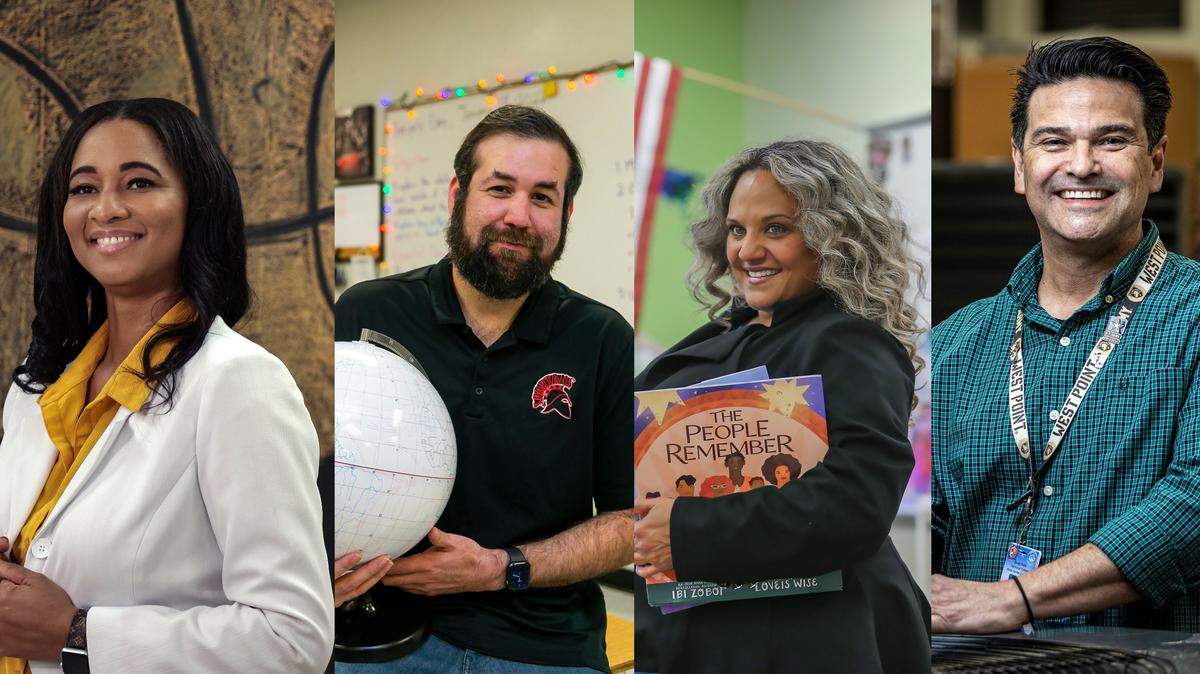
One is an air-conditioning contractor who wanted to share his love for the trade with others.
Another wants students to see themselves in America’s history.
The third had plans to be a lawyer, but found her purpose in a special education classroom.
And the fourth worked for corporate America before being drawn to teaching.
One of them will be honored Thursday as the 2023 Francisco R. Walker Teacher of the Year for Miami-Dade Public Schools. The annual celebration recognizes educators who are superlative in how they teach, pushing students to scale the highest heights.
Superintendent Alberto Carvalho will be at the ceremony, one of his last official acts before becoming superintendent of the Los Angeles Unified School District. Last Monday, José Dotres was named the new superintendent of Miami-Dade. Zoo Miami spokesman Ron Magill will emcee the event.
The four regional winners are products of Miami-Dade County Public Schools, yet the paths that led them to the classroom were quite different.
Here are their stories:
Alternative Education: Derek Bostick
Vocational training transformed Derek Bostick’s life, and he hopes a similar education can do the same for others.
Bostick, 54, an air-conditioning contractor, teaches heating, ventilation and air conditioning (HVAC) at South Dade Technical College. He earned his major appliance and refrigeration certification from the Robert Morgan Educational Center & Technical College, formerly known as a vocational technical institute and part of Miami-Dade Schools, in 1987.
His students range from dual-enrolled high schoolers to adults. But for Bostick, it doesn’t matter a student’s age or who they were prior to enrolling in his course.
“When you come to my classroom, you’re going to start from the beginning. We just know each other because you’re here,” he said. “I don’t know what happened in the past, whether it was good or bad, [but] we’re going to start anew.”
And it’s with that mindset, Bostick said, he hopes people will see the positive outcomes that come from trade schools. Moreover, he said, his equal approach to both teenagers and adults — he refers to all his students as “kids” and speaks to his high school students as if they were adults — can eliminate any negative perceptions people have toward trade schools.
“It’s very important we provide this huge amount of job and workforce training. ... It’s a powerful thing.”
Bostick sees that power every day, when a student transitions from being uncertain about their abilities to feeling confident after mastering a new skill.
A common misconception people have toward trade schools is that they’re lesser than, he said. But trade schools touch everybody’s life: Pharmaceutical staff at CVS or Walgreens, nail technicians and electricians, to name a few, are all trades workers, coming from trade schools.
In recent years, Bostick acknowledged there has been a push to reignite and revitalize trade schools, particularly in the last decade or so.
In Miami-Dade, that’s the ‘Career in a Year’ concept, a program that readies students in a year’s time to be career-ready, part of the district’s adult and career technical education division.
“I think we’re at that point where the whole nation is saying, ‘We have to get back to people [and] this is a great way to get kids and adults out of part-time, hourly wages and get them into a career pathway where they can really make some serious money and feel like they can take care of their families.”
South Region: Andres Cerrato
Andres Cerrato’s passion for each student to succeed is palpable, even through a computer screen.
Cerrato, 36, is a Miami Southridge Senior High graduate and, now, a social sciences teacher at the school, where he’s been since 2016. He teaches U.S. history and debate, subjects he says sometimes fail to provide the type of environment that “students are clamoring to get into.”
Nevertheless, Cerrato is changing that by allowing each student to feel connected to what they’re being taught. “History is based on telling a story, and one of the things I think people love about stories is when they can see themselves in them,” he said. “So part of it is [asking] how does the past actually connect to today, and having [students] see all of those connections. I want them to feel included in history.”
One way he does that is by looking at policies in history and comparing how similar or different efforts are playing out today. While looking at Republican Party platforms from the 1920s may not be the most exciting thing to a student, Cerrato said, when students can draw parallels to today’s political platforms, it makes them feel a part of that history.
“When students come into my classroom, they understand that [they’re] not just going to be taught something that’s going to be forgotten, but something that is actually meaningful,” he said. He hopes what they learn inside the classroom extends to their desire to understand how government works and actively participate in it.
Cerrato’s efforts to ensure students feel included extends outside of the classroom. A few years ago, he began taking photos and videos of students playing sports. He did so to both cheer them on, but also promote the school’s teams through social media.
“I want people to know how great our kids are, and this allows me to do that,” he said.
Cerrato has experienced a handful of blows throughout his teaching career. In fact, when asked to describe his career in a few words, he used “setbacks.” He began his career at the height of the recession in 2008, and experienced layoffs in various teaching roles in the years that followed. But eventually, he found his way back to Southridge Senior, his alma mater.
He often uses his own journey as an example and message for his students: “When you fall, you get up, you keep going and you make yourself even better.”
Central Region: Unethia Fox
Students know her as Coach.
Unethia Fox, 41, a teacher at South Miami Senior High, has coached basketball, volleyball, track and girls flag football at the school. And she’s an athlete herself.
Her start as a teacher is “an odd story,” Fox said. After graduating college, she visited South Miami Senior, her alma mater. Her old coach asked her to fill in for the girls volleyball team coach, who’d been out. It was a perfect match.
Then, the principal, who’d been watching Fox interact with the students, asked if she’d be willing to teach a math class before heading to law school. Fox said yes. She didn’t know she’d be teaching special education classes.
“My first class was a class of seniors. One [student] in particular came in and was totally distraught, saying ‘I’m not ready for this,’” Fox said. Seeing her students’ reactions and hesitations about the future, she decided to forgo the math lesson. “We had to sit and be with each other. I had to make them comfortable.”
Many people assume students living with disabilities simply won’t pass their exams or won’t be able to finish school, she said. But on that first day, in talking with her students, Fox realized the classroom — not law school — was where she needed to be.
“They needed to have somebody believe in them, so that they can believe in themselves to get things done.”
That was 19 years ago. Today, Fox continues to teach math and special education for high school students. She uses math to encourage students outside of the classroom, too.
Her motto — “every problem has a solution” — is a way to show students how to problem solve, gain life skills and how to handle stressful situations. She directs students to focus on the process, not the numbers in an equation, because understanding the steps will help them move from start to finish of any problem or challenge they encounter.
Her encouragement of students to become leaders and to believe in themselves extends to extracurricular activities and clubs, too. She helped reestablish the Watu Wazuri club, an initiative that supports African American and other minority students.
It’s easy for minority students to feel overlooked, she said, “but when you have something for them, that builds them, that promotes them for being different [and] being a minority, we use that as a foundation to help them develop their skills.”
For Fox, her nearly 20 years as an educator has been life changing, professionally and personally.
“I learned from them just as much as they learned from me.”
North Region: Renee O’Connor
Renee O’Connor became a teacher in her late 30s.
It was her third career, making her way from corporate America to the classroom via Teach for America in 2012. At the time, she said, it felt as if the universe was drawing her to teaching.
She talks often about the teachers she had growing up — how they were and continue to be her inspiration.
Over the last decade, she’s offered that same inspiration to her students, whether they pursue a career in education or not. She’s connected with and remains in contact with many past students, sharing photos of their travels and receiving updates about their higher education.
O’Connor, 49, is a product of Miami-Dade Schools, attending Norland Elementary, Norland Middle and Norland Senior High, where she teaches high school social studies, specifically, African American History.
“I’m very open with my students, because we have daily class conversations,” O’Connor said. “The news leads my class, but I also want to give them statistics and facts and factual information so they can make their mind up themselves.”
Since the murder of George Floyd, the class has taken on new importance. O’Connor has heard from more than 100 teachers and school districts around the country to learn how she was teaching the subject in the wake of his death and the months that followed.
One principal in Kalamazoo, Michigan, successfully pushed for his entire district to adopt O’Connor’s curriculum. Her class is now taught in all high schools, something she wishes could happen not just in Miami-Dade high schools, but at every level of education.
“I absolutely enjoy going to my job every day. I don’t dread Sundays. I love what I do,” O’Connor said. Some days are difficult, she said, but O’Connor believes she’s making an impact.
Yet, there’s more to do, more to improve on and more to change, she said.
“We need to adjust as quickly as TikTok is adjusting. We are not keeping up,” she said. Teachers should be given space and the support they need to maneuver and make changes, without being forced into a box.
“When you make an effort to keep up,” she said, “amazing things can happen in the classroom.”
This story was originally published January 31, 2022 at 6:00 AM.