Developer Avra Jain finds gold where others can’t. Saving Miami’s history is her thing.
READ MORE
Hialeah gets hip
Buoyed by developers such as Arva Jain, who is converting warehouses into an entertainment venue, Hialeah is becoming a place to see and be seen.
Expand All
Avra Jain studied industrial engineering, cut her professional teeth as a Wall Street trader and launched what would become an unusual 25-year career as a developer almost as a sideline: She cobbled together cash from friends and colleagues to convert an old industrial building in Manhattan’s TriBeCa neighborhood into residential lofts.
When not yet 40, she resettled in Miami Beach with her earnings at the end of 1999. She thought she might enjoy some sun and relaxation, maybe dabble in real estate. But as she began exploring her new hometown beyond the shiny confines of the Beach, she came to a realization.
Like SoHo or TriBeCa, Miami’s older neighborhoods were full of overlooked architectural and historical treasures that might have great revitalization potential in the right hands. And the competition for them in Miami, unlike New York, was virtually nil, and prices were low.
WIth investor friends, she bought a set of near-derelict buildings and vacant lots around the future site of the Arsht Center for the Performing Arts for $18 million. The buildings and lots, where they planned to erect a high-rise, were eventually taken through eminent domain for $78 million by Florida’s Department of Transportation for the replacement of Interstate 395, a project only now under construction.
But first Jain converted an old warehouse on the property into artists’ studios, while an adjacent former pawn shop, which she painted highway-sign yellow, became the Pawn Shop — a music club that was for a few years a glowing beacon for young, hip nightlife in what was otherwise bleak terrain, helping gradually turn the image of downtown from vaguely threatening to daringly alluring.
Two decades later, she’s doing it all over again, this time in the improbable environs of east Hialeah. In what might be her most ambitious undertaking, Jain, working with a group of partners, acquired a six-acre former mattress factory in an old industrial section. They are now slowly converting it into greater Miami’s latest and perhaps most offbeat arts and entertainment district.
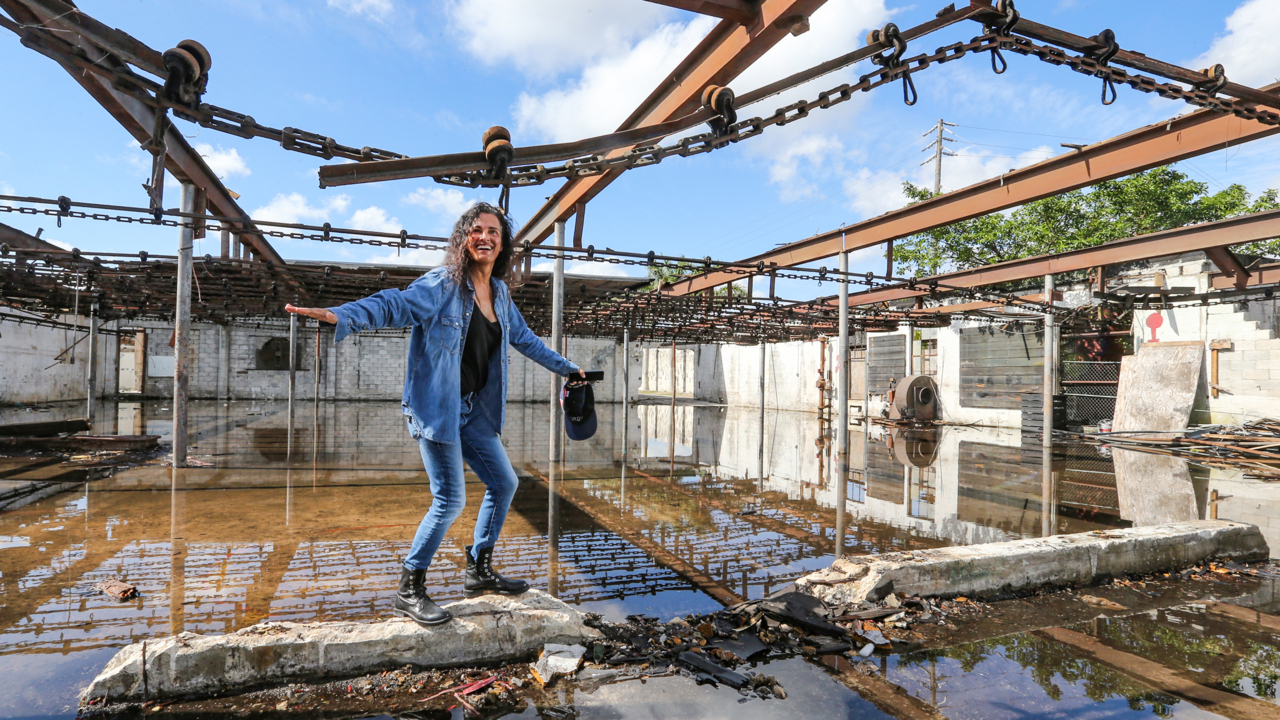
Dubbed Factory Town, it’s an ensemble of warehouse and factory buildings so extensive the property has its own internal streets. But instead of tearing down and starting anew, Jain is in characteristic fashion keeping much of it in all its raw industrial glory — stripping the roofs off crumbling structures that couldn’t be saved and leaving just the walls standing to create an open-air venue for bands and DJ raves and much more.
She has plans to add artists’ studios, a distillery, bars, inexpensive space for food start-ups and eventually a hotel. And she has transplanted to the site a few dozen mature trees, including a massive kapok tree, to create an ecological garden in the middle of east Hialeah’s concrete jungle.
To Jain, Factory Town is the culmination of two decades of lessons learned in good deals and bad. Jain, who speaks in rapid-fire bursts, barely exhausting one idea before she’s off on another, said it all boils down to this: She learned to recognize and capitalize on value where others may see only junk.
“In New York and in my travels, I saw how neighborhoods changed. Everything in New York was adaptive reuse. I saw how preservation drives economic recovery,” she said. “If you do something really great, people will come to you.”

Jain’s eagerness to explore the unconventional and test ideas may stem from a family background that encouraged independent thought and accomplishment. She is the child of Indian immigrants, both academics with doctorates. Her father Ravinder is a leading authority on environmental engineering and the author of numerous textbooks and manuals. Mother Barbara’s Ph.D. is in education.
Fiercely competitive, Jain was a varsity tennis player at Purdue University on an athletic scholarship. She and an identical twin sister, Anna Bakst, followed divergent yet strangely congruent paths.
Like Jain, Bakst majored in industrial engineering at Purdue on a tennis scholarship, but switched to the fashion industry after getting an MBA, becoming a top executive at Donna Karan, Michael Kors and Kate Spade. Today she’s CEO of a biotech startup, Modern Meadow, and runs her own fashion label, we-ar4, specializing in reusing surplus fabrics and fashions. Bakst is also a partner in Factory Town.
Finding value in rundown properties
For years after the forced Florida transportation department sale, Jain worked mostly under the radar with partners like Paul Murphy and Joe Del Vecchio, acquiring outdated commercial buildings in neighborhoods that were not yet up-and-coming but soon would be, where property was cheap and the upside large. Many sold for a tidy profit after renovation and adaptation to new uses in neighborhoods like Wynwood and the resurgent Miami Design District, where Jain was among the first of a new wave of investors.
In Little River, the historic name for a gradually gentrifying corner of Little Haiti, Jain was one of the first to assemble a portfolio of commercial properties, working with partner Matthew Vander Werff to turn them into cafes, shops and offices for creative businesses.
Del Vecchio, who has partnered with Jain on numerous commercial projects since 2011 and shares an office with her, said what distinguishes her from many other developers is a keen mathematical mind paired with an obsessive study of the local market. That means that when she finds a property she wants, she can assess value and move rapidly, often making offers on the spot without need for a spreadsheet analysis.
So when Jain boasts, as she does often, that she makes many of her deals based on feel and not a spreadsheet analysis, it’s true, Del Vecchio said.
“That speed has gotten her deals and it’s also emboldened her. She’s bold when she makes her offer,” Del Vecchio, who specializes in rehabbing office buildings, said. “She goes around to open houses to understand the value, to understand what things are selling for, and she does it constantly. So when it’s time to make an offer, she’s done all the preparatory work and can do the numbers in her head.”
And clinching the deal often requires no more than a handshake because she’s open and transparent, he said.
“We do things without formal paperwork. She’s incredibly trustworthy,” he said. “We’ve done deals on a handshake and nothing more.”
2008 real-estate crash humbling
But Jain has hit rough patches. Her partners in Little River bought her out after a disagreement that ended up in court before a settlement was reached. The 2008 real-estate crash hit her career hard. She and her partners lost several condo investments in the 10 Museum Park Tower in downtown Miami to foreclosure and had to sell others.
Jain also lost a handful of condos in a Doral project she developed with a partner and that has led to protracted legal entanglements yet to be fully resolved. She lost a lawsuit filed against her by the partner in the condo project and had to pay a $10 million judgment. Then she sued her own law firm, claiming malpractice, lost, and was ordered to pay $1.5 million in legal fees. While noting she can’t comment on the case, she said the matter of legal fees is in mediation and she hopes it will be concluded soon.
But she said she could afford to pay the judgment, and the legal disputes have not affected her relations with current and longstanding partners or her ability to borrow to finance new projects.
“I like to think I’ve put it all behind me,” she said. “Even with the lawsuit, I’ve been very transparent with my partners, and they stood by me.”
Following her big recession debacle, Jain decided she had to rebuild, make a mark and tackle ventures in which she is indisputably the boss.
“I can’t be managed,” she said. “I’m not an employee.”
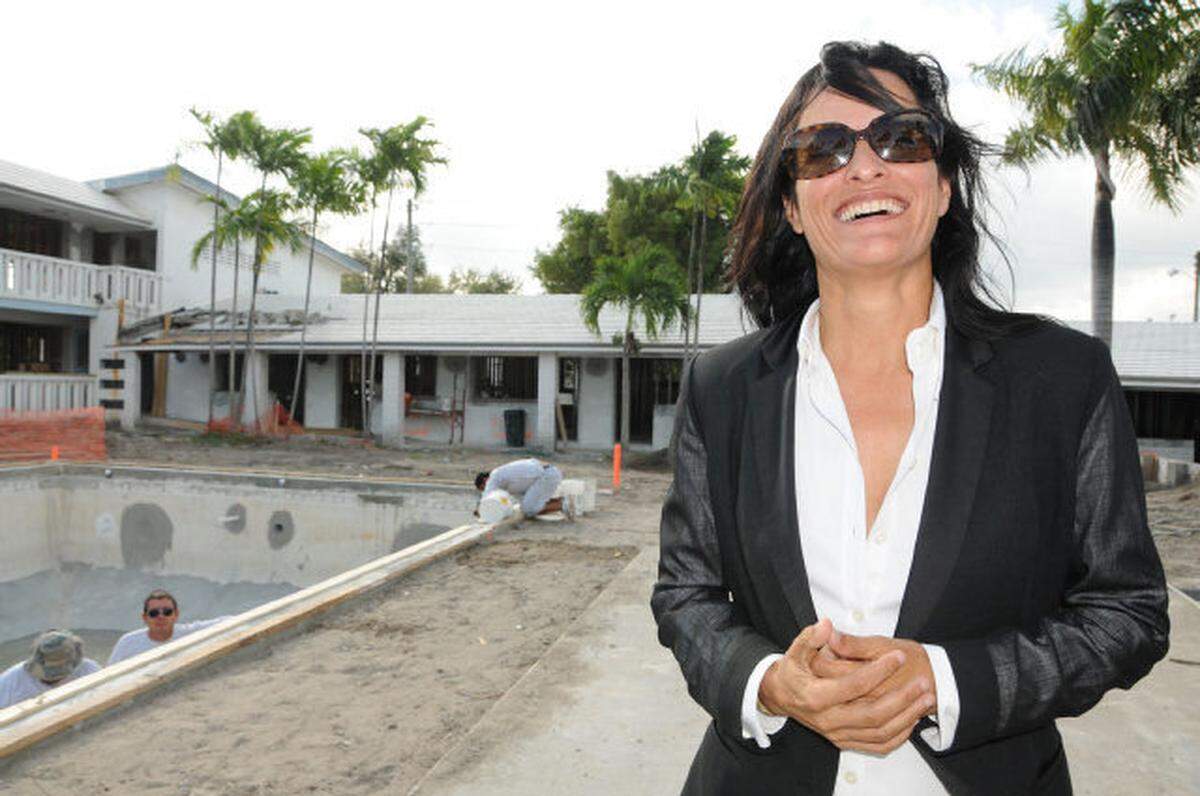
In 2012, Jain set her sights on the Miami Modern historic district, a decayed 20-block stretch of Biscayne Boulevard with a broad range of distinctive 20th-century architecture that had failed to attract reinvestment in part because of a waning but still obvious street traffic in drugs and prostitution. Moreover, given the limitations of small lots and restrictions that made it hard to expand the historic buildings, renovations weren’t feasible with conventional financing.
Jain bought the district’s signature property, the jazzy, neon-soaked 1953 Vagabond Motel, which sat abandoned after an unsuccessful restoration attempt. Because no bank would loan money for the renovation, she again pooled her own money with loans from friends and family.
Then came her innovation. Jain and her attorneys at Greenberg Traurig devised a way to capitalize on an unused city law that allows owners of historic properties to raise money for renovations by selling the “air rights” — that is, construction capacity allowed by existing zoning that those owners can’t use. Developers in high-density city districts like Edgewater and Brickell bought the rights to add “bonus” height to their projects.
Del Vecchio, a partner in the project, called Jain’s air-rights push “a brilliant move.”
Jain’s successful 2016 reopening of the Vagabond, transformed into a historically resonant, resort-like boutique hotel, put her in the public eye for good. Her Vagabond Group — an all-women five-person team that includes two licensed architects — then tackled restoration and renovation of six other MiMo motels on the Boulevard, cementing the district’s revival, even as they expanded their portfolio to Little Havana’s historic Miami River Inn, a Midtown Miami warehouse conversion and, now, Hialeah.
What Jain has shown others, said Christine Rupp, executive director of Dade Heritage Trust, is that historic preservation can pay off, though it takes patience and perseverance and strong support from partners.
“She’s passionate about this stuff. It’s not just another real estate deal for her,” said Rupp, on whose board Jain sits. “She sees it’s beneficial to the community to bring these buildings back to life in a new way. It can be done and done well and make financial sense.
“She’s got a great team of people around her. They help her talk the talk and walk the walk. It’s not easy.”
Paying homage to the past
All the while, Jain has continued buying and flipping properties with other partners, sometimes big players like Terra’s David Martin, for big gains. She flipped a vacant site in Liberty City that she, Martin and Del Vecchio bought for $3.8 million in 2018, with plans for a warehouse development, for $7.5 million last year, for instance. In Wynwood, she bought a 47-unit apartment complex in 2013 for $3.5 million, and sold it two years later to entrepreneur Moishe Mana for nearly $10 million.
She divests at times when her partners’ goals or approaches diverge from hers — or they’re made offers they can’t resist, Jain said.
But it’s only confirmed her conclusion that her small-bore approach and big development are incompatible. Jain said it’s best for her to do things her way and focus on preserving buildings with heritage and the stories behind them. For some of her most significant projects, Jain and her team assemble detailed illustrated histories that pay homage to the past and link it to the present.
“Big developers in the end don’t have the patience for cool. They’re too busy building big projects,” she said. “I’ve done small projects, because I couldn’t afford big projects. It’s not always highest and best use. But it’s thoughtful and impactful.
“This is not about saving everything. It’s about saving the right things, and preserving the context. Because if we lose the context, then we lose the heritage.”
.jpg)