
What happens to your trash bill if Miami-Dade never rebuilds its Doral incinerator?
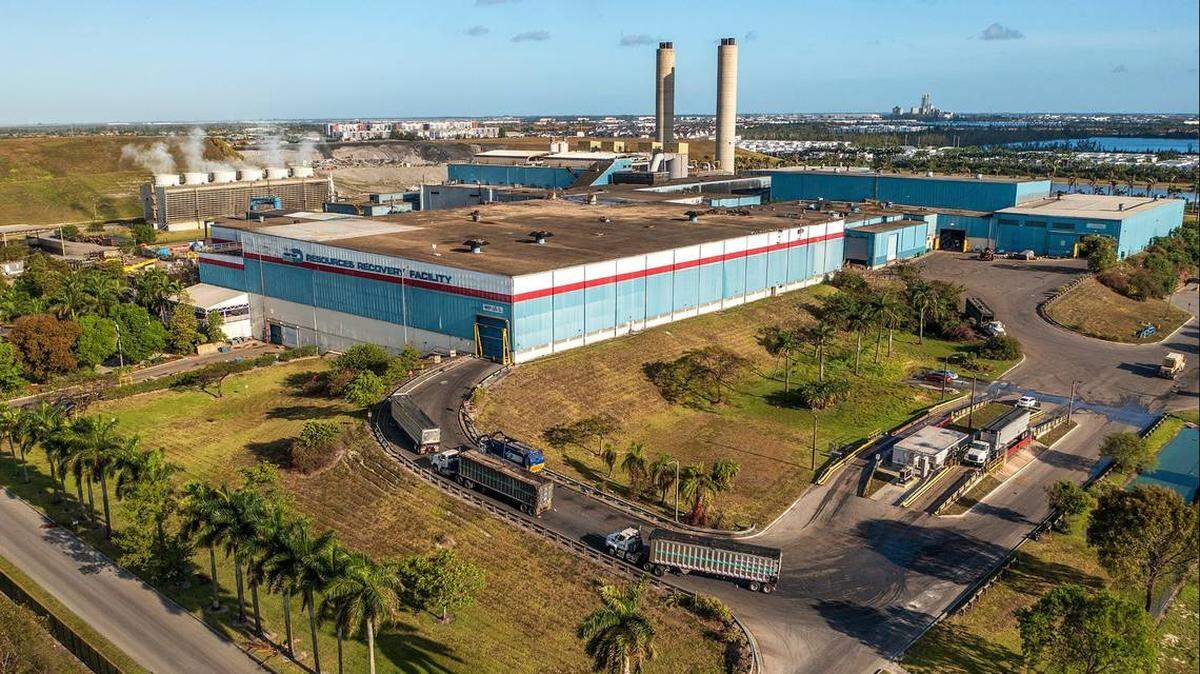
If Miami-Dade declines to spend nearly $2 billion on an incinerator to burn trash again, what would that mean for homeowners and their yearly garbage bills?
A memo from Mayor Daniella Levine Cava offers the first look at what homeowners can expect if the County Commission backs the mayor’s latest plan to instead haul almost all of the county’s garbage to landfills across Florida.
That’s the alternative to the mayor’s prior recommendation to replace the county’s defunct incinerator in Doral — a plan now under attack by President Donald Trump’s resort business, which owns a hotel and golf course a few miles away.
County commissioners this week delayed votes on whether to replace the incinerator that once burned over 40% of the more than 2 million tons of trash that come in each year from county sanitation trucks and other sources. The Doral incinerator closed in early 2023 after a fire, forcing Miami-Dade to shift all of its trash disposal to landfills — both local and as far away as Central Florida.
Instead of deciding whether to rebuild the incinerator or back Levine Cava’s landfill plan, the board voted to wait until the administration can deliver an analysis of potential private-sector proposals for building an incinerator funded with public dollars.
Levine Cava released a cost analysis ahead of Wednesday’s meeting to map out household expenses tied to the two main options: building a new incinerator or relying entirely on private landfills in the coming decades.
Whichever path the county takes, there’s no option on the table that would mean lower garbage fees for Miami-Dade homeowners who rely on the county for trash pickup every week.
They currently pay $697 a year, and that fee would rise with or without a new incinerator expected to cost about $1.8 billion to build.
The Feb. 8 memo from Levine Cava makes the case that her landfills-only plan will save homeowners the most money. While the cost for the incinerator “stabilizes in its later years, its upfront costs make it a significant financial burden in the short term,” Levine Cava wrote.
Even so, the financial figures in her analysis show an incinerator eventually produces lower garbage bills for residents.
Here’s a look at what the county’s garbage options could mean for yearly trash bills:
The incinerator option increases costs in the short term due to Miami-Dade relying entirely on landfills while it spends nearly $2 billion building a facility capable of burning about half of the trash that otherwise would be buried. Under the incinerator option, homeowners would pay an extra $98 a year by 2035 to cover both the incinerator construction costs and the county’s landfill costs.
Under the landfill option, trash bills eventually move higher than what they are under the incinerator option — but it takes almost 20 years. By 2042, the yearly trash bill under the landfill option hits $1,174, slightly higher than the $1,168 projected under the incinerator option. The gap widens from there, with homeowners paying an extra $48 a year by 2049 under the landfill option, when bills are forecast to hit $1,439. Under the incinerator option, the bill that year would be $1,391.
Under both scenarios, Miami-Dade continues to use private landfills for disposing of the county’s trash. But with an incinerator open by 2036, those landfill costs are much less. By 2049, the county would spend $580 million a year on landfills without an incinerator and about $300 million with one, according to the memo. Running the incinerator would cost roughly $111 million a year. Add in that year’s debt expense, and the costs are still slightly lower with an incinerator — $540 million in 2049.
The Levine Cava analysis only includes years when the incinerator debt remains unpaid, with the first loan payment scheduled for 2029 and the last one in 2049, the final year in the mayor’s memo. That means the forecast doesn’t include years when the county doesn’t have to make annual debt payments of $134 million to pay off the incinerator construction.
County consultants gave an estimated 20-year lifespan of a new incinerator, meaning maintenance expenses should increase after that. A Levine Cava spokesperson, Natalia Jaramillo, said that while the incinerator option gets more “cost beneficial” once the debt is retired, “it is important to note that there will be potential capital costs for maintenance and upgrades once the facility reaches its 20th year of operation.”
This story was originally published February 20, 2025 at 4:24 PM.