
Can a big ‘transit community’ at a west Miami-Dade bus station ease traffic woes?
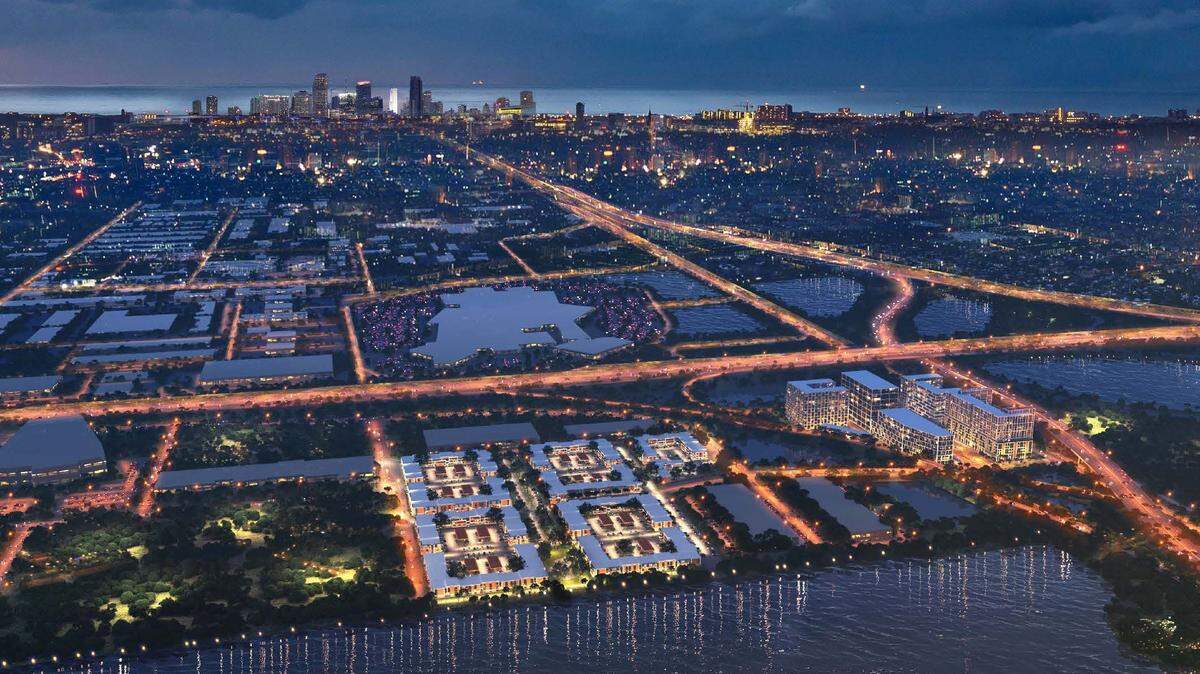
For nearly two decades, Miami-Dade County has been on an aggressively effective campaign to recruit developers to create dense clusters of apartments and shops at Metrorail stations. By now a familiar model, it works to boost housing supply and transit ridership while curtailing auto dependency.
Now the county transit department and a prominent Miami developer have teamed up to launch what promises to be Miami-Dade’s largest, most ambitious — and perhaps chanciest — transit-oriented development: a self-contained community with 2,000 apartments, a supermarket, a hotel, offices and a charter school around an underused bus station on the far western reaches of the county.
Terra Group, which has built several Metrorail development projects, including the new Grove Central at the Coconut Grove station, is set to start construction on Upland Park, a 47-acre, $1 billion development just inside an expanded Sweetwater city line at the juncture of State Road 836 and the Florida Turnpike.
In December, Terra announced it had secured a $170 million construction loan for the project’s first phase, which consists of a mix of just over 1,000 apartments that will rent for what company CEO David Martin describes as “accessible price points.” Land preparation is already under way for a February groundbreaking, the county says. Terra won a competitive bid for the project in 2021.
Miami-Dade transit officials say Upland Park will give people in fast-growing west Miami-Dade an option that’s been lacking amid overwhelming suburban sprawl — the ability to live in a compact neighborhood with shopping, transit, recreation and even work at their doorstep.
“The western part of the county has seen significant growth,” said Josiel Ferrer-Diaz, the county’s interim transit and public works director. “People want to live, work and play in the same environment. When you talk about transit-oriented communities, this is a community in itself.”
For Miami-Dade’s transit agency, Upland Park represents both an expansion and, in some significant respects, a departure from the model it has successfully adopted at Metrorail stations from Dadeland to Hialeah.
For starters, each of those Metro stations is built around a train network already used each week by hundreds of thousands of riders.
Upland Park, by contrast, is linked to the Dolphin Transit Station, a park-and-ride facility that’s the western terminus of the 836 express bus service. The system, which uses red-painted bus-only lanes along the expressway at rush hour for speedier travel, has seen relatively low if growing ridership since the station opened at the onset of the COVID-19 pandemic in early 2020.
Another big difference: Unlike the highly urban setting of the Metrorail developments, which are typically surrounded by dense, existing neighborhoods, the Upland Park location abuts the western flank of the Turnpike and is sparsely populated. It’s also isolated by highways, ramps, retention ponds and dispersed suburban commercial development like logistics centers, a Home Depot and a sprawling mall, with no other residential development nearby to connect to.
And unlike the Metrorail projects, where the station, apartments, shops and other amenities are clustered closely together on compact former parking lots to form tightly coherent urban districts, Upland Park would be spread out over two far larger, separate and disconnected properties. One portion of the project will go up on the parking lots around the bus station, in similar fashion to the Metrorail projects. But the other, the first to be built, will occupy a 33-acre vacant piece of former farmland that’s nearby but not connected to the terminal property.
That means there are connectivity challenges: The two pieces of the project are separated by busy Telemundo Way, an extension of Northwest 112 Avenue that leads north to the broadcaster’s headquarters complex. The second, scrub lot is also hidden behind a logistics and warehouse facility and City Furniture and Home Depot big-box stores, and sits on the shoreline of a containment lake.
Terra CEO David Martin said he expects the development will function much like a small neighborhood, rather than the dense, high-rise projects at Metrorail stations where some residents fully forgo having cars. But he hopes that will change in the future as the county undertakes upgrades to its transit services along the Dolphin. The project even allows for the future use of passenger drones.
“I am hopeful that it will become that anchor for transit out west,” Martin said. “The big mission here was to create taxes, housing and enhanced traffic solutions. A lot of people are moving west for affordability and employment centers. What we are trying to do is provide housing that has a convenient connection to both transit and highway infrastructure.”
There is another element of most Metrorail station residential development that will be missing. Upland Park won’t include any income-restricted apartments that meet criteria as workforce or affordable housing, althoughMartin says by keeping development costs low the firm can keep market rents at Upland Park at levels comparable to workforce housing rates. That’s legally defined as apartments affordable to people making no more than 120 percent of county median income, which at present stands at $79,400.
Martin and county transit leaders say the project makes far smarter and financially sensible use of the bus station’s existing 12 acres of surface parking and the second, 33-acre piece of former farmland, which the county transit agency also owns. The vacant land portion will be primarily housing, with more than half the planned apartments on that site.
Both will be leased to Terra for 90 years, yielding more than $1 billion in rent payments to the county over the life of the deal. The bus station will continue to operate even during construction of the project around it. Terra will fully finance the project.
Slow growth on 836 express
Like Metrorail developments, which transit officials say have boosted boardings at redeveloped stations by 20 percent, they expect Upland Park will increase use of the 836 express, which makes a stop at Miami International Airport and another at downtown Miami.
Though use of the 836 express flailed after making it made its debut amid a continuing pandemic, ridership has risen steadily since, with a 50 percent rise in boardings ever year since 2022, to an annual total in 2024 of 84,502. The station also is a stop on bus routes serving nearby Dolphin Mall and the cities of Sweetwater and Doral.
“We do have the demand in terms of bus service, and this development will feed into that demand,” Ferrer-Diaz said. “It’s sort of, if you build it, they will come. The experience that we’ve had is a good indicator that this will turn out to be a great project.”
Terra’s plan also calls for 1,428 parking spaces in garages on the portion of the project on vacant land, a number that suggests the project would add lots of cars to the already heavy traffic in the area — even as it potentially further boost mass transit ridership.
The county is now studying possible transit upgrades for the 836 corridor that contemplate converting the route to bus rapid transit, the fast-bus system now being built along U.S. 1 south of the Dadeland South Metrorail station, or to rail, by using the CSX line that parallels 836, also known as the Dolphin Expressway.
Either of those options would hike ridership even more, the county says. The Upland project includes space set aside for a possible bridge to a potential rail station should that come to pass.
Under a master plan by Miami-based Arquitectonica, which is also designing the buildings, the project will include new sidewalks, bike lanes and connecting streets to link up both parts of Upland Park to each other and surrounding commercial properties. Each piece will also have extensive walkways, plazas and green space.
Terra is among developers that in recent years have built compact “town center” projects in areas of low-density suburban sprawl like Doral. But the bus-station connection gives Upland Park something most of the others don’t have, Terra’s Martin said.
“What’s interesting is this bringing some urban ideas into the suburban area,” Martin said in an interview. “That’s been the big move. Having these mini urban cores is important — office districts, retail districts — so you don’t have to drive an hour or two to get to some entertainment and lifestyle amenities.
“But the key point that is sometimes missing is transit connectivity. That will make this just that more successful.”
Martin said the project provides other benefits for the county. Land that was off the tax rolls will produce substantial new revenue, produce badly needed housing and improve transportation in that corner of Miami-Dade, he said.
“It’s a very strategic intersection,” said planner and urban designer Juan Mullerat, whose award-winning Plusurbia Design firm helped Martin develop the conceptual plan for Upland Park for submission to the county. “We’re not going to give up cars. But this provides the opportunity to start that transition from car to transit in that area.”
Upland Park will be built in phases. The first two heavily residential phases, consisting of low-rise garden-style apartment buildings, will rise on the vacant 33 acres, where environmental remediation has already taken place. Those are set to be done by May of 2026.
The final two phases will build around the existing, U-shaped bus station. The station development will include a 14-story apartment building for seniors and a possible urgent-care center.
The first two phases include substantial parking, transit’s Ferrer-Diaz concedes. That’s because lenders are demanding it given that the property is not directly adjacent to the bus station. But the future phases around it will have sharply reduced parking, he said.
If all goes to plan, the county says, the full Upland Park project will be completed in 2028.
This story was originally published January 22, 2025 at 7:37 AM.