
Do new bike-lane ‘armadillos’ protect or endanger cyclists on the Venetian Causeway?
The Venetian Causeway’s bright-green bike lanes, the most heavily used in Miami-Dade County, are daily traversed by a rolling carnival of commuters heading to and from Miami Beach. There are packs of Lycra-clad speedsters, loads of gawking tourists on CitiBikes or beach cruisers, and locals out for a spin along one of the city’s most scenic routes.
Not to mention people zipping along on rollerblades, e-scooters and other alternative conveyances.
So when South Beach chef Flavia Carnicelli, 40, was struck from behind and killed by a motorist while on her way to work in 2019, alarms went off. Carnicelli’s death and 25 other collisions between cars and cyclists or pedestrians since 2016 prompted anguished calls for physical barriers to keep heavy traffic from invading the busy, narrow bike lanes on either side of the causeway, used by some 2,000 people on bikes every day.
The solution Miami-Dade’s transportation officials chose for the county-managed causeway is a novel one, at least in South Florida: armadillos. That is, hard plastic bumpers shaped like the armored critters, and bolted along the white lines that divide the bike lanes from cars in both directions on the roughly three-mile length of the historic causeway.
But no sooner was installation completed in December than the complaints started coming from the cyclists the armadillos were meant to protect.
The armadillos’ local debut comes as Miami Beach, Miami and Miami-Dade are adding to bike-lane networks. Although the Beach commission on Thursday voted to remove parking-protected bike lanes on Washington Avenue over the protest of advocates, the city is adding lanes elsewhere. So are neighborhoods across Miami, especially in rapidly densifying areas like downtown, Brickell and Little Haiti, among others, with rising demand for safe cycling routes.
Several cyclists say they hit the pavement on the Venetian after wheels or pedals made contact with the oblong armadillos — with some reporting injuries and at least two taken by ambulance to the hospital. And now the lane separators are splitting cyclists and advocates, some of whom question their safety. A change.org petition calling for their removal has drawn more than 1,500 supporters.
“Please get rid of this terrible idea,” one petition signer, Thomas Modica, wrote.
He said he collided with an out-of-control skateboarder he couldn’t avoid because he was boxed in the bike lane by the armadillos. He crashed, slid into the car lane, where he barely avoided getting hit by a car, but he scraped his knees, shins and hands. He ended up skidding to a stop in front of the white-painted “ghost bike” installed in Carnicelli’s memory near the spot where she was killed.
The problem, the critics say, is the armadillos make it tricky, if not hazardous, to pass slower users safely or avoid obstacles, like wayward skaters, trash or debris, in tight bike lanes that measure a scant four feet in width along the causeway’s 10 narrow fixed bridges. Where previously riders could move over slightly to the striped lane markers, the armadillos are now in the way. The low, black armadillos, zebra-striped with white reflectors, can also be hard for cyclists who are facing forward to pick up in their peripheral vision.
County transportation officials and bike advocates who support the barriers say the armadillos are doing what they’re supposed to — ensuring motor vehicles stay in their lane.
And while they acknowledge the separators have led to some crashes, they say it’s a matter of cyclists and others adjusting to the armadillos’ presence, exercising caution and slowing down. The causeway armadillos are typically set nine feet apart, longer than the typical six-foot length of a bike, but some tweaks to the placement and spacing may ameliorate the issues, they say.
“It’s more about education, and we’re going to get to that,” said Carlos Cruz-Casas, assistant director at the county’s department of transportation and public works. “We are exploring what else can we do. To me, it’s more of this early learning curve. You can’t pass others at full speed. Probably you will have to tolerate going a little bit slower.”
The county installed the armadillos, at a cost of about $2 million, as a three-year test. Cruz-Casas said his agency is collecting information on their effect, including accident reports, to evaluate their safety and efficacy.
But he said the devices, made by a Spanish firm named Zicla under the trademark Zebra, have been tried and tested in European cities and are now being used across the United States. In contrast to other dividers used commonly to protect bike lanes, like plastic flex-poles or concrete curbs, the armadillos are durable, simple to maintain and relatively inexpensive to buy at around $75 each. And they are quick and easy to install or remove if they don’t work out, supporters say.
The county, which approves all bike lanes, is experimenting with different ways of meeting demand from cyclists and advocates for physically separating bike lanes from automobile traffic, including plastic flex-poles and armadillos. Research has shown that buffering bike lanes with solid barriers instead of just paint significantly cuts down on collisions, injuries and fatalities for all road users, including motorists, and also encourages more people to ride instead of driving.
At least one elected official, however, is concerned enough about the armadillos to call for a public evaluation of their safety. On Thursday, the Miami Beach city commission agreed to refer the matter to its committee on neighborhoods and quality of life at the request of Vice Mayor David Richardson.
“When they first went in, people were pretty excited by their appearance,” Richardson said in an interview “Some cyclists feel they offer a level of protection. But now some cyclists are telling me they are dangerous. If for some reason you have to swerve out of the bike lane, and you hit one of them, you are most likely going down.”
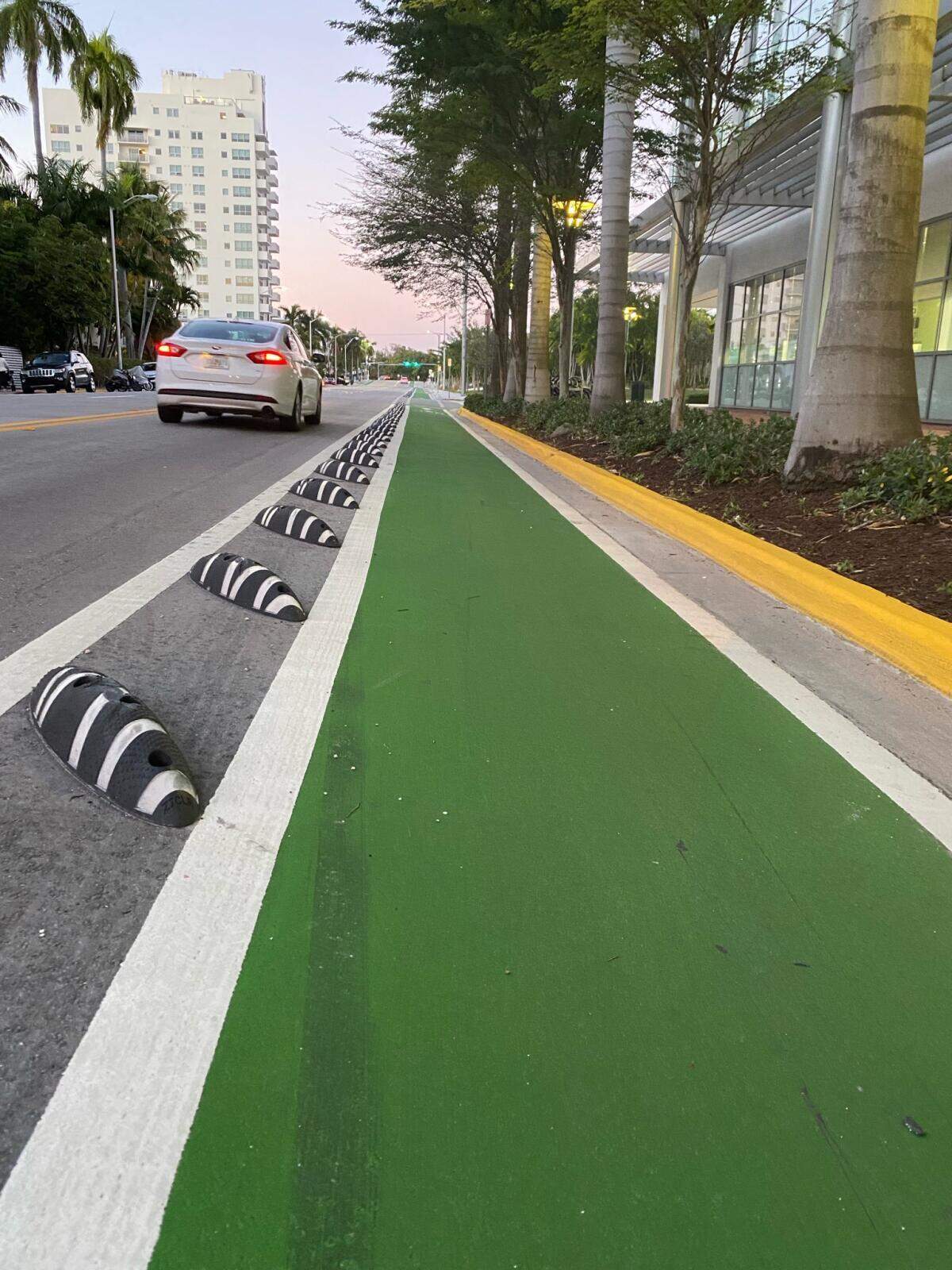
The devices are already popping up elsewhere, including on Meridian Avenue in Miami Beach, where they’re being installed along relatively wide new bike lanes between Lincoln Road and Dade Boulevard as a pilot project. The city also plans to use armadillos along a new bike lane now going in along Ocean Drive as part of the reopening of the famed street to cars following a two-year pandemic-related closure, Beach transportation director Jose Gonzalez said.
The Beach considered plastic poles on Meridian, but decided they were ugly and too easily damaged by cars, Gonzalez said. He said he thinks the armadillos will work on the city’s new lanes because they’re sufficiently wider than the Venetian lanes, giving users adequate maneuvering space. Response has been positive so far, he said.
“A lot of it depends on how they’re placed and the comfort level of the bike lane. As bicyclist, you have wiggle room,” he said of the armadillo-buffered Meridian lanes. “You don’t want to clip one of these things.”
For Evelyn Mendal, the Venetian armadillos have already failed the test. She ended up in an ambulance and in surgery with a fractured clavicle after her road bike wheel struck a divider shortly after the armadillos were installed. In trying to protect cyclists with the armadillos, she said, the county has created other unintended hazards.
Mendal said she was on her usual Sunday ride with a group of recreational cyclists from Aventura, including her father and husband. When they got to the Venetian, they decided the dividers made it unsafe for them to ride in the bike lane, and felt they had little choice but to use the causeway’s car lane, where the posted speed limit is just 25 mph — a speed fast cyclists in a group can easily attain, so that it’s theoretically safe for them to do so.
But an aggressive, speeding driver forced her into the dividers.
“My wheel touched the barrier and it sent me flying,” Mendal said. “The whole group is furious about these barriers. There is more frustration. There is no space. The second your wheel touches one of these barriers, that’s it. I’m not trying to hate on them, I appreciate the effort. I just don’t think this is the solution.”
Some issues were clear when this reporter took a bike ride along the causeway on a recent busy holiday weekend. As slow riders and other users, including a rollerblading man pushing a baby in a stroller, caused logjams on the narrow bridges, some faster cyclists and scooter riders veered sharply and out of the bikeway and into the car lane after squeezing in between armadillos.
Others waited to pass clots of slow users on the two bascule bridges or the causeway’s six islands, where the roadway widens and armadillos are spaced farther apart, or at intersections, where the devices are absent. That at times created a scramble resembling the start of the Indy 500 auto race as people swerved in and out of the bike lane before the next bridge.
That’s left many recreational riders and commuters with a difficult choice, said veteran Miami cycling advocate and attorney Lee Marks, who represents many riders injured in auto collisions. Though the MacArthur Causeway has bike lanes, it’s widely regarded as perilous for cyclists, and the Julia Tuttle Causeway is unrideable, leaving the Venetian as the only safe route for cyclists to use south of the 79th Street Causeway, he said.
“It’s a complete and present danger,” Marks said of the Venetian with the armadillos, but added: “There is no alternative.”
But some prominent Miami bike advocates defend the armadillos, saying they’re a sensible response to the demand from local cyclists for protecting bike lanes with something other than painted stripes.
Cyclists and other users on the Venetian are better protected thanks to the armadillos and must learn patience, said Mickey Witte, a former competitive cyclist and a bike commuter who manages the University of Miami’s BikeSafe program, which promotes safe cycling for children. She said there are plenty of intervals with longer breaks in the armadillo spacing along the causeway to allow safe passing.
“The more protected bike lanes we get the safer people will feel. This is for your kids. This is the mom who was commuting to the Beach for work and didn’t make it,” Witte said, referring to Carnicelli.
“My fear is that we scream we need protected infrastructure, then we get it and we’re not happy,” she said. “We have to go baby steps. This is a baby step in the right direction.”
The armadillo issue underscores the difficulties involved in retrofitting old road infrastructure for cycling, walking and other uses their designers did not contemplate. The narrow causeway, built in 1927, was designed primarily for cars. But the county added bike lanes in recent years to accommodate surging use by incorporating the roadway’s slender shoulders and slightly narrowing the single car lanes in each direction.
That left little room for physical barriers, but the armadillos, at just six inches wide, fit perfectly within the lane stripes, making the devices the best available solution, the county’s Cruz-Casas said. The causeway’s deteriorating bridges will eventually be rebuilt and widened with seven-foot bike lanes, but that’s years away, he said.
“It’s a very constrained environment. It’s very tight,” Cruz-Casas said. “It’s a fascinating environment, but very challenging.”
This story was originally published January 22, 2022 at 6:00 AM.