Chef’s death while bicycling on Venetian Causeway raises call for safe lanes
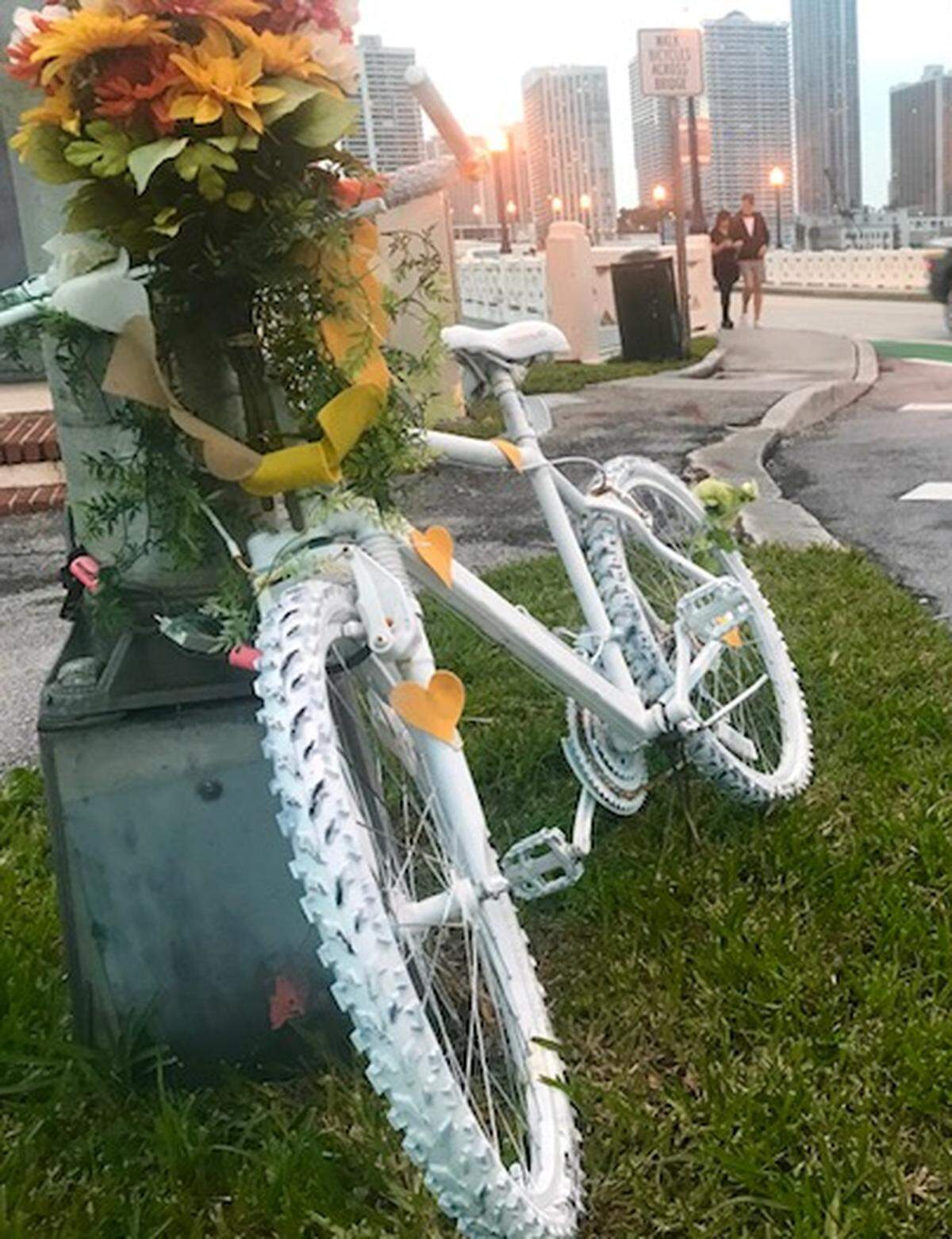
A ghost bike, painted white to symbolize the death of a cyclist, has been placed near the spot on the Venetian Causeway where Flavia Carnicelli was struck and killed by a motorist last year.
She was executive chef at the Brazilian restaurant Ofa on Purdy Avenue in Miami Beach. Carnicelli, 44, was cycling to work on Aug. 29 when she was hit by a driver from behind. She was riding east over the west bridge in the designated bike lane, but the brightly painted green pavement was not enough to save her from the car that crashed into her.
Carnicelli’s death, and the lack of improvements to Miami’s inadequate bike infrastructure in the wake of her death, have led to the creation of the “Safer Venetian Causeway” campaign by Transit Alliance Miami, the nonprofit organization that advocates for better public transit and mobility options, including walkable streets and bikeable neighborhoods.
“It’s an amazing initiative,” said Carmen Rodriguez, Carnicelli’s friend. She persuaded Carnicelli to move to Miami from Sao Paulo to open the restaurant. She said Carnicelli “loved to do everything on her bike.” “What happened to Flavia could happen to anyone. If we can make our roads safer, prevent accidents and prevent fatalities, it will mean that she did not die in vain.”
Bike lanes that are separated and protected from traffic with a barrier or buffer are essential to cyclists’ safety and encourage bike use, according to numerous studies and surveys and Azhar Chougle, the alliance’s executive director.
“It is tragic that Flavia’s death has not resulted in any action to prevent fatalities and protect cyclists,” Chougle said. “We are still way behind most cities. In all of Miami-Dade County, we have a grand total of five blocks of protected bike lanes on Southeast First Street. Does that sound like a place where we’ve made cycling a safe transportation option?”
The Venetian Causeway, built in 1913, is a popular bike route because it is the gentlest road connecting the mainland to Miami Beach. About 1,500 cyclists use it every day. Compared to the high-speed, multi-laned traffic on the MacArthur or Julia Tuttle causeways, it should provide safe and scenic passage as it crosses through residential islands.
In 2018, bike lanes on the causeway were painted green. But without a physical barrier, it’s just a line on the road.
“Without a protected lane, you are always looking over your shoulder, worried that a speeding or distracted driver will hit you,” Chougle said. “If people don’t feel comfortable and secure, they won’t ride.”
Miami Beach commissioners unanimously supported an upgrade to protected lanes during a meeting of the Neighborhood and Quality of Life committee last week. Commissioner Mark Samuelian declared that installing barriers — and not just plastic poles — is “a priority.”
In Miami, Commissioner Ken Russell — whose district encompasses downtown and part of the Venetian Causeway — announced that the scooter sharing program has raised $1 million that will be dedicated to improving Miami’s bike network.
Chougle lauded that support but said it’s going to take a collaborative effort by both cities and the county. The western half of the 2.8-mile causeway runs through the city of Miami and the eastern half through Miami Beach. The county has jurisdiction over the roadway, and its public works planners have previously voiced concern that narrowing the driving lanes would lead to more head-on vehicular collisions.
“When you think about safe cycling infrastructure in Miami, you think of the Venetian. So when someone is killed there, you know the reality is that we do not have safe cycling infrastructure. Not even close,” Chougle said. “We need to build out complete bike networks. The obstacle is always county planners envisioning every road as a car road. Do we want to spend our tax dollars to intensify the pace and expand the space at which drivers move and sacrifice everyone else?”
The installation of protected bike lanes usually requires a reduction of on-street parking or narrowing or eliminating motorized traffic lanes. But redesign is often beneficial because wide urban streets encourage and enable cars to move fast — a significant factor in crashes that injure or kill cyclists, pedestrians and even motorists.
Nine of the 20 deadliest U.S. cities for pedestrians are in Florida, according to the 2019 “Dangerous By Design” report from Smart Growth America and the National Complete Streets Coalition. Florida, built for speed, retained its distinction as the place where a person who is walking or biking is most likely to be struck and killed by a driver.
Cities that have installed protected bike lanes have seen an increase in bike use as urban dwellers, particularly environmentally conscious young people, demand alternatives to cars. Hundreds of miles have been installed in New York, Chicago, San Francisco, Dallas, Austin, Atlanta and Tallahassee, according to an inventory maintained by People for Bikes, a national advocacy group. West Palm Beach designed a protected lane that’s been nominated for a Complete Streets/Safe Streets Summit award. They’ve copied the success of bike-friendly European cities like Amsterdam and Copenhagen.
“We are decades behind New York, where 40 percent of the lanes are protected,” Chougle said. “Miami came up with a bike master plan in 2009 and Miami Beach in 2015 but neither has made significant strides in activating those plans. Nothing is connected. You get to the western end of the Venetian and the bike lane ends abruptly, dumping you onto unmarked, unsafe streets.”
The University of Miami’s BikeSafe injury-prevention program created a rendering of an attractive 4-foot-tall barrier that looks like and runs parallel to the Venetian Causeway’s outer white railing.
“Protected bike lanes are not only safer and build equity but they can be visually appealing, too,” BikeSafe said of its plan. “Renderings show how life-saving protection can be harmonious with surrounding architecture.”
Carnicelli’s death should serve as a warning that South Florida cities cannot continue to neglect the necessity of designing safe roads to be shared.
“We hope that Ms. Carnicelli’s death will encourage city leaders to end the inaction on safety measures for bicyclists and finally try to make our streets safer for all its users, not just motorists,” said the Miami Riders Alliance.
The riders alliance also derided Coral Gables’ latest defeat of a bike network proposal -- more evidence of a lack of progress.
“It’s a no-brainer to increase funding for bicycle infrastructure, especially in a city so apparently focused on climate change,” the riders alliance stated. “The city of Coral Gables took a tremendous step backward in killing their Alhambra complete streets project. It is unacceptable that in the 21st century we continue the same exclusionary practices in urbanism that have been proven wrong again and again.”
The investigation into Carnicelli’s death is still open, said her friend Rodriguez, who has been communicating with Carnicelli’s family.
“Even when it is closed, there’s a good chance the driver will only pay a fine,” said Rodriguez, who has adorned the ghost bike with flowers. “That is not much of a deterrent for people who don’t pay attention while driving. And that’s why we want to raise awareness and build safe bike lanes. We want Flavia to be remembered.”
This story was originally published February 10, 2020 at 7:06 AM.