
‘How could you not speak up?’ Floyd protests are drawing a diverse slice of Miamians
Dr. Bernard Ashby, a cardiologist born and raised in Miami, has been pulled over for driving while black “a million times” and once had police draw guns on him during a routine traffic stop. His first intimidating encounter with police came when he was put in the back of a squad car for playing hide-and-seek on public school grounds near home in Carol City. He was all of 6.
When he saw the video of George Floyd’s death at the hands of Minneapolis police, Ashby was, like millions of Americans, appalled and outraged, he said — not only as a black man at the officers’ cruelty and contempt, but, as a doctor, at what he says was a callous and lackadaisical response from emergency medical responders.
And so last weekend, Ashby, now a physician with a private practice and degrees from Florida State, Cornell and Princeton, found himself at a large, noisy and peaceful afternoon protest in downtown Miami, grabbing a megaphone and leading demonstrators in chanting Floyd’s name.
But what he saw around him was an inspiring surprise, Ashby said: A few thousand people, overwhelmingly young, whose black, white and brown faces reflected the full diversity of his hometown.
“It was incredibly diverse. Seeing that made me very happy and hopeful,” Ashby said in an interview days later. “It warmed my heart. I felt that for the first time in our history we were seeing that level of diversity at something like this. That there is a sentiment out there where we can all unify around freedom and the problem of racial inequity.”
In a city with a bitter history of racial disturbances, ethnic tension and persisting segregation, the protests over Floyd’s death may mark a change in attitudes. It is especially notable among the young, who have grown up in a Miami with a greater degree of casual, everyday racial and ethnic integration than their parents ever sought out or experienced, demonstrators and organizers say.
While the composition and size of daily demonstrations has shifted, all have something in common that seems novel, observers and participants have noted: They are drawing a cross-section of Miamians of all colors and ethnic origins, from high school and college students to parents with young kids in strollers who turn out on the weekend. Many have never been to a demonstration before this.
And though some Hispanic demonstrators have complained their peers are not showing up to protest in proportion to their numbers in Miami, the local demonstrations have drawn broad white and Hispanic participation — at times outnumbering black protesters.
At the first big protest in downtown Miami on May 30, hundreds of young and Hispanic demonstrators turned out to show solidarity with their African American friends and neighbors. One Hispanic teen, who came with her grandparents, had the words “I can’t breathe” written on both of her arms in black marker. As she stood in the street, her silver-haired grandparents snapped a photo of her.
The crowds have not been as large as in other major cities, but they have stood out for another reason as well.
With the exception that first May 30 standoff, daily protests since then have been largely peaceful. Arrests steadily dwindled as organizers exerted greater control and a non-violent ethic took hold, while police exercised watchful restraint.
Protesters and organizers say there is a reason for the increasing unity. Where older generations of Cuban exiles might throng an anti-Castro rally but would never dream of attending a protest over a police killing of a black person, for instance, at least some of their kids and grandkids see it as an obligation.
In Miami, where school and friendship routinely cross ethnic and racial lines. many young people attend schools with — and are friends with — kids of many other races and ethnic and national origins. Those often include immigrants from other Latin American countries and other regions who may themselves have experienced discrimination or rough treatment from police.
They’ve grown up with social media videos of violent encounters between police and black civilians, from Eric Garner in Staten Island to George Floyd in Minneapolis, amplifying messages against police brutality to a receptive audience. They are comfortable with activism spurred by school shootings like the Parkland massacre next door in Broward County.
And when they see police violence directed at black victims, they simply see injustice and feel a duty to speak out, several protesters said. Among the young especially, the revolt against police brutality inspired by Floyd’s death has become a movement they don’t want to leave to others, be left out of, some protesters said.
Miami Herald reporters asked some participants what motivated them to turn out to the demonstrations. Here are their stories.
DR. BERNARD ASHBY
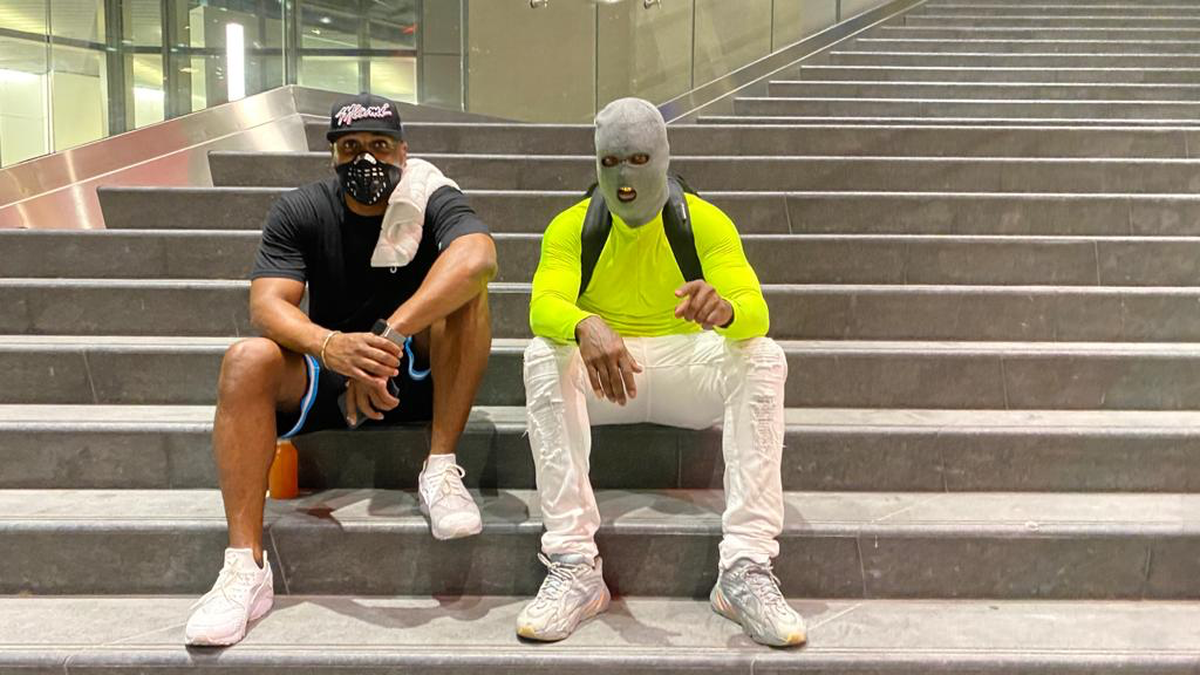
Ashby, 39, said he is “a representation of America.” He was born to Caribbean immigrant parents, has a brother in prison and another, now deceased, who was beaten by police. His sister is a New York City cop, and Ashby said he also has had positive interactions with police. He has family in Overtown and other majority-black neighborhoods.
“I see the impact of the police state in these communities,” he said. “There is a policing punishment posture instead of one of cultivating.”
The clear and fatal mistreatment of Floyd by police and medical responders laid bare the disparities African Americans suffer both in the justice and health-care systems, Ashby said. That inequity has been on full display in the COVID-19 pandemic — which studies show, has disproportionately affected blacks and other minorities — and the news that Floyd had been infected by the coronavirus, Asbhy noted.
“It’s this underlying current of racism. This is what people are seeing on now, because of the pandemic, because of police brutality. You are seeing these racial inequities,” he said.
Ashby said left May 30 after he was tear-gassed when the protest took a violent turn, but participated as a medic the next dayat a protest in downtown Fort Lauderdale. He left before police gassed and shot rubber bullets at demonstrators that day in what observers have said appears to have been an unprovoked offensive.
“I was rebelling not just as a black man but as a physician. I was out there for the rights of black folks who have been disenfranchised, but also for a basic human right. Everyone has the right to the American dream and access to basic resources. But if you have a certain skin color or live in certain neighborhoods, you will be denied those basic services.”
KYLIE RAE WANG
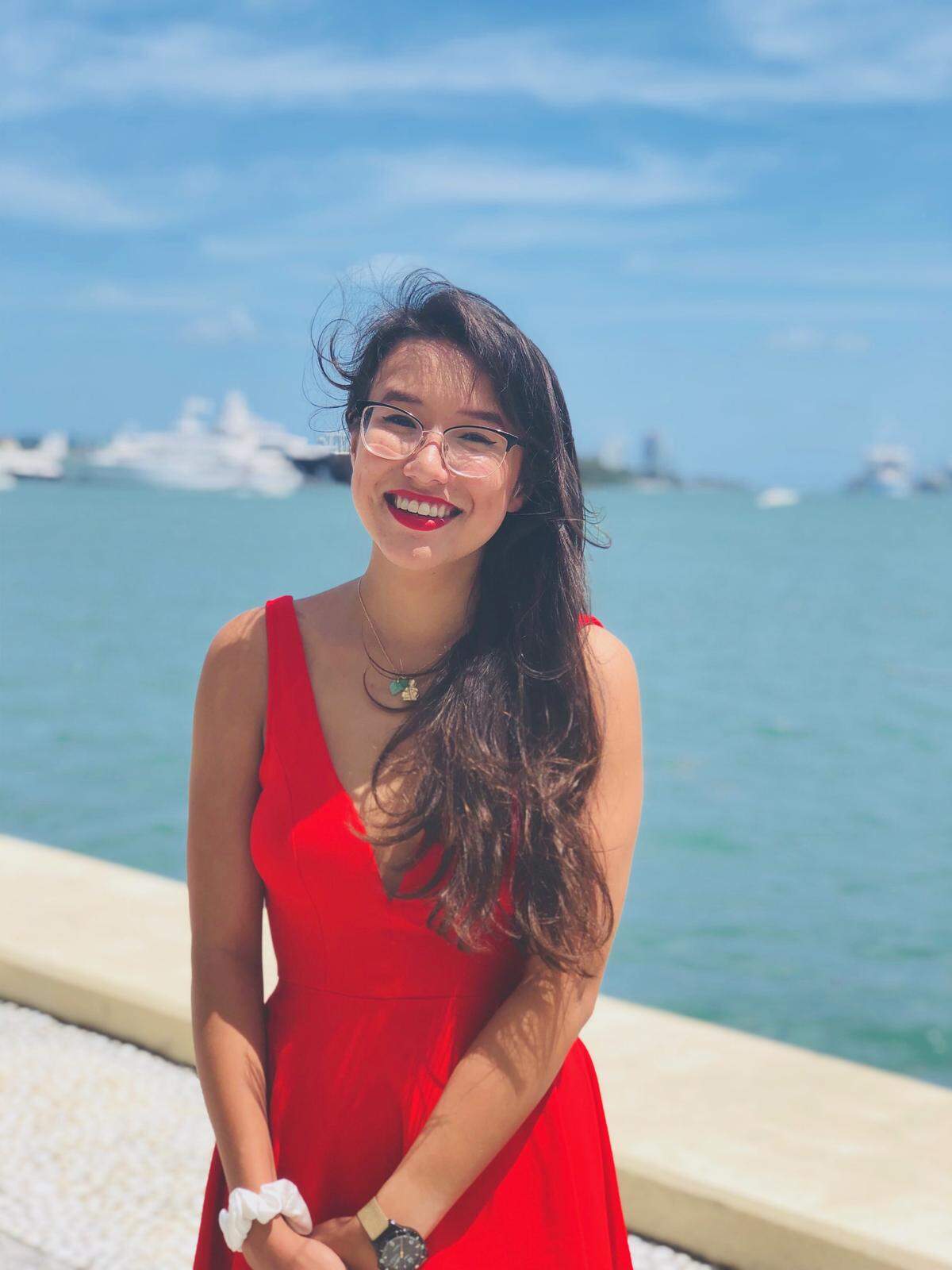
Wang, 21, is a communications and journalism student at the University of Miami who grew up in Coral Gables and attended Gables High. As an Asian-American, a relative rarity in South Florida, she said she’s had some experience with discriminatory treatment.
Accompanied by a Hispanic friend and a white-non Hispanic friend, she attended the downtown demonstration on May 30, leaving before the disruption turned rough. She returned on Tuesday, when demonstrators marched, largely without incident, through Overtown to the Miami-Dade County jail. There they called for the defeat in upcoming elections of Miami-Dade State Attorney Katherine Fernandez-Rundle, who critics say has failed to aggressively prosecute abusive cops.
A few years ago, Wang participated in a local March for their Lives demonstration after the Parkland shootings. But the protests this week felt a lot more charged and somehow personal, she said.
“I’m not black and don’t believe I have any idea of what that experience is,” she said. “But, for me, what really hit home was the Asian police officer (who stood by as Floyd was held down by colleagues) and his aiding and abetting of this horrible crime. That’s not how I wanted my race to be perceived. That’s not how I want to be represented.
“This was definitely a lot closer to home in terms of the emotion, and a lot more tense because of the police presence there. That would never have crossed my mind in March of our Lives.
“Both times I went out [this past week], things have been very peaceful. We’re not out here not here to start a fight. We’re not here to start a riot,” Wang said. “I wish there was more coverage about how peaceful things have been. There was such an emphasis on being peaceful by the organizers.”
Her one disappointment, she said, was to see relatively few other non-black people of color at the protests.
“We non-black minorities, we understand what racism is, not to the same extent, but how could you not speak up?”
FRANCISCO PEDRO
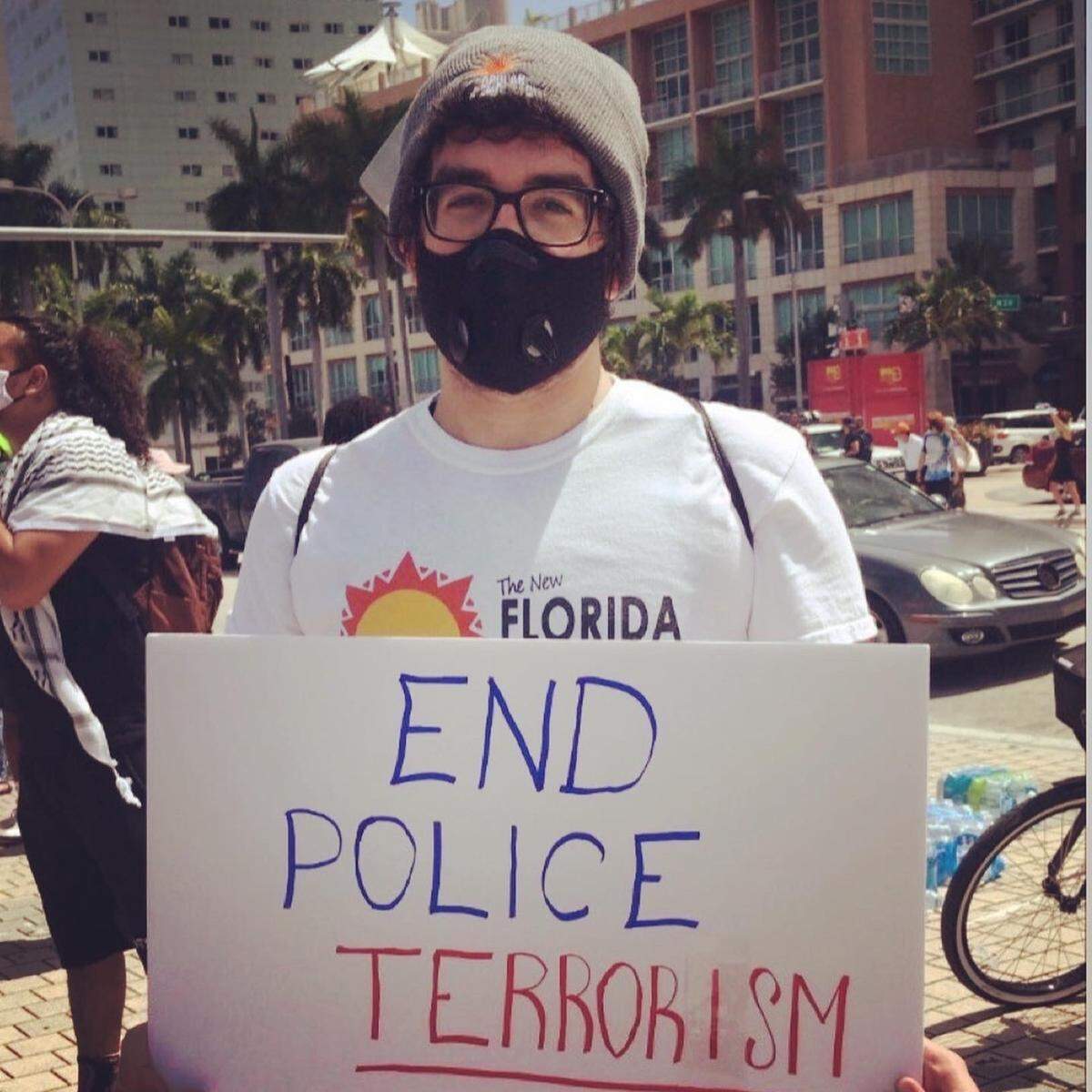
Pedro, 32, who works in Miami for the nonprofit Center for Popular Democracy and represents the New Florida Majority, has helped organize and participated in many demonstrations in downtown Miami. Rarely, if ever, has he seen a response as large as the Floyd demonstrations have drawn — nor as diverse. “A very brown crowd,” he called demonstrators.
“I’m very moved. I’ve been to protests here at the Torch of Friendship many, many times,” he said, referring to a spot in Bayfront Park at the center of many demonstrations, including some of the Floyd rallies. “Usually there are 15 people. The most crowded I have seen here is 50 people. It is a city that has a notorious history of police brutality in the 1980s. It’s important that [protest] happens here for that reason.”
Pedro is from Brazil and moved to Miami at age 10. In Brazil, he notes, he’s considered white. In Miami, he’s labeled Latino. That made him something of an anomaly when he attended Palmetto Senior High, where he found that signs of racial discrimination were not always overt. The formerly nearly all-white school has seen increasing numbers of black and Hispanic students.
“This city is very, very segregated. And I remember that when I went to Palmetto it was a mostly white school. There was a huge prejudice against people who, quote, ‘don’t belong there.’ That was the coded language. That’s when I realized there was a fear of kids going to the ‘wrong’ school,” he said.
Pedro has been disappointed also to hear Hispanic immigrants in Miami, who might themselves face discrimination outside the city, often and casually make disparaging remarks about blacks. His own professional activism began almost by accident, when he volunteered to canvass for the ACLU on issues of equity and other progressive concerns.
He notes the turnout and diversity at the Miami protests has been driven not only by bald injustice, but the COVID-19 pandemic. Many students are home from closed schools and colleges; many young people lost jobs and face fears for their future, he said.
“The fact that George Floyd’s murder was caught on tape, it was like a “here we go again’ feeling,” Pedro said. “I think it will be a change of consciousness. There is a generational gap. I think now you have the generation that grew up with (the awareness of) police brutality.
“I saw the story about the officer who knocked down the woman during the protest in Fort Lauderdale being investigated for [use of force] complaints 79 times. What other job would give you 78 other chances? This may opening up people’s eyes to things they didn’t think about much before.”
JOHN PERSAUD
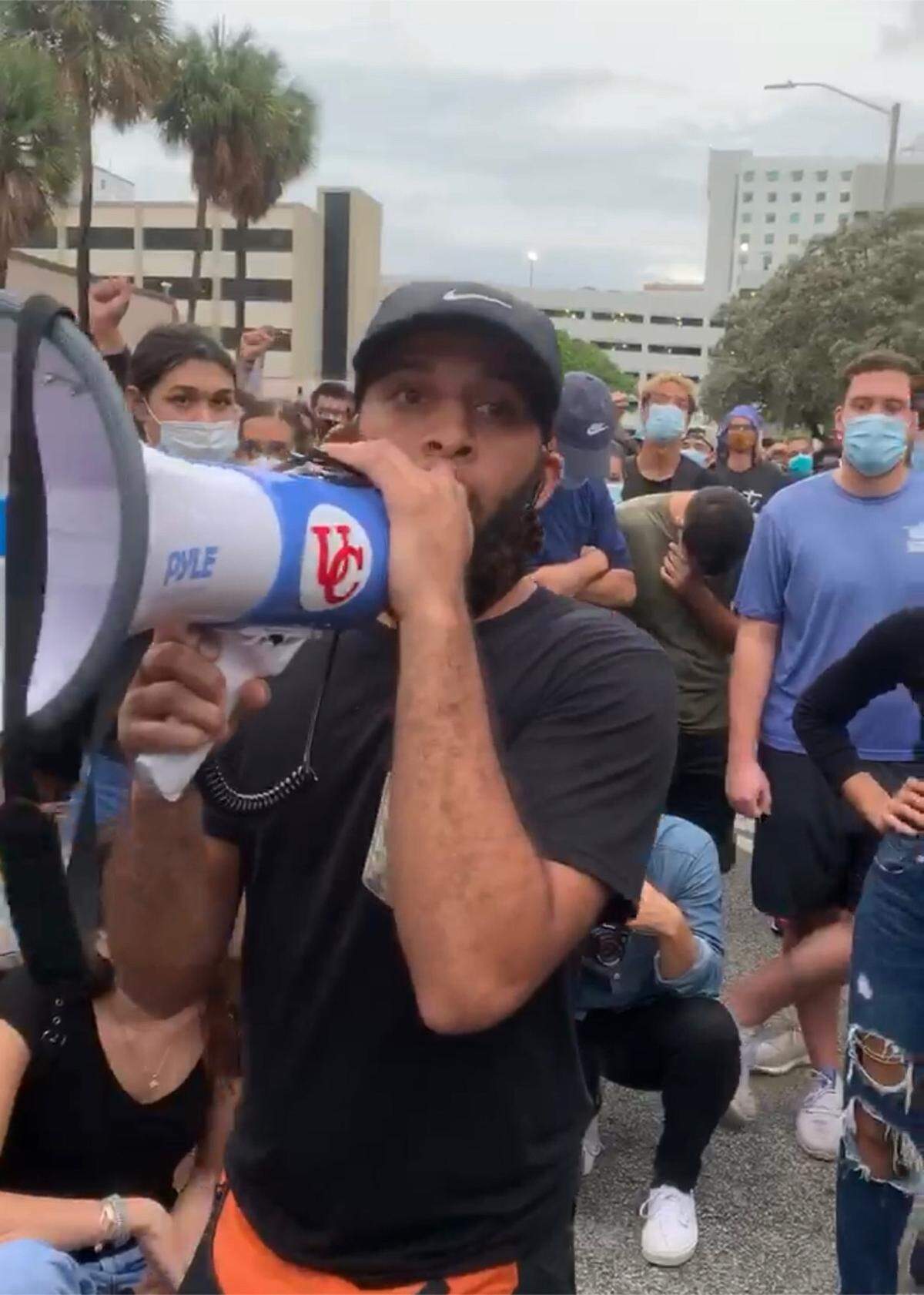
Persaud, 23, a poet and musician, has been going to protests since he was at Miramar High, when African American teen Trayvon Martin was murdered by a white vigilante. Persaud, who just graduated from Florida International University, has already developed a reputation for his spoken-poetry performances in schools and venues around South Florida.
Persaud, whose parents are Jamaican and Dominican, said a friend was unjustly beaten by police and he’s had close shaves himself. One reason so many people of different backgrounds turned out to protest, he believes, is that they, too, have experienced abusive treatment by police or know someone who has.
“I feel there are so many reasons. Some people want justice, for the police officers [in the Floyd case] to be convicted. Some may have a family member who has been brutalized. People just want to take action. They are tired of just posting things on social media,” Persaud said. “Now it’s ‘Do you see what’s going on the news? It’s now or never.’
“If people don’t take action, it’s just going to continue to happen. So people are starting to take a different approach. A lot of people understand that people who keep silent are siding with the racists, with the oppressors. And if people don’t stand up and speak, this could be your family member, your son, your daughter.
“At the end of the day it doesn’t matter if you’re black, white or brown. An innocent life was taken,” he said. “That’s what people are outraged about. Growing up in Miami, we are a melting pot. These protests have shown that there are numerous people who are invested in this issue. It gives me a lot of hope in the younger generation. This is just another of those historical moments for Miami, like the McDuffie riots.”
Z0E CROSS
Zoe Cross, 22, decided to attend a protest in downtown Miami with her longtime friends Amanda Caban and Costanza Musetti after days of posting on social media and making donations in support of the Black Lives Matter movement. The three are college students come from diverse ethnic backgrounds: Cross is Jewish, Caban of Puerto Rican descent and Musetti is from Venezuela.
It was Cross’s first protest.
“We’ve all been just very interested in supporting the Black Lives Matter movement, trying to educate ourselves. We wanted to do more,” Cross, who lives in Miami Shores, said. “Honestly, it was like nothing I’ve ever experienced before. We felt like we were part of something so strong.
“I am white and Jewish, and I feel in the past there has also been anti-Semitism and I’ve never been one to speak out or protest with social issues. But I feel this movement has made me want to. There has been so much racial inequality. I may not be black, but I want to fight for their rights, because everyone deserves to be equal in the world.”
Her generation, brought up on social media, is not shy about speaking out, Cross said. Floyd’s death, for her, has underscored much that seems wrong right now.
“My generation is very vocal about people’s rights. We do most things together and lately it’s most of what we talk about,” Cross said, referring to Caban and Musetti. “It’s all over social media and it’s something you can’t not talk about. A lot of people are saying it’s just a social media trend. I don’t see that at all. George Floyd was just, enough is enough.
“I do feel people are frustrated with the world in general. [Many] people aren’t taking coronavirus seriously. They don’t care about social injustice. People don’t seem to care about what’s going on in the world.”
REBEKAH KETCHAM
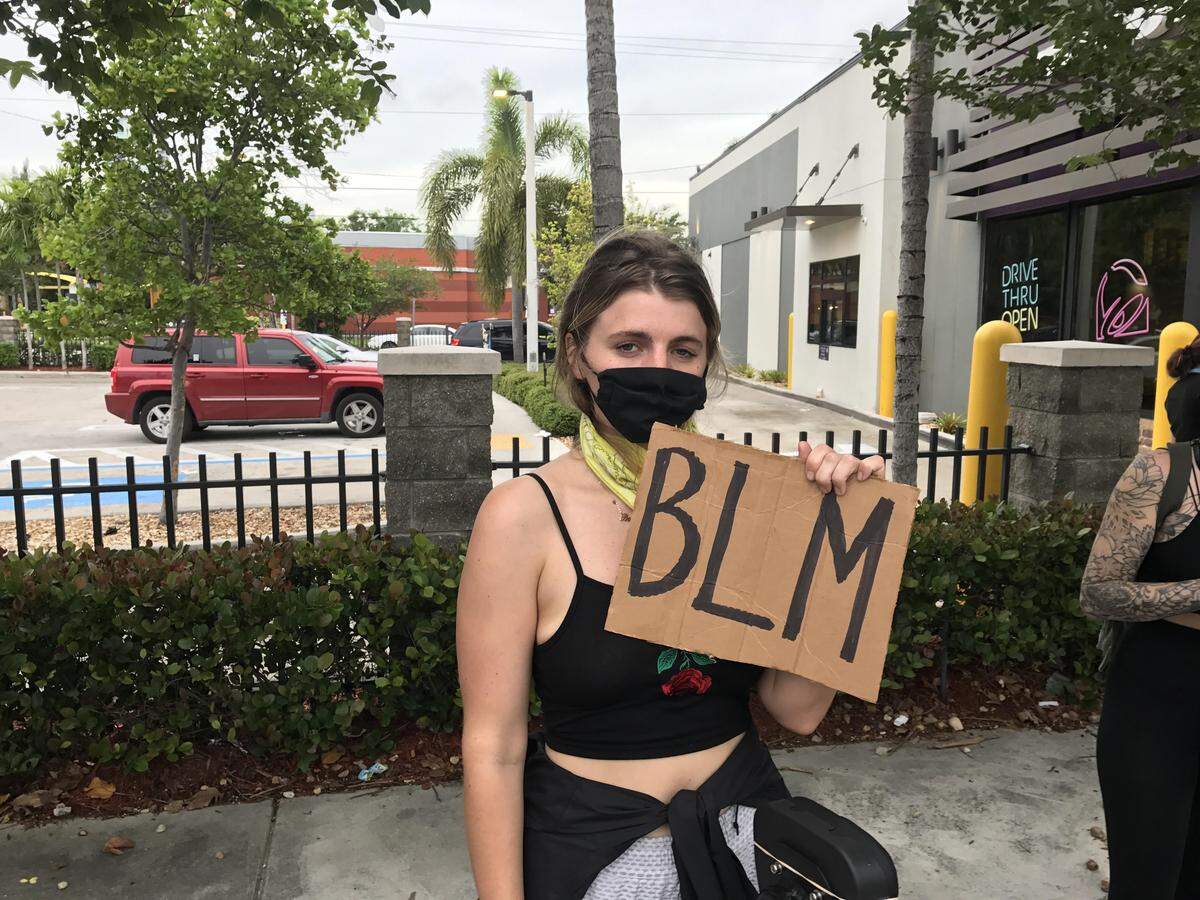
Rebekah Ketcham came to Miami from a long distance — Gainesville — to attend a Friday evening protest march in Wynwood. She was staying with friends who live nearby.
“I’m from a diverse place, Gainseville, Florida, and I know what it’s like to live in unity, and I want to achieve it again,” Ketcham said.
She also said she felt a civic responsibility to speak out about Floyd’s death, especially as a white person.
“As a white woman, it’s my duty to show up,” Ketcham said. “It’s the least that I can do.”
MIRANDA RYSHAWY
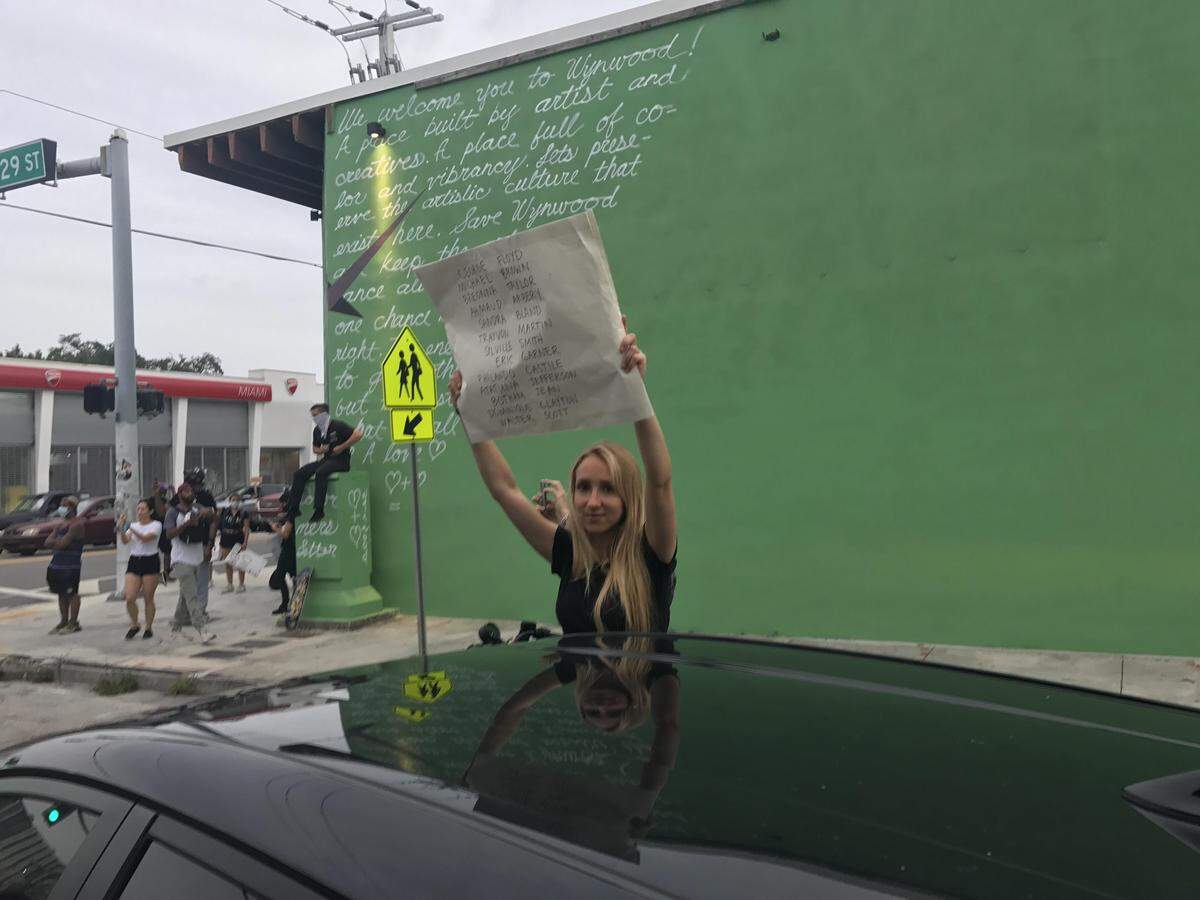
Miranda Ryshawy, 23, hung out of the passenger side of a car while marchers at Friday night’s Wynwood protest passed by. She held a sign with about a dozen names of black people who have been killed by police officers in recent years.
The Miami resident said she and her parents came out in support of the protesters because they have been “just appalled at what’s happening in the country.
“The names I wrote on my sign, there are so many more that didn’t fit,” she said.
Ryshawy also took part in the protest because she feels this is a turning point in America’s history that she wanted to be a part of.
“We just want to show support for the cause. It seems like part of history, and we didn’t want to miss this,” she said.
TORRIE JACKSON
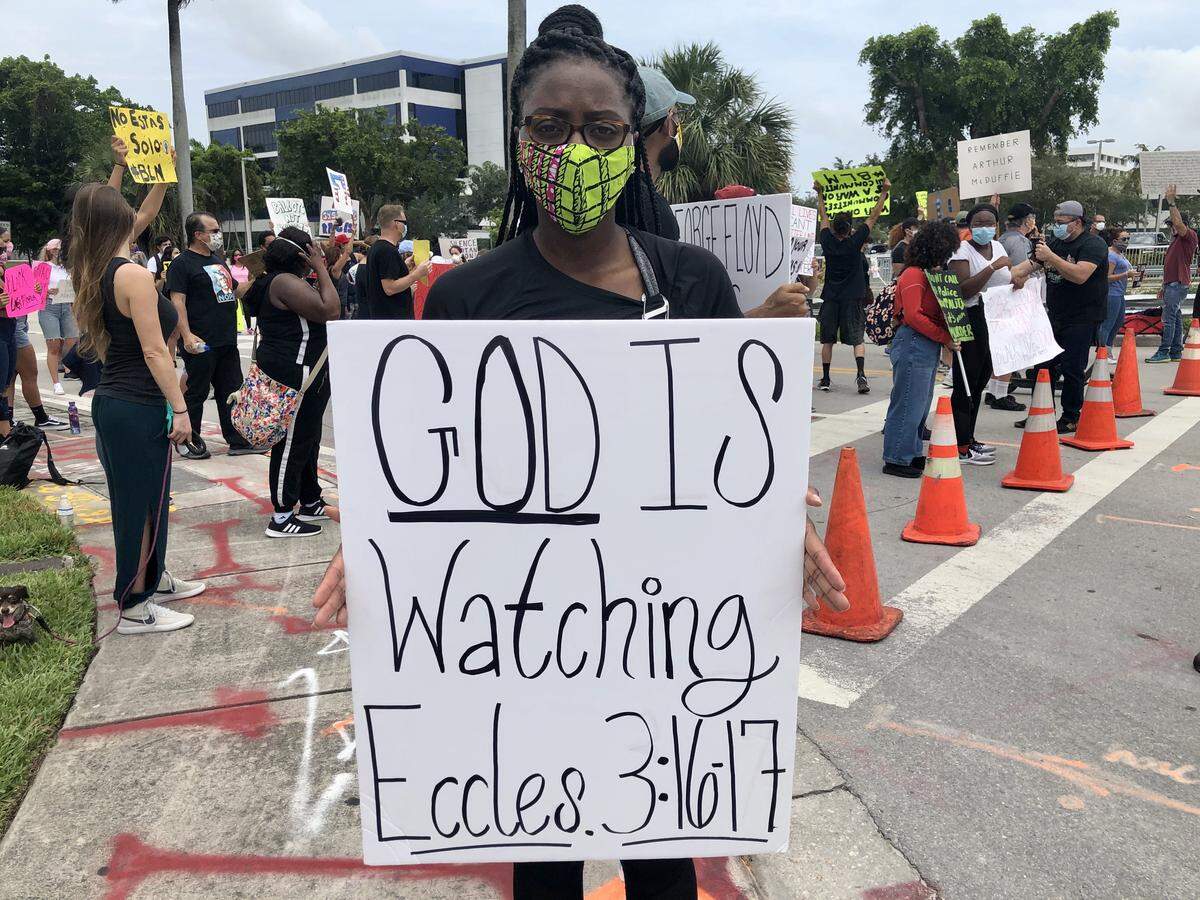
Torrie Jackson, 29, a Kendall resident who described herself as a Baptist, said she was offended by President Donald Trump’s use of her Christian faith and holy Bible as a prop in a controversial photo opp earlier this week.
“He’s clearly not reading it,” she said. “I just feel like it’s offensive to God, but the actions he’s taken and the things he’s said are not of God.”
So on Saturday, Jackson, who is black and works at a local university, stood during a protest at the corner opposite the entrance to Trump National Doral, the president’s golf resort in a suburb west of Miami International Airport. The demonstration was called by Latinos for Black Lives Matter.
Under an overcast sky, Jackson held a sign quoting a verse from the Old Testament, a passage from the book of Ecclesiastes she paraphrased. In black marker on a white poster board, she wrote: “God is watching.”
She said as a black woman, she was compelled to speak out because “being silent means you may agree.” As a Christian, she said, she sees a clear line from Jesus to calls for equality in the United States.
“Love your neighbor as you love yourself,” she said.
“He’s clearly not reading it,” he said. “I just feel like it’s offensive to God, but the actions he’s taken and the things he’s said are not of God.”
This story was originally published June 7, 2020 at 6:00 AM.