‘Where are my Latinos?’ Miami protesters call out police brutality and Latino silence
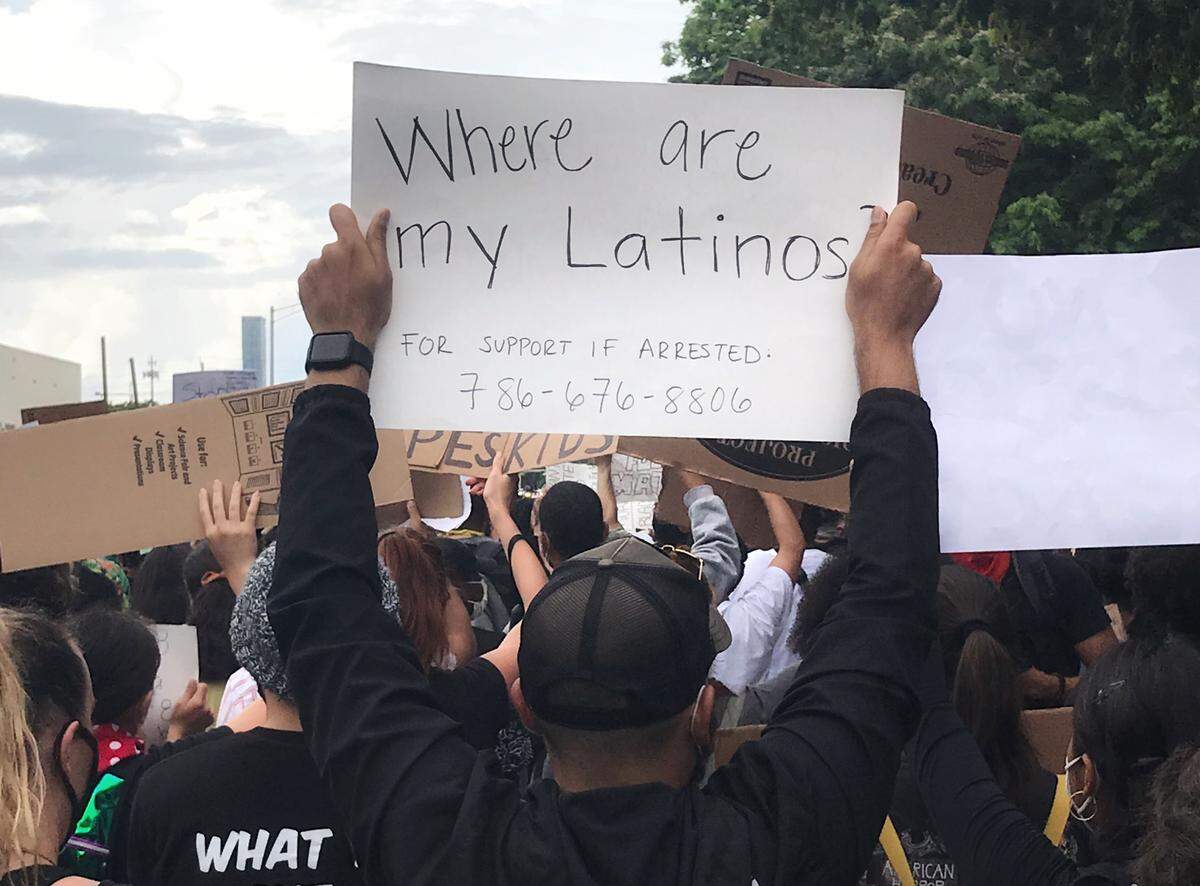
While marching alongside fellow protesters in a rain-soaked demonstration against police brutality Tuesday afternoon, Marvin Pineda brandished a sign that posed a straightforward question: “Where are my Latinos?”
Tuesday’s march through Wynwood and Overtown was among the many daily protests, almost all peaceful, that have taken hold in Miami in response to the police killing of George Floyd in Minneapolis.
Pineda explained that his sign — a departure from those around him, many of which said “Black Lives Matter” — stemmed from a belief that Latinos in Miami haven’t been vocal enough in denouncing racism, or even in recognizing the racial prejudices inside their own community.
“I just believe that right now a lot of our Latino brothers are being silent with their complacency, and not saying anything,” said Pineda, whose family is Nicaraguan. “Just because I’m a Latino doesn’t mean I don’t stand behind black lives.”
Marching alongside Pineda on Tuesday was Alexandra Cortright, who is half Mexican.
She also described Latino participation in anti-racism activism this week as underwhelming.
“The thing with Miami is, unless it hits home, we don’t give a s---. If that were a Latino man on the floor, the city would be on fire. But because it’s not, we are complacent. We are just not seeing enough Latinos out here, especially white Latinos,” said Cortright. “The problem is that we are racist against ourselves. White Latinos are against black Latinos. Until we can deal with that we are not going to have progress in this city.”
A few paces ahead of Pineda and Cortright in the crowd of more than 500 people was Carolina Gomez, a Miami-native with Colombian roots.
She was holding up one of the only signs in Spanish visible at the protest. It said “Sin miedo” or “Without fear.”
“I wrote sin miedo because we live in a community with a big Latino presence, where people have to be conscious of the fact that they can also participate in this movement. We have lots of Latino parents, Latino grandparents who are seeing this on the news and who don’t get it. I think we have to give them hope that it’s possible to be sin miedo, without fear, and that they should support this amazing cause,” said Gomez.
The decision to write a Spanish-language message on her sign was deliberate.
“It just reaches more people that way,” she said. “There are so many Spanish speakers here. I think it’s important for them to realize that our community is also in this fight, that this is also our responsibility.”
On Tuesday, one of the only other signs in Spanish (or, more accurately, Spanglish) was held by Sebastian, from Colombia.
It read, “And to all the racist Latinos: eso no se hace, eso no se hace, y yo no me voy a quedar callado.” (“And to all the racist Latinos: that’s not OK, that’s not OK, and I won’t stay quiet.”)
For Sebastian, who declined to share his last name, acknowledging and calling out the racism in his own community feels important.
“I think the first step for all Latinos in order to help the Black Lives Matter movement is to recognize that there’s a lot of colorism and racism in our community and we also unfortunately spew that venom out. Just recognizing that is important,” he said. “We need more from the Latino community.”
Specifically, Sebastian called for “white Latinos to use their privilege to help out the Afro-Latino community.”
Andrea Mercado, executive director of the New Florida Majority, agrees.
George Floyd’s murder is “not the first time that we see police brutality and there are many Latinos who die at the hands of police or border patrol. But Latinos can also be complicit in violence on black bodies and anti-blackness exists in our communities,” she said. “Here in Miami-Dade many of our police officers speak Spanish and maybe Latino police officers are responsible for perpetuating violence in black communities. So this is an important moment for all of us to stand up in defense of black lives.”
Both Sebastian, the protester, and Mercado also said that the government’s heavy-handed response to the wave of protests — including threats from President Donald Trump to deploy the military in U.S. cities — should trigger Latinos who had to flee oppression in their home countries.
“Many of us Latinos experienced police brutality and dictatorship in our home countries … And I think when we don’t respond in the same way here it makes me ask why. And it is because of the anti-blackness that exists in our countries of origin, and I think that’s something for us to reckon with as a community,” said Mercado.
“WHITE LATINOS … WANT US TO BE INVISIBLE”
In 2017, Yvonne Rodriguez, who is Afro-Cuban, co-founded Afro-Latinos Professionals of Miami, a network that seeks to “expand and enhance” the visibility of Afro-Latinos.
On a conference call with other Afro-Latinos on Wednesday, Rodriguez said that efforts made by members of the Latino community to begin speaking up about racism in the wake of George Floyd’s death highlights the silence that until recently had been the status quo.
“When I see my Latino friends posting [on social media], I’m not saying ‘thank you,’ I’m saying ‘it’s about time.’ You know, I’m not clapping for them,” she said. “We are not starting at zero, we are starting at negative 20.”
The community is unprepared to meet this moment, Rodriguez feels, because of its history of dismissing Afro-Latino voices and experiences.
“We are constantly begging to be visible and recognized by the Latino community, and we do not get it. In my experience, as much as you dialogue with them, as much as you try to talk to them, they are a brick wall,” she said. “I deal with a lot of white Latinos. They will not be happy with any type of protest. They want us to be invisible … We have to solidify our union.”
Omilani Alarcón is a Miami-based filmmaker who directed the 2018 documentary Latinegras.
She identifies as a Latinegra, or black Latina — a label that didn’t always feel accessible to her.
“Now a lot of people are talking about Afro-Latinidad but we haven’t always had that choice. When I was growing up I was just black, there was no black and,” said Alarcón. “When people see me walking down the street I don’t have time to explain what is my heritage and my [Puerto Rican] background. What they first see is my African hair, my African nose, and that I’m black.”
Alarcón is hopeful that the wave of activism and protests in Miami and across the country over the last week will serve as an opportunity for Latinos to not only support Black Lives Matter, but also confront some of the racism and colorism inside their own community.
“It will help if white people speak out and stop being … complacent with systems of oppression,” she said. “It goes beyond simply using one’s privilege for the greater good, it takes holding those around you accountable as well and speaking out when injustices are seen. Many times black voices, women’s voices, and indigenous voices do not have as much weight as others. This is something I hope to see change within my lifetime.”
This story was originally published June 5, 2020 at 7:00 AM.