As protests across Florida intensify, Miami emerges as peaceful outlier. Here’s why.
In a stark departure from the earlier images of agitators confronting police in heavy riot gear and burning police cars, hundreds of Miami protesters knelt on the streets of Historic Overtown Tuesday afternoon around a couple of young men who passed around a megaphone. Their chants subsided as the men spoke.
“Overtown was one of the busiest districts in Miami-Dade until they built I-95 through it,” said Dahmiec Denson, an independent activist from Overtown, right before the massive group overtook some of the neighborhood’s empty residential streets. “We will respect this neighborhood.”
The protesters listened.
While most of the country’s biggest cities, including some in Florida, are seeing demonstrations intensify over the police killing of George Floyd in Minneapolis, Miami has emerged as a peaceful outlier.
The change in Miami was dramatic. On Saturday, protesters shut down a major interstate, police cars were set on fire, and smoke from several blazes, mixed with tear gas, clouded Northwest Third Avenue downtown. By Tuesday, organizers were leading protesters through an oral history tour of Miami’s neighborhoods, while others recited slam poetry under pouring rain.
There are ground rules now: Bikers go first. No instigating violence. Call out the agitators. Waving of hands means quiet down. Yelling at police is OK; throwing anything at them is not. Don’t break glass — or curfew. Get home safe.
It’s not to say that the anger at witnessing police aggression in black communities isn’t there, organizers reinforce. But while law enforcement agencies chose to take patrol cars off the streets and block off main highways starting Sunday, organizers took policing into their own hands to limit interactions with police. The result has been a series of daily downtown protests, which entered their sixth consecutive day Thursday, that have waned in the size and aggression that first sparked the public demonstrations against police brutality.
And from 57 protesters arrested in Miami-Dade County on Saturday, the number dwindled into the week, dropping nearly to zero overnight Wednesday. Later Wednesday, the county moved its 9 p.m. curfew to midnight.
Rather than staying out later or confronting police on the first night of Miami-Dade’s midnight curfew, the group of about 50 protesters that showed up Wednesday to spontaneously shut down Biscayne Boulevard for about an hour had fully dispersed by 8:30 p.m. Protester Freddy Peralta, 59, negotiated with a Miami police officer to let them block Biscayne at Northeast Third Street.
“I’m trying to be as peaceful as possible,” the officer replied. “All of the cops here support you, OK? But this here we cannot have.”
A few minutes later, police helped redirect traffic a block away.
The interaction was vastly different than what protesters had experienced the previous day, when police were rarely visible to demonstrators. While the crowds marched through the streets of Downtown, Overtown and Midtown, dozens of police lined surrounding streets, blocking off nearby roads. But they always followed close behind.
“We keep ourselves safe,” the activists chanted.
After Saturday’s mayhem, about a dozen people, some of them organizers affiliated with the group Dream Defenders, came together to decide how to move forward. They traded deescalation tactics, recruited their friends and family to pass out food and water and pinpointed volunteers to block traffic with their bicycles and skateboards. They made calls to community leaders for advice.
“We got together and realized that we couldn’t let every protest be like Saturday. We want people to be able to bring their children to these functions. Their parents, their grandparents,” said Adrianna Mack, an 18-year-old organizer with Dream Defenders, the activist organization formed in 2012 after Trayvon Martin, a black teenager from Miami Gardens, was killed.
“We can’t do that when tear gas is being thrown at us. That only instills more fear,” Mack said. And protesters can’t get up and show up another day “if people are going to jail.”
For many, the Saturday protest was the exception, not the rule. Mack attributed the violence to a lack of leadership among protesters, adding that it was not as well planned as it should have been.
When a few protesters tried to agitate police near the Miami-Dade Pre-Trial Detention Center downtown on Tuesday, Mack and others tried to calm them down, surrounding them and redirecting the crowd’s attention to a recurring chant.
“Vote her out,” they chanted, referring to Miami-Dade State Attorney Katherine Fernández Rundle.
“It’s good when you have someone step up and have that leadership,” Mack said. “It was a matter of like-minded people coming together to help out the greater good.”
Shortly before that, the crowd had turned their attention to John Persaud, a 23-year-old musician and poet from Miramar, who performed one of his poems for the group. Judging from videos circulating throughout the country showing tense and violent confrontations in cities like Washington, D.C., and Dallas, Persaud was surprised to see Miami’s protest end the way it did.
“People are in a space where some people feel like words aren’t enough and actions are what’s getting people’s attention,” he said. “Did I expect it to be as peaceful as it was? Not really.”
From poetry to prayer, protests in downtown Miami have brought out protesters with a wide range of opinions on the right way to protest and how to best bring attention to their issues. But the one constant is that even when protesters are angered at the sight of heavily equipped police and are threatened with arrest, Miami demonstrators have found a way to police their own.
This crucial moment, when organizers and police have to make quick decisions on how to deal with rising tensions, has ended differently in other major metro areas, in spite of early planning. Even in Florida cities like Tampa, St. Petersburg, Orlando and nearby Fort Lauderdale, police have deployed tear gas and shot rubber bullets to disperse crowds.
Veteran organizer Jasmen Rogers Shaw said Sunday’s protest in Fort Lauderdale was the largest she’s ever helped to plan. She said the protest involved lots of strategizing beforehand, like planning for volunteer medics to attend and ensuring plenty of food and water was distributed.
And things were peaceful — until they weren’t.
There came a point when police became “antagonistic,” she said. Protesters at the scene say they saw a group of police officers in full riot gear move toward them from a nearby parking garage shortly after 6 p.m. After a peaceful gathering, demonstrators began to yell at police from the street.
The way police showed up in riot gear made peaceful protesters feel unsafe and anxious, which Rogers Shaw said contributed to the violent ending.
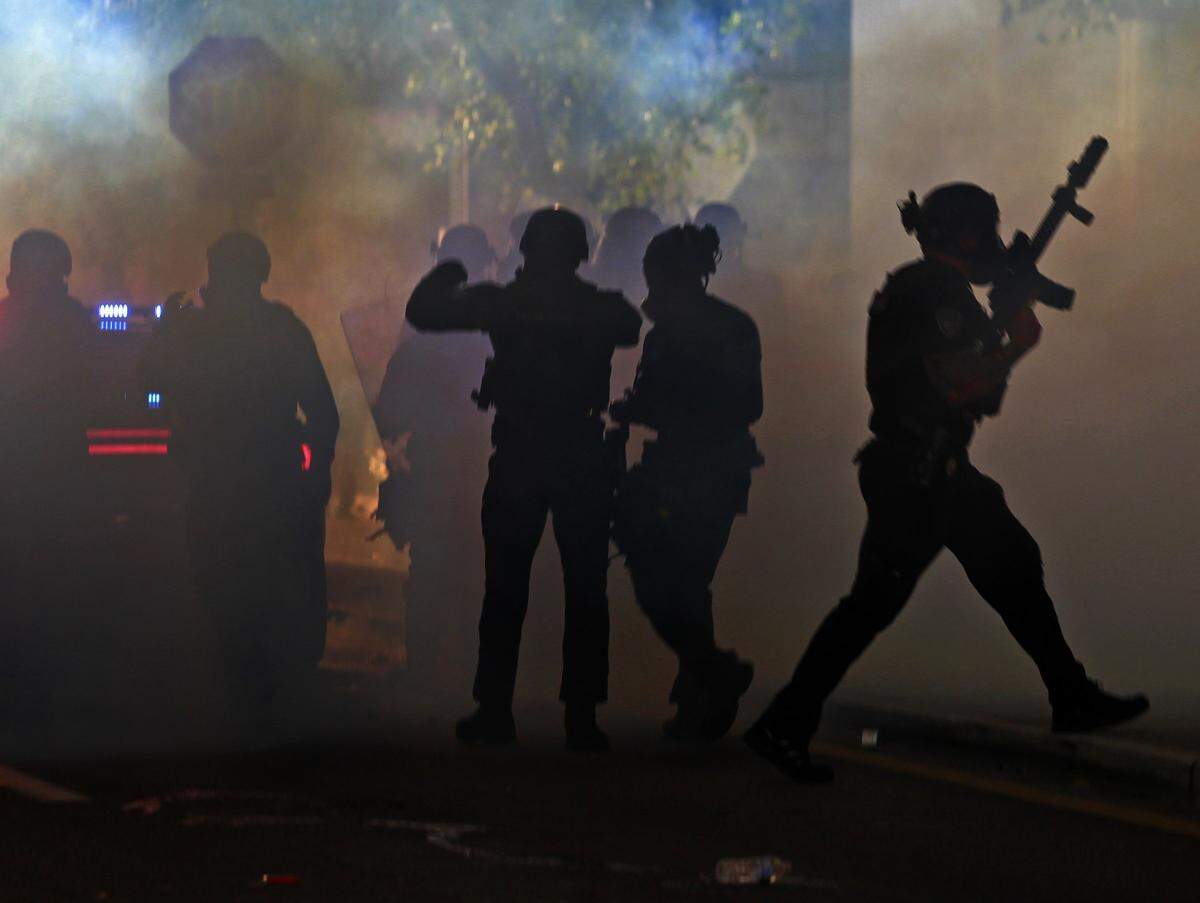
Things got worse. A Fort Lauderdale police officer knocked over a woman who was sitting on the ground. Shortly after, police began to fire tear gas and rubber bullets at the crowd.
On Monday, Fort Lauderdale patrol officer Steven Pohorence, the one who knocked over the protester, was suspended. Pohorence had been investigated 79 times over three-and-a-half years for use of force.
“Beyond the broken system of policing, I don’t know what caused that level of agitation,” said Rogers Shaw, who is also a candidate for Florida House District 95. “Leaders need to understand that they set a tone for everything we do.”
That was different than what was going on in Miami on Sunday. A crew of organizers promptly squashed every opportunity to instigate violence, effectively breaking up arguments and dissuading agitators. Attendees said this approach made them feel safe in the crowd.
On Tuesday, police in Miami were stationed near highway ramps and government buildings, but most of the 4-mile loop around downtown did not have heavy surveillance.
The police response was lauded by Miami-Dade’s Black Affairs Advisory Board, which convened for the first time Wednesday since George Floyd’s death in Minneapolis on May 25.
“You acted in stark contrast to Fort Lauderdale,” board chairman Stephen Hunter Johnson said to city and county police administrators in an online meeting. “And you had more to handle. ... Much restraint was shown.”
Law enforcement officials said their plan was to allow people to demonstrate while maintaining peace.
“We will block traffic for them,” Miami Deputy Police Chief Ron Papier said Monday. “What we won’t tolerate is damage to property or the public’s safety.”
Organizers say they share a similar goal.
Joseph Martinez, a Dream Defenders leader who has been at the forefront of the Miami protests, noted that any violence incited during the protests just ends up hurting the community, damaging businesses and shattering the trust of residents. He said the majority of the protesters are Miami locals who care deeply about their city.

“We have seen what that looks like,” Martinez said, referring to the 1980 race riots that occurred after four Miami-Dade County officers were acquitted in the death of businessman Arthur McDuffie. After days of protest, 18 people were killed, 350 were hurt and 600 arrested.
Property destruction exceeded $100 million.
“Historically the only way to get change is through both peaceful and violent movements,” Martinez said. “Both are justified. They have their pros and cons. We don’t mess up our communities.”
Herald staff writers Douglas Hanks and Charles Rabin contributed to this report
This story was originally published June 4, 2020 at 12:11 PM.