Bike lanes to nowhere: Miami lags behind other cities during coronavirus bicycling boom
A bicycling boom has swept the world, propelled by the coronavirus pandemic. Cities have reacted to plummeting traffic by creating new bike lanes and connecting old ones for workers needing an alternative to subways and buses, for stir-crazy families and for people running errands, seeking exercise or visiting friends.
Not in South Florida, where leaders have not designated new bike lanes and continue to let old bike master plans that map out a cycling network languish on the shelf.
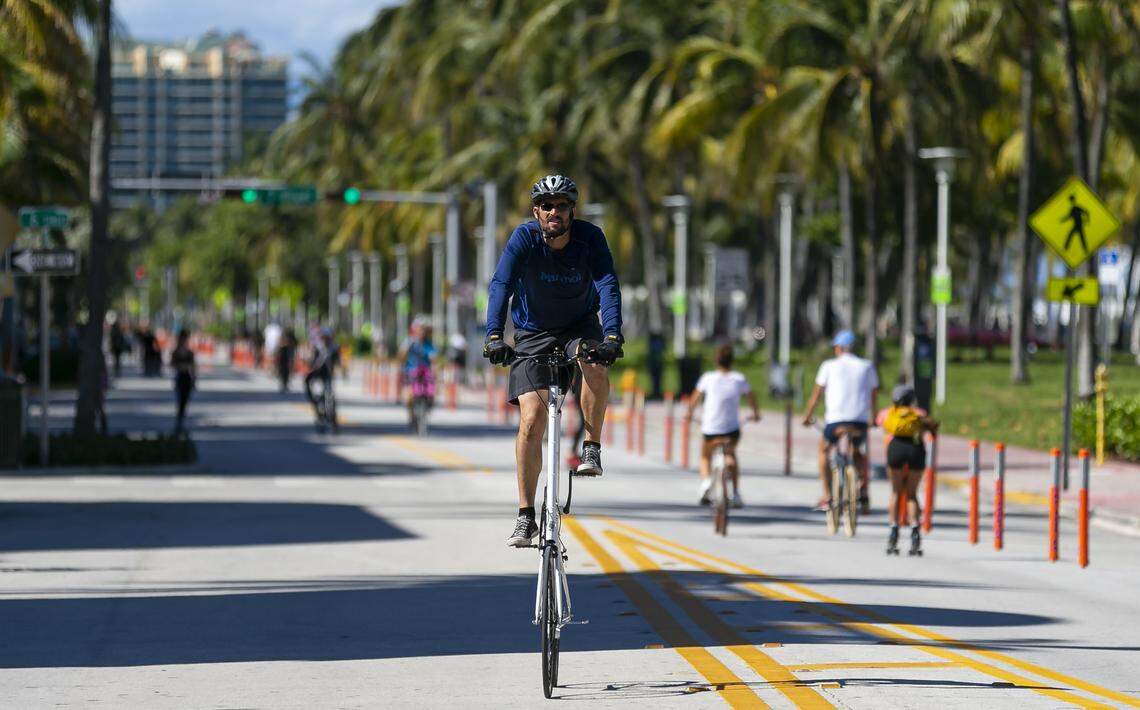
Just when bike infrastructure is in high demand, nothing is happening in a metropolis consistently ranked as one of the deadliest places in the country for cyclists, an audit by Transit Alliance Miami found. A 10-block stretch of Ocean Drive in South Beach is the only street in greater Miami that’s been completely closed to cars in response to the pandemic, mainly to relieve crowding in Lummus Park and enable socially distanced dining.
“We still don’t have a network of bike pathways — we have unsafe fragments that don’t connect our communities to anything,” said Azhar Chougle, executive director of Transit Alliance Miami, the nonprofit pro-mobility organization. “We have an abundance of plans here that have never been adopted, whether it’s a bike plan, a transportation plan, an affordable housing plan or a sea-rise resiliency plan, and those failures are a symbol of government ineptitude.”
He pointed to two plans in particular, one in Miami and one in Miami Beach. The audit didn’t examine Coral Gables’ bike plan, which has also stalled.
Little headway has been made on the 187-page Miami Beach Bicycle Pedestrian Master Plan, drafted in 2015 by the Miami Street Plans Collaborative urban planning firm. Only one-tenth of a mile of protected lanes has been built. Three miles of unprotected lanes are under construction. An additional 5.8 miles of lanes marked with sharrows recommended in the plan haven’t been completed. And since then, sharrows — painted arrows on pavement to warn drivers to share the road — have been found to be an unsafe and obsolete form of bike pathways.
In total, 16.6 miles of bike lanes that should be in place by now are not, and only 1.26 miles of a planned 40 miles of bike lanes on major corridors and causeways are finished, according to the audit. Key gaps in North Beach and Middle Beach remain.
The city of Miami’s 232-page Bicycle Master Plan, also written by the Miami Street Plans Collaborative, was adopted in 2009, but Miami still has only a muddle of unconnected segments and one lonely half-mile-long protected lane on Southeast First Street — set up as a pilot project — where most of the poles have been knocked down.
Planners acknowledged in 2009 that the bike network consisted of merely 17.12 miles, or 1.6 percent of the city’s total street network, on eight bikeways, and that even included the 0.14-mile hop on Pan American Drive from South Bayshore Drive to Miami City Hall.
“The major corridors within the city allow for a high volume of swift-moving traffic which results in isolation rather than connection of the city’s neighborhoods,” planners wrote. “Existing motor vehicle speeds do not provide for a safe environment for bicyclists along these important thoroughfares. Furthermore, existing conditions research revealed the lack of bicycle facilities, parking, and the unbalanced geographical distribution of what has been implemented.”
The goal was to add 276 miles of new or improved bikeways which would make up about 33% of the city’s total street network. Progress has been dismal and limited to sharrow-painting, according to the audit.
“Miami should be a cycling paradise, but we’ve failed cyclists and this whole constituency created by the pandemic,” said Chougle, who pointed out that Miami is one of the few U.S. cities that continues its coronavirus ban on bike and scooter rentals. “Bike lanes are so inexpensive and uncomplicated compared to building or expanding roads. Overnight, Paris, New York and other cities erected barrier protection to meet the people’s needs and desires.
“In Miami, are we going to abandon all the people who got out on their bikes and realized the benefits, all those who want to do short trips, all the service employees going to work? Are we going to tell them get back in their cars and suffer forever because it’s Miami?”
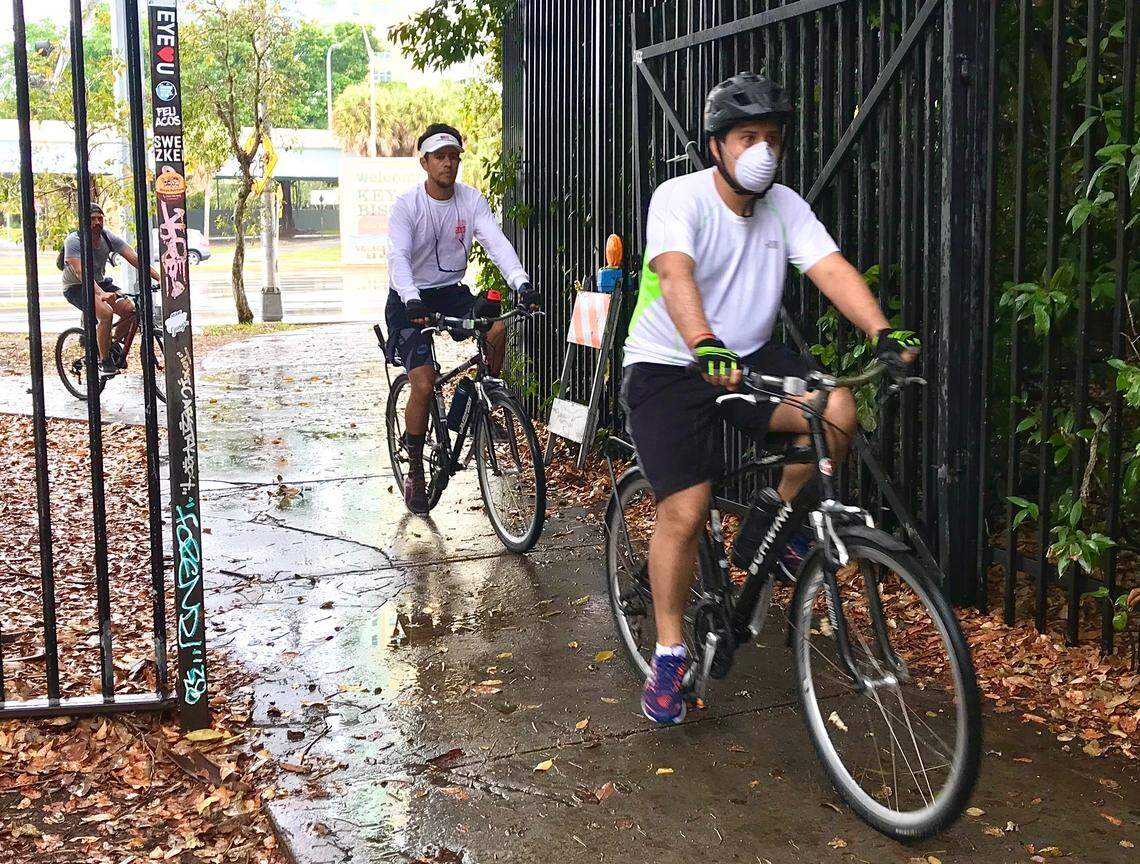
Bike sales in the U.S. doubled in April compared to last year, according to market research company NPD Group. In Italy, the government is supporting the cycling surge by giving out $575 “bici bonuses” toward the purchase of bikes. In response to social-distancing rules, many cities closed off streets and traffic lanes to cars to make more room for pedestrians, cyclists and restaurant patrons, and are using the opportunity to rethink how public space is allocated.
Miami Beach closed Ocean Drive from Fifth to 15th Street, but the city must do more and activate its master plan, Commissioner Ricky Arriola said.
“We do not take biking seriously enough,” said Arriola, who is a competitive triathlete. “Miami Beach is an ideal place to walk and bike. There’s no reason people should be using their cars to go a few blocks. I had great hopes we’d have made more progress by now but it’s been a combination of delays beyond our control and complete neglect of the plan.”
Arriola cited West Avenue as an example of a segment that should have been completed but has been delayed because sea-rise resiliency construction pre-empted bike lane construction. He’d like to make installation of protected lanes a priority over the next five years, as well as expansion of electric bike and electric scooter rentals.
“Why has New York City been so successful and we can’t get any traction?” Arriola said. “I think we have to pressure elected officials not to walk away from studies we’ve spent money on. Most elected officials don’t ride bikes. They view bike infrastructure as a luxury rather than a necessity.”
Arriola said his perspective is different because of the hours he spends riding Miami’s roads.
“It’s difficult to stay safe in Miami and that’s why we need protected lanes if we want people to keep cycling as traffic increases,” he said. “I’ve been hit, all my friends have been hit, I witnessed a horrific accident, and I was riding five minutes ahead of a woman who was killed on the Venetian Causeway.”
Collin Worth, transportation analyst and bike coordinator for Miami, agrees with Arriola that citizens should ask their local leaders for a change in priorities, from funding road projects to funding mobility projects.
“This is a really big moment to seize because people are out on their bikes, experiencing what’s missing in Miami,” said Worth, who’s been a tireless advocate for improvements. “New York has been transformed because they have a willingness to get things done. Here, we step on our own feet. Here, we do everything to assure new developments get 1,600 additional parking spaces. I’d be eager to see what a change in culture could lead to if we demand it.”
Worth said the city’s 11-year-old master plan is moving forward slowly and will be updated. Bike lanes in the Brickell area along Southwest First Avenue and South Miami Avenue should be done by the end of summer. Bike lanes being created in conjunction with the Downtown Development Authority’s Micro Modal Plan on Northeast First Avenue and North Miami Avenue should be completed in the fall. A bike lane plan along busy and narrow South Bayshore Drive is finally progressing, he said.
“A lot of our projects are reliant on other agencies, and we’re also finding ways to get developers to contribute more funding,” he said. “We lack connectivity. It’s a piecemeal approach. But it’s coming along.”
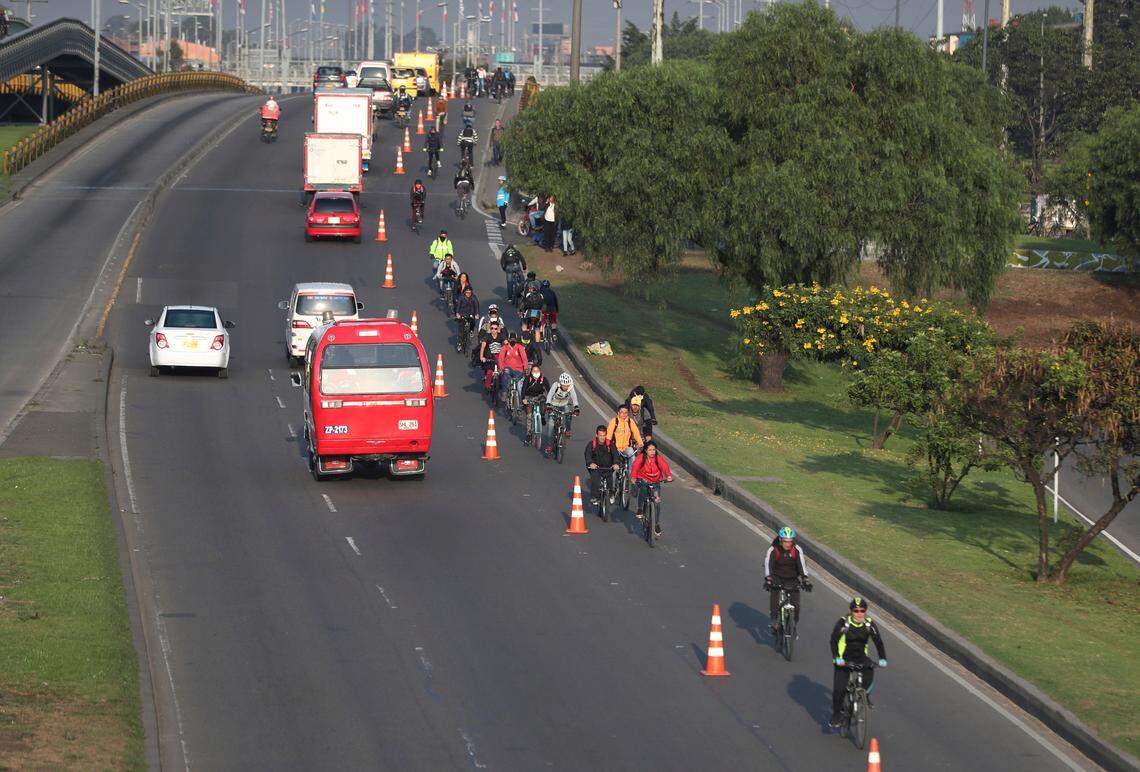
Miami-Dade County is working with the city and the Downtown Development Authority to create two miles of separated and protected lanes in the city’s core. Although limited in scale, the Downtown Mobility Network would include lanes along North Miami Avenue and South Miami Avenue, along Southeast First Avenue and Northeast First Avenue, along Northeast Fifth Street and Northwest Fifth Street and along Northeast Sixth Street and Northwest Sixth Street.
“We have to start somewhere to build a full network, and we want to use the current popularity of cycling to advance the repurposing of travel lanes,” said Carlos Cruz-Casas, assistant director of the county’s Department of Transportation and Public Works. He used to ride to work, and when he lived downtown he started a Bike to Brunch group on weekends.
“Let’s be more agile with bike infrastructure.” he said. “Let’s make it permanent and safe. Let’s apply what we’re learning during the pandemic.”
The purpose of the Transit Alliance audit was not only to show what Miami lacks, but how plans and promises stagnate, Chougle said.
“We are absurdly behind when it comes to cycling and mobility options. Imagine how different Miami would be if we had safe links to neighborhoods, employment centers, business districts, transit hubs,” Chougle said. “It’s not from lack of plans. We’ve procured and invested in plenty of plans. It’s from lack of accountability by our leaders. Execute the plans we needed yesterday.”
This story was originally published June 18, 2020 at 6:30 AM.