This recycling business leverages partnerships, pragmatics and philanthropy
READ MORE
Miami Herald Startup Pitch Competition 2020 winners
Judges for the annual Miami Herald Startup Pitch Competition chose winners in two tracks, one for the community at large, and the other for students, faculty and alumni of Florida International University. And the winners are...
Expand All
Two University of Miami freshmen roommates, Anwar Khan and Connor Pohl, wanted to enter a Holt Prize competition just three weeks away. The concept they quickly came up with — a business that rewards college students for recycling — came in third place. An assistant dean encouraged them to keep working on it.
They continued tweaking their startup idea and entered more business competitions around the nation, collecting feedback and improving their business model. In 2019, the students, now sophomores, won the University of Miami’s contest — and $10,000, which provided seed capital and valuable connections to begin bringing their startup idea, Cycle Technology, to life.
Today, the Miami Herald announced Cycle as the winner in the logistics category of its 2020 Pitch Competition.
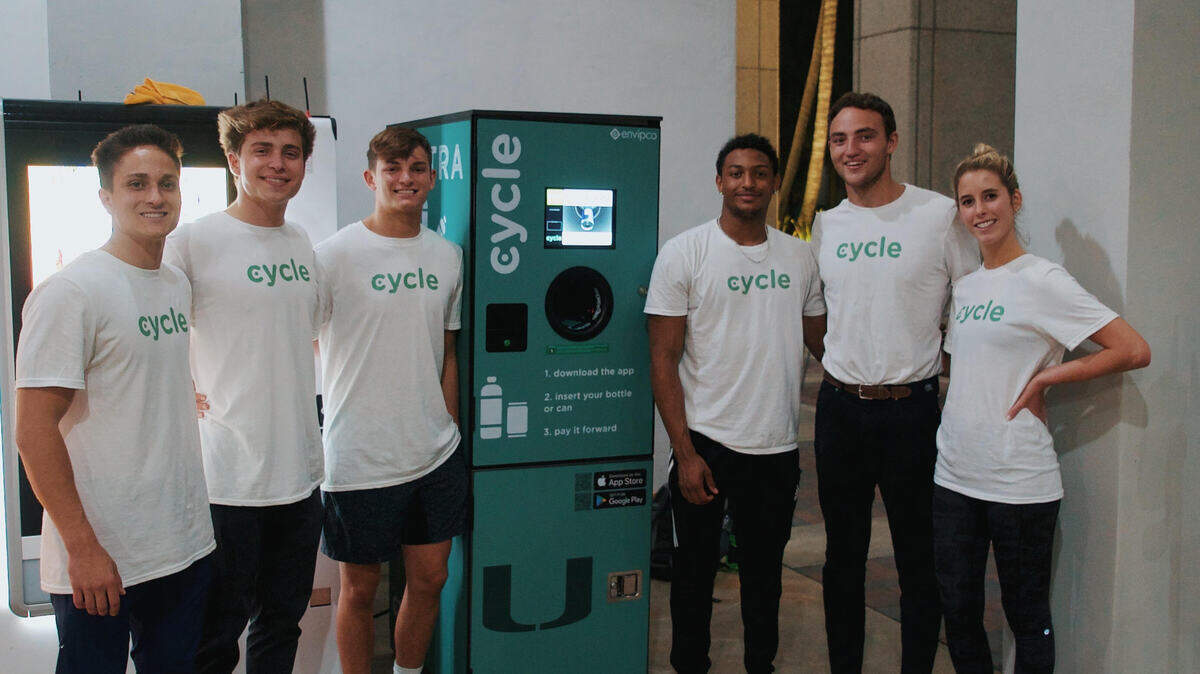
Cycle works like this: Students can recycle both plastic bottles and aluminum cans through reverse vending machines on campuses. Cycle, which is contracted by universities, takes care of the recycling; the money it makes from the recyclables will be split with the university — a win-win as Pohl and Khan see it.
For their part, student recyclers receive Cycle points that can be redeemed for charitable donations through the Cycle app. In the future, the points may be redeemed for other benefits.
“The whole reason we got behind this is because, largely in the US, the recycling system is broken — 90 percent of all plastics are never recycled,” Khan said. “Everything that goes into our machine is guaranteed to be recycled. That’s when we said, let’s put these on college campuses and incentivize college students to recycle.”
Khan, CEO of Cycle Technology, is studying environmental science, German and chemistry. Pohl, COO, is majoring in microbiology and immunology with a second major in economics and a minor in chemistry. Together with three other UM students, they co-founded the company in November 2019, and formulated a partnership with UM. They had planned to launch their first vending machine this spring near UM’s business school.
The Cycle team placed the machine just before the university’s spring break, with a few days to test it out, and expected to launch as students were coming back from spring break. COVID-19 had other plans. Cycle now hopes to launch in the fall, and if all goes well, add more machines around campus.
The team is using this quarantine time to work on its national expansion strategy. Cycle now is a team of about a dozen students; some of them go to other U.S. universities. The idea is to gain support at those schools and then propose it to the administrations. “It’s a student coalition of highly motivated environmentally friendly college kids across the U.S. to spread this mission, leveraging everyone’s college networks to continue to grow,” Pohl said.
Finding a hardware manufacturer that makes the reverse vending machines and a developer to create the software linking the machine and the app have been challenges. They now have both; Cycle’s hardware manufacturer is in Connecticut.
Cycle receives monthly subscription fees for the placement and maintenance of the vending machine and for the waste management services, such as transporting and selling the recyclables to a bulk recycling facility, Pohl said.
As a socially responsible company, Cycle will donate to charity half the money it collects from the recycled products. The other half goes back to the university, incentivizing the school to promote Cycle. In addition, students can donate the value of their earned Cycle points to charity. Currently the company is working with a sustainable development project for a school in India, as well as the Boys and Girls Club and the South Wales Fire Service battling brush fires in Australia. Cycle app users can also propose charities.
In version 2 of the app, Cycle is building out a marketplace where people will be able to redeem Cycle points for gift cards and discounts with partnering companies or Cycle-branded merchandise. In bottle-deposit states, Cycle may also let users earn cash for their recycling, Pohl said.
To finance the business, the students raised $130,000 from friends and family, and are now negotiating with a family office for a larger financing round. They are also partnering with other companies with green missions to create “a menu of sustainability services.”
Pohl and Khan also said they are trying to create a Cycle Entrepreneurial Ecosystem Fund for struggling college startups during this COVID period, which has slowed internships, competitions and funding. Working with capital partners to match investments, “we are attempting to create a fund and promote innovation at a time when we need it most,” Khan said.
This story was originally published May 18, 2020 at 6:00 AM with the headline "This recycling business leverages partnerships, pragmatics and philanthropy."
.JPG)