
Local filmmakers are telling Miami stories their way. Meet six of them
READ MORE
Miami grabs the movie spotlight
A new generation of gifted filmmakers — most of them born and raised in Miami — are telling stories about their city, their diverse cultures and their neighborhoods.
Expand All
.jpg)
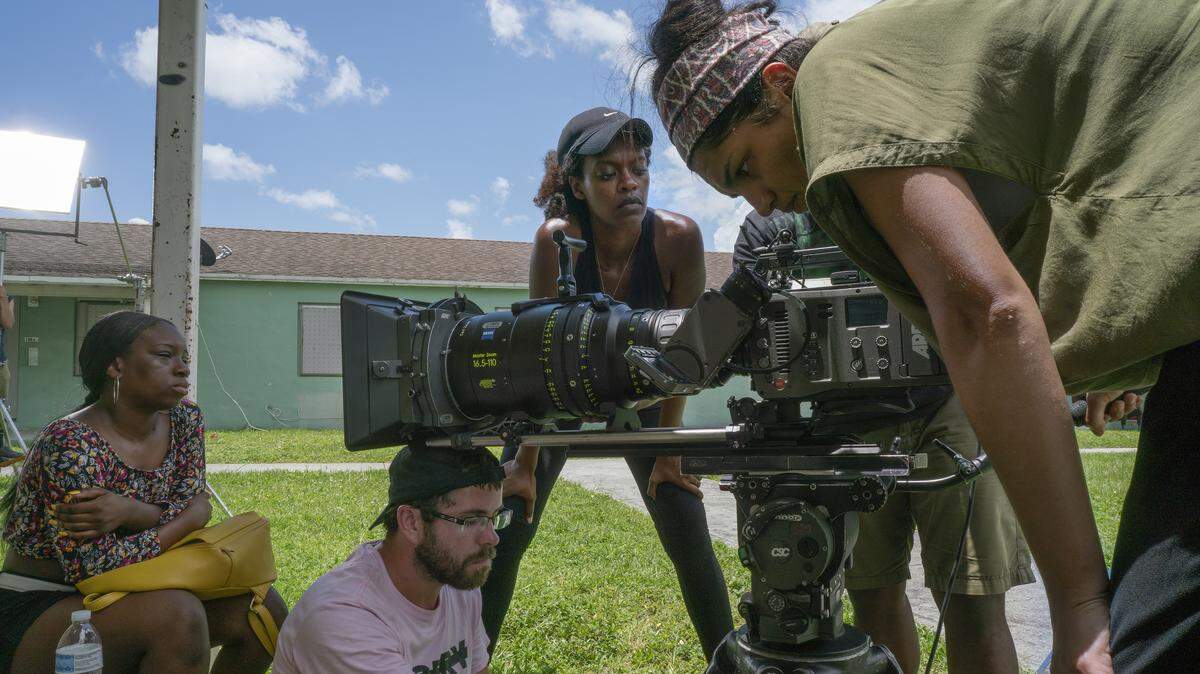
There are so many Miami filmmakers working on short and feature-length movies today that it’s impossible to keep track of them all. Here are six South Florida cinematic talents.
Name: Faren Humes
Credits: “Nasir” (2010), “Our Rhineland” (2011), “Macho” (2016), “Liberty” (2019)
Current project: “Don’t Stop, Get It, Get It”
Growing up in Miami, Faren Humes didn’t think about movies as anything more than a way to decompress after school.
But when Humes was studying journalism at the University of Florida — specifically TV broadcast news — she attended a party near the end of her junior year, where a fellow student popped in and asked, “You guys wanna see this film I made?”
“I watched his movie and remember feeling like a record breaking in my head,” said Humes, 35. “I asked him, ‘What class is this?’ ”
Once she got the film bug, Humes proceeded to enroll in Florida State University’s graduate film program, where she made “Our Rhineland,” the story of two sisters of mixed race living in 1937 Germany under the Third Reich. The movie won the Directors Guild of America’s Student Film Award in 2011.
2019’s short “Liberty,” a lyrical tale about two teenage girls living in historic Liberty City preparing for the neighborhood’s redevelopment, snagged multiple awards at international festivals, including Miami, Berlin, Chicago, SXSW, AFI, Champs-Élysées and Winterthur.
Her background in journalism became a tool in her filmmaking. Although her movies are told in an artful manner that doesn’t always spell everything out for the viewer, they are rooted in an earthy reality and filled with small, telling details that a journalist would notice.
Humes is currently shooting a feature-length expansion of “Liberty” that blends documentary interviews, vintage news footage, fictional narratives and other styles of filmmaking to tell the stories of the residents of Liberty City, their sense of what they think their future will be after the redevelopment is complete, and what they want that future to be.
“I’m editing, writing and filming at the same time,” Humes said. “I’m in post-production and in production. It’s like I’m quilting the movie and finding the film as I make it. And I am making it with my friends and family. That’s what frames and supports the uniqueness of Miami’s filmmaking lens. It’s more about family and less about the business and the industry.”
Name: Jonathan and Michael Cuartas
Credits: “The Pallor” (2013), “Twelve Traditions” (2015), “The Horse and the Stag” (2018), “My Heart Can’t Beat Unless You Tell It To” (2020)
Current project: Untitled horror film set in 1980s Miami
Brothers Jonathan and Michael Cuartas were born to Colombian parents in Miami and raised in Kendall, where they attended Miami Dade College’s School of Entertainment & Design Technology. While still in film school, they bought a Canon 7D camera and headed into the Everglades with a friend, whom they filmed running and hiding behind trees.
“We didn’t have a script, or a crew, or any gear besides the camera,” Jonathan, 29, said. “Our inclination was to do something in the horror genre, but nothing specific. We put this proof-of-concept together, and then wrote a script revolving around this spontaneous footage we captured, for what would become our first short film [’The Pallor’].”
Originally, the brothers planned to take turns directing, but Michael fell in love with cinematography and Jonathan with writing and directing. That’s the way they have worked together since, including their feature-film debut, “My Heart Can’t Beat Unless You Tell It To.”
The movie, which received national theatrical distribution in 2020, stars Patrick Fugit (“Almost Famous”) and Ingrid Sophie Schram (“Phantom Thread”) as two siblings tasked with finding blood for their younger brother, who happens to be a vampire.
The film was shot in Salt Lake City, Utah, because the producers (including Kenny Riches, a Miami filmmaker) were based there and the low-budget production could also take advantage of Utah’s tax incentives.
But their next feature will be shot in Miami, no matter what.
“We really want to focus on telling stories that are more specific to our Colombian heritage,” Michael, 30, said. “The story will take place in 1980s Miami and will follow a Colombian immigrant woman trying to make ends meet in a new country and going to extreme lengths to do so. Horror is the genre we gravitate toward as storytellers, and this will fall into the subgenre of possession and body horror. We hope to be making this movie in the next year or so. Fingers crossed!”
Name: Dudley Alexis
Credits: “Liberty in a Soup” (2015), “When Liberty Burns” (2020)
Current project: Untitled documentary about Haitian migration
Dudley Alexis was born in Delmas, a neighborhood within Port-au-Prince, Haiti, and emigrated to Miami as a teenager. He graduated from North Miami Beach Senior High and studied at the Miami International University of Art & Design.
From an early age, movies were part of his fabric.
“I can’t remember a moment in my life when movies were not involved,” he said. “Some of my earliest memories are watching ‘The Goonies,’ ‘E.T. the Extra-Terrestrial’ and ‘The Neverending Story.’ I used to watch Eddie Murphy comedies with my mother, because she loved his movies.”
As he grew older, Alexis realized that the film medium was capable of generating strong emotions from viewers.
“I can remember my anger the first time I saw ‘Mississippi Burning’ [a fictionalized retelling of the murder of three civil rights activists in 1960s Mississippi]. I felt so empowered when I saw ‘Passenger 57’ and saw someone who looked like me [Wesley Snipes] kicking butt. The first film that made me cry was ‘The Last of the Mohicans.’ It still has that effect on me today.”
Despite his love for feature films, Alexis has gravitated to the documentary arena. His first film, “Liberty in a Soup,” was spurred by a conversation with a taxi driver in Las Vegas about a traditional Haitian pumpkin soup that symbolizes freedom.
“First, we started talking about the Haitian Revolution,” Alexis said. “Once he found out I was from Haiti, we started to talk about the Haitian Revolution. Then he mentioned soup joumou. I did not expect anyone but Haitians to know about it. That got me curious, and I decided to explore the subject. Before you know it, I found myself filming a feature documentary.”
The film, shot in Miami and Haiti, uses the history of the dish to recount the tumultuous history of the country that spawned it and its continuing relevance in Haitian communities today.
Alexis’ second film, “When Liberty Burns,” is a powerful and eye-opening look back at the events leading up to the McDuffie riots in 1980 and their deadly aftermath. But the movie’s main focus was Arthur McDuffie’s life, his Overtown neighborhood (which bustled in the 1950s) and his legacy as a human being instead of a headline.
“Miami has storytellers with stories that are yet to be told,” Alexis said. “We’re not like the Northeast or the Northwest or the West Coast. You can’t even say we are part of the American South. We are a unique city filled with people from the Caribbean and Latin America who have unique perspectives. It’s been like that for a while. People are just starting to pay attention now.”
Name: Monica Sorelle
Credits: (as producer) “Liberty” (2019), “T” (2019), “HOW TO” (2021), “Oh look at me” (2021), “Lost Underground” (2021), “You Can Always Come Home” (2021); (as director) “Reginald O’Neal” (2020)
Current project: (as director) “Mountains” (2022)
Monica Sorelle was born and raised in North Miami but spent a lot of her childhood in the 1990s in Little Haiti, where her mother worked at the housing advocacy group Haitian American Community Development Corporation and later at the Center for Haitian Studies.
In 2009, Sorelle moved to Orlando to study film production at the University of Central Florida. When she returned in 2014, she was stunned by the gentrification that had started to spread throughout Little Haiti and Wynwood.
“I sensed that something was off and was going to change quickly,” Sorelle, 32, said. “I was figuring out a way to talk about this and combat it. My producing partner Robert Colon and I would walk through Wynwood in 2018 and saw houses being condemned and demolished. One day we saw a demolition worker crossing Northwest 36th Street into Wynwood Norte. That’s where we came up with the idea of a construction worker having to deal with demolishing his neighborhood and whether he’s demolishing a part of himself as well.”
That’s the central idea of “Mountains,” Sorelle’s latest project, which is currently in pre-production. Her previous work includes a beautiful portrait of Miami artist Reginald O’Neal, commissioned by the Institute of Contemporary Art Miami, that uses artful images of day-to-day life in Overtown to illustrate the inspirations for O’Neal’s paintings.
“Art and film are converging in a way they never did before,” she said. “Something happened that made filmmakers embrace how unique and weird this city is. When I was younger, I imagined I would have to move to New York City, because I didn’t see anything worthwhile here in terms of an arts world. But after returning home from college, I realized the value Miami had. It was the only place in the U.S. where I could really be a Caribbean person. We’re all interested in investing in the culture in Miami — to create the city we want to see.”
Name: Jose Navas
Credits: “Miami Our City” (2016), “El Balsero” (2019), “Beat Lingo” (2021), “With His Eyes Closed” (2021)
Current project: Crime drama set in Miami
Jose Navas, 37, was just a baby when his parents left his small hometown of Chinandenga, Nicaragua, and relocated to Miami’s Little Havana neighborhood. He attended Barbara Goleman Senior High, a magnet school with one of the biggest TV production programs in the state.
“I was the first director in that school to go live with our newscast program,” Navas said. “All of our stuff used to be pre-recorded. I came in and said, ‘This isn’t how it’s done in the real world.’ I pushed for that change and it is still such a special moment in my life.”
Navas went on to sharpen his filmmaking skills at the Miami University of Arts and Design for Film. He made his directorial debut with the feature-length documentary “Miami Our City,” a look at the impact the Latino community has had on Miami. The film was infused with music from local underground rap groups.
“I learned a lot about the technical aspects of filmmaking from that production,” Nava said. “There’s a constant learning curve when working as an indie filmmaker. Things will always go wrong on set, and your job is to be a play-maker on the spot. You have to be able to find solutions on the fly to make sure the production moves forward.”
In 2019, Navas directed “El Balsero,” a short film about the first Cuban to make the dangerous trek from the island to Miami via a makeshift raft. The movie won several prizes, including the Audience Award at the Miami Film Festival and Best Short Film at the New York Latino Festival.
Since then, Navas has directed two other shorts: “Beat Lingo,” about a home-schooled mute teenager attending high school for the first time, and “With His Eyes Closed,” about the coming-of-age of a young teenager living with an abusive father.
In July, the Tower Theater screened a retrospective of all of Navas’ shorts. His films have also played at regional festivals around the country.
“After ‘El Balsero’ found success on the film festival circuit, I was asked about moving to California to further my career,” Navas said. “Florida doesn’t offer tax incentives to big production companies, which makes it difficult for local filmmakers to make a living.
“But there’s a major upside to this problem: The quality of work coming out of Miami is currently some of the best in the world,” Navas added. “When you deprive people of certain resources they tend to work harder and become more innovative. Miami isn’t Hollywood and we don’t have parents in the film industry. Still, what you are seeing now is a brewing hub of some of the most gifted and talented storytellers anywhere.”
_pp%20Cropped.jpg)