
Raúl Castro’s son reappears at Havana rally. What does his comeback mean?
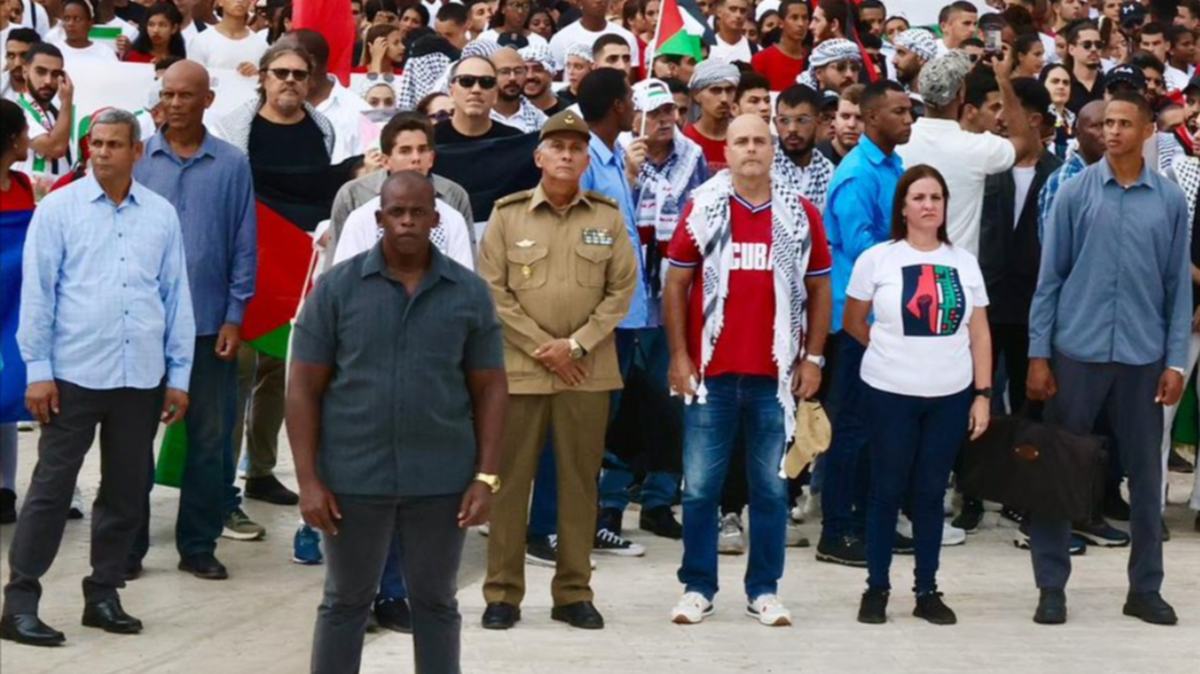
Wearing a traditional Palestinian scarf, Cuban leader Miguel Díaz-Canel once again led a rally in front of the U.S. embassy in Havana on Monday to signal both his government’s criticism of the war in Gaza and its anti-American alignment.
But in the second row, wearing sunglasses, a black T-shirt and holding a Palestinian flag, the once powerful son of Raúl Castro reappeared for the first time in public after several years’ absence to signal something else: that he is back.
After years of speculation about his whereabouts, Col. Alejandro Castro Espín marched Monday in Havana amid rumors about his father’s health and a spiraling economic crisis that has put Díaz-Canel in a difficult position. Cuban official media did not mention him in their reports of the rally, but he is seen standing next to his brother-in-law, Paolo Titolo, who is married to Mariela Castro, in a photo shared by the account of the Cuban office of the president on X.
Rumors of Raul Castro’s death circulated on social media last month but were shut down by photos of Castro attending two different events: a meeting with the president of Vietnam and the funeral of a prominent Cuban general, Ramón Espinosa. But he is 93, and questions about another power transition in the communist island remain, becoming the backdrop of Castro Espín’s surprising public return.
None of the few nonagenarian leaders who still have a say in the country’s decisions, including his father, participated in the rally in front of the embassy and the march along the Cuban seaside walk known as the Malecón.
“As his father’s national security adviser, Alejandro Castro played a central role in the negotiations that led to the 2014 beginning of normalizing U.S.-Cuban relations, but when Donald Trump rolled back President Obama’s Cuba policy and Raúl Castro stepped down from the presidency, Alejandro disappeared from public view,” said William Leogrande, a professor at American University who co-wrote a book about the secret negotiations between the two countries.
“His reappearance may signal a return to public life, but in what capacity, vamos a ver,” — let’s see — he said.
The negotiator
Castro Espín amassed significant power during Raúl Castro’s time as president and first secretary of the Communist Party. He was put in charge of the secret negotiations that led to a prisoner exchange with the U.S. in late 2014 and the restoration of diplomatic relations with Washington in 2015.
As head of the Commission for Defense and National Security, a position created as a cover for his secret meetings with Obama’s aides, he also controlled Cuba’s security and intelligence apparatus.
But at some point, after Trump came to office and the so-called “Havana Syndrome” affair became public in late 2017, he disappeared from public sight, and rumors began to swirl.
Havana Syndrome, which the U.S. government now refers to as “anomalous health incidents,” affected more than 300 American diplomats, spies and their family members abroad and was first reported in Havana in late 2016. Investigations about the incidents continue and suspicions that Russian operatives might have been involved still linger despite a controversial assessment last year by U.S. intelligence agencies ruling out an attack by foreign adversaries.
At the time, the Trump administration and some U.S. senators like Florida Republican Marco Rubio believed that Cuba had some involvement, either because Cuban intelligence services took part or because they knew about what happened but failed to stop it.
Intelligence experts speculated that Castro Espin’s disappearance from the public eye might have been related to those events. As someone overseeing the intelligence services, he should have known about the incidents or should have been able to stop them, experts said.
The Havana Syndrome incidents put a frost again on the relationship with the U.S, dismantling most of what Castro intended to achieve.
A hardliner turning soft?
Another theory about why Castro Espín seems to have lost his prominent position involves events that may have led some hardliners in the Cuban government to perceive him as getting too cozy with the U.S.
Castro’s son, who has degrees in engineering and international relations, was also known as the writer of a ferociously anti-American book with the title “Empire of Terror.”
But he had several Skype calls and meetings abroad with Obama negotiators and discussed intelligence cooperation over roast pork with John Brennan, at the time the head of the CIA, the U.S. agency most demonized in Cuban state media. Brennan traveled secretly to Havana in 2015, according to a 2018 New Yorker story. Castro Espín told Trump officials shortly after his inauguration that Cuba was interested in continuing normalization. And he was likely the “Castro’s son” who met with Trump’s former campaign manager ,Paul Manafort, in January 2017 in Havana, according to a U.S. Senate report.
“His conspicuous appearance at the front of this crowd perhaps is an early indication that he is in the process of being rehabilitated politically,” said Brian Latell, a former U.S. National Intelligence officer for Latin America and author of several books about Cuba. “The next question would be, what are his policy views now? Does he advocate for more opening of the economy and foreign investment, or is he now reverting to being the hardliner he appeared to be before the negotiations?”
A power transition
Castro Espín’s alleged loss of influence also coincided with a transition in power that saw his father select Díaz-Canel as his successor for president in 2018 while he remained at the top of the Communist Party until 2021. By January 2018, it was clear that Castro Espín had been stepped over for the presidency, because he was not included in the list of candidates for the National Assembly, a requirement to holding the highest office.
Whatever happened to him these past years is still shrouded in secrecy. After the Obama era, the Commission for Defense and National Security was no longer mentioned in state media.
An Interior Ministry colonel who was the only other publicly known member of the Commission, Abel Enrique González Santamaría, reinvented himself as an academic and is reportedly working in the office of the Historian of Havana.
After the sudden death in 2022 of Cuba’s most powerful general, Luis Alberto Rodríguez López-Calleja, who controlled most of the island’s economy and was once married to Alejandro’s sister, Deborah, the Communist Party newspaper Granma publicly debunked a fake story about Castro Espín taking over the position the general left as president of the powerful military conglomerate known as GAESA.
But maybe Castro-Espín has just been laying low, working in the shadows inside the Interior Ministry, said Enrique García, a former Cuban intelligence official who defected to the United States. He pointed out that there have been rumors that Castro-Espín was even made a general.
García doesn’t believe Raúl Castro, known as a family man, would have allowed any retaliation against his son. Instead, he thinks it was convenient for the Cuban government to let rumors that Castro Espín had been disciplined after Havana Syndrome spread.
“That way, the Cuban government can say Raúl didn´t know, it was his son,” García said. “Alejandro was probably given a low profile but with Raúl still alive, I don´t think he has fallen out of favor.”
This story was originally published October 16, 2024 at 6:48 AM.