
Latin American Studies congress will host Cuban colonel who supported crackdown on protests
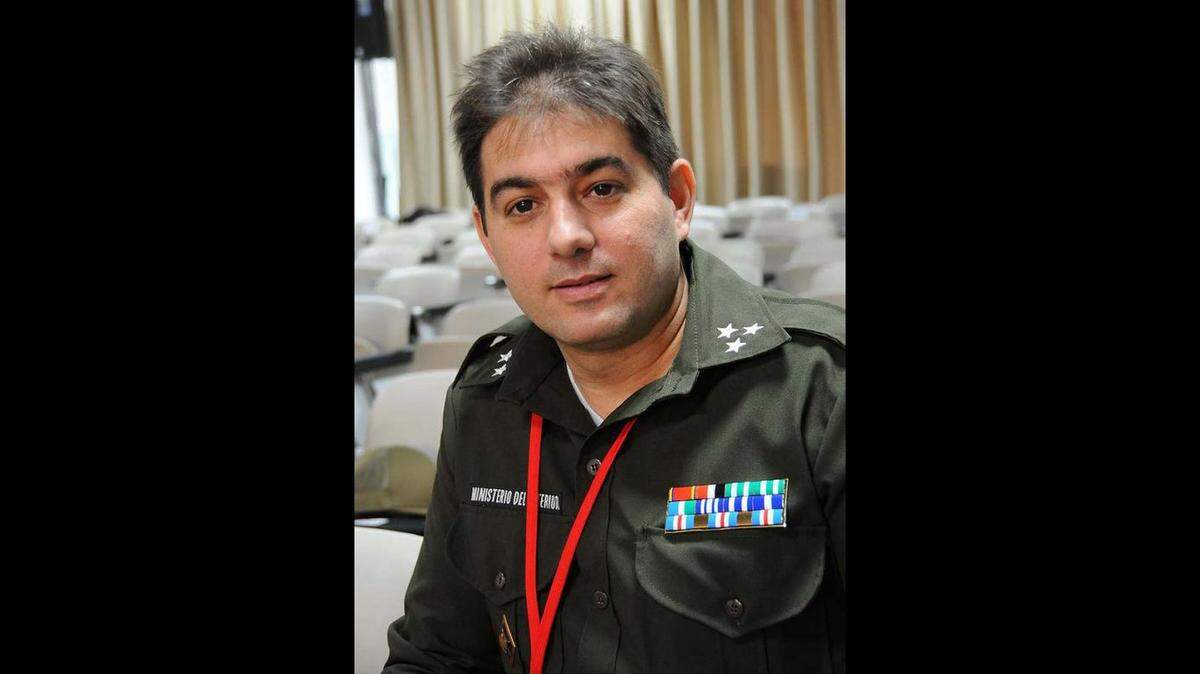
A Cuban intelligence colonel who participated in top-level talks between U.S. and Cuban officials during the Obama administration will be speaking as an academic in the upcoming congress of the Latin American Studies Association this week, along with several representatives of the Cuba Communist Party’s political training school and other government officials.
According to the program for the virtual event, Col. Abel Enrique González Santamaría, who holds a Ph.D. in political science, is scheduled to speak Saturday at a panel addressing the anti-government protests on the island in July. His military rank is not identified in the document, which states the Office of the Havana Historian as his institutional affiliation. The association is the largest professional group in the world for academics who study Latin America.
Santamaría participated in the negotiations to restore diplomatic relations between the U.S. and Cuba during the Obama administration and led high-level discussions about sensitive matters such as the American fugitives of justice hiding in Cuba both as an official of the Ministry of the Interior and member of the now dismantled Defense and National Security Commission. The commission was led by Raúl Castro’s son, Colonel Alejandro Castro Espín.
After the commission was reportedly dismantled after news of “health incidents” affecting American diplomats in Havana, state media stopped mentioning Santamaría’s intelligence rank and has promoted him as an author and scholar.
Santamaría is the author of books criticizing the U.S. and exalting Cuban leaders Fidel and Raúl Castro. He recently compiled a book justifying the government’s crackdown on the July 11 protesters, arguing that the uprising resulted from a social media “operation financed by the government of Florida.”
On July 11, after Cuban leader Miguel Díaz-Canel urged government loyalists to confront the protesters “by any means necessary,” Santamaría posted an image of Díaz-Canel and wrote that “the Revolution has the right to defend itself.”
Jose Raúl Gallego, a Ph.D. candidate at the University of Guadalajara in Mexico, first called public attention on social media to Santamaría’s participation in the Latin America association panel, which he said was a sign of “lack of respect to Cubans.” He also noted that Cuba’s Interior Ministry oversees the police, state security and intelligence services that have led the crackdown against the demonstrators. The U.S. Treasury Department sanctioned the ministry and some of its top leaders in January 2021, citing its role in human rights violations.
“A year ago, I voluntarily left LASA because of its pusillanimous position towards the violations of rights in Cuba, a decision that I maintain, and every day, that institution gives me more reasons to confirm that I did the right thing,” Gallego said on Twitter.
LASA, with headquarters in Pittsburgh, is the largest professional organization dedicated to studying the region in the humanities and social sciences. Several of its annual congresses have taken place in the U.S. Committee members from the association’s various sections vet and approve the proposals included in the final congress program.
Iraida H. López, a professor at Ramapo College in New Jersey, who is one of the current co-chairs of the Cuba section, said that “submitting a CV or even a short bio is not a requirement to join a professional association or to participate in a congress. You do have to provide an affiliation, and in the case of Santamaría, this is listed as the Office of the Havana Historian. I believe this is his current workplace, and, as I learned yesterday, he has a number of publications to his credit.”
López said she was not aware of Santamaría’s intelligence rank and suggested the organization would not take further action regarding his inclusion in the LASA Congress.
“As far as I know, the panel has remained intact,” she added.
There is no reference to Santamaría on the Office of the Havana Historian’s website. Still, another website linked to the Cuban Foreign Affairs Ministry lists him as a researcher and the director of Science and Education at Office of the Havana Historian. Some of his most recent Facebook posts suggest he is linked to the office but his profile on the same social media platform states he works at the Cuban Union of Writers and Artists.
The late historian Eusebio Leal headed the Office of the Havana Historian until he died in 2020. He oversaw the restoration of Old Havana thanks to an unconventional deal with the late Fidel Castro that allowed Leal’s office to keep part of the revenues from Old Havana stores, restaurants and hotels. But the office lost its independence when the military conglomerate known as GAESA took over Old Havana’s businesses in late 2016.
The Herald could not readily obtain Santamaría’s contact details. When the Herald requested his personal contact information, López provided a general email for the Office of the Havana Historian’s website. Several websites promoting his work as an author do not include his email or phone number. He did not immediately reply to a message via Facebook.
Over the years, LASA’s Cuba section has fostered ties between Cuban and American academics. But the organization has been criticized for the influence of the island’s authorities on the association’s Cuba section, which is regularly co-chaired by a Cuban scholar with ties to a government institution. According to the section’s rules, half of its executive committee must reside in Cuba. Many academics have resented the section’s leadership living on the island, who have often worked as gatekeepers on the topics and the scholars allowed to participate under the section’s sponsorship.
López defended the work of the section under her tenure.
“I realize there is a lot of mistrust about LASA and the Cuba section, but I can assure you that in the past few years, the period when I have been directly involved, the section has conducted its work as transparently as possible and we certainly have some accomplishments to show for it,” she said.
Many of the best known scholars on Cuba topics worldwide are not participating in this congress. Several left the association after LASA released a statement last year about human rights in Cuba with no condemnation of the authorities’ harassment of academics and intellectuals critical of the government, but “deploring” the U.S. embargo.
In the past, the participation of academics and scientists based on the island in LASA’s annual congress was limited by the logistics of securing a visa and funding to travel to the United States, and Cuba has complained about the U.S. denying visas to members of its delegation participating in the event.
But as LASA’s executive committee decided to make the event virtual this year, several Cuban scholars from universities and research centers are set to participate, along with many others whose institutional affiliation details indicate they are staffers at Cuban ministries and even the Communist Party’s political school, named “Ñico López,” largely regarded as an indoctrination center.
“For the Cuban revolutionaries, Fidel is and will continue to be the Commander in Chief of all Time,” is the opening line in a paper authored by Camilo Rodríguez Noriega, a professor at the Ñico López School who is scheduled to speak Friday in a panel about how Cuba provides a model for “a more just and inclusive society.” The other presenters are also professors at Ñico López. The panel’s lead commentator, a role that aims to spur debate, is Rafael Emilio Cervantes Martínez, an official from the Ministry of Higher Education overseeing the teachings of Marxism in Cuban universities and a former teacher at a military school.
Lopez said the Cuba section did not sponsor or approve that panel. Gerardo Otero, LASA’s president and a professor at Simon Fraser University in Canada, did not reply to emails and a voicemail seeking comment. Juan Publio Triana Cordoví, the other Cuba section co-chair and professor at the University of Havana’s Center for the Study of the Cuban Economy, did not reply to an email seeking information about the panels.
The panel listing Santamaría was sponsored by the Cuba section, but it is not entirely clear how he was added as a presenter.
López said the topics for the section’s panels are decided “by consensus” and that section members meet to brainstorm on the possible issues to tackle.
“It wasn’t difficult to identify the [July 11 protests] among other subjects, as a topic of interest to the section’s members,” she said. “The panels are not arbitrarily proposed or imposed, and we strive to have a diversity of views represented in them.”
Ricardo Torres, a Cuban economist currently on a fellowship at American University in Washington, D.C., is listed as its organizer. Carlos Alzugaray, a former Cuban diplomat who usually defends the government’s positions in foreign media, is the session’s chair.
But Torres told the Herald his role was merely “procedural because the workshops are proposed and approved by the directors of the Cuba section.”
“When the workshops of the Cuba section were prepared, several of us (inside and outside of Cuba) thought it was important to talk about the events of July 11,” Torres said. “And in that panel, there are different points of view about the events. I do not know Abel; I only know of his affiliation with the Office of the Historian and that he compiled a book containing several articles on July 11. Maybe that’s why he ended up being part of the panel.”
Danielle Pilar Clealand, an associate professor at the University of Texas at Austin, and the author of the book “The Power of Race in Cuba,” is listed as a presenter in the same panel. But she said she was added to the panel late in the process and was not aware of Santamaria’s work with the interior ministry. Clealand said she was invited to participate by Milagros Martinez, a professor and administrator at the University of Havana who has co-chaired the Cuba section in the past.
Clealand has stressed in media interviews the central role of Afro-Cubans and racial inequities in the protests last year. She said she was still undecided about how to move forward with the panel.
“This is a difficult position to be in,” Clealand said. “I think my voice and participation are important here because of my alternative perspective on the protests.”
This story was originally published May 3, 2022 at 4:31 PM.