NABCEP certification sounds like one credential until you see all the different options.
Some are designed for beginners, while others require training and real solar work experience.
That means two people can both have a NABCEP credential while holding qualifications that represent completely different skills and experience levels.
In this guide, I’ll explain what NABCEP certification actually means, how the credential levels differ, and how the process works.
Key Takeaways
- Credential Levels: NABCEP offers both beginner and advanced credentials.
- Exam Requirements: Most credentials require an exam.
- Eligibility: Board Certifications usually require training and experience.
- Job-Specific Focus: Each exam focuses on a specific renewable energy job.
- State Licensing: NABCEP certification does not replace a state license.
The Basics: What Is NABCEP Certification?
NABCEP is short for the North American Board of Certified Energy Practitioners. If you are still deciding on the job itself, start with how to become a solar installer.
It offers professional certifications for people working in solar installation, PV system design, system inspection, technical sales, maintenance, commissioning, energy storage, and solar heating.
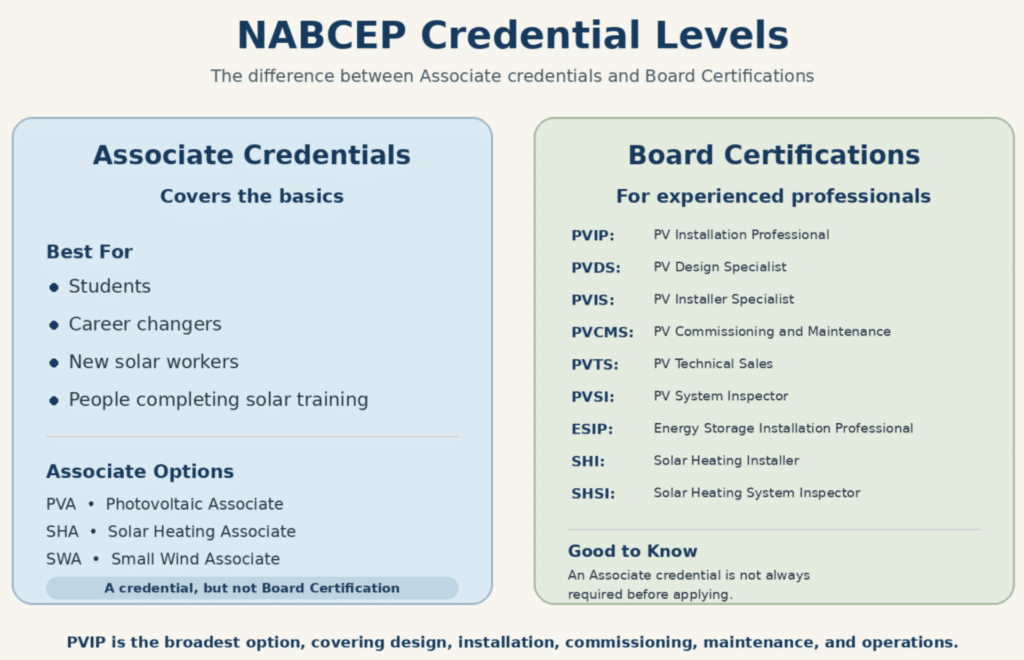
Here’s where it gets confusing: NABCEP offers two credential levels.
Associate Credentials
Associate credentials cover the basics.
They are generally for:
- Students
- Career changers
- New solar workers
- People completing solar training
You can earn credentials in areas such as photovoltaics, solar heating, small wind, and operations and maintenance.
Passing an Associate exam gives you a NABCEP credential. It does not make you NABCEP Board Certified.
Board Certifications
Board Certifications are generally for experienced professionals.
The options include:
- PVIP: PV Installation Professional
- PVDS: PV Design Specialist
- PVIS: PV Installer Specialist
- PVCMS: PV Commissioning and Maintenance Specialist
- PVTS: PV Technical Sales
- PVSI: PV System Inspector
- ESIP: Energy Storage Installation Professional
- SHI: Solar Heating Installer
- SHSI: Solar Heating System Inspector
The PVIP is one of the broadest options. It covers system design, installation, commissioning, maintenance, and operations.
You do not always need an Associate credential before applying for Board Certification.
Exams, Registration, Fees, and Eligibility
Yes, most NABCEP credentials require an exam. But you cannot always register and take one immediately.
Associate Credentials
You can usually qualify through one of these paths:
- Education Pathway: Complete an approved training course.
- Experience Pathway: Document at least six months of related full-time work.
- Conversion Pathway: Convert an older NABCEP Entry Level Achievement Award if eligible.
The education and experience pathways both require you to pass the exam.
Board Certification Requirements
Most Board Certifications require you to:
- Be at least 18.
- Complete the required training.
- Document qualifying work or projects.
- Submit an application.
- Agree to the NABCEP Code of Ethics.
- Pay the fees.
- Pass the exam.
The exact requirements depend on the certification. System Inspector certifications do not have the same training and experience prerequisites as most other Board Certifications.
NABCEP also has a Board Eligible PVIP pathway. It allows some candidates to take the PVIP exam after completing the training requirements but before finishing all required work experience.
If they pass, they have three years to complete the experience requirements and become fully Board Certified.
What Is on a NABCEP Certification Exam?
There is no single NABCEP exam. Each credential follows its own Job Task Analysis (JTA), which tells you exactly what skills and topics may appear.
Questions can test more than memorization. You may need to interpret plans, apply electrical codes, complete basic calculations, or choose the safest way to handle a real job-site situation.
| Exam Type | Questions | Scored | Pilot | Time | Application Fee | Exam Fee |
|---|---|---|---|---|---|---|
| Associate Credential | 70 | 60 | 10 | 2 hours | $25 | $125 |
| Most Board Certifications | 70 | 60 | 10 | 4 hours | $125 | $375 |
| System Inspector Certification | 45 | 40 | 5 | 2 hours | $0 | $150 |
Pilot questions are unscored, but you will not know which questions they are during the exam.
What Do the Exams Test?
- Associate Exams: Renewable energy basics, terminology, system components, and safety
- Design Certifications: Plans, system design, electrical and mechanical codes, and calculations
- Installation Certifications: Equipment, wiring, safety procedures, and job-site installation
- Commissioning and Maintenance: Performance testing, system checks, maintenance, and troubleshooting
- Inspector Certifications: Plans, code compliance, safety, and system operation
- PVIP Certification: The full PV process, including design, installation, commissioning, maintenance, and troubleshooting
Retakes, renewals, and international testing may cost extra. NABCEP can also change its fees. Once your application is approved, you will receive instructions for scheduling the exam.
View the current NABCEP fee schedule.
Is NABCEP Certification Difficult?
Honestly, a Board Certification exam is not meant to be easy.
It tests whether you can apply your knowledge to real solar work. You may need to read plans, use electrical codes, complete calculations, and choose the safest solution.
The difficulty depends on:
- Your Experience: Real field experience makes the questions easier to understand.
- Your Training: A short beginner course may not be enough for an advanced exam.
- Your Code Knowledge: Several exams require you to work with electrical or building codes.
- Your Math Skills: You may need basic algebra, percentages, measurements, and electrical calculations.
- Your Exam Choice: A broad exam like PVIP may require more preparation than a narrow specialty exam.
NABCEP does not regularly publish a current pass-rate list for every certification.
Its exams are also not graded on a curve. Experts set the passing standard based on what a qualified professional should know.
Should You Get NABCEP Certification?
It depends on where you are in your career.
It May Be Worth It If:
- You Work in Solar: The credential can confirm skills you already use.
- Employers Request It: Some jobs prefer or require a specific NABCEP credential.
- You Want to Specialize: Certifications are available for design, installation, sales, inspection, and maintenance.
- You Need More Credibility: Board Certification can help customers and employers trust your knowledge.
- You Want to Advance: It may help you move into more technical or responsible positions.
If you are new to solar, an Associate credential may be the better starting point. If you already work in the field, a Board Certification related to your actual job may carry more value.
Final Thoughts
NABCEP certification is not one test or one career path. It is a group of credentials built for different levels of solar knowledge and experience.
If you are new to the field, an Associate credential can show that you understand the basics. If you already have hands-on experience, Board Certification can verify more advanced skills.
The important part is choosing a credential that matches the work you actually do, then checking its exact requirements before applying.
If you want training next, compare our best solar PV courses.
FAQs
What Does NABCEP Stand For?
The name NABCEP stands for North American Board of Certified Energy Practitioners.
Is NABCEP Certification Required?
NABCEP certification is generally voluntary. However, an employer, customer, contract, or incentive program may prefer or require it.
Is NABCEP Certification a License?
No. It does not replace any electrician, contractor, or solar license required by your state or local government.
Do You Have to Take an Exam?
Yes, most NABCEP credentials require an exam. A limited conversion option exists for some older entry-level award holders.
Can a Beginner Get NABCEP Certified?
A beginner may qualify for an Associate credential after completing approved training. Board Certification normally requires advanced education and related work experience.

![Bluehost Promo Codes and Discounts [Verified Coupons]](https://www.miamiherald.com/careers-education/wp-content/uploads/sites/2/2026/10/bluehost-promo-code-mh-1024x768.jpg)
![Incogni Promo Codes [Verified Discounts]](https://www.miamiherald.com/careers-education/wp-content/uploads/sites/2/2026/10/incogni-promo-code-mh-1024x768.jpg)
![Shopify Promo Codes [Verified Discounts]](https://www.miamiherald.com/careers-education/wp-content/uploads/sites/2/2026/10/shopify-promo-code-mh-1024x768.jpg)