Solar installer jobs are projected to grow 42% from 2024 to 2034, according to the BLS.
That makes solar installation one of the fastest-growing careers in the country.
But how do you actually become an installer? You need to understand the equipment, learn the safety rules, and get real practice.
I’ll explain the different ways to train, when licensing matters, and how to find your first solar job. Let’s dive in.
Key Takeaways
- Education: A college degree is usually optional, and most entry-level solar installer jobs require only a high school diploma or GED.
- Training: You can learn through a solar course, trade school, apprenticeship, or on-the-job training.
- Licensing: Electrical or contracting work may require a state or local license, depending on your duties and location.
- Certification: NABCEP credentials are separate from licensing and can help demonstrate your solar knowledge and experience.
- Career Growth: Hands-on experience can lead to higher-level roles in electrical work, crew leadership, maintenance, design, or project management.
What Solar Installers Do and the Skills They Need
Solar installers build systems that turn sunlight into electricity.
A normal job may include:
- Measuring the roof
- Marking panel locations
- Installing mounts and racking
- Securing solar panels
- Sealing roof openings
- Routing wires
- Testing equipment
You will use ladders, power tools, safety equipment, and basic math. You may also work outside in heat, cold, wind, or light rain.
Before choosing this career: Make sure you are okay with heights, physical work, and changing weather.
Most entry-level jobs require a high school diploma or GED. Experience in roofing, electrical work, HVAC, or construction can help, but it is not always required.
Choose an Education, Training, or Apprenticeship Path
There is no single required training path. You have three main ways to begin:
- Take a short solar course: Learn basic electricity, system parts, installation methods, safety, and codes. Look for hands-on practice instead of a program that only gives you videos.
- Attend trade school: Choose an electrical or renewable-energy program if you want deeper training. This path can also help if you plan to become a licensed electrician.
- Join an apprenticeship: Get paid while completing supervised training and classroom lessons.
Some companies also hire complete beginners and provide on-the-job training. BLS says this training can last up to one year.
💡 Course tip: Check whether a program includes real lab work and supports NABCEP requirements. You can compare the best solar courses before enrolling.
Understand State Licensing, NABCEP Certification, and Safety Credentials
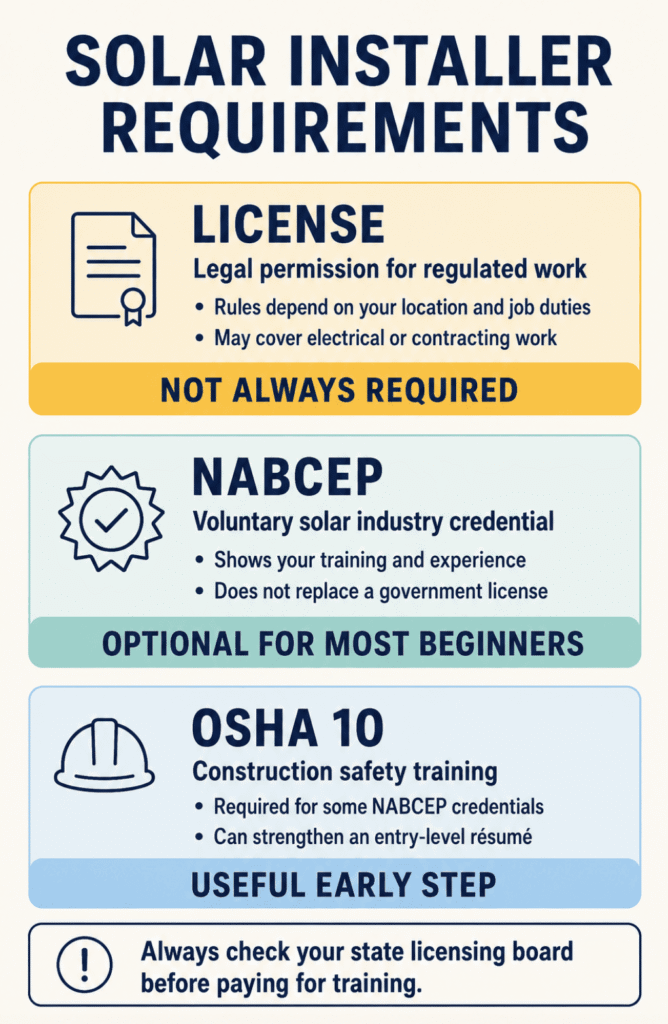
These requirements are easy to mix up. Here is what each one actually means:
| Requirement | What It Does | Is It Always Required? |
|---|---|---|
| State or local license | Gives legal permission to perform certain electrical or contracting work | No, requirements depend on your location and duties |
| NABCEP credential | Proves solar knowledge and experience | No, it is usually voluntary |
| OSHA training | Teaches construction and job-site safety | Not for every job, but some employers and NABCEP credentials require it |
Licensing Depends on the Work
A beginner working under supervision may not need an individual license. However, electrical connections or independent contracting may require a licensed electrician, solar contractor, or general contractor.
Check with your state licensing board before paying for training. A school certificate does not give you legal permission to perform regulated electrical work.
NABCEP Has Different Levels
NABCEP offers several solar credentials:
- PV Associate: Basic solar knowledge
- PV Installer Specialist: Hands-on installation skills
- PV Installation Professional: Advanced installation, design, maintenance, and code knowledge
PV Installation Professional applicants currently need OSHA 10, 58 hours of approved training, and six project credits completed in a decision-making role. You do not need that advanced credential for your first helper job.
Gain Hands-On Experience and Land Your First Solar Installer Job
Search for jobs that are clearly open to beginners:
- Solar installer helper
- Entry-level solar installer
- Electrical helper
- Roofing technician
- Construction laborer
Your first job may involve carrying panels, organizing tools, preparing the roof, installing attachments, building racking, and mounting panels.
Highlight any experience with tools, ladders, measurements, wiring, roofing, blueprints, or outdoor labor on your résumé.
Keep a project log: Record the project date, system size, work you completed, and supervisor’s contact information. You may need those records for future NABCEP or licensing applications.
Solar Installer Salary and Career Advancement Opportunities
The latest BLS wage data shows a national median of $53,140 in 2025.
Your pay may change based on:
- Location
- Experience
- Overtime
- Electrical skills
- Project type
- Union membership
Solar installation can also lead somewhere else. You may move into crew leadership, electrical work, maintenance, design, inspections, estimating, or project management. Learning electrical theory and troubleshooting will give you more options than only knowing how to mount panels.
Final Thoughts
You do not need every solar credential before you can start working. In fact, real job-site experience may help you decide which credentials are actually worth your time.
Focus on finding solid beginner training and a company that takes safety seriously. Then pay attention to the parts of the job you enjoy most.
You may love installation, or you might eventually prefer electrical work, design, maintenance, or leading a crew. Getting onto your first project is what helps the bigger career plan finally make sense.
FAQs
How long does it take to become a solar installer?
You may qualify for a beginner job after completing a short training program or safety course. BLS says on-the-job training can last up to one year, depending on the employer and your experience.
Do solar installers need a college degree?
Most entry-level positions require you to have a high school diploma or equivalent. Trade school or community college can help, but a bachelor’s degree is not normally required.
Do you need an electrician’s license to install solar panels?
Not always. You may install panels under supervision without one, but regulated electrical connections often require a licensed electrician. Rules depend on your state and local area.
Is NABCEP certification required?
NABCEP certification is voluntary unless an employer, customer, contract, or local program requires it. It can still help prove your skills and support career growth.
Is solar installation hard work?
It can be. You will lift equipment, climb ladders, work on roofs, and spend time outside in changing weather. Careful safety habits and physical stamina matter.
How much do solar installers make?
The national median was $53,140 in 2025. Beginners may earn less, while experienced installers, electricians, and crew leaders may earn more.

![Bluehost Promo Codes and Discounts [Verified Coupons]](https://www.miamiherald.com/careers-education/wp-content/uploads/sites/2/2026/10/bluehost-promo-code-mh-1024x768.jpg)
![Incogni Promo Codes [Verified Discounts]](https://www.miamiherald.com/careers-education/wp-content/uploads/sites/2/2026/10/incogni-promo-code-mh-1024x768.jpg)
![Shopify Promo Codes [Verified Discounts]](https://www.miamiherald.com/careers-education/wp-content/uploads/sites/2/2026/10/shopify-promo-code-mh-1024x768.jpg)