Shopify merchants accounted for more than 14% of U.S. e-commerce in 2025.
That’s a lot of money moving through one platform. But when someone buys from a Shopify store, how does Shopify work?
Is it just the website? Does Shopify process the payment? Track inventory? Handle shipping?
Here’s what Shopify actually does, how a sale moves through the platform, and where Shopify’s job ends and yours begins.
Key Takeaways
- Shopify Runs More Than the Storefront: It manages products, checkout, orders, inventory, customers, and more.
- You Still Run the Business: You choose what to sell, set prices, attract customers, and decide how orders get fulfilled.
- A Sale Flows Through Shopify: Orders and payment information come back into your Shopify admin.
- Shopify Works Across Sales Channels: You can sell online, in person, and through supported social and marketplace channels.
- Fees Depend on How You Take Payments: Payment-processing and some third-party transaction fees can apply.
What Does Shopify Actually Do?
The easiest way to understand Shopify is to look at the jobs it pulls into one place.
You add your products, including prices, photos, descriptions, variants, and inventory. Shopify stores that information and uses it wherever those products are available for sale.
Shopify also gives you the customer-facing side of the business. You can build an online store, choose a theme, create product pages, and use Shopify’s cart and checkout. Hosting is included, so you don’t need a separate hosting plan.
Then there’s the part customers don’t see.
Inside the Shopify admin, you can manage orders, inventory, customers, discounts, returns, refunds, reports, sales channels, and apps. Shopify can also process payments through Shopify Payments or work with supported outside payment providers.
So Shopify isn’t just the website someone shops on. It’s also the system you use to run what happens behind it, all in the same place.
What Happens When Someone Buys From You?
Say you sell candles.
You add a lavender candle to Shopify, set the price, upload photos, and enter how many you have in stock.
Then, a customer buys one. That looks like this:
The customer adds the candle to their cart and checks out.
Shopify collects the information needed for the order and sends the payment through your chosen payment provider.
The order appears in your Shopify admin.
If you track inventory, Shopify updates the available stock.
You or your fulfillment provider prepare and send the candle.
You can manage shipping, returns, refunds, and other order details through Shopify.
The payment provider processes the customer’s payment, deducts applicable fees, and pays out the remaining funds according to the provider’s payout schedule.
Shopify also doesn’t simply take a marketplace-style commission from every order. You pay for your Shopify plan, payment-processing fees can apply, and additional transaction fees can apply when certain third-party payment providers are used.
What Can You Use Shopify For?
An online store is probably the most familiar use for Shopify, but it isn’t the only one.
You can use Shopify to:
Run an online store with product pages, a cart, and checkout.
Sell in person with Shopify POS.
Connect products to supported social platforms and marketplaces.
Track inventory across locations.
Manage orders, returns, refunds, and customers.
Create discounts and promotions.
Add features through Shopify apps.
View sales reports and analytics.
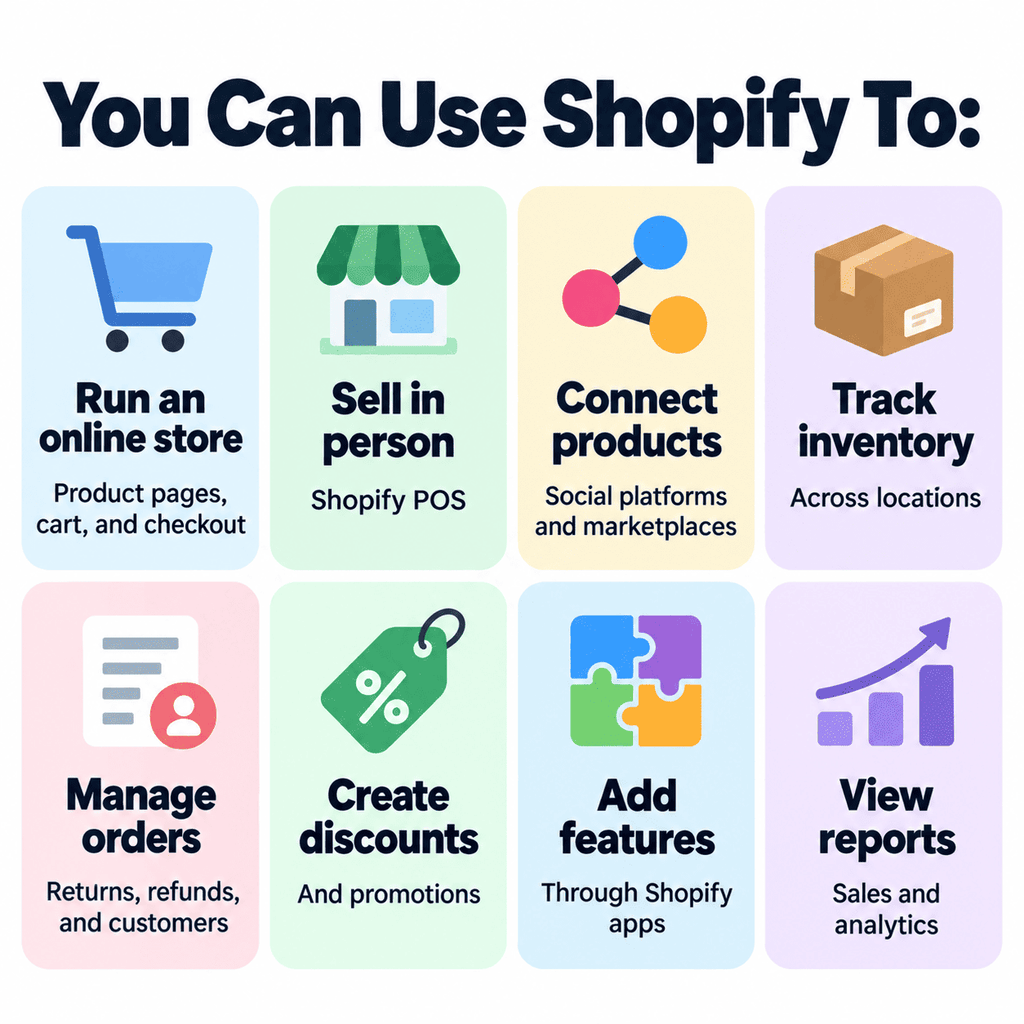
The useful part is that these pieces can work together. A product you manage in Shopify can be sold through more than one channel while Shopify remains the place where you manage the business.
What Does Shopify Handle vs. What Do You Handle?
Shopify provides the commerce system, and in my experience, it does a great job. That said, it doesn’t run the business for you. Let’s talk about what Shopify covers, and what you’ll still have to do.
| Shopify Provides | You’re Responsible For |
|---|---|
| Storefront and hosting | Choosing what to sell |
| Product and inventory tools | Product information and pricing |
| Cart and checkout | Branding and store content |
| Payment tools | Marketing and attracting customers |
| Order management | Customer service |
| Shipping and fulfillment tools | Packing orders or arranging fulfillment |
| Analytics and reports | Making business decisions |
For example, Shopify can help you buy a shipping label and keep track of the order. That doesn’t mean Shopify automatically packs the box. You still decide how fulfillment works.
Bottom Line
Shopify works by pulling the main pieces of selling into one system.
A customer sees the storefront and checkout. Behind that, Shopify keeps track of the product, payment, order, customer, inventory, and fulfillment status so you don’t have to build separate systems for each one.
Yes, you’re still responsible for creating a business people want to buy from. But Shopify gives you the technology to actually sell, take orders, and manage what happens next.
FAQs
Does Shopify take a percentage of every sale?
Not exactly. Shopify charges plan fees, and payment-processing fees can apply. Additional third-party transaction fees can also apply when you use certain outside payment providers.
Does Shopify ship products for you?
Not automatically. You can fulfill orders yourself or connect a fulfillment service. Shopify also provides shipping and order-management tools.
How do you get paid on Shopify?
Your payment provider processes the customer’s payment and sends payouts to the bank account you’ve connected according to its payout schedule.
Do you need a separate website to use Shopify?
No. Shopify can provide the online store itself, including hosting. You can also use Shopify for in-person sales and supported external sales channels.
Does Shopify bring customers to your store?
Not automatically. Shopify provides selling and marketing tools, but you’re still responsible for attracting customers.

![Hosting.com Coupon Discounts [Verified October 2026 ]](https://www.miamiherald.com/careers-education/wp-content/uploads/sites/2/2026/10/hosting-com-promo-code-mh-1024x768.jpg)

![Bluehost Promo Codes and Discounts [Verified Coupons]](https://www.miamiherald.com/careers-education/wp-content/uploads/sites/2/2026/10/bluehost-promo-code-mh-1024x768.jpg)
![Incogni Promo Codes [Verified Discounts]](https://www.miamiherald.com/careers-education/wp-content/uploads/sites/2/2026/10/incogni-promo-code-mh-1024x768.jpg)
![Shopify Promo Codes [Verified Discounts]](https://www.miamiherald.com/careers-education/wp-content/uploads/sites/2/2026/10/shopify-promo-code-mh-1024x768.jpg)